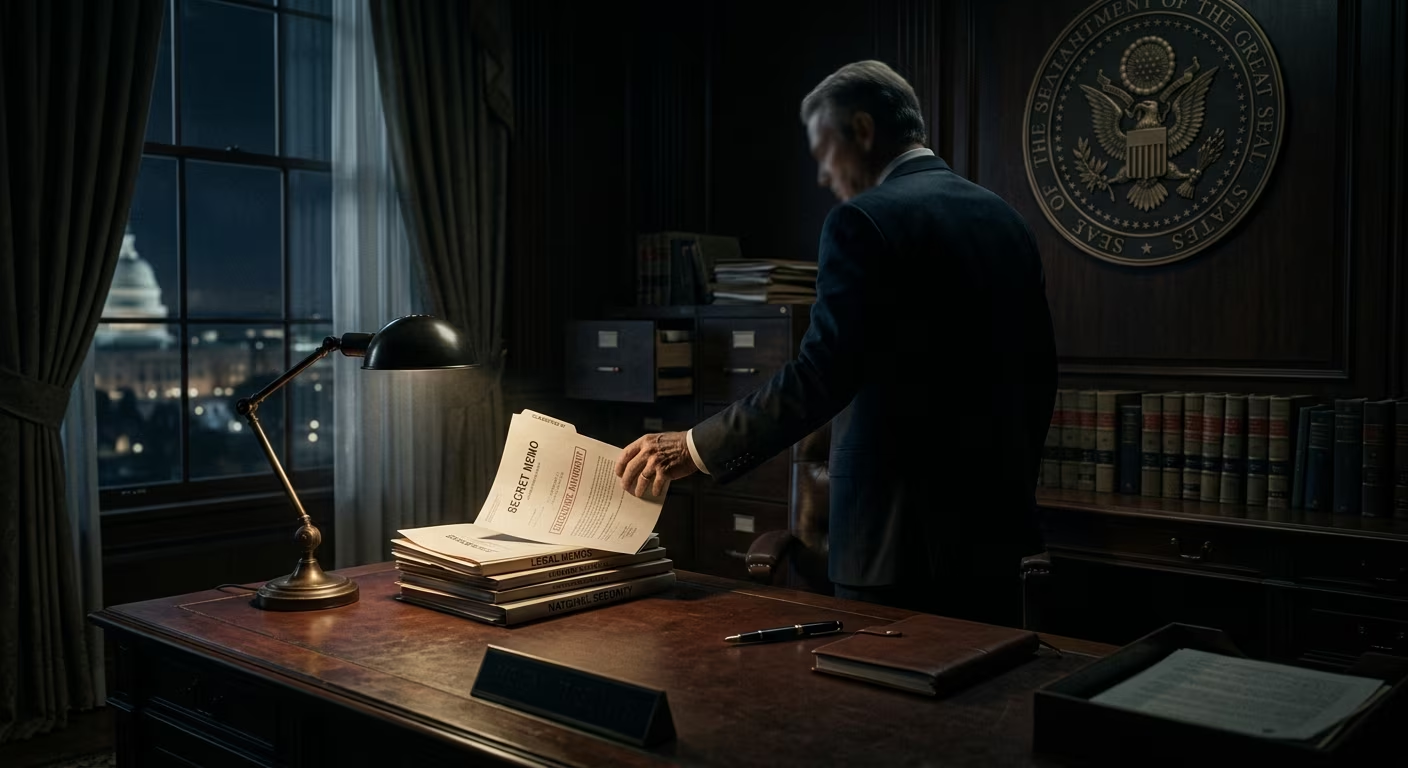
Every day, the United States government operates under a complex framework of laws, regulations, and constitutional interpretations. While the public and Congress debate the legality of various executive actions, there is a small, relatively obscure office within the Department of Justice that often has the final say. The Office of Legal Counsel (OLC) acts as the definitive legal authority for the executive branch. Known colloquially as the “President’s law firm,” the OLC issues memos that carry the weight of law for federal agencies.
The core issue, however, is that many of these binding interpretations are hidden from public view. This practice creates a perilous system of “secret law,” where the executive branch can stretch its powers behind closed doors. When the legal justifications for sweeping presidential actions remain classified or undisclosed, the fundamental democratic principles of transparency and checks and balances are severely undermined. Unpacking the role of the OLC is crucial to understanding the modern expansion of executive power and the ongoing struggle for government accountability.
The Hidden Architecture of Presidential Authority
The origins of the executive branch’s internal legal advice can be traced back to the Judiciary Act of 1789, which required the Attorney General to advise the President and department heads on questions of law. The modern Office of Legal Counsel was formally established in 1934 to fulfill this specific mandate. Today, the OLC is responsible for drafting the legal opinions of the Attorney General, providing its own written opinions to executive agencies, and reviewing all executive orders before they are signed by the President.
What makes the OLC extraordinarily powerful is the binding nature of its guidance. By delegation from the Attorney General, the OLC’s interpretations of the Constitution and federal statutes are treated as controlling law throughout the executive branch. If the Department of Defense, the Central Intelligence Agency, or the Treasury Department needs to know if a proposed policy is legal, they turn to the OLC. If the OLC says an action is lawful, the agency proceeds; if the OLC objects, the action is typically halted.
Because many of the issues the OLC reviews involve national security, military operations, or internal executive branch operations, these questions rarely make their way into the federal court system. As a result, the OLC effectively acts as a shadow Supreme Court for the executive branch. Without the opportunity for judicial review, the OLC’s conclusions become the definitive legal reality. When the executive branch operates based on legal theories that are insulated from adversarial testing in a courtroom, the boundaries of presidential authority are defined solely by the very attorneys appointed to serve the President.
The Danger of “Secret Law”
The most alarming aspect of the OLC’s influence is not just its power, but its profound secrecy. A significant portion of the OLC’s written opinions is never published or shared with Congress. This lack of transparency means that the government is frequently operating under a body of “secret law”—legal interpretations that govern government conduct but remain entirely hidden from the citizens who are governed by them.
When legal justifications are concealed, Congress is stripped of its constitutional ability to perform robust oversight. If lawmakers do not know how the executive branch is interpreting a statute, they cannot know whether their legislative intent is being honored or if they need to draft corrective legislation. This dynamic severely weakens the separation of powers designed by the framers of the Constitution. The dangers of a transparency deficit can be categorized into several critical areas:
- Evasion of Judicial Review: By keeping legal memos secret and out of the courts, the executive branch bypasses the judicial check on its authority. Theories of expansive presidential power go unchallenged.
- Erosion of Congressional Oversight: Without access to the OLC’s interpretations, congressional committees are effectively flying blind. They cannot adequately question executive officials if they do not know the legal framework those officials are using.
- Loss of Public Accountability: Voters cannot hold the President or their representatives accountable at the ballot box if they are unaware of how civil liberties and human rights are being interpreted in secret.
The danger of this secrecy is not merely theoretical; history is replete with examples of controversial OLC memos that authorized extreme expansions of executive power. During the early 2000s, for instance, the OLC authored the infamous “torture memos,” which provided the legal green light for the CIA’s enhanced interrogation techniques. These memos relied on fringe legal theories that narrowly defined torture, effectively shielding government officials from prosecution. The public and Congress were kept in the dark for years while these policies were implemented.
During the Obama administration, the OLC was tasked with providing the legal framework for using lethal force against an American citizen abroad who was suspected of terrorism. When the government finally released a redacted version of the memo following immense public pressure and lawsuits, it sparked a fierce national debate about due process and the limits of the Commander-in-Chief’s powers. Whether one agreed with the legal conclusion or not, the fact remained that a matter of life and death was decided through a secret legal memorandum rather than an open judicial process.
More recently, the OLC has been used to justify the extrajudicial targeting of individuals, the obstruction of congressional subpoenas, and the shielding of presidential records. In each of these instances, the executive branch relied on the OLC’s classified or unreleased memos to bypass traditional legal norms. When the President’s lawyers are allowed to grade their own client’s homework in secret, the temptation to stretch legal boundaries to accommodate political goals becomes nearly irresistible. The rule of law requires that the rules be known; when they are not, executive power becomes virtually unchecked.
The Transparency Deficit and the Freedom of Information Act Battles
The fight to shine a light on the OLC’s operations has largely been waged in the courts through the Freedom of Information Act (FOIA). Advocacy groups, civil liberties organizations, and transparency watchdogs have spent decades filing FOIA requests and subsequent lawsuits to compel the Department of Justice to release these foundational documents.
The Department of Justice has historically resisted these efforts by invoking the “deliberative process privilege,” a FOIA exemption designed to protect internal government deliberations. The government argues that forcing the OLC to publish its memos would chill candid legal advice, making attorneys hesitant to put their unfiltered thoughts into writing. However, transparency advocates counter that once an OLC opinion is finalized and adopted as the operating policy of an agency, it is no longer a mere “deliberation”—it is the working law of the government. By withholding these documents, the DOJ is essentially claiming a privilege meant for brainstorming sessions to hide binding legal rules.
Significant victories have been won in recent years. Organizations like the Knight First Amendment Institute at Columbia University and various civil rights groups have successfully sued to obtain the release of historic OLC memos and comprehensive indexes of classified opinions. In 2016, Congress amended the FOIA to explicitly limit the deliberative process privilege to records less than 25 years old. This amendment has forced the disclosure of decades-old memos that shed light on how the executive branch has historically viewed its war powers, civil rights enforcement, and national security authorities. While releasing old memos is valuable for historians and legal scholars, it does not solve the immediate crisis of contemporary secret law. The public urgently needs real-time access to the legal arguments shaping current government policy.
Reforming the OLC: A Path to Accountability
To restore the balance of power and ensure that the executive branch remains tethered to the rule of law, comprehensive reform of the Office of Legal Counsel is desperately needed. Transparency is the most potent antidote to executive overreach. While there are legitimate national security concerns that may require redacting specific operational details, the underlying legal analysis—the government’s interpretation of a statute or the Constitution—should never be classified.
Several reform proposals have gained traction among legal scholars and government oversight organizations. The most fundamental reform is a statutory requirement that the Department of Justice publish all final OLC opinions within a reasonable timeframe, such as 30 days after issuance. If an opinion contains classified factual information, the OLC should be required to release a redacted version that still clearly articulates the legal reasoning. Furthermore, the DOJ should maintain and publish an exhaustive, up-to-date index of all OLC opinions, including those that are classified. Knowing that an opinion exists, even if the contents are partially obscured, allows Congress to ask targeted questions and demand necessary briefings.
Beyond FOIA and statutory disclosure mandates, the Senate Judiciary Committee possesses unique leverage to enact indirect constraints on the OLC. Because the Assistant Attorney General who leads the OLC requires Senate confirmation, the Judiciary Committee can demand commitments to transparency during the nomination process. Senators can refuse to advance nominees who will not commit to publishing critical legal opinions or who refuse to brief Congress on controversial national security directives. Furthermore, because OLC attorneys frequently go on to be nominated for federal judgeships, the Senate can scrutinize their past contributions to secret law during their judicial confirmation hearings. This creates a powerful professional incentive for OLC lawyers to remain within the mainstream of legal thought and to advocate for greater transparency within the department.
Conclusion
The Office of Legal Counsel occupies a uniquely powerful and precarious position within the American constitutional framework. It is tasked with the vital responsibility of ensuring that the President and the executive branch faithfully execute the laws. Yet, when this duty is performed in secret, the OLC transforms from a guardian of legality into an enabler of unchecked executive ambition. The proliferation of secret law fundamentally contradicts the democratic ideals of accountability, public debate, and congressional oversight.
Addressing the dangerously expansive views of presidential power requires dragging the legal architecture of the executive branch into the sunlight. Reforming the OLC to mandate transparency will not cripple the government’s ability to function; rather, it will legitimize it. By forcing the executive branch to publicly defend its legal interpretations, we can ensure that the rule of law remains a shield for the people, rather than a cloak for the powerful. True democratic governance cannot thrive in the shadows of the Justice Department.
Frequently Asked Questions (FAQs)
What is the Office of Legal Counsel (OLC)?
The OLC is a specialized division within the United States Department of Justice that provides authoritative legal advice to the President and all executive branch agencies. It is responsible for reviewing executive orders and issuing formal opinions on complex questions of law, acting effectively as the executive branch’s internal law firm.
Why are OLC memos considered “binding”?
The Attorney General delegates the authority to interpret the law for the executive branch to the OLC. When the OLC issues a final opinion on a legal matter, executive agencies treat that interpretation as controlling law, meaning they are obligated to follow it unless overruled by the President, the Attorney General, or a federal court.
What is “secret law”?
“Secret law” refers to legal interpretations and policies that govern how the government operates but are hidden from the public and Congress. Because many OLC memos are classified or withheld under claims of privilege, they function as secret laws that dictate federal actions without public scrutiny.
Do courts ever review OLC opinions?
Rarely. Many OLC opinions deal with internal executive branch matters, national security, or military operations—areas where private citizens usually lack the legal standing to sue. Without a lawsuit challenging a specific action, courts cannot review or overturn the OLC’s interpretations, leaving the OLC’s word as final.
How can the OLC be reformed?
Reform advocates propose mandating the public release of all final OLC opinions within 30 days of issuance, maintaining public indexes of all memos (including classified ones), and limiting the use of the deliberative process privilege under the Freedom of Information Act to withhold these foundational documents.
References
- Office of Legal Counsel — United States Department of Justice. 2025-09-15. https://www.justice.gov/olc
- Fact Sheet: Office of Legal Counsel Transparency — Project On Government Oversight. 2021-11-03. https://www.pogo.org/fact-sheets/fact-sheet-office-of-legal-counsel-transparency
- Indirect Constraints on the Office of Legal Counsel: Examining a Role for the Senate Judiciary Committee — Stanford Law Review. 2021-06-06. https://www.stanfordlawreview.org/print/article/indirect-constraints-on-the-office-of-legal-counsel/
- The Office of Legal Counsel’s Client is the President — Georgetown Law Journal. 2022-01-07. https://www.law.georgetown.edu/georgetown-law-journal/wp-content/uploads/sites/26/2022/04/Monroe_The-Office-of-Legal-Counsels-Client-is-the-President.pdf
- The OLC’s Opinions Reading Room — Knight First Amendment Institute at Columbia University. 2025-01-01. https://knightcolumbia.org/reading-room/olc