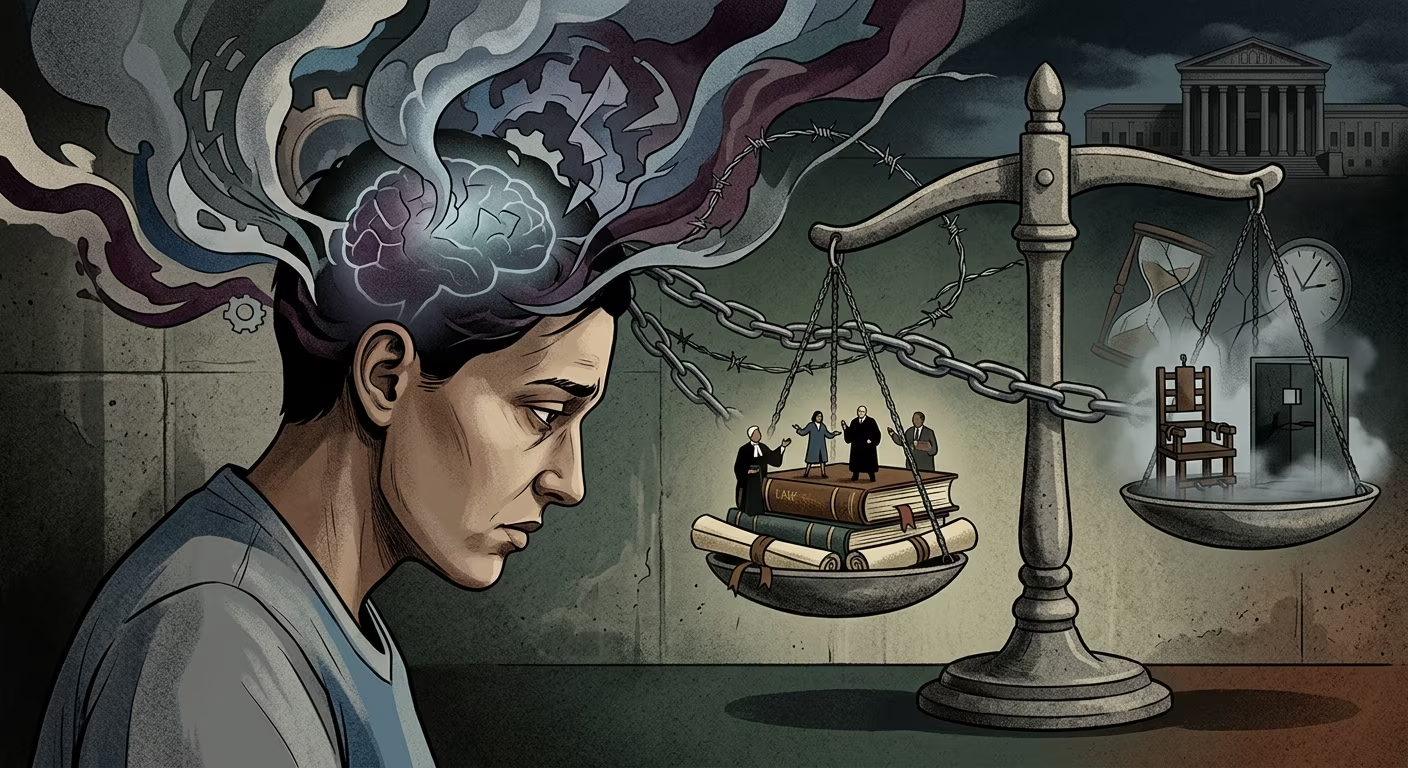
Severe Mental Illness and the Evolving Landscape of Capital Punishment
The intersection of the criminal justice system and severe mental health disorders represents one of the most fraught territories in modern jurisprudence. While the United States continues to debate the overarching morality, constitutionality, and efficacy of capital punishment, a specific consensus has steadily gathered momentum in recent decades: the profound ethical and legal dilemmas inherent in executing individuals afflicted with severe mental illnesses. For a long time, legal scholars, mental health professionals, medical ethicists, and civil rights advocates have fiercely challenged the application of the death penalty to this highly vulnerable population. The debate hinges not on excusing violent behavior or dismissing the trauma of victims, but on accurately assessing moral culpability, cognitive capacity, and the fundamental constitutional rights designed to protect citizens from cruel and unusual punishment. As scientific understanding of psychiatric conditions deepens and societal views shift, the legal frameworks governing life and death are being forced to adapt to a more nuanced reality.
Understanding Culpability: Mental Health in the Justice System
To fully comprehend the legal complexities surrounding mental illness and the death penalty, one must first delineate between distinct legal concepts that are frequently conflated by the public and media: legal insanity, competency to stand trial, and mitigation in sentencing.
- Competency to Stand Trial: This concept refers exclusively to a defendant’s present mental state at the time of their trial. It assesses whether they can understand the nature of the proceedings against them and effectively assist their attorneys in their defense. If deemed incompetent, proceedings are halted until competency can be restored.
- The Insanity Defense: “Not guilty by reason of insanity” is a strict affirmative defense focusing on the defendant’s state of mind at the exact moment the crime was committed. It is an exceptionally high bar to clear in the United States, generally requiring proof that the defendant did not know the nature of their act or could not distinguish right from wrong due to their mental illness.
- Mitigation in Sentencing: If a defendant is found guilty in a capital case, their mental health can be presented as a mitigating factor during the penalty phase to argue against a death sentence, urging the jury to opt for life imprisonment instead.
The systemic gap lies in the fact that many individuals suffer from profound, debilitating mental illnesses—such as severe schizophrenia, schizoaffective disorder, or bipolar disorder with psychotic features—yet they do not meet the stringent legal criteria for the insanity defense. These individuals are frequently convicted and thrust into the capital punishment pipeline, despite their psychiatric conditions severely diminishing their capacity to exercise rational judgment, regulate impulses, or fully comprehend the consequences of their actions at the time of the offense.
The Evolution of Constitutional Protections
The United States Supreme Court has historically intervened to restrict the application of the death penalty for specific classes of individuals, guided by the Eighth Amendment’s prohibition against “cruel and unusual punishments.” The Court’s interpretations are famously anchored in the doctrine of “evolving standards of decency that mark the progress of a maturing society,” a principle that continuously reevaluates justice through the lens of modern moral consensus.
Key Supreme Court Rulings
Several landmark decisions have shaped the boundaries of who can constitutionally face execution:
| Case Name | Year | Key Constitutional Ruling |
|---|---|---|
| Ford v. Wainwright | 1986 | Established that the Eighth Amendment prohibits the execution of the insane, requiring that an inmate must comprehend the fact of their impending execution and the reason for it. |
| Atkins v. Virginia | 2002 | Ruled that executing intellectually disabled individuals is unconstitutional, as their cognitive impairments diminish moral culpability and render deterrence ineffective. |
| Roper v. Simmons | 2005 | Abolished the juvenile death penalty, citing the neurological immaturity, susceptibility to peer pressure, and diminished culpability of adolescent offenders. |
| Panetti v. Quarterman | 2007 | Clarified Ford, holding that a prisoner must have a rational, not just factual, understanding of the state’s rationale for their execution. |
While the Court categorically exempted juveniles and the intellectually disabled from the death penalty, it has not yet extended a blanket categorical exemption to individuals who committed their crimes while suffering from severe, active mental illnesses. This omission has left a highly fragmented legal landscape governed largely by individual state legislatures and the varied interpretations of lower courts.
The Clinical Perspective on Severe Mental Disorders and Deterrence
The psychiatric community has long advocated for the exclusion of severely mentally ill offenders from capital punishment. Professional organizations, notably the American Psychological Association (APA), have issued comprehensive policy recommendations emphasizing that severe mental disorders fundamentally alter cognitive and volitional capacities. When a person is experiencing active psychosis, intense hallucinations, or severe delusions, their perception of reality is highly distorted.
The clinical argument against the death penalty for this demographic rests on the failure of the two primary pillars of penological philosophy:
- Deterrence: Capital punishment is theoretically intended to deter future crimes by demonstrating the ultimate consequence of severe offenses. However, individuals suffering from profound psychiatric disorders such as schizophrenia or severe bipolar mania are generally incapable of engaging in the rational cost-benefit analysis required for deterrence to be effective. The threat of execution cannot deter a mind disconnected from reality or driven by compulsive psychotic delusions.
- Retribution: Retributive justice relies on the premise that the punishment should fit the culpability of the offender. Mental health experts argue that severe mental illness inherently diminishes an individual’s blameworthiness. Punishing an offender whose crime was inextricably linked to untreated or treatment-resistant mental illness fails to meet the standard of proportionate retribution. The societal demand for vengeance loses its moral footing when applied to a severely broken mind.
Legislative Shifts and the Abolition Momentum
In the absence of a sweeping Supreme Court mandate, the battle over mental illness and the death penalty has shifted dynamically to state legislatures. Recognizing the profound ethical quagmire and the high risk of executing those with diminished culpability, several states have proactively passed legislation to protect this vulnerable group.
A prominent example of this momentum occurred in Ohio, which enacted House Bill 136 in 2021. This landmark legislation explicitly prohibits imposing the death penalty on individuals who can demonstrate that they were suffering from a “serious mental illness” at the time of their offense. The law carefully specifies qualifying conditions, including schizophrenia, schizoaffective disorder, bipolar disorder, and delusional disorder. Under this framework, if a court determines that the illness significantly impaired the individual’s capacity to conform their conduct to the requirements of the law or appreciate the nature and consequences of their actions, they are exempt from capital punishment. Instead, the maximum sentence available becomes life imprisonment without parole.
Ohio’s legislative reform reflects a growing, bipartisan consensus across the nation. Lawmakers across the political spectrum are increasingly viewing the execution of the severely mentally ill as an overreach of state power, an unnecessary fiscal burden, and a failure of the justice system’s foundational principles. Other jurisdictions are engaging in similar legislative debates, signaling a robust trend toward recognizing psychiatric disability as a categorical barrier to execution, much like intellectual disability or juvenile status.
The Human Cost: Case Studies in Systemic Failure
Beyond the abstract legal doctrines and clinical diagnoses, the everyday reality of housing severely mentally ill individuals on death row presents profound humanitarian challenges. The conditions of solitary confinement, which are pervasive and often permanent on death rows across the country, are well-documented to exacerbate psychiatric symptoms. This isolation leads to a phenomenon often described as “Death Row Syndrome,” characterized by rapid psychological deterioration, severe depression, and profound psychotic breaks.
This creates a disturbing cyclical dilemma for the penal system and the medical profession. An inmate may deteriorate neurologically and psychologically to the point of incompetence, thereby halting their execution under the Ford v. Wainwright standard. In response, the state may attempt to forcibly medicate the inmate to restore their competency, effectively treating their mental illness solely for the purpose of rendering them legally sane enough to execute. Medical ethicists and professional medical associations strongly condemn this practice. It violates the core tenets of the Hippocratic Oath, warping the purpose of medical care from healing the patient to serving as an instrument of state-sanctioned death.
Future Legal Horizons and Policy Reform
The overarching trajectory of capital punishment in the United States suggests a continued narrowing of its application, particularly concerning vulnerable populations. Advocates for criminal justice reform emphasize the critical need for standardized, nationwide protocols for evaluating psychiatric health in capital cases.
Currently, the lack of a uniform federal standard means that an individual’s life may depend entirely on the geographic location of their trial. Policy reform requires implementing rigorous pretrial psychiatric evaluations, ensuring defense teams have the necessary funding and specialized expertise to thoroughly investigate mental health histories, and properly educating juries on the complex realities of mental illness. All too often, juries misinterpret symptoms of severe psychiatric distress—such as a lack of visible emotion, blunted affect, or erratic courtroom behavior—as evidence of remorselessness or “future dangerousness.” This tragic misunderstanding frequently converts what should be a mitigating factor into an aggravating one, sealing the defendant’s fate.
The ultimate goal of reform is not to absolve individuals of responsibility for their violent actions or to dismiss the gravity of their crimes. Rather, it is to ensure that the ultimate punishment is reserved strictly for those with the highest degree of cognitive and moral culpability. As society’s understanding of brain chemistry, genetics, and psychological trauma advances, the legal system’s mechanisms must evolve in tandem, replacing archaic, rigid punitive measures with evidence-based, equitable justice.
Frequently Asked Questions (FAQs)
Does a severe mental illness diagnosis automatically prevent a death sentence?
No. Under current federal law, a severe mental illness diagnosis does not automatically exempt an individual from the death penalty. While some individual states (like Ohio) have passed specific bans, in many jurisdictions, mental illness is only considered a mitigating factor that a jury may weigh alongside aggravating factors during the penalty phase of a trial.
How does severe mental illness differ from intellectual disability in legal terms?
Intellectual disability, which categorically precludes execution under the Supreme Court’s ruling in Atkins v. Virginia, involves significantly subaverage intellectual functioning and deficits in adaptive behavior that must be present before adulthood. In contrast, severe mental illness refers to psychiatric disorders (like schizophrenia or bipolar disorder) that can develop at any age. These illnesses disrupt perception, mood, and reasoning, but do not necessarily reflect low intelligence or cognitive developmental delays.
What is the significance of “competency to be executed”?
Stemming from the 1986 Supreme Court case Ford v. Wainwright, competency to be executed mandates that an inmate must understand that they are going to be executed and the reasons why the state is imposing the punishment. If severe mental illness renders them actively psychotic or deeply delusional to the point of being unable to grasp these concepts, their execution must be stayed until they are deemed legally competent.
What happens if an inmate is found too mentally ill to be executed?
If an inmate is deemed incompetent for execution, they remain on death row or are transferred to a secure psychiatric facility for treatment. If psychiatric intervention eventually restores their competency, the state may theoretically proceed with the execution. This practice raises immense medical and ethical controversies regarding the weaponization of psychiatric care.
Why are states moving away from executing the severely mentally ill?
States are shifting policies due to a combination of rapidly advancing psychiatric knowledge, evolving public morality, and the realization that executing the severely mentally ill does not serve the primary penological goals of deterrence and proportional retribution. Bipartisan legislative efforts reflect a growing societal consensus that this practice is fundamentally unjust and out of step with modern values.
References
- Ford v. Wainwright — Oyez / Supreme Court of the United States. 1986-06-26. https://www.oyez.org/cases/1985/85-5542
- Atkins v. Virginia — Oyez / Supreme Court of the United States. 2002-06-20. https://www.oyez.org/cases/2001/00-8452
- Roper v. Simmons — Oyez / Supreme Court of the United States. 2005-03-01. https://www.oyez.org/cases/2004/03-633
- Panetti v. Quarterman — Oyez / Supreme Court of the United States. 2007-06-28. https://www.oyez.org/cases/2006/06-6407
- Report of the Task Force on Mental Disability and the Death Penalty — American Psychological Association. 2005. https://www.apa.org/pubs/info/reports/mental-disability-and-death-penalty.pdf
- House Bill 136 | 133rd General Assembly — Ohio Legislature. 2021-04-12. https://www.legislature.ohio.gov/legislation/133/hb136