
Service Dog Documentation Rights Under ADA Law
Understanding what businesses can and cannot ask about service dogs.
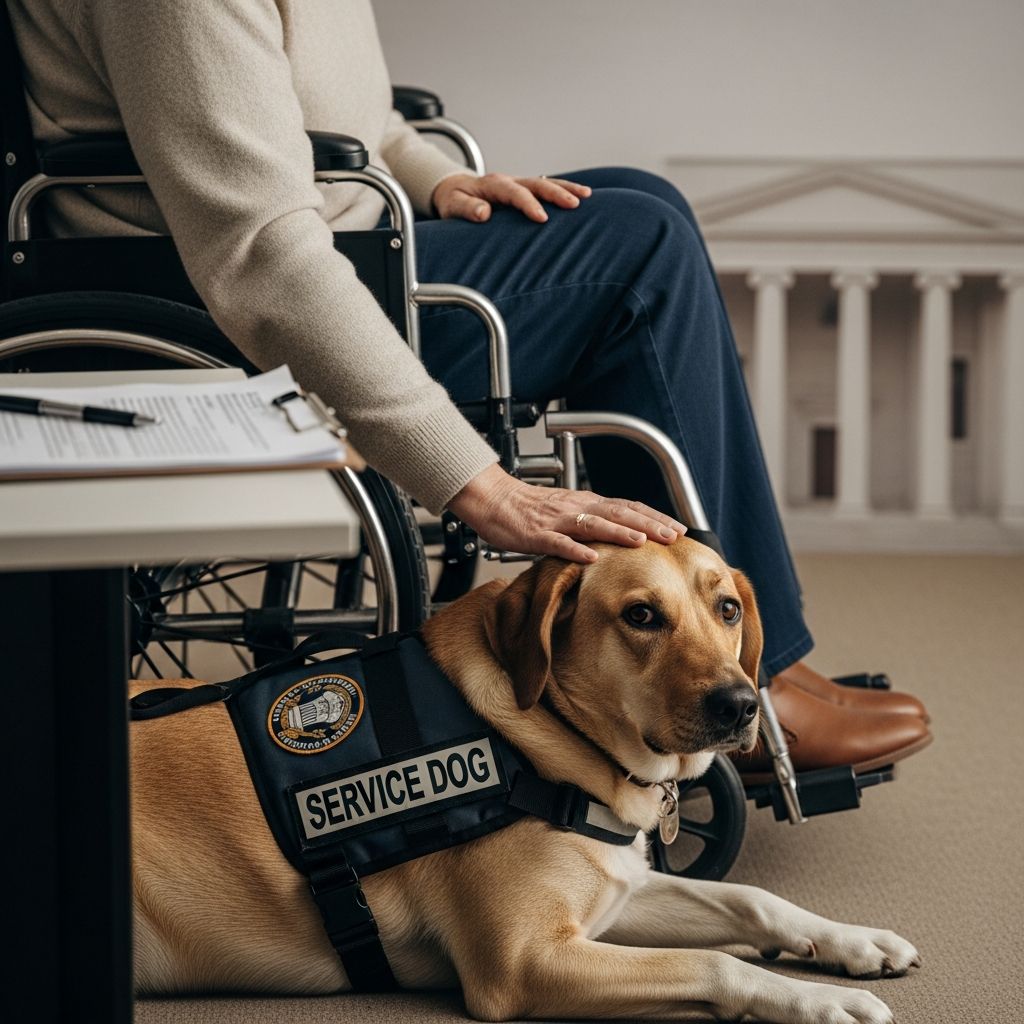
Understanding Service Dog Documentation and Legal Protections
Service dogs play a vital role in the lives of individuals with disabilities, providing trained assistance that enables greater independence and safety. However, confusion often arises regarding what documentation business owners, landlords, and other entities may legally request from service dog handlers. Many individuals with disabilities face inappropriate inquiries about their service animals, leading to misunderstandings about rights and responsibilities. Understanding the legal framework governing service dog documentation is essential for both handlers and those operating public accommodations.
The Foundation of Service Dog Law
Federal law, specifically the Americans with Disabilities Act (ADA), establishes the baseline protections for individuals who use service animals in public spaces. Unlike many other aspects of disability accommodation, the ADA takes a distinctly clear position on documentation requirements: no paperwork is legally required for service dogs in most circumstances. This principle exists to prevent barriers for individuals with disabilities while maintaining reasonable standards for public safety and access.
The distinction between service animals and other categories of animals is fundamental to understanding these regulations. A service animal is defined as a dog that has been individually trained to perform specific work or tasks related to a person’s disability. This training must be directly tied to the handler’s functional limitations, making the animal’s role measurable and purposeful rather than merely comforting or emotional in nature.
What Documentation Is Legally Required
The straightforward answer to many business owners’ and landlords’ questions is this: service dog handlers are not required to provide any documentation. No certification, registration, license, or official papers need to be presented as a condition of access to public accommodations. This stands in direct contrast to common misconceptions perpetuated by online scams and illegitimate service dog “registration” websites that charge fees for non-existent official documents.
While service dogs may wear identification vests, tags, or carry ID cards, these items serve the handler’s convenience rather than legal necessity. Some handlers choose to use visible identifiers to minimize unwanted questioning or interference while their dog is working. However, the absence of such items does not diminish a dog’s legal status as a service animal or reduce its handler’s rights.
It is particularly important to note that no national registry for service dogs exists in the United States. Any website claiming to provide official service dog registration operates outside the legal framework and offers no enforceable rights or protections. These services may be helpful for personal record-keeping or as a conversation starter with uninformed individuals, but they carry no legal weight under federal or most state laws.
Limited Questions Businesses May Ask
While documentation cannot be requested, the ADA does permit covered entities to ask limited questions in specific circumstances. This narrow exception exists to verify that an animal is genuinely a service dog rather than a pet, while protecting the privacy and dignity of individuals with disabilities.
Staff at businesses or government facilities may ask only two questions when it is not immediately obvious what service the dog provides:
- Is the dog a service animal required because of a disability?
- What work or task has the dog been trained to perform?
These inquiries are designed to be straightforward and non-invasive. A handler might respond, for example, that their dog is trained to alert them to low blood sugar or to provide mobility assistance. The questions are intentionally limited to these two matters because broader inquiries would compromise the handler’s right to privacy regarding their disability and medical information.
Questions That Cannot Be Asked
The boundaries of permissible questioning are equally important. There are numerous questions that businesses, landlords, airlines, and other entities absolutely cannot ask service dog handlers, even if internal company policies suggest otherwise:
- Requests for documentation, certification, training records, or licenses
- Questions about the handler’s specific disability or medical condition
- Demands that the dog demonstrate its trained tasks
- Requirements for special identification cards or vests
- Inquiries about where the dog was trained or by whom
- Questions about the cost of training or any other financial details
- Requests for veterinary records or vaccination proof (beyond what applies to all animals)
Many business owners operate under the mistaken belief that company policies override ADA requirements. This is false. If a company policy requires service dog documentation or demands demonstrations of the animal’s abilities, that policy violates federal law and cannot be enforced. Handlers facing such requests should understand that they are dealing with either confused staff members or an organization failing to comply with their legal obligations.
Removal of Service Dogs from Public Spaces
While service dogs have broad access rights in public accommodations, two specific circumstances justify removing a service dog from a business or facility:
- Loss of Control: If the dog is actively out of control and the handler does not take effective action to manage the animal’s behavior, staff may ask the handler to remove the dog. This would apply, for example, to a dog that is jumping on customers or barking continuously.
- Housebreaking Issues: If the dog is not reliably housebroken and poses a sanitation risk, the animal may be removed from the premises.
Importantly, staff must offer accommodation by allowing the handler to purchase goods or services without the dog present if removal becomes necessary. The handler cannot be refused service entirely based on the dog’s presence or removed for speculative or discriminatory reasons.
Service Animals in Training: A Special Category
Service animals that are still undergoing training occupy a different legal space than fully trained service dogs. Under federal ADA law, service animals in training are not covered by the same access requirements. However, some states, including California, provide additional protections for animals in the training process. These dogs may require identification tags issued by local animal control and must typically be on-leash in public spaces.
Handlers training their own dogs should be aware of whether their state recognizes rights for animals in training and comply with any tagging or identification requirements that may apply. This represents an important distinction from the blanket prohibition on requiring documentation for fully trained service animals.
Air Travel and Service Dogs
Transportation represents a unique regulatory context where service dogs receive specific consideration separate from general business access. Under the Air Carrier Access Act (ACAA), airlines may require certain limited documentation from service dog handlers during travel. Unlike the ADA’s absolute prohibition on documentation requests, airlines operate under a different legal framework that permits them to require specific information for transport compliance.
This does not mean airlines can demand certification or training records. Rather, they may require documentation related to federal or territorial requirements for animal transport. Handlers should contact their airline in advance of travel to understand what documentation or forms may be requested, which differs from routine public access scenarios.
Addressing Documentation Requests Inappropriately
When faced with a request for service dog documentation or inappropriate questioning, handlers have several options. The most direct approach is to politely but firmly explain that the ADA does not permit such requests and that documentation is not available. Many staff members simply do not understand service dog law and may comply with this explanation once informed.
If a business persists in requesting documentation or otherwise violates service dog access rights, handlers may file complaints with the U.S. Department of Justice or pursue legal action under the ADA. Some state attorneys general offices also investigate service dog access violations. Documentation of the incident, including dates, times, locations, and staff names, strengthens any potential complaint.
Handlers should consider whether they wish to educate staff on the spot or move their patronage elsewhere. Not every encounter warrants formal legal action, but patterns of discrimination by businesses may justify complaints or legal review.
Why the No Documentation Rule Exists
The prohibition on requiring service dog documentation reflects careful legal policy. Allowing businesses to demand paperwork would create barriers for individuals whose disabilities are invisible or who cannot easily obtain official documentation. It would incentivize the creation of fraudulent credentials and place enforcement burden on the wrong parties. Instead, the two-question standard allows for verification while protecting handler privacy and minimizing access barriers.
This approach also reflects the reality that service dogs are fundamentally different from pets. They are working animals trained to perform specific functions. They are not optional accessories but essential tools for managing disabilities. Treating them differently from pets—by allowing them in establishments where pets are prohibited—acknowledges this distinction without creating administrative hurdles.
State-Specific Variations and Additional Protections
While federal ADA law establishes the baseline, some states and municipalities provide additional protections. California, for example, allows service animals in training to access public spaces under the California Disabled Persons Act, with certain identification requirements. Some municipalities waive licensing fees for service dogs. It is advisable for handlers to research their local laws to understand what protections apply beyond the federal baseline.
Conversely, some state laws address the misrepresentation of pets as service animals. Falsely representing a pet as a service dog is illegal in many jurisdictions and may result in fines or criminal penalties. This distinction helps protect both genuine service dog handlers from fraud-related confusion and the public from inappropriate animals in access-restricted spaces.
Frequently Asked Questions
Q: Can a business ask for a service dog vest or ID card?
A: No. While handlers may voluntarily use vests or ID cards for convenience, businesses cannot require them as a condition of entry. They cannot ask for documentation of any kind.
Q: What if my service dog doesn’t wear a vest? Can I be denied access?
A: Absolutely not. The absence of a vest or identifier does not reduce your rights. If the service is not obvious, staff can only ask the two permitted questions about disability requirement and task training.
Q: Is there an official service dog registry I should register with?
A: No national registry exists or is required. Any online “registration” websites charging fees for official status are fraudulent. Some handlers voluntarily register for personal purposes, but this is optional and carries no legal significance.
Q: Can a landlord require service dog documentation?
A: No. Landlords are covered under the ADA’s housing provisions and cannot require documentation, certification, or other paperwork. They may ask the two permitted questions if the disability is not obvious.
Q: What should I do if a business denies my service dog access?
A: Document the incident and inform the business of the ADA requirements. If they persist, file a complaint with the U.S. Department of Justice Civil Rights Division or consult with a disability rights attorney.
Q: Does the rule about documentation apply to emotional support animals?
A: Emotional support animals are legally distinct from service dogs and do not receive the same access rights in public accommodations, though they may have protections in housing and transportation contexts under different laws.
Q: Can an airline ask for service dog documentation?
A: Airlines operate under different rules than public accommodations. They may request documentation for federal transport compliance purposes, so check with your airline in advance of travel.
References
- ADA Requirements: Service Animals — U.S. Department of Justice, Civil Rights Division. 2010. https://www.ada.gov/resources/service-animals-2010-requirements/
- Service Animals — ADA.gov, Official Government Resource. Accessed January 2026. https://www.ada.gov/topics/service-animals/
- Service Animals — U.S. Department of Transportation, Aviation Consumer Protection. https://www.transportation.gov/resources/individuals/aviation-consumer-protection/service-animals
- Fact Sheet: Service Animals in Business and Public Spaces — Disability Rights California. https://www.disabilityrightsca.org/publications/fact-sheet-service-animals-in-business-and-public-spaces
- Do Service Dogs Need Certification? Understanding the Requirements — Eastern Center for Accessible Living (ECAD). https://www.ecad1.org/index.php/resources/blog/241-do-service-dogs-need-certification
- Service Dog Fraud: U.S. Service Dog Laws — BraunAbility. https://www.braunability.com/us/en/blog/accessible-living/service-dog-fraud.html
Similar Articles








Read full bio of Sneha Tete




