
Series LLCs vs Restricted LLCs: Key Differences
Discover the core distinctions between series LLCs and restricted LLCs to optimize asset protection and business planning strategies effectively.
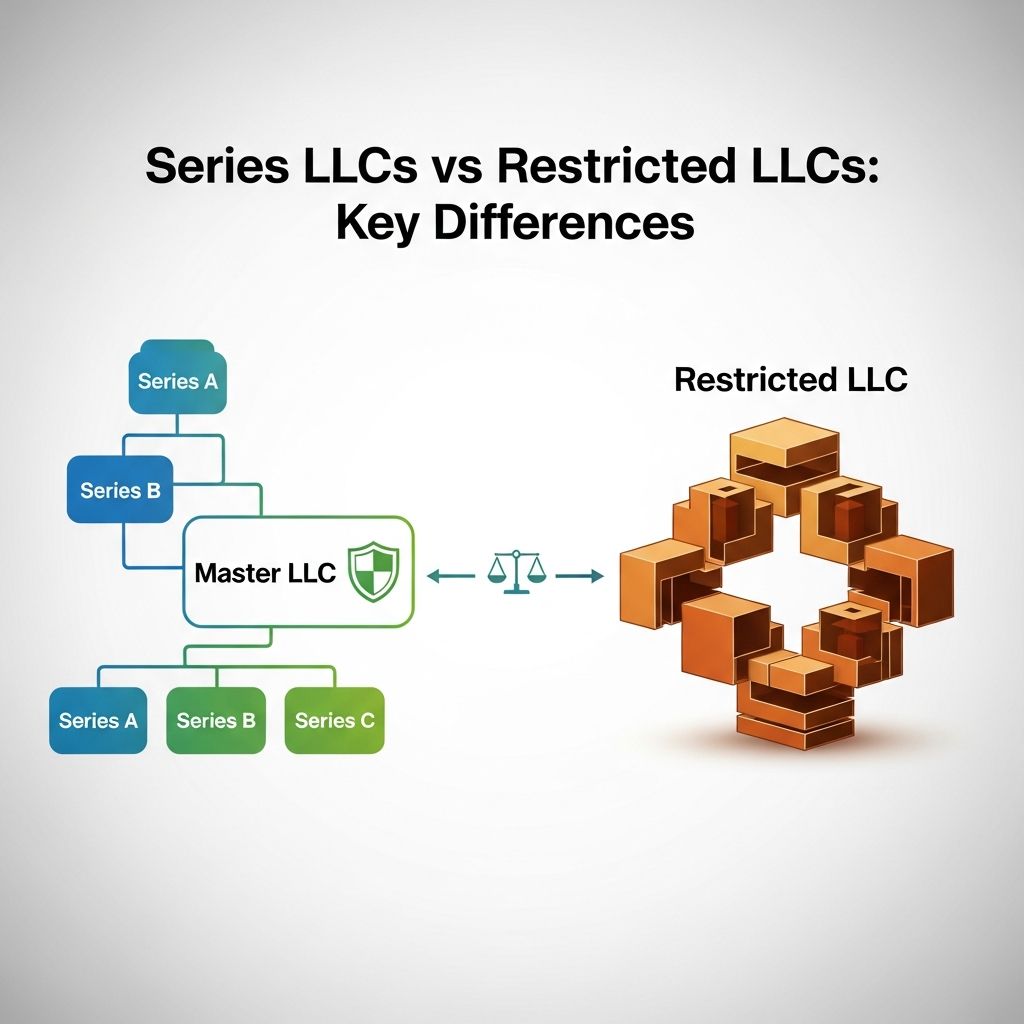
Business owners and estate planners often seek specialized limited liability company structures to enhance asset protection and streamline operations. Series LLCs and restricted LLCs represent innovative variations on the traditional LLC model, each tailored to distinct objectives. Series LLCs enable compartmentalized operations under a single entity, while restricted LLCs focus on long-term family asset transfers with tax advantages. This article delves into their definitions, operational mechanics, comparative analysis, and practical considerations to guide informed decision-making.
Understanding the Series LLC Structure
A
series LLC
functions as a master entity that oversees multiple independent subunits, known as series. Each series operates with its own assets, liabilities, members, and business purposes, legally insulated from the others. This design mimics corporate subsidiaries but consolidates administrative burdens into one filing.Originating in Delaware in 1996, series LLCs have expanded to states including Nevada, Illinois, Texas, and Tennessee. The master LLC files unified formation documents, after which new series can be established internally without separate state registrations in many jurisdictions. This setup proves invaluable for real estate investors managing multiple properties, as each property forms a distinct series shielded from others’ risks.
Core Features of Series LLCs
- Internal Segregation: Series maintain separate books, records, and bank accounts to uphold liability barriers.
- Flexibility in Management: Each series may have unique managers or members, allowing customized governance.
- Cost Efficiency: Single annual report and tax filing for the master LLC reduces overhead compared to multiple standalone LLCs.
Liability protection stands as the hallmark benefit. Creditors pursuing one series cannot access assets from the master or sibling series, provided proper formalities are observed. However, courts in non-recognizing states may disregard these shields, treating the entire structure as one entity.
Exploring the Restricted LLC Model
Exclusively available in
Nevada
, a restricted LLC prioritizes estate planning over active commerce. Formed by electing this status in the articles of organization, it imposes stringent distribution controls to facilitate tax-deferred asset transfers among family members.The defining restriction prohibits member distributions for a decade post-formation. During this period, gifted interests escape immediate taxation, as assets remain illiquid and non-distributable. Post-10 years, limited distributions resume under Nevada statutes, balancing preservation with eventual access.
Essential Characteristics of Restricted LLCs
- Estate-Focused Purpose: Ideal for gifting real estate or business interests to heirs without triggering gift taxes.
- Tax Deferral Mechanism: Illiquidity prevents valuation and taxation of transferred interests for 10 years.
- Standard Liability: Mirrors traditional LLC protections but lacks series-style internal divisions.
Nevada’s framework, codified in NRS Chapter 86, ensures personal assets remain safeguarded while enabling generational wealth transfers. Unlike series LLCs, restricted versions conduct no ongoing business, emphasizing holding and succession.
Comparative Analysis: Series vs Restricted LLCs
While both enhance LLC utility, series and restricted LLCs diverge sharply in geography, intent, and mechanics. The table below summarizes pivotal distinctions:
| Aspect | Series LLC | Restricted LLC |
|---|---|---|
| Availability | Delaware, Nevada, Texas, IL, TN, etc. (8+ states) | Nevada only |
| Primary Use | Multiple business ventures/assets | Family asset gifting/estate planning |
| Liability Structure | Internal series isolation | Standard LLC protection |
| Distributions | Flexible, state-dependent | None for 10 years; limited thereafter |
| Tax Treatment | Pass-through; no deferral | Pass-through with 10-year tax deferral on gifts |
| Formation Cost | Single master + internal series | Standard NV filing with election |
Series LLCs excel in operational scalability, protecting diverse holdings like rental portfolios where one property’s lawsuit won’t jeopardize others. Restricted LLCs, conversely, offer tax efficiency for non-business transfers, deferring capital gains recognition.
Advantages and Drawbacks of Each Structure
Strengths of Series LLCs
- Streamlined compliance: One EIN, tax return, and registered agent suffice.
- Enhanced risk compartmentalization beyond single LLCs.
- Adaptable for industries with high litigation exposure, such as construction or hospitality.
Limitations of Series LLCs
- Not universally recognized; foreign state judgments may pierce veils.
- IRS treats as single entity for taxes, complicating allocations.
- Requires meticulous record-keeping to validate separations.
Strengths of Restricted LLCs
- Powerful estate tool: Tax-free gifting window preserves family wealth.
- Simplicity: No need for multi-series management.
- Nevada’s business-friendly courts bolster enforceability.
Limitations of Restricted LLCs
- Geographic restriction limits accessibility.
- 10-year lockup hinders liquidity for active owners.
- Inapplicable to commercial operations.
Formation Processes and Compliance Essentials
Forming a series LLC begins with master articles specifying series authority, followed by internal operating agreements delineating each series’ boundaries. States like Texas mandate registered series filings for public notice.
Restricted LLCs require Nevada SOS filing with explicit restriction election. Operating agreements must detail the 10-year moratorium and gift intentions. Annual reports remain standard, with no series-specific filings.
Both demand robust documentation: separate ledgers, resolutions, and contracts reinforce protections. Professional counsel ensures compliance amid evolving statutes.
Tax Implications and Financial Planning
Pass-through taxation unites both, reporting via Schedule K-1 on personal returns. Series LLCs file one Form 1065, allocating income per series internally. Restricted LLCs defer gift taxes via illiquidity, but ordinary income passes through immediately.
Consult IRS guidelines and state revenue departments, as series taxation remains somewhat unsettled in federal courts.
Ideal Scenarios for Implementation
- Choose Series LLC if: Managing rental properties, joint ventures, or segmented operations needing cross-protection.
- Choose Restricted LLC if: Nevada-based family transferring appreciating assets like farmland or securities to descendants.
Frequently Asked Questions
Can series LLCs operate in states that don’t recognize them?
Yes, but register as foreign entities and risk veil-piercing; best for primary operations in authorizing states.
Does a restricted LLC provide better asset protection than a standard LLC?
It matches standard protections but adds tax deferral for gifts; not superior for business liability.
How many series can one master LLC support?
Unlimited, subject to operating agreement and practical management.
Are distributions from series LLCs taxed differently?
No, all pass through proportionally; no inherent deferral.
Can I convert a traditional LLC to a series or restricted one?
Possible via amendments, but consult attorneys for state-specific conversions.
References
- Series vs. Restricted LLC: What’s the Difference? — LegalZoom. 2023. https://www.legalzoom.com/articles/series-vs-restricted-llc
- What Is the Difference Between a Series & Restricted LLC? — Nevada Registered Agent. 2024. https://nevada-ra.com/FAQ_files/What%20Is%20the%20Difference%20Between%20a%20Series.htm
- Series LLC vs Restricted LLC {Updated January 2026} — Go Vitru. 2026-01-01. https://govitru.com/series-llc-vs-restricted-llc/
- The Series LLC: The Pros, Cons and Best Practices — Cohen Seglias Pallas Greenhall & Furman PC. 2023-10-12. https://www.cohenseglias.com/news-article/the-series-llc-the-pros-cons-and-best-practices/
- Restricted & Series LLCs | SBEP Startup Quick Tip — University of Nevada, Reno Extension. 2022. https://extension.unr.edu/publication.aspx?PubID=4074
Similar Articles








Read full bio of Sneha Tete


