
Why the Wall of Separation Matters: Secular Government and LGBTQ+ Civil Rights
Protecting the First Amendment's Establishment Clause is fundamental to safeguarding LGBTQ+ equality against religious exemptions.
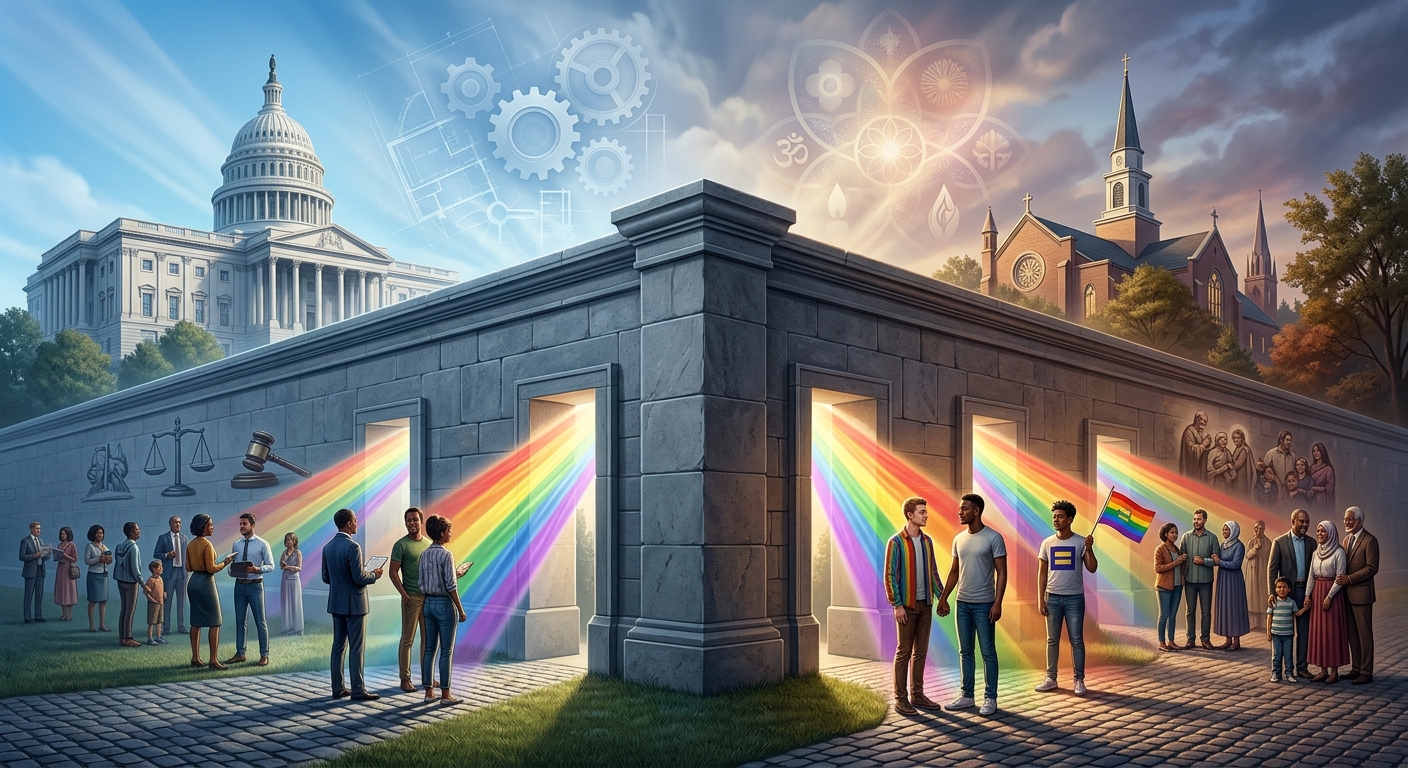
For decades, the fight for civil rights and equal protection under the law has been inextricably linked to the structural foundations of American governance. Among the most vital of these structural pillars is the separation of church and state. While conversations about religious liberty often focus on an individual’s right to practice their faith without government interference, there is a profound, equally critical component to this legal doctrine: preventing the government from endorsing or enforcing religious dogma. For marginalized communities, particularly LGBTQ+ individuals, this constitutional safeguard is not just a theoretical legal concept—it is a tangible shield protecting their dignity, their legal rights, and their physical safety in the public square.
When state institutions align themselves with specific religious doctrines, they inherently create an ‘in-group’ and an ‘out-group.’ Historically, moral and religious objections have been the primary justification for laws that criminalize queer existence, deny marriage equality, and restrict access to healthcare and housing. Consequently, maintaining a strictly secular government is an essential prerequisite for achieving true LGBTQ+ equality. Without a neutral public arena, the civil rights of sexual and gender minorities remain vulnerable to being dismantled under the guise of religious orthodoxy.
The First Amendment and the Establishment Clause Explained
To understand the stakes of this intersection, one must first look at the constitutional framework that governs the relationship between religion and the state. The First Amendment to the United States Constitution contains two primary clauses regarding religion: the Free Exercise Clause and the Establishment Clause. The Establishment Clause expressly prohibits the government from making any law ‘respecting an establishment of religion’. In practical terms, this means the government cannot establish an official state religion, nor can it unduly favor one religious viewpoint over another, or favor religion over non-religion.
This dual protection is what forms the metaphorical ‘wall of separation’ famously described by Thomas Jefferson. The Establishment Clause ensures that public spaces—such as public schools, courthouses, and municipal buildings—remain religiously neutral. When the state remains neutral, it prevents majority religious groups from leveraging the power, funds, and authority of the government to impose their specific tenets on the broader, diverse population. For the LGBTQ+ community, this neutrality is vital. Because opposition to LGBTQ+ identities is frequently rooted in specific interpretations of religious texts, a government that adheres strictly to the Establishment Clause is fundamentally constrained from using those religious texts as a basis for public policy or legal discrimination.
Historical Precedents: Dogma as a Weapon
The history of the LGBTQ+ rights movement is deeply intertwined with a struggle against state-sanctioned religious morality. For the vast majority of American history, anti-sodomy laws, bans on same-sex marriage, and prohibitions against queer people serving in public capacities were defended using explicitly religious rhetoric. Legislators and judges routinely cited divine law and historical religious traditions to justify the exclusion of queer people from full citizenship.
It was only by challenging the legal basis of these moral laws that the LGBTQ+ community began to secure fundamental rights. Landmark legal victories overturning state-level bans on same-sex intimacy and recognizing marriage equality were grounded in the constitutional principles of due process and equal protection, rejecting the notion that majoritarian religious morality was a sufficient rational basis for discriminatory laws. Removing religious dogma from the legal code was the necessary precursor to the modern era of LGBTQ+ civil rights.
Modern Battlegrounds: The Rise of Religious Exemptions
While the era of explicit, state-enforced moral bans has largely receded, a new legal strategy has emerged to challenge LGBTQ+ equality: the expansion of religious exemptions. Rather than attempting to outright ban queer identities, opponents of LGBTQ+ equality increasingly argue that individuals, private businesses, and even government contractors should be granted legal immunity from anti-discrimination laws if compliance violates their sincerely held religious beliefs.
These exemptions represent a significant threat to the fabric of civil rights protections. If a broad ‘license to discriminate’ is established, anti-discrimination laws become functionally meaningless. LGBTQ+ individuals could face legal denial of critical services, from medical care and housing to employment and public accommodations. However, public polling indicates strong opposition to this trend. Data from the Williams Institute at the UCLA School of Law reveals that over 70 percent of adults in the United States oppose allowing businesses, healthcare providers, and employers to discriminate against LGBTQ+ individuals based on religious beliefs. Despite this public consensus, legislative and judicial battles over exemptions continue to escalate.
A prominent example of this legal friction is the 2021 Supreme Court case Fulton v. City of Philadelphia. The Court ruled unanimously that Philadelphia could not exclude Catholic Social Services from its foster care program for refusing to certify same-sex couples. However, the ruling was notably narrow, resting on the fact that the city’s non-discrimination contract included a mechanism for discretionary exemptions, which it failed to extend to the religious agency. While the Court did not create a blanket constitutional right for religious organizations to violate non-discrimination laws, the case underscored the precarious balance between the Free Exercise Clause and civil rights protections in taxpayer-funded public programs.
Areas Frequently Targeted by Religious Exemptions
The push for religious exemptions spans multiple sectors of public and private life, directly impacting the daily lives of LGBTQ+ individuals. Below is a summary of the most common arenas where these legal conflicts arise:
| Sector | Nature of Exemption Claim | Impact on LGBTQ+ Individuals |
|---|---|---|
| Healthcare & Medicine | Providers refusing to offer services such as gender-affirming care, fertility treatments, or prescribing PrEP. | Limits access to life-saving medical care and creates deeply stigmatizing healthcare environments. |
| Child Welfare Services | Taxpayer-funded adoption and foster agencies refusing to place children with qualified same-sex couples. | Reduces the pool of available, loving homes for vulnerable youth and legally sanctions discrimination in state programs. |
| Public Accommodations | Private businesses (e.g., bakeries, event spaces, photographers) refusing services for same-sex weddings. | Undermines local and state civil rights laws, exposing queer individuals to public humiliation and denial of service. |
| Employment | Employers claiming religious rights to fire or refuse to hire LGBTQ+ workers despite federal protections. | Threatens economic stability and forces queer individuals back into the closet in professional environments. |
Symbols of the State: The Impact of Public Displays
Beyond the realm of legal exemptions, the battle for church-state separation is fiercely fought over government endorsement of religious symbols. When the state mandates the display of specific religious texts in public institutions, it sends an unequivocal message about who belongs to the favored civic class and who does not.
A stark recent example occurred in Louisiana, where lawmakers passed a 2024 mandate requiring all public school classrooms to visibly post the Ten Commandments. This legislation represented a direct challenge to long-standing Supreme Court precedent which strictly forbade such religious endorsements in public schools to protect impressionable students from government-sponsored religious coercion. In June 2025, a panel of federal appellate judges ruled the Louisiana law unconstitutional, recognizing that such mandates violate the Establishment Clause and isolate students who belong to minority faiths or are non-religious.
For LGBTQ+ youth, the mandate of conservative religious texts in classrooms is particularly alienating. When the government elevates texts that have historically been wielded to condemn their identities, it creates a hostile educational environment. Maintaining secular public schools is vital to ensuring that all students, regardless of their sexual orientation, gender identity, or religious background, feel safe and equally valued by their government.
Balancing Religious Liberty and Civil Rights
Advocating for the separation of church and state is not synonymous with hostility toward religion. True religious freedom is a core American value that ensures every individual has the absolute right to hold their own beliefs and practice their faith peacefully. The friction only arises when the concept of religious liberty is distorted into a right to impose one’s beliefs on others or to secure immunity from laws designed to protect the public from discrimination.
Civil rights advocates emphasize that religious freedom should act as a shield to protect individual conscience, not as a sword to strike down the legal rights of minority groups. If religious beliefs are permitted to override non-discrimination statutes, the legal framework that protects marginalized demographics will slowly unravel. The government must maintain a careful equilibrium: fiercely protecting the right of private worship while ensuring that the public square, commercial marketplaces, and government services remain strictly secular and accessible to all.
Key Takeaways for Advocates
- Secularism is a Civil Rights Issue: The protection of LGBTQ+ rights relies heavily on a government that does not enforce religious morality as public policy.
- The Establishment Clause is Critical: By forbidding state-sponsored religion, the Constitution prevents majoritarian religious groups from using state power to marginalize minorities.
- Exemptions Threaten Equality: Broad religious exemptions from anti-discrimination laws threaten to legalize discrimination in healthcare, employment, and public services.
- Public Sentiment Favors Equality: A large majority of Americans oppose the weaponization of religious beliefs to deny services to LGBTQ+ individuals.
- Symbols Matter: Government-mandated religious displays in public spaces, like schools and courthouses, inherently create hostile environments for queer individuals and religious minorities.
Frequently Asked Questions (FAQs)
What exactly is the Establishment Clause?
The Establishment Clause is a provision within the First Amendment of the U.S. Constitution that forbids the government from establishing an official religion, endorsing one religion over another, or favoring religion over non-religion. It is the legal foundation for the separation of church and state.
Why do religious exemptions specifically impact the LGBTQ+ community?
Because opposition to LGBTQ+ identities is often rooted in conservative religious doctrines, those seeking to bypass anti-discrimination laws frequently cite their faith as justification. Broad religious exemptions could allow businesses, healthcare providers, and employers to legally deny services or employment to queer individuals.
Did the Supreme Court rule that businesses have a right to discriminate against LGBTQ+ people?
The legal landscape is complex and continually evolving. In cases like Fulton v. City of Philadelphia, the Supreme Court ruled in favor of a religious foster agency based on specific, narrow contractual grounds rather than establishing a sweeping constitutional right for all religious organizations to ignore anti-discrimination laws. However, other legal battles regarding private businesses continue to test the boundaries of civil rights protections.
Why are religious displays in public schools considered unconstitutional?
Public schools are government institutions with a captive audience of impressionable students. Courts have consistently held that when a public school mandates the display of religious texts (like the Ten Commandments) or leads students in prayer, it constitutes government coercion and an unconstitutional endorsement of religion, violating the Establishment Clause.
References
- Establishment Clause | Wex | US Law — Legal Information Institute, Cornell Law School. https://www.law.cornell.edu/wex/establishment_clause
- More than 70% of US adults oppose using religious beliefs as a reason to discriminate against LGBTQ people — The Williams Institute at UCLA School of Law. 2023-06-15. https://williamsinstitute.law.ucla.edu/press/religious-exemptions-press-release/
- Court blocks Louisiana law requiring schools to post Ten Commandments in classrooms — Associated Press. 2025-06-20. https://apnews.com/article/louisiana-ten-commandments-ruling-appeals-court-public-schools-b498705f1f3a53d6f14125b29b6fdb75
- Fulton v. City of Philadelphia — Oyez. 2021-06-17. https://www.oyez.org/cases/2020/19-123
Similar Articles








Read full bio of Sneha Tete


