
Search Warrants: Legal Foundations and Protections
Unpacking the essential role of search warrants in balancing law enforcement needs with individual privacy rights under the Fourth Amendment.
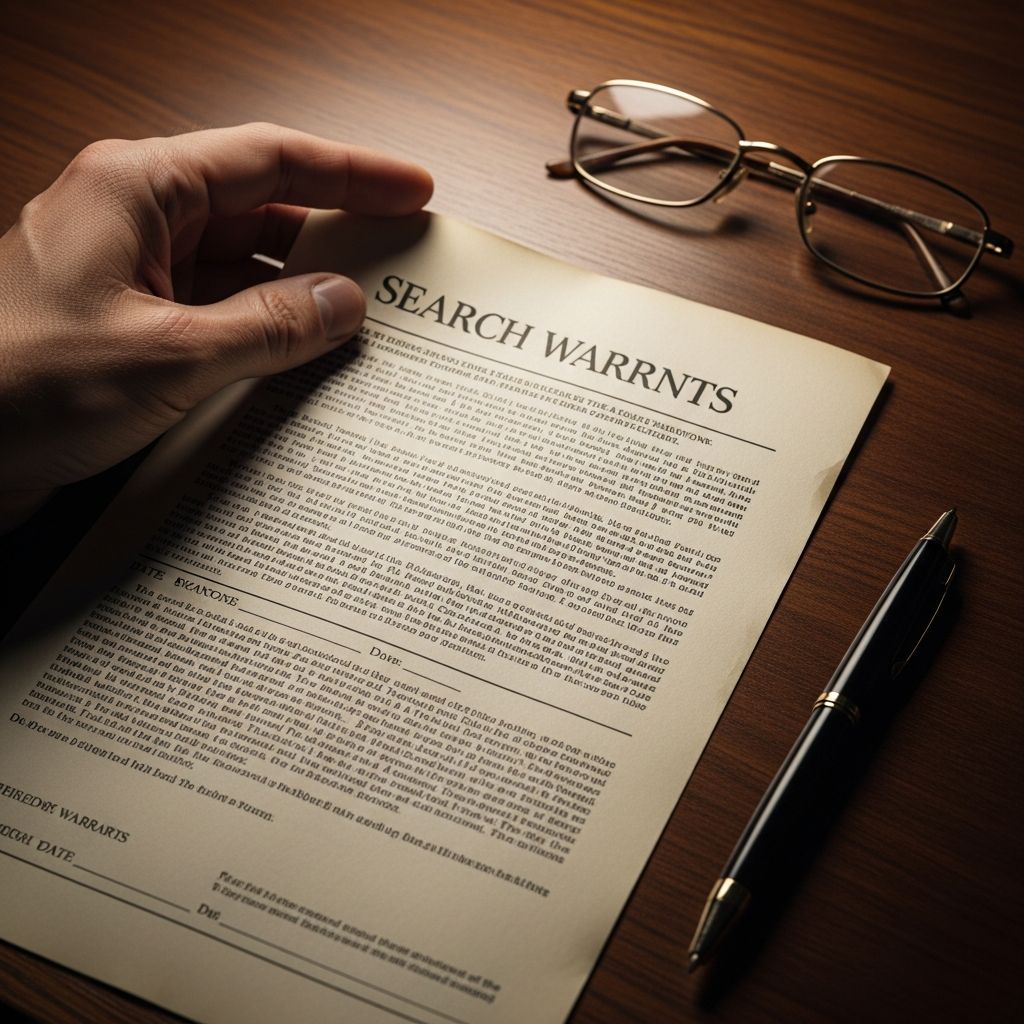
A search warrant serves as a critical judicial tool that empowers law enforcement to investigate crimes while safeguarding citizens from arbitrary intrusions into their privacy. Rooted in constitutional principles, it requires officers to demonstrate sufficient justification before accessing private spaces or seizing property.
Constitutional Basis and Core Purpose
The
Fourth Amendment
to the U.S. Constitution forms the bedrock of search warrant requirements, prohibiting unreasonable searches and seizures and mandating that warrants be supported by probable cause and particularly describing the place to be searched and items to be seized. This amendment emerged from colonial-era abuses where British officials conducted general searches without specific justification, prompting the framers to establish strict procedural safeguards.In essence, search warrants bridge the gap between public safety and personal liberty. They authorize targeted searches for evidence of criminal activity, ensuring that investigations remain focused and respectful of reasonable privacy expectations. Without this mechanism, police could theoretically ransack homes or vehicles at will, undermining trust in the justice system.
Defining Probable Cause: The Threshold for Approval
**Probable cause** represents a practical, non-technical standard: a fair probability that contraband or evidence of a crime exists in the specified location. It does not demand absolute certainty or proof beyond a reasonable doubt but something more than mere suspicion. Courts evaluate it based on the totality of circumstances, including direct observations, informant tips, or circumstantial evidence.
For instance, an officer spotting drug paraphernalia in plain view during a traffic stop might contribute to probable cause, combined with reliable witness statements. Judges assess whether the facts create a reasonable belief that a search will yield fruits of criminality.
| Standard | Description | Threshold Level | Example Application |
|---|---|---|---|
| Probable Cause | Fair probability of evidence or crime | Moderate (more than suspicion) | Warrant issuance for home search |
| Reasonable Suspicion | Specific, articulable facts for brief stop | Low | Terry stop for questioning |
| Beyond Reasonable Doubt | Nearly certain guilt | Very High | Criminal conviction |
Application Process: From Officer to Judge
Obtaining a search warrant begins with law enforcement preparing an
affidavit
—a sworn statement detailing the basis for probable cause. This document outlines facts from personal knowledge, surveillance, or credible informants, often presented telephonically or in person to a neutral magistrate.The judge reviews the affidavit for sufficiency, ensuring it establishes a nexus between the crime, location, and evidence sought. If approved, the warrant is issued, typically valid for a short period (e.g., 10-14 days) to prevent stale information. Federal rules emphasize that the issuing authority must be detached from the investigation to avoid bias.
- Key Steps:
- Officer compiles evidence and drafts affidavit.
- Presents to judge or magistrate (often after hours via phone).
- Judge verifies probable cause and particularity.
- Warrant issued with execution instructions.
Essential Elements of a Valid Warrant
A properly drafted search warrant must exhibit
particularity
, precisely identifying the premises and items subject to search. Vague descriptions risk invalidation, as they invite fishing expeditions.Typical components include:
- Physical address or detailed description of the location (e.g., ‘red house at 123 Oak St., Apt. 2B’).
- Specific items (e.g., ‘heroin, scales, packaging materials’).
- Search scope (e.g., entire residence, including garage).
- Execution timeline and authorized officers.
Deviation from these terms can lead to suppressed evidence under the exclusionary rule, deterring police overreach.
Executing the Warrant: Rules and Procedures
Upon issuance, officers must execute the warrant reasonably, usually with a
knock-and-announce
policy—announcing presence and purpose before entry, absent exigent circumstances. This respects occupant dignity and allows time for peaceful compliance.Forced entry may occur if there’s risk of evidence destruction or officer safety threats. Officers document the search via an inventory of seized items, providing a receipt to the property owner. Searches must stay within the warrant’s bounds; unrelated areas or items generally fall outside scope unless in plain view.
Plain View Doctrine and Incidental Seizures
During a lawful search, officers may seize contraband or evidence of other crimes if it’s immediately apparent and in plain view. This doctrine expands investigative reach without needing a new warrant.
For example, while searching for drugs under a warrant, spotting an illegal firearm on a table allows seizure. Courts scrutinize to prevent pretextual searches.
Common Exceptions to the Warrant Requirement
Not all searches demand warrants; established exceptions balance urgency with protections.
| Exception | Conditions | Purpose | Source Example |
|---|---|---|---|
| Consent | Voluntary agreement by person with authority | Cooperation in low-risk scenarios | Traffic stops, home visits |
| Search Incident to Arrest | Immediately after lawful arrest | Officer safety, evidence preservation | Person and grab area |
| Exigent Circumstances | Imminent danger or evidence destruction | Prevent harm or loss | Hot pursuit, emergencies |
| Plain View | Legally present + incriminating nature obvious | Efficient evidence collection | During valid entry |
| Automobile | Movable vehicles with probable cause | Practicality due to mobility | Cars, boats |
These exceptions undergo strict judicial review to prevent abuse.
Your Rights During a Search Warrant Execution
If police arrive with a warrant:
- Verify the warrant: Ask to see it and read carefully—ensure it matches your location and isn’t expired.
- Do not resist: Compliance prevents escalation; challenge legality in court later.
- Observe silently: Note officer actions, names, and badges for potential disputes.
- Request inventory: Get a list of seized items post-search.
- Seek counsel: Contact a lawyer immediately to review validity.
Homeowners aren’t obligated to assist or open locked areas beyond what’s authorized.
Challenging a Search Warrant in Court
Defendants can file a
motion to suppress
if the warrant lacks probable cause, particularity, or was improperly executed. Theexclusionary rule
bars tainted evidence from trial, potentially dismissing charges. Franks hearings probe affidavit falsehoods.Success hinges on procedural flaws, not the evidence’s weight.
International Perspectives on Search Warrants
While U.S. practices emphasize judicial oversight, global approaches vary. Many nations require warrants via judges for probable cause, per human rights treaties. Some delegate to prosecutors; others limit to constitutions or statutes, balancing privacy and security universally.
Frequently Asked Questions (FAQs)
What exactly is a search warrant?
A court-issued order allowing police to search a specific place for particular evidence of a crime, based on probable cause.
Can police search without a warrant?
Yes, under exceptions like consent, arrests, or emergencies, but warrants are preferred for homes.
How long is a search warrant valid?
Typically 10-14 days, depending on jurisdiction; must execute promptly to avoid staleness.
What if the warrant describes the wrong address?
It may be invalid; challenge via suppression motion, as particularity is required.
Do I have to let police in if they have a warrant?
Yes, but verify it first and do not physically resist—address issues legally afterward.
Can police search my phone with a warrant?
Yes, if particularly described; digital warrants increasingly specify devices or accounts.
References
- Search Warrants in Criminal Investigations by Law Enforcement — Justia. 2023. https://www.justia.com/criminal/procedure/search-and-seizure-rules/search-warrants/
- Search Warrants | Judiciaries Worldwide — Federal Judicial Center. 2022-10-15. http://judiciariesworldwide.fjc.gov/search-warrants
- Search Warrants | Research Starters — EBSCO. 2024. https://www.ebsco.com/research-starters/law/search-warrants
- What Is a Search Warrant? Legal Basics Explained — Garrett & Walker. 2023-05-12. https://www.garrettandwalker.com/what-is-a-search-warrant-legal-basics-explained/
- Search Warrant | Wex — Legal Information Institute, Cornell Law School. 2025. https://www.law.cornell.edu/wex/search_warrant
- Understanding Search Warrants: Definitions, Requirements, and Limitations — California Attorney. 2024. https://www.california-attorney.us/articles-faqs/understanding-search-warrants-definitions-requirements-and-limitations/
- Understanding Search Warrants: Their Purpose and Limitations — William Weinberg. 2023. https://www.williamweinberg.com/understanding-search-warrants-their-purpose-and-limitations.html
Similar Articles








Read full bio of Sneha Tete


