
Crafting Holiday Displays That Pass Supreme Court Scrutiny
Navigate First Amendment rules for public holiday decorations with Supreme Court precedents to avoid legal pitfalls.
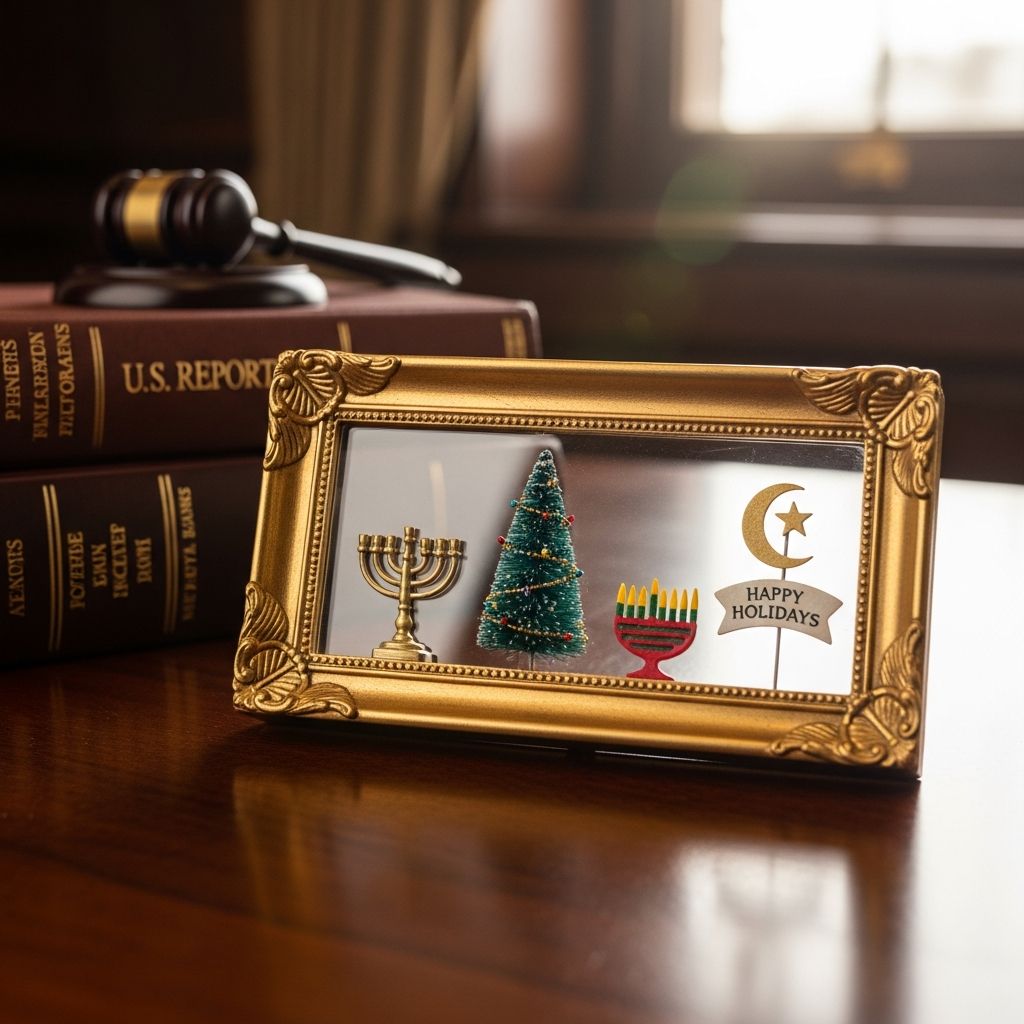
Public holiday displays featuring religious elements, such as nativity scenes or menorahs, must navigate the delicate balance required by the First Amendment’s Establishment Clause. This clause prohibits government from establishing religion, yet allows certain expressions when contextualized properly. Supreme Court decisions provide clear frameworks for compliance, emphasizing history, context, and lack of coercion.
Understanding the Establishment Clause in Public Spaces
The Establishment Clause states that “Congress shall make no law respecting an establishment of religion,” extending to state and local governments via the Fourteenth Amendment. It prevents government favoritism toward any faith or religion over non-religion. In holiday contexts, courts assess whether displays endorse religion from a reasonable observer’s viewpoint.
Historically, challenges arise when governments place religious symbols like Christmas creches on public property. The Court has ruled that isolated religious items signal endorsement, but mixed displays with secular elements often pass muster. For instance, a standalone nativity scene violates the clause, while one amid Santa Claus figures, reindeer, and candy canes does not.
- Core Principle: Government cannot compel religious participation or appear to endorse faith.
- Key Test: Displays must reflect cultural traditions without proselytizing.
- Observer Perspective: What a reasonable person sees as the government’s intent matters most.
Landmark Cases Shaping Holiday Display Rules
Supreme Court precedents define permissible public celebrations. In Lynch v. Donnelly (1984), a Pawtucket, Rhode Island, display including a nativity scene alongside secular items like a Santa sleigh was upheld. Chief Justice Burger noted the city’s secular purpose of celebrating the holiday season.
Contrastingly, County of Allegheny v. ACLU (1989) struck down a standalone menorah next to a Christmas tree but allowed a creche in a mixed display. The Court scrutinized context: the menorah lacked secular buffers, implying Jewish endorsement.
| Case | Display Elements | Ruling | Reason |
|---|---|---|---|
| Lynch v. Donnelly (1984) | Creche + Santa, reindeer, tree | Constitutional | Secular holiday celebration context |
| Allegheny v. ACLU (1989) | Standalone menorah | Unconstitutional | Appeared to endorse Judaism |
| Van Orden v. Perry (2005) | Ten Commandments monument | Constitutional | Historical, passive display |
Recent shifts, like Kennedy v. Bremerton School District (2022), discarded the Lemon test for a history-and-tradition approach, stressing no coercion in religious expression. This favors longstanding practices.
The Rise and Fall of the Lemon Test
For decades, Lemon v. Kurtzman (1971) governed: laws must have secular purpose, primary effect neither advancing nor inhibiting religion, and avoid excessive entanglement. Holiday displays failing these prongs were struck down.
However, Kennedy overruled Lemon, calling it abstract and chaotic. Courts now reference Founding-era understandings, permitting practices without compulsory observance. No coercion occurred in a coach’s midfield prayer, paralleling passive displays.
The government may not force religious exercise, but historical holiday symbols in mixed settings align with tradition.
Practical Guidelines for Compliant Holiday Displays
To ensure SCOTUS approval:
- Incorporate Secular Symbols: Pair religious items with Frosty the Snowman, stars, or wreaths to celebrate winter festivities broadly.
- Choose Neutral Locations: Place in parks with diverse monuments, not courthouses, to dilute endorsement perception.
- Avoid Exclusivity: Rotate symbols like nativity, menorah, and crescent for inclusivity.
- Include Disclaimers: Plaques noting private sponsorship or cultural acknowledgment help.
- Promote Private Speech: Encourage community groups to erect displays on public forums.
Local governments should document secular intent in resolutions, referencing celebration of community traditions.
Recent Developments and Evolving Standards
Post-Kennedy, courts apply history: longstanding displays like capitol creches survive. American Legion v. American Humanist Assn. (2019) upheld a 40-foot cross as a war memorial, not proselytizing.
In schools, displays must avoid coercion; voluntary student-led elements fare better. Vouchers for private religious schools were upheld if neutral.
Common Pitfalls and How to Avoid Them
- Pitfall: Solo Religious Icons – Solution: Surround with holiday paraphernalia.
- Pitfall: Official Endorsement Language – Solution: Use neutral greetings like “Happy Holidays.”
- Pitfall: Prominent Government Placement – Solution: Integrate into larger exhibits.
Taxpayer challenges succeed if displays seem partisan. Consult counsel before installation.
Frequently Asked Questions
Can a city display a nativity scene on public property?
Yes, if accompanied by secular symbols like trees and lights, signaling holiday cheer, not religious promotion per Lynch.
What if only one religion’s symbol is shown?
That risks unconstitutionality, as in Allegheny, unless historically justified.
Does a disclaimer plaque protect the display?
It helps by clarifying no endorsement, supporting private expression views.
Are school holiday displays allowed?
Limited; avoid teacher-led prayers, but student diversity shows may pass.
How has Kennedy changed rules?
Emphasizes history over strict tests; no coercion needed for approval.
Balancing Tradition and Constitutionality
Holiday displays embody American pluralism when inclusive. Governments foster unity by celebrating shared customs without alienating observers. Ongoing cases refine boundaries, but core tenets—context, history, no force—guide safe practice.
Educate officials on precedents to preempt lawsuits. Communities thrive when festivities unite, not divide.
References
- Church and State: U.S. Supreme Court Makes Changes to Establishment Clause Analysis — MRSC. 2022-07-18. https://mrsc.org/stay-informed/mrsc-insight/july-2022/church-and-state-challenged-in-new-ruling
- Selected U.S. Supreme Court Rulings Related to Private and Home Schools — U.S. Department of Education. N/A. http://www.ed.gov/birth-grade-12-education/school-choice/selected-us-supreme-court-rulings-related-private-and-home-schools
- Establishment Clause — Legal Information Institute, Cornell Law School. N/A. https://www.law.cornell.edu/wex/establishment_clause
- Interpretation: The Establishment Clause — National Constitution Center. N/A. https://constitutioncenter.org/the-constitution/amendments/amendment-i/interpretations/264
- Religion Supreme Court Cases — Justia. N/A. https://supreme.justia.com/cases-by-topic/religion/
Similar Articles








Read full bio of Sneha Tete


