
The Enduring Echoes of 1931: How the Scottsboro Boys Reshaped American Justice
An in-depth retrospective on the 1931 tragedy that exposed the Jim Crow legal system and forged landmark constitutional precedents.
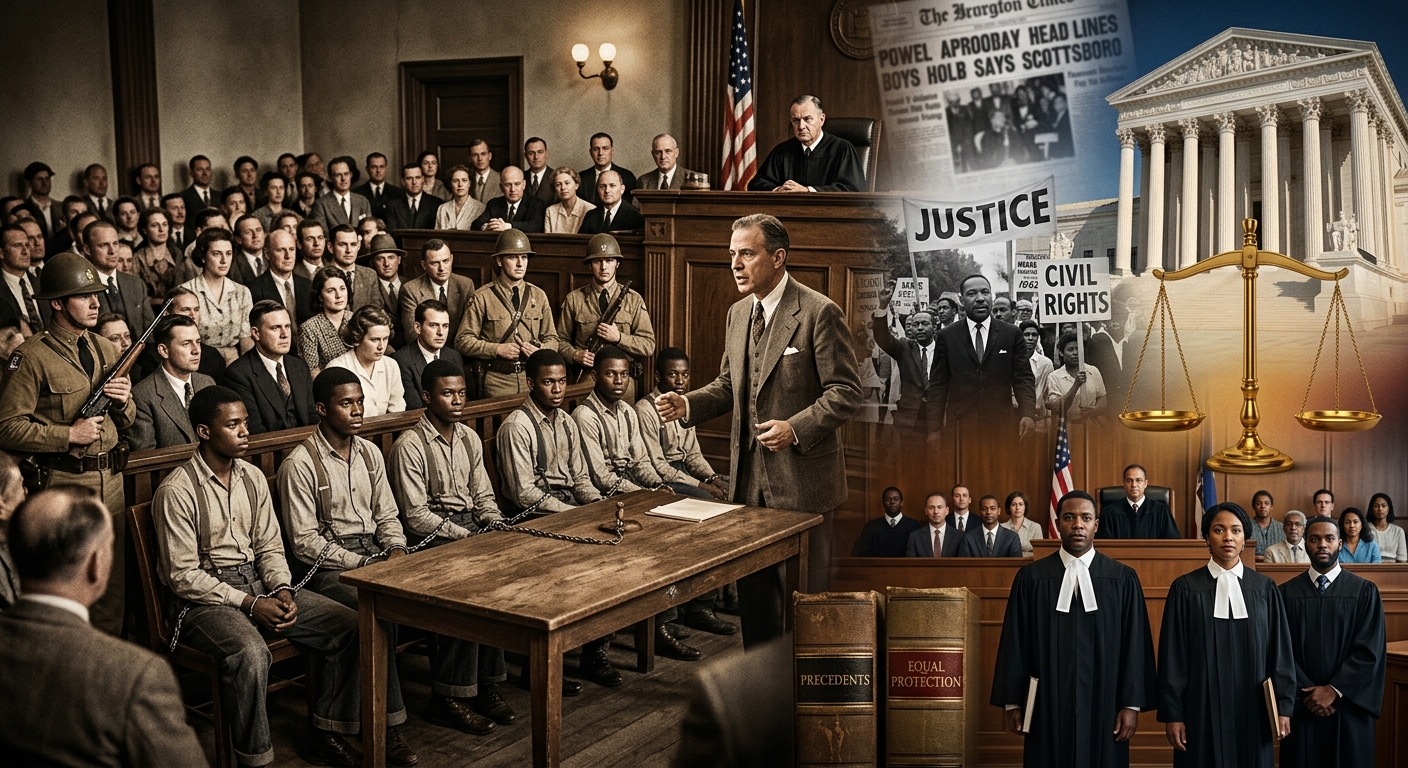
The history of the American legal system is marked by profound struggles for equity, but few events have cast as long and dark a shadow as the saga of the Scottsboro Boys. In the spring of 1931, the deeply entrenched racism of the Jim Crow South converged with a fundamentally flawed justice system to destroy the lives of nine young Black teenagers. Falsely accused of a heinous crime they did not commit, these adolescents were thrust into a legal nightmare that would last for decades. Yet, out of this profound human tragedy emerged a series of constitutional earthquakes that would permanently alter the landscape of American criminal law.
To understand the modern civil rights movement and the ongoing fight for criminal justice reform, one must look back to the railway tracks of Jackson County, Alabama. The trials, retrials, and Supreme Court interventions surrounding these nine youths laid the unshakeable groundwork for rights that contemporary defendants rely upon today—namely, the right to effective legal counsel and the right to a jury selected without racial discrimination.
The Spark on the Southern Railroad Freight Train
The catalyst for this historical tragedy occurred on March 25, 1931, aboard a Southern Railroad freight train making its way from Chattanooga, Tennessee, toward Memphis. The Great Depression had forced countless Americans, both Black and white, to travel the rails in desperate search of employment. During the journey, a physical altercation broke out between a group of young Black men and several white transients. The white men, having been bested in the skirmish and forced off the train, immediately reported the incident to a stationmaster, framing it as an unprovoked assault by a gang of Black youths.
By the time the train reached the town of Paint Rock, Alabama, an armed sheriff’s posse was waiting. They stopped the train and rounded up nine Black teenagers ranging in age from 13 to 20: Haywood Patterson, Clarence Norris, Charlie Weems, Olen Montgomery, Ozie Powell, Eugene Williams, Andy Wright, Roy Wright, and Willie Roberson. To the surprise of the posse, they also discovered two young white women, Victoria Price and Ruby Bates, traveling in men’s overalls.
In 1930s Alabama, white women traveling vagrantly alongside Black men on a freight train faced severe social stigma and potential prosecution for vagrancy or violation of the Mann Act. To deflect attention from their own illicit travel and protect themselves from the authorities, Price and Bates made a calculated and devastating accusation: they claimed the nine Black teenagers had violently raped them. In an era and a region where an accusation of this nature against a Black man was essentially a death sentence, the fate of the nine youths was sealed the moment the words were spoken.
A Mockery of Due Process: The Initial Rushed Trials
The youths were transported to the county seat in Scottsboro, Alabama, where a lynch mob numbering in the hundreds rapidly gathered outside the jail. The atmosphere was so volatile and soaked in racial animus that the governor was forced to call in the National Guard to prevent the boys from being murdered before they could even face a judge. However, the courtroom proceedings that followed were scarcely better than the mob violence they narrowly escaped.
The legal process was a terrifying display of systemic efficiency wielded as a weapon. The trials began on April 6, 1931, merely twelve days after the arrests. Due process was entirely abandoned in favor of a swift, predetermined vengeance. The state’s provision of legal defense was a hollow pantomime. The judge appointed all members of the local bar to represent the defendants, a collective assignment that meant no single attorney took responsibility. On the morning of the trials, representation fell to an unprepared real estate lawyer from Tennessee who admitted he knew nothing of Alabama law, and a local attorney who was reportedly intoxicated during the proceedings.
In this hostile environment, the defense failed to cross-examine witnesses effectively, neglected to point out glaring medical inconsistencies in the accusers’ stories, and did not prepare the youths to testify. Within a matter of days, the all-white, all-male juries delivered their expected verdicts. Eight of the nine teenagers were convicted of rape and sentenced to death by electrocution. The only exception was 12-year-old Roy Wright; the prosecution sought a life sentence due to his youth, but the jury held out for the death penalty, resulting in a mistrial for the youngest defendant.
The Defendants
| Defendant Name | Age at Arrest (1931) | Initial Sentencing |
|---|---|---|
| Charlie Weems | 19 | Death |
| Clarence Norris | 19 | Death |
| Andy Wright | 19 | Death |
| Haywood Patterson | 18 | Death |
| Olen Montgomery | 17 | Death |
| Ozie Powell | 16 | Death |
| Willie Roberson | 15 | Death |
| Eugene Williams | 13 | Death |
| Roy Wright | 12 | Mistrial (Hung Jury) |
Landmark Supreme Court Decisions Forged in Injustice
The sheer velocity and blatant unfairness of the Scottsboro convictions drew the attention of northern journalists, civil rights advocates, and political organizations. Appeals were rapidly filed, halting the executions and elevating the cases to the highest judicial authority in the land. The resulting Supreme Court decisions would forever alter the framework of American constitutional law.
Powell v. Alabama (1932): The Right to Counsel
In the fall of 1932, the United States Supreme Court heard Powell v. Alabama (287 U.S. 45), a case challenging the constitutionality of the initial trials based on the lack of adequate legal representation. Historically, the Sixth Amendment’s guarantee of the “assistance of counsel” had been interpreted largely as applying to federal courts, leaving state courts to their own devices. The Supreme Court, in a 7-2 decision, ruled that the denial of effective counsel in a capital case violated the Due Process Clause of the Fourteenth Amendment.
Justice George Sutherland, writing for the majority, emphasized that an accused person requires the “guiding hand of counsel at every step in the proceedings against him.” The Court noted the extreme youth, illiteracy, and public hostility facing the defendants, concluding that the trial court’s failure to assign dedicated, prepared counsel was a fundamental violation of human rights. This landmark decision vacated the convictions and mandated new trials, establishing the vital precedent that states must provide attorneys to indigent defendants in capital cases—a principle that would later be expanded to all felony cases in the 1963 ruling Gideon v. Wainwright.
Norris v. Alabama (1935): Dismantling the All-White Jury
Despite the Supreme Court’s intervention, the state of Alabama relentlessly pursued the prosecution. During the retrials, defense attorney Samuel Leibowitz meticulously documented that not a single Black citizen had ever served on a jury in Jackson or Morgan counties, despite a substantial Black population. The state argued this was merely coincidental, a claim the defense aggressively challenged.
The convictions were once again appealed to the Supreme Court in Norris v. Alabama (294 U.S. 587). In 1935, the Court delivered a unanimous decision reversing the conviction of Clarence Norris. Chief Justice Charles Evans Hughes ruled that the systematic, arbitrary exclusion of Black citizens from jury pools was a direct violation of the Equal Protection Clause of the Fourteenth Amendment. The Court rejected the state’s facade of race-neutral juror selection, stating that a defendant has the right to a jury selected from a cross-section of the community. Norris struck a severe blow to the structural racism of the Jim Crow justice system, legally invalidating the practice of the all-white jury, even if enforcement would lag for decades.
Ideological Clashes and the Courage of Recantation
Beyond the courtroom, the defense of the Scottsboro Boys became a battleground for competing political ideologies. The National Association for the Advancement of Colored People (NAACP) initially hesitated, wary of the explosive allegations and unsure of the defendants’ innocence. In this vacuum, the Communist Party’s legal arm, the International Labor Defense (ILD), swooped in. The ILD recognized the propagandistic value of the case, using it to highlight the systemic oppression of the capitalist, racially segregated South. They provided the aggressive, high-profile defense attorney Samuel Leibowitz, a brilliant New York lawyer who fearlessly confronted the southern legal establishment.
The most shocking twist of the retrials occurred when Ruby Bates, one of the two original accusers, found the courage to recant her testimony. Bothered by her conscience and the prospect of sending innocent boys to the electric chair, Bates traveled to New York, sought religious counsel, and shockingly returned to the South to testify for the defense. Under oath, she admitted that her previous testimony was a complete fabrication constructed to avoid vagrancy charges and that “those boys never touched me.”
Tragically, in a display of racial prejudice that shocked the global community, the all-white Alabama juries entirely disregarded Bates’s recantation and Leibowitz’s irrefutable medical evidence. The state’s prosecutor leaned heavily into regional and racial prejudices, painting Leibowitz as a northern interloper and Bates as a compromised woman bought by radical communists. The juries convicted the boys once again, proving that in the Jim Crow South, the preservation of racial hierarchy superseded factual innocence.
Decades of Suffering and the Long Road to Exoneration
Though the Supreme Court rulings saved them from the electric chair, the nine men were doomed to endure the horrors of the Alabama penal system. They served a combined 130 years in prison for a crime that never happened. Prison life was brutal; Charlie Weems was severely beaten and suffered permanent eye injuries, while Haywood Patterson endured horrific conditions before eventually escaping to the North in 1948, where he wrote a book about his ordeal before dying in a Michigan prison.
Over the years, public pressure and collapsing evidence led to the release of some of the defendants. Four were freed in 1937 when the state abruptly dropped charges against them, a tacit admission of the case’s frailty. Others were slowly paroled throughout the 1940s. Clarence Norris, who had broken parole and fled the state, was finally officially pardoned by Governor George Wallace in 1976.
However, total exoneration remained elusive for decades. It was not until 2013—eighty-two years after the initial arrests—that the final chapter was closed. Driven by the relentless advocacy of the Scottsboro Boys Museum founder Sheila Washington and the legislative efforts of State Senator Arthur Orr, the Alabama Board of Pardons and Paroles issued posthumous pardons to the final three defendants: Haywood Patterson, Charlie Weems, and Andy Wright. The 2013 Scottsboro Boys Act legally absolved the men, officially recognizing the devastating miscarriage of justice that had stolen their lives.
The Lasting Legacy
The saga of the Scottsboro Boys remains one of the darkest, yet most consequential chapters in American history. These nine young men were victims of a ruthless system designed to subjugate them, yet their suffering was not in vain. The international outrage generated by their plight helped galvanize a generation of activists, laying the philosophical and legal groundwork for the mid-century Civil Rights Movement.
Today, every time a public defender stands beside an indigent client, and every time a judge strikes down a racially biased jury selection, the legacy of the Scottsboro Boys is invoked. Their story is a sobering reminder of the fragility of justice and the continuous, vigilance required to ensure the constitutional promise of equal protection under the law is afforded to every citizen, regardless of race or class.
Frequently Asked Questions (FAQ)
Who were the Scottsboro Boys?
The Scottsboro Boys were nine Black teenagers (ranging in age from 13 to 20) who were falsely accused of raping two white women on a freight train in Alabama in 1931. Their case became an international symbol of racial injustice in the American South.
What was the significance of Powell v. Alabama?
Decided in 1932, Powell v. Alabama was a landmark Supreme Court case that ruled state courts must provide adequate legal counsel to defendants in capital cases who cannot afford their own, establishing a vital precedent for the 14th Amendment’s Due Process Clause.
Did the accusers ever admit they lied?
Yes. One of the two accusers, Ruby Bates, recanted her testimony during the retrials, admitting under oath that the rape story was entirely fabricated to avoid being arrested for vagrancy. Despite her confession, the all-white juries continued to convict the defendants.
Were the Scottsboro Boys ever pardoned?
Yes, though it took decades. Clarence Norris was pardoned in 1976. In November 2013, the state of Alabama issued posthumous pardons to the final three men (Haywood Patterson, Charlie Weems, and Andy Wright) whose records had never been cleared.
References
- Powell v. Alabama, 287 U.S. 45 (1932) — Library of Congress. 1932-11-07. https://tile.loc.gov/storage-services/service/ll/usrep/usrep287/usrep287045/usrep287045.pdf
- Norris v. Alabama (1935) — Legal Information Institute (LII), Cornell Law School. 2020-06-15. https://www.law.cornell.edu/wex/norris_v._alabama_%281935%29
- ANNUAL REPORT FY 2013 — Alabama Bureau of Pardons and Paroles. 2013-11-21. https://paroles.alabama.gov/wp-content/uploads/2019/10/Annual-Report-2013.pdf
- State board approves pardons for ‘Scottsboro Boys’ — The Associated Press. 2013-11-21. https://apnews.com/article/04c10705f1f94df2ba1a2164de85c8e0
- Scottsboro — Marquette Law Review. 2009. https://scholarship.law.marquette.edu/mulr/vol93/iss2/8/
Similar Articles








Read full bio of medha deb


