
School Prayer and the Pledge: What the Constitution Allows
Understand how the First Amendment shapes school prayer, the Pledge of Allegiance, and student religious rights in public classrooms.
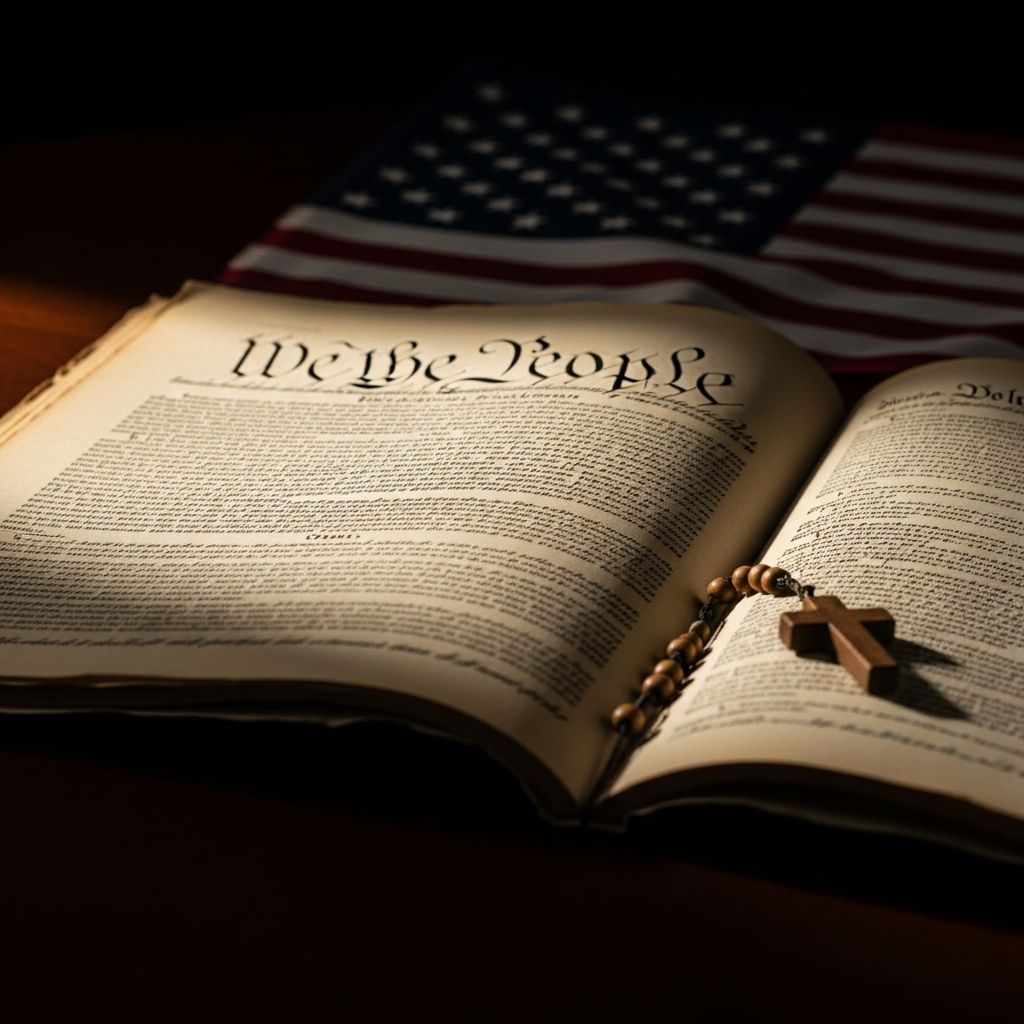
The questions of whether students may pray in school, and whether they can be required to recite the Pledge of Allegiance, sit at the crossroads of religious liberty, free speech, and public education. This article explains how the U.S. Constitution regulates school prayer and the Pledge in public schools, what the Supreme Court has decided, and what rights students and educators still retain.
Foundations: The First Amendment in Public Schools
Debates over school prayer and the Pledge of Allegiance arise from the First Amendment, which binds public schools because they are arms of the government. Two constitutional protections are central:
- Establishment Clause: Government may not establish or endorse religion, or appear to favor one faith (or religion in general) over others.
- Free Exercise and Free Speech Clauses: Individuals have a right to practice their religion and express their beliefs, including through prayer, so long as they do not violate neutral laws or disrupt school operations.
The Supreme Court has emphasized that the Constitution requires public schools to maintain neutrality toward religion: they may not sponsor or organize religious activities, but they also may not suppress private religious expression simply because it is religious.
School Prayer: What Is and Is Not Allowed
Modern school-prayer law in the United States is rooted in several landmark Supreme Court cases decided in the 1960s and 1990s. Together, they draw a sharp line between government-sponsored prayer (which is generally forbidden) and student-initiated, voluntary religious expression (which is generally protected).
Key Supreme Court Decisions on School Prayer
| Case | Year | Context | Constitutional Ruling |
|---|---|---|---|
| Engel v. Vitale | 1962 | Short, state-written prayer recited daily in public classrooms | Unconstitutional for public schools to compose and lead official prayers, even if participation is nominally voluntary. |
| Abington School District v. Schempp | 1963 | Mandatory Bible readings and the Lord’s Prayer in classrooms | School-sponsored Bible readings and prayer violate the Establishment Clause. |
| Lee v. Weisman | 1992 | Clergy-led prayer at a middle school graduation ceremony | Prayer at graduation, arranged and controlled by school officials, is unconstitutional because of the subtle coercion on students. |
| Santa Fe Independent School District v. Doe | 2000 | Student-led prayer over the loudspeaker before football games | Officially sanctioned prayers at school events, even when student-delivered, violate the Establishment Clause. |
In these and related decisions, the Court has consistently held that public schools may not organize or endorse religious exercises.
Government-Sponsored Prayer vs. Private Prayer
The U.S. Department of Education and federal courts draw a practical distinction between what schools themselves do and what individual students do:
- Not allowed (generally unconstitutional):
- Teachers or administrators leading prayer during class or school events.
- School policies prescribing an official prayer or devotions at the start of the day.
- School-sponsored prayers at graduation ceremonies or athletic events where attendance is effectively required or heavily encouraged.
- Using the public-address system, school assemblies, or class time for organized prayers under school authority.
- Generally allowed (constitutionally protected):
- Students praying silently or individually during free time.
- Students engaging in voluntary, student-initiated group prayer outside instructional time, such as during lunch or before school, so long as it is not disruptive.
- Student religious clubs meeting on the same terms as other noncurricular clubs where allowed by law.
- Students expressing religious views in homework, assignments, or conversations, when consistent with academic requirements and classroom rules.
Federal guidance emphasizes that officials must neither promote nor be hostile to religious expression: they must treat comparable religious and nonreligious speech equally.
The Pledge of Allegiance in Public Schools
The Pledge of Allegiance presents different, though related, constitutional issues. Many states permit or require schools to provide time for the Pledge. The constitutional questions are whether students may refuse to participate and what role the phrase “under God” plays.
Student Right to Decline the Pledge
Long before modern school-prayer cases, the Supreme Court held that students cannot be forced to salute the flag or recite the Pledge. In West Virginia State Board of Education v. Barnette (1943), the Court ruled that compelling students to say the Pledge violates free speech and freedom of conscience.
- Schools may offer the Pledge as a patriotic exercise.
- Students may not be punished for refusing to stand, salute, or recite, whether for religious, political, or personal reasons.
- This right applies even when school policy or state law appears to require participation; constitutional protections override contrary local rules.
Thus, while daily recitation may be routine in many classrooms, participation must remain voluntary in practice.
“Under God” and Establishment Concerns
The words “under God” were added to the Pledge in 1954. Courts have been asked whether including this phrase in a school setting is an unconstitutional endorsement of religion. Federal appellate courts have generally upheld the practice of reciting the Pledge with “under God” where participation is voluntary, viewing it as a ceremonial or patriotic reference rather than an official religious exercise.
However, these decisions do not give schools license to coerce students into saying the Pledge. The same principles governing school prayer apply: any meaningful pressure to join in can raise constitutional problems, particularly for students from minority faiths or nonreligious backgrounds.
Balancing Religious Liberty and Neutrality in Schools
Public schools must walk a careful line between avoiding establishment of religion and safeguarding individual religious liberty. Federal guidance summarized by the U.S. Department of Education explains how to maintain this balance in everyday school life.
Responsibilities of Schools and Educators
School officials act on behalf of the state, so they must ensure that any religious activity in school is genuinely voluntary and not school-endorsed. Key responsibilities include:
- Neutrality in classroom instruction: Teachers may teach about religion objectively (e.g., in history or literature) but may not promote faith or lead devotions.
- Equal treatment of student speech: Schools must apply the same rules to religious and secular student expression, including access to facilities and communication channels.
- Avoiding coercion: Administrators must be alert to subtle pressures on students, especially younger children, when planning ceremonies, assemblies, and official activities.
- Training and policies: Districts should adopt clear, written policies on religious expression and ensure staff understand the constitutional standards.
Student Rights: Prayer, Speech, and Conscience
Students do not lose their constitutional rights at the schoolhouse gate. In the context of religion and the Pledge, students generally have the right to:
- Pray individually or in informal groups during non-instructional time, as long as it does not disrupt school or infringe on the rights of others.
- Express religious views in assignments and discussions when relevant and when they meet academic standards.
- Form and attend religious clubs, where other noncurricular student clubs are allowed, on a nondiscriminatory basis.
- Decline to participate in the Pledge of Allegiance, including refusing to stand or recite.
At the same time, students may not use school activities or authority to pressure classmates into religious observance or disrupt instruction.
Common Scenarios in Today’s Schools
Because the line between private and official religious expression can be subtle, it helps to look at typical school situations. The following examples summarize how constitutional principles are usually applied, assuming public (not private or parochial) schools:
- Silent prayer before a test: A student quietly prays at their desk before beginning an exam. This is private, non-disruptive religious exercise and is generally protected.
- Teacher-led prayer at homeroom: A teacher asks the class to bow their heads for a daily prayer. This constitutes school-sponsored prayer and violates the Establishment Clause.
- Student prayer circle at lunch: A voluntary group of students meets around a table in the cafeteria to pray over their food. If school rules allow comparable secular gatherings, this is typically permissible.
- Prayers over the loudspeaker at games: A prayer broadcast over the public-address system at a football game, organized or approved by school officials, is likely unconstitutional as school-sponsored prayer.
- Refusal to recite the Pledge: A student chooses to remain seated and silent during the Pledge. The school may not discipline the student merely for this choice, though it can require respectful non-disruptive behavior.
Practical Tips for Schools and Families
Because disagreements about school prayer and the Pledge often arise from misunderstanding, proactive communication can help prevent conflict.
For Schools and Administrators
- Develop clear written policies on religious expression and distribute them to staff, students, and parents.
- Train teachers on the difference between teaching about religion and promoting religious practice.
- Ensure that any moment of silence or reflection is genuinely neutral and not used to reintroduce organized prayer.
- Monitor school events—graduations, assemblies, athletic games—to ensure any religious content is truly student-initiated and not encouraged or structured by staff.
For Students and Parents
- Know that students may quietly pray and may choose not to participate in the Pledge, within reasonable conduct rules.
- If a student feels pressured by a teacher or coach to join a religious activity, document the situation and raise it with school officials.
- When in doubt, ask for the district’s written policy and, if necessary, consult a lawyer or civil liberties organization for guidance.
Frequently Asked Questions (FAQs)
Can students pray in public schools?
Yes. Students may pray individually or in groups during non-instructional time, such as before or after school, at lunch, or between classes, as long as the activity is not disruptive and is not sponsored or directed by school officials.
Can a teacher lead the class in prayer?
No. When teachers or administrators lead or organize prayer, they act as government representatives and violate the Establishment Clause. The Supreme Court has struck down state-composed and teacher-led prayers in public schools.
Can prayer be included in a graduation ceremony?
Prayer organized or controlled by school officials at graduation is generally unconstitutional, even if labeled “nonsectarian” or “voluntary,” because of the pressure on students to participate in an important, one-time event.
Can students start a religious club at school?
In many public secondary schools, if the school allows noncurricular student clubs, it must give religious clubs the same access to meeting space and resources, provided participation is voluntary and student-led.
Can a student be forced to say the Pledge of Allegiance?
No. Students may not be compelled to recite the Pledge or salute the flag. They may remain silent or seated, provided they are not disruptive. This protection stems from the First Amendment’s free speech and freedom-of-conscience guarantees.
Is it constitutional to include “under God” in the Pledge at school?
Courts have generally upheld recitation of the Pledge with “under God” as a permissible patriotic exercise when participation is voluntary. However, schools must not pressure or punish students who decline to participate.
What should I do if my child is punished for praying or for refusing the Pledge?
First, gather specific information about what occurred. Then, raise the issue with teachers and administrators and request the district’s policy on religious expression. If the problem persists, consider consulting an attorney or a civil liberties organization specializing in education and First Amendment law.
References
- Facts and Case Summary: Engel v. Vitale — Administrative Office of the U.S. Courts. 2024-01-01. https://www.uscourts.gov/about-federal-courts/educational-resources/educational-activities/first-amendment-activities/engel-v-vitale/facts-and-case-summary-engel-v-vitale
- Engel v. Vitale, 370 U.S. 421 (1962) — Supreme Court of the United States (via Justia). 1962-06-25. https://supreme.justia.com/cases/federal/us/370/421/
- Engel v. Vitale — Oyez, IIT Chicago-Kent College of Law. 2023-01-01. https://www.oyez.org/cases/1961/468
- School Prayer — Research Starters, EBSCOhost. 2014-01-01. https://www.ebsco.com/research-starters/education/school-prayer
- Guidance on Constitutionally Protected Prayer and Religious Expression in Public Elementary and Secondary Schools — U.S. Department of Education. 2023-05-15. https://www.ed.gov/laws-and-policy/laws-preschool-grade-12-education/preschool-grade-12-policy-documents/guidance-on-constitutionally-protected-prayer-and-religious-expression-in-public-elementary-and-secondary-schools
- Guidance on Constitutionally Protected Prayer and Religious Expression in Public Elementary and Secondary Schools — U.S. Department of Education (alternate access). 2023-05-15. https://www.ed.gov/laws-and-policy/education-policy/guidance-on-constitutionally-protected-prayer-and-religious-expression-in-public-elementary-and-secondary-schools
- School Prayer in the United States — Background summary based on Supreme Court decisions, various courts. 2022-01-01. https://en.wikipedia.org/wiki/School_prayer_in_the_United_States
Similar Articles








Read full bio of Sneha Tete


