Public schools maintain a unique environment where maintaining order and safety often intersects with students’ expectations of privacy. Unlike private homes, where warrants are typically required, school lockers and personal belongings can be subject to searches by educators under specific legal standards. This article delves into the foundational principles governing these searches, drawing from landmark Supreme Court decisions and state interpretations to clarify what is permissible.
Foundational Legal Principles for School Searches
The cornerstone of school search law in the United States is the Fourth Amendment, which protects against unreasonable searches and seizures. In the seminal 1985 case New Jersey v. T.L.O., the U.S. Supreme Court established that while students retain Fourth Amendment rights, the school’s interest in maintaining discipline outweighs full privacy protections. School officials need only “reasonable suspicion”—a lower threshold than the “probable cause” required for police searches—to initiate a search.
Reasonable suspicion demands more than a mere hunch; it requires articulable facts suggesting a violation of school rules or law. For instance, California’s Supreme Court has emphasized that searches must be backed by specific, observable evidence, ruling out random or rumor-based intrusions. This standard ensures searches are targeted and proportionate.
Differences Between School Property and Personal Items
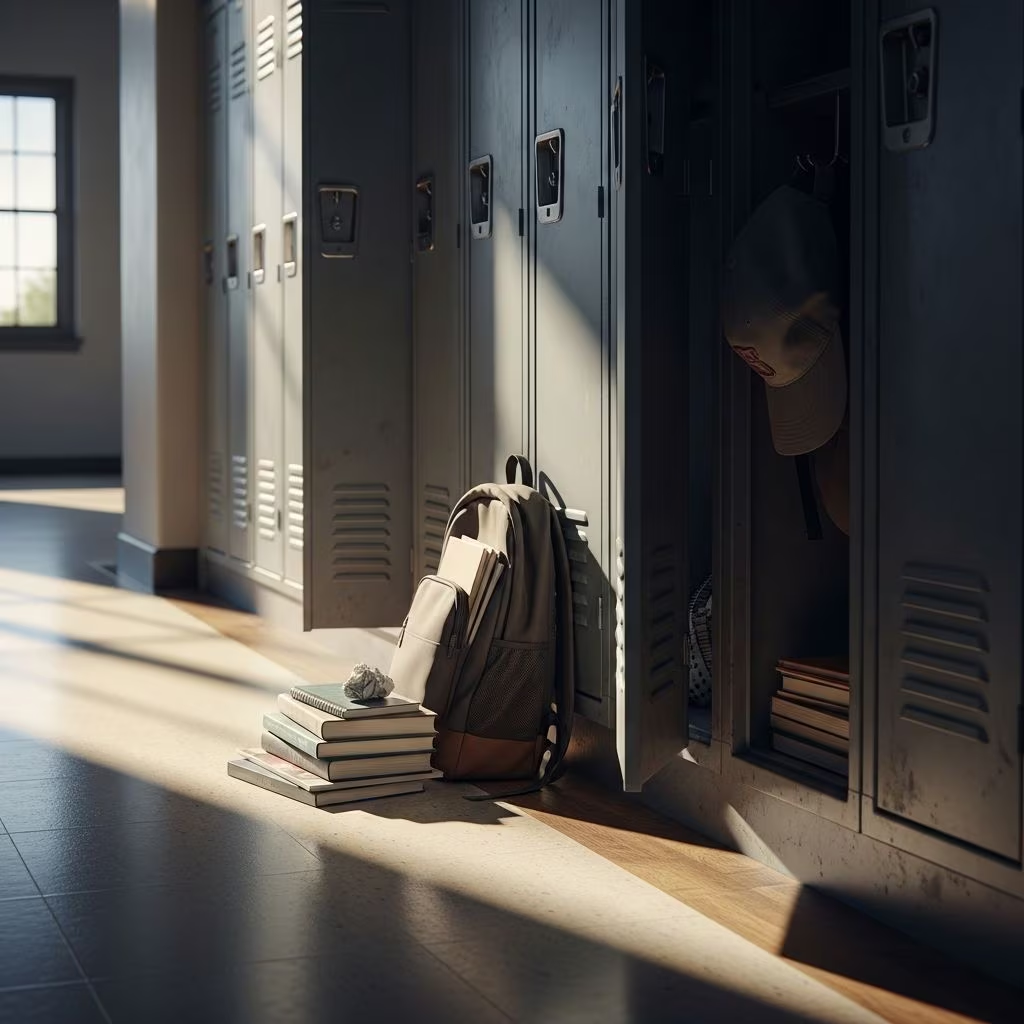
School lockers are often classified as school property, despite student use. Policies in student handbooks typically notify families that lockers remain under administrative control, allowing searches without prior suspicion in some cases. Desks and assigned storage fall under similar rules, as they are provided for educational purposes.
Personal belongings like backpacks, clothing, or phones demand stricter scrutiny. Officials must justify searching each item based on its connection to the suspected violation. A search starting with reasonable suspicion for a backpack cannot automatically extend to unrelated areas without new evidence.
Evaluating the Reasonableness of a Search
Courts assess searches using a two-pronged test from New Jersey v. T.L.O.: (1) Was the search justified at inception? (2) Was its scope reasonably related to its objectives? Factors include the student’s age, gender, the infraction’s nature, and search intrusiveness.
- Age and Maturity: Younger students warrant more deference to privacy; searches must account for developmental stages.
- Gender Considerations: Same-gender officials should conduct personal searches to minimize intrusion.
- Infraction Severity: Suspected weapons justify broader searches than minor rule breaks like dress code violations.
For example, suspecting drug possession might permit backpack checks but not strip searches absent escalating evidence.
Role of Tips and Reports in Justifying Searches
Information sources significantly influence search validity. Anonymous tips carry little weight unless corroborated, as courts view them skeptically. In contrast, reports from teachers, parents, or identified students hold more credibility. A case upheld a search after a parent reported seeing a student with a firearm, deeming parental concerns reliable.
Timing and location matter too. A tip about off-campus behavior a year prior rarely justifies an on-campus locker search, but recent, school-related observations do. Courts weigh recency and relevance to ensure searches address immediate threats.
| Factor | High Reliability Example | Low Reliability Example |
|---|---|---|
| Source Credibility | Teacher or parent report | Anonymous phone tip |
| Specificity | “Student X in locker 123 has drugs” | Vague rumor about “someone” |
| Recency | Incident witnessed today | Event from months ago |
| Connection to Location | Observed at school | Off-campus party |
Consent Searches: Voluntary or Coerced?
Students may consent to searches, waiving some protections, but consent must be voluntary and informed. Officials aren’t required to advise of refusal rights, yet coercion invalidates it. If a backpack search yields evidence, it may build suspicion for further areas like lockers, but only within expanded reasonable bounds. Policies should outline consent procedures and consequences for refusal, such as disciplinary action for obstructing a justified search.
Police Involvement: Higher Standards Apply
When law enforcement enters the equation, standards elevate. Police need probable cause—a substantial belief a crime occurred and evidence will be found—often with a warrant, unless exigent circumstances exist. School resource officers acting in a policing capacity follow these rules, not the lower school-official threshold. This distinction prevents schools from bypassing criminal protections via administrative searches.
Consequences of Unlawful Searches
Illegally obtained evidence is inadmissible in criminal court, protecting students from prosecution based on violations. However, schools can use it in disciplinary hearings, like suspensions. In Gordon v. Santa Ana Unified School District, marijuana from an illegal pocket search led to a year-long suspension despite court invalidation for criminal purposes. This underscores that school discipline operates separately from criminal law.
School Policies and Best Practices
Clear policies foster compliance. Effective handbooks define search protocols, locker ownership, consent rules, and seized item handling. They require parent-student acknowledgment, reducing disputes. Schools should train staff on legal limits, documenting facts justifying each search for defensibility.
- Notify students: Lockers are school property subject to inspection.
- Document: Record suspicion basis, witnesses, and search scope.
- Limit Scope: Stop once objectives met; avoid excess.
- Involve Witnesses: Use same-gender staff for personal searches.
State Variations and Evolving Standards
While federal law sets the baseline, states interpret differently. California mandates “articulable facts,” while others align closely with T.L.O.. Recent cases refine applications, like prohibiting shoe searches for attendance issues. Schools must monitor updates, as courts adapt to technology (e.g., cell phones) and societal changes.
Frequently Asked Questions
Can schools conduct random locker searches?
Generally no, if lockers are deemed student property; yes, if school policy designates them as administrative property with prior notice.
What counts as reasonable suspicion?
Specific, observable facts linking the student and item to a rule violation, beyond hunches or rumors.
Can evidence from an illegal search lead to suspension?
Yes, in school disciplinary actions, but not in criminal court.
Do police need a warrant to search at school?
Typically yes, with probable cause; school officials use lower reasonable suspicion standards.
Should parents review school search policies?
Absolutely; handbooks outline rights and procedures—request copies annually.
Empowering Students and Parents
Knowledge equips families to advocate effectively. If a search feels unjust, document details and consult legal aid. Organizations like the ACLU provide resources. Schools benefit from transparent practices, fostering trust while ensuring safety.
References
- New Jersey v. T.L.O. and School Locker Searches — LegalZoom. 2023 (accessed 2026). https://www.legalzoom.com/articles/school-lockers-what-can-a-teacher-search
- Know Your Rights: Student Searches & Investigations — ACLU of Massachusetts. 2024-02-15. https://www.aclum.org/know-your-rights/know-your-rights-student-searches-investigations/
- The Right to Search Students — Association for Supervision and Curriculum Development (ASCD). 2022-05-10. https://www.ascd.org/el/articles/the-right-to-search-students
- Searches of Students — My School My Rights (Public Counsel). 2025-01-20. https://www.myschoolmyrights.com/rights/searches-of-students/
- School Searches and Seizure — Kids Legal (North Carolina). 2023-11-05. https://kidslegal.org/school-searches-and-seizure