
Safeguarding Democratic Dissent: Protecting Peaceful Assembly in the US
Examining the crucial role of government in protecting the human right to peaceful assembly and free expression.
Introduction: The Civic Necessity of Public Demonstrations
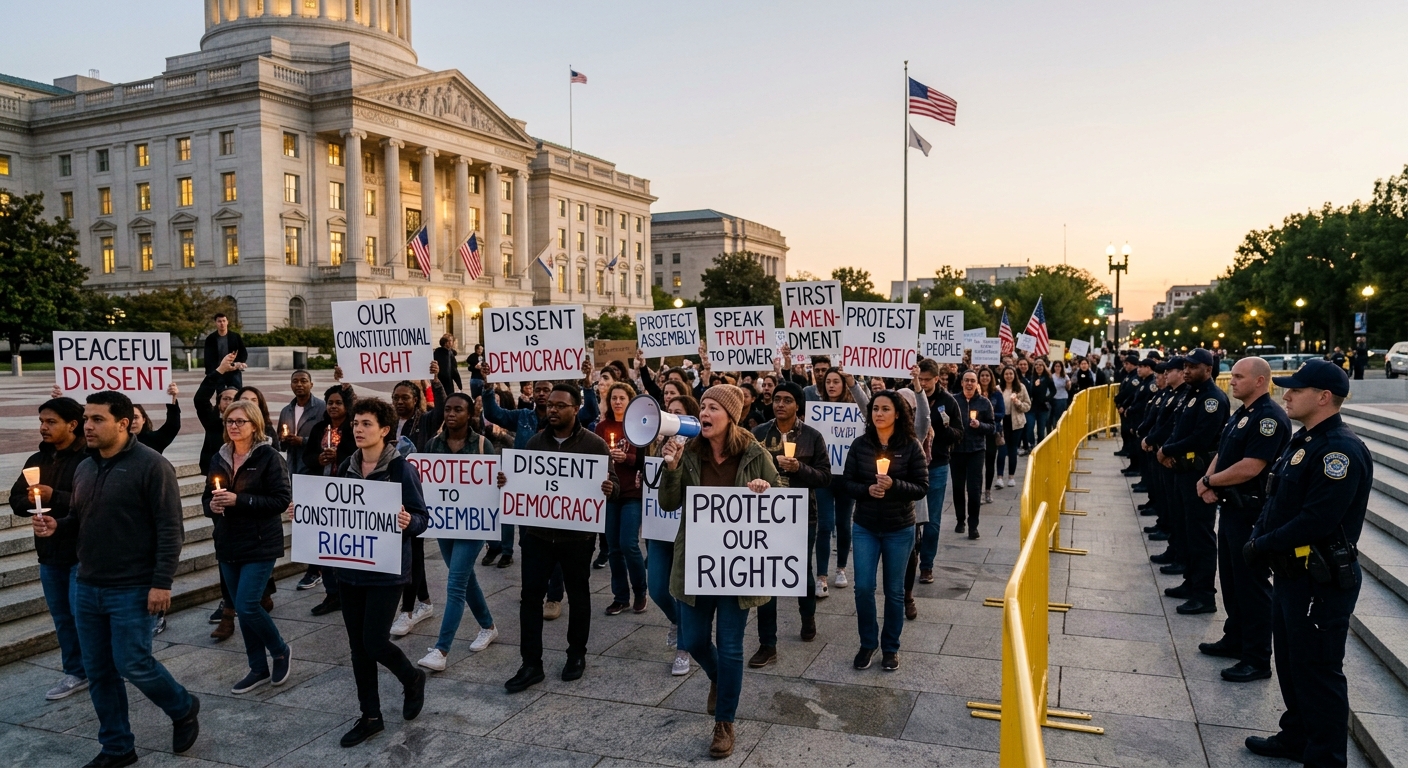
Public demonstrations have long served as the heartbeat of democratic societies, functioning as both a vital barometer of public sentiment and an indispensable mechanism for demanding accountability. Throughout history, whenever ordinary citizens have found traditional channels of political influence closed, systematically compromised, or unresponsive to their immediate needs, they have taken to the streets and public squares. This physical reclamation of civic space is especially prevalent when addressing deep-seated economic disparities. When marginalized populations experience the crushing weight of financial inequality, wage stagnation, and housing insecurity, the right to voice their grievances collectively becomes a crucial survival tool.
However, the presence of thousands of dissenting voices in public spaces frequently triggers a profound tension between government authorities seeking to maintain public order and citizens exercising their fundamental freedoms. This dynamic requires a careful examination of the obligations resting upon the United States government. Rather than viewing demonstrations as a logistical nuisance to be managed or a security threat to be neutralized, state and federal authorities must recognize peaceful assembly as a fundamental human right that requires active, rigorous protection. Ensuring that individuals can peacefully gather to protest without fear of violent suppression, excessive surveillance, or arbitrary arrest is not merely a domestic constitutional mandate; it is a profound international legal obligation.
The Bedrock of Democratic Expression and Economic Grievances
At the core of any functioning, resilient democracy is the unwavering belief that the people hold the right to petition their government for a redress of grievances. In the modern era, these grievances are frequently rooted in systemic economic inequality. As wealth concentrates at the uppermost echelons of society and basic necessities—such as healthcare, higher education, and affordable housing—become increasingly inaccessible to the working class, public frustration inevitably mounts. Grassroots movements that establish physical presences in urban centers are often attempting to make invisible economic struggles visible to insulated lawmakers and the broader public.
By occupying a public space, whether through temporary marches or prolonged encampments, demonstrators force a societal conversation about poverty, labor rights, and outsized corporate influence over democratic institutions. The right to articulate these concerns collectively is intrinsically tied to freedom of expression. To silence these gatherings is to silence the political participation of those who may lack the financial resources to hire powerful lobbyists, purchase extensive campaign advertisements, or readily access the corridors of political power.
Therefore, the robust protection of public demonstrations is fundamentally linked to the protection of marginalized and economically disadvantaged communities. When municipalities impose overly burdensome permit requirements, arbitrary curfews, or outright bans on public encampments, they disproportionately restrict the speech of those who cannot simply rent private venues to express their dissent. A healthy democracy must tolerate a certain degree of disruption to daily commercial life if that disruption is the required price of allowing vital political expression to flourish. Authorities must consciously shift their operational perspective from seeing assemblies as administrative hurdles to viewing them as essential democratic functions that actively require facilitation.
International Human Rights Standards and the ICCPR Framework
The obligation to protect public demonstrations extends far beyond domestic constitutional jurisprudence; it is deeply embedded in the comprehensive international human rights framework to which the United States is legally bound. The cornerstone of this framework is the International Covenant on Civil and Political Rights (ICCPR), a multilateral treaty ratified by the United States that forms a critical part of the International Bill of Human Rights . Article 21 of the ICCPR explicitly guarantees the right of peaceful assembly, emphasizing that no restrictions may be placed on this right other than those imposed in strict conformity with the law and demonstrably necessary in a democratic society .
To clarify the operational scope of this fundamental right, the United Nations Human Rights Committee published General Comment No. 37 in September 2020 . This exhaustive guidance underscores that peaceful assembly is a fundamental human right enabling individuals to express themselves collectively, exercise individual autonomy in solidarity with others, and participate directly in shaping their societies. Importantly, the UN guidance clarifies that the baseline operational presumption of the state must always be in favor of the right to assemble. It explicitly dictates that governments possess a positive obligation to facilitate these gatherings, meaning law enforcement must actively protect participants from undue interference, including aggressive counter-protesters or hostile private actors.
Furthermore, General Comment No. 37 emphatically highlights that peaceful assemblies may inherently cause some level of temporary disruption, such as vehicular traffic delays, public transit rerouting, or localized commercial interruptions. However, under international law, this disruption does not strip the assembly of its peaceful status nor does it legally justify forced dispersal . The legal threshold for restricting an assembly is exceptionally high. Any state-imposed limitations must be strictly necessary and proportionate, primarily aimed at protecting imminent public safety or the fundamental rights of others, rather than merely maintaining municipal aesthetic order or preventing political embarrassment for elected officials.
Additionally, recent advancements in surveillance technologies have added a new layer of complexity to the right of peaceful assembly. The unchecked use of facial recognition software, international monitoring bodies note, can exert a severe chilling effect on the willingness of individuals to participate in public demonstrations. General Comment No. 37 explicitly recognizes the right to anonymity, establishing that the use of masks or hoods to protect one’s identity cannot automatically be construed as evidence of violent intent. This guidance is particularly critical in the modern era, where participants face severe risks of targeted harassment, doxing, employment termination, or extrajudicial surveillance simply for being present at a rally advocating for economic reforms.
The Disconnect: Domestic Policing Versus International Standards
Despite these clear, binding international mandates, a stark and alarming disconnect frequently emerges between established human rights standards and the realities of domestic policing within the United States. In recent years, premier human rights organizations and federal watchdogs have documented deeply troubling patterns regarding the policing of mass demonstrations. When economic or social justice movements gain massive momentum, municipal authorities frequently rely on heavily armed law enforcement units to rapidly clear public squares, enforce minor municipal ordinances aggressively, or dismantle peaceful encampments under the guise of public sanitation .
The widespread militarization of local police forces has drastically exacerbated this tension. The routine deployment of riot gear, armored tactical vehicles, and less-lethal munitions—such as chemical tear gas, potent pepper spray, and kinetic rubber bullets—against unarmed, peaceful protesters fundamentally contradicts the core principles of necessity and proportionality required by human rights law. Amnesty International has thoroughly documented numerous instances where U.S. law enforcement violated human rights daily out on the streets instead of fulfilling their legal obligations to respect and facilitate the right of people to peacefully protest . Instead of skillfully de-escalating tensions, these forceful, combative tactics frequently escalate them, actively turning peaceful, orderly gatherings into chaotic, panic-inducing, and highly dangerous environments.
Moreover, the rigid enforcement of localized “time, place, and manner” restrictions is frequently weaponized to suppress dissenting viewpoints covertly. While authorities may legally impose strictly viewpoint-neutral restrictions to maintain truly essential emergency services, these regulations are sometimes selectively and hypocritically applied to clear out movements that directly challenge the economic or political status quo. The strategic use of minor infractions—such as trespassing in a public park shortly after sunset or erecting a temporary fabric shelter against the elements—as convenient pretexts for initiating mass arrests serves to criminalize the fundamental act of protest itself. This suppressive approach not only violates the core spirit of the First Amendment but directly contravenes the ICCPR’s explicit mandate that restrictions must never impair the absolute essence of the right to peacefully assemble.
The Federal Government’s Obligation to Safeguard Demonstrators
When localized municipal or state jurisdictions consistently fail to uphold the fundamental rights of demonstrators, the federal government bears the ultimate responsibility to intervene and rectify these systemic abuses. As a signatory to the ICCPR, the United States national government cannot legally or morally claim that the independent actions of decentralized municipal police forces absolve the nation of its binding international human rights obligations. Federal oversight is absolutely essential to ensure that local ordinances and frontline policing tactics do not systemically violate constitutional liberties and international human rights law.
The Department of Justice (DOJ) plays a paramount role in this necessary oversight architecture. Through exhaustive pattern-or-practice investigations, the DOJ possesses the authority to scrutinize local police departments that exhibit a documented history of utilizing excessive force against peaceful demonstrators, or engaging in highly discriminatory policing tactics . By entering into binding federal consent decrees, the United States government can forcefully compel municipal law enforcement agencies to thoroughly overhaul their crowd control policies, prioritize intensive de-escalation training, and implement unyielding accountability measures for officers who abuse their badge to suppress speech .
The July 2024 comprehensive review published by the DOJ’s Office of the Inspector General thoroughly investigated the Department’s own internal and interagency response to civil unrest in Washington, D.C. . This detailed report illuminated the highly intricate chain of command operating during mass mobilizations and deeply underscored the imperative for all federal agencies to maintain absolute operational transparency. When federal law enforcement forces are deployed to assist overwhelmed local police, they must never dilute or bypass the constitutional protections rightfully afforded to civilians. The findings heavily reiterate that robust accountability mechanisms—such as rigorous post-incident reviews, independent civilian oversight boards, and highly transparent reporting regarding the deployment of force—are utterly non-negotiable components of any democratic law enforcement structure .
Beyond reactive, post-incident investigations, federal authorities must proactively establish standardized nationwide guidelines for the policing of public assemblies that completely align with General Comment No. 37. This imperative includes firmly tying federal funding grants for local law enforcement to their strict, verifiable compliance with established human rights standards regarding the use of less-lethal weapons and crowd control munitions. The federal government must make it unequivocally clear to all jurisdictions that the violent suppression of peaceful economic or political dissent is entirely incompatible with core American democratic values and binding international legal commitments.
Pathways to a Rights-Respecting Approach to Public Protest
Moving forward, municipalities and law enforcement agencies across the nation must undergo a radical paradigm shift in how they conceptualize and manage large-scale public demonstrations. A rights-respecting approach fundamentally prioritizes active communication, logistical facilitation, and minimal police intervention over the immediate enforcement of low-level ordinances and rapid crowd dispersal.
Key strategies for adopting this human rights-compliant approach include:
- Prioritizing Sustained Dialogue: Authorities should proactively establish open, non-adversarial lines of communication with designated protest organizers before, during, and after an assembly to negotiate logistics, identify needs, and collaboratively prevent misunderstandings.
- Refraining from Preemptive Shows of Force: Deploying heavily armed officers in full tactical riot gear preemptively serves to intimidate civilian participants and predictably escalates tensions. Police presence should be minimal, highly visible, and approachable, escalating intervention only in direct response to specific, severe, and immediate threats to public safety.
- Actively Tolerating Disruption: City officials and local commerce boards must culturally accept that effective protests are inherently disruptive by design. Temporary roadway closures or the sustained occupation of a central public plaza should be actively accommodated as the acceptable operational cost of maintaining a vibrant democratic society.
- Strict Absolute Limits on Force Deployment: The utilization of chemical irritants, acoustic weapons, and kinetic impact projectiles must be strictly regulated by clear statutes, utilized exclusively as an absolute last resort to prevent serious bodily harm or widespread destructive violence, and never deployed for the routine dispersal of non-violent crowds.
To clearly illustrate the necessary institutional shift in policy, the following table directly contrasts historically suppressive crowd control tactics with modern rights-respecting operational strategies:
| Suppressive Tactics (Human Rights Violations) | Rights-Respecting Strategies (ICCPR Compliant) |
|---|---|
| Preemptive deployment of militarized riot gear and armored vehicles. | Minimal, approachable community police presence focused entirely on crowd safety. |
| Aggressive, strict enforcement of minor curfews to violently break up peaceful encampments. | Logistically accommodating and protecting temporary civilian occupations of public civic spaces. |
| Indiscriminate, unannounced use of chemical tear gas and rubber bullets on dense crowds. | Strict statutory limits on less-lethal weapons; targeting only specific, identifiable violent actors if necessary. |
| Initiating mass “kettling” arrests for minor infractions (e.g., trespassing in city parks). | Tolerating minor logistical disruptions as a natural component inherent to the right to assemble. |
| Institutionally viewing protesters as hostile adversaries, criminals, or public nuisances. | Viewing all peaceful protesters as protected citizens actively exercising their fundamental democratic rights. |
Conclusion
The right to peacefully assemble and publicly petition the state for the redress of pressing economic and political grievances is not a conditional privilege to be casually granted or abruptly revoked at the administrative convenience of local authorities; it is an irrevocable, inalienable human right. As domestic economic inequality continues to persistently drive public frustration and marginalize vulnerable communities, the urgent need for the robust, unyielding protection of public dissent will only exponentially grow. The United States government, heavily bound by both its foundational Constitution and critical international treaties like the ICCPR, must take decisive, systemic action to conclusively rein in the militarized policing of civilian protests. By fundamentally shifting the law enforcement paradigm from one of hostile suppression to one of active democratic facilitation, the nation can ensure that its public squares remain safe, vibrant arenas for discourse, giving an essential voice to the marginalized and permanently safeguarding the fundamental liberties of all its people.
Frequently Asked Questions (FAQs)
Is peaceful assembly officially recognized as an international human right?
Yes, peaceful assembly is a universally recognized and protected human right. It is explicitly enshrined in major international legal frameworks, including Article 21 of the International Covenant on Civil and Political Rights (ICCPR) and the Universal Declaration of Human Rights. It fundamentally allows individuals to express themselves collectively and participate meaningfully in public affairs.
How does the ICCPR influence United States law regarding public protests?
The United States ratified the ICCPR, meaning it is legally bound by international treaty law to uphold its critical provisions. While domestic courts within the US often rely primarily on the First Amendment of the Constitution to adjudicate specific protest rights, the ICCPR establishes an unyielding baseline human rights standard that the federal government is obligated to enforce and respect globally and domestically. It requires that any state restriction on public assembly be strictly necessary, lawful, and proportionate.
What does the UN General Comment No. 37 entail for demonstrators?
Published by the UN Human Rights Committee in 2020, General Comment No. 37 provides exhaustive, modern legal guidance on the right to peaceful assembly. It firmly clarifies that governments possess a positive duty to facilitate protests, that peaceful demonstrations inherently cause some level of societal disruption, and that authorities absolutely must not use excessive physical force, surveillance, or arbitrary mass arrests to disperse crowds.
Can the government legally restrict or shut down a public protest?
Under international human rights standards, governments can only restrict protests under highly exceptional and specific circumstances. State restrictions must be entirely lawful, strictly necessary, and proportionate to immediately protect public safety, public order, or the fundamental rights of others. Minor disruptions to local traffic or daily commercial life are explicitly not valid or legal grounds for violently suppressing a peaceful assembly.
What is the exact role of the Department of Justice in protecting assembly rights?
The Department of Justice actively oversees local and state law enforcement agencies to ensure they do not systemically violate constitutional or human rights. Through comprehensive pattern-or-practice investigations and enforceable federal consent decrees, the DOJ can forcefully mandate systemic reforms in police departments that demonstrably engage in the use of excessive force, illegal surveillance, or discriminatory arrest practices against peaceful civilian demonstrators.
References
- General comment No. 37 (2020) on the right of peaceful assembly (article 21) — UN Human Rights Committee (OHCHR). 2020-09-17. https://www.ohchr.org/en/documents/general-comments-and-recommendations/general-comment-no-37-article-21-right-peaceful
- International Covenant on Civil and Political Rights — UN Office of the High Commissioner for Human Rights (OHCHR). 1976-03-23. https://www.ohchr.org/en/instruments-mechanisms/instruments/international-covenant-civil-and-political-rights
- USA: End unlawful police violence against Black Lives Matter protests — Amnesty International. 2020-06-23. https://www.amnesty.org/en/latest/press-release/2020/06/usa-end-unlawful-police-violence-against-black-lives-matter-protests/
- Investigation of the Ferguson Police Department — U.S. Department of Justice (DOJ), Civil Rights Division. 2015-03-04. https://www.justice.gov/sites/default/files/opa/press-releases/attachments/2015/03/04/ferguson_police_department_report.pdf
- A Review of the Department of Justice’s Response to Protest Activity and Civil Unrest in Washington, D.C. in Late May and Early June 2020 — U.S. Department of Justice Office of the Inspector General. 2024-07-26. https://oig.justice.gov/reports/review-department-justices-response-protest-activity-and-civil-unrest-washington-dc-late
Similar Articles








Read full bio of Sneha Tete


