
Defending Democracy in the Streets: A Roadmap for Constitutional Policing
How law enforcement can optimally balance broad public safety and fundamental constitutional rights during mass demonstrations.
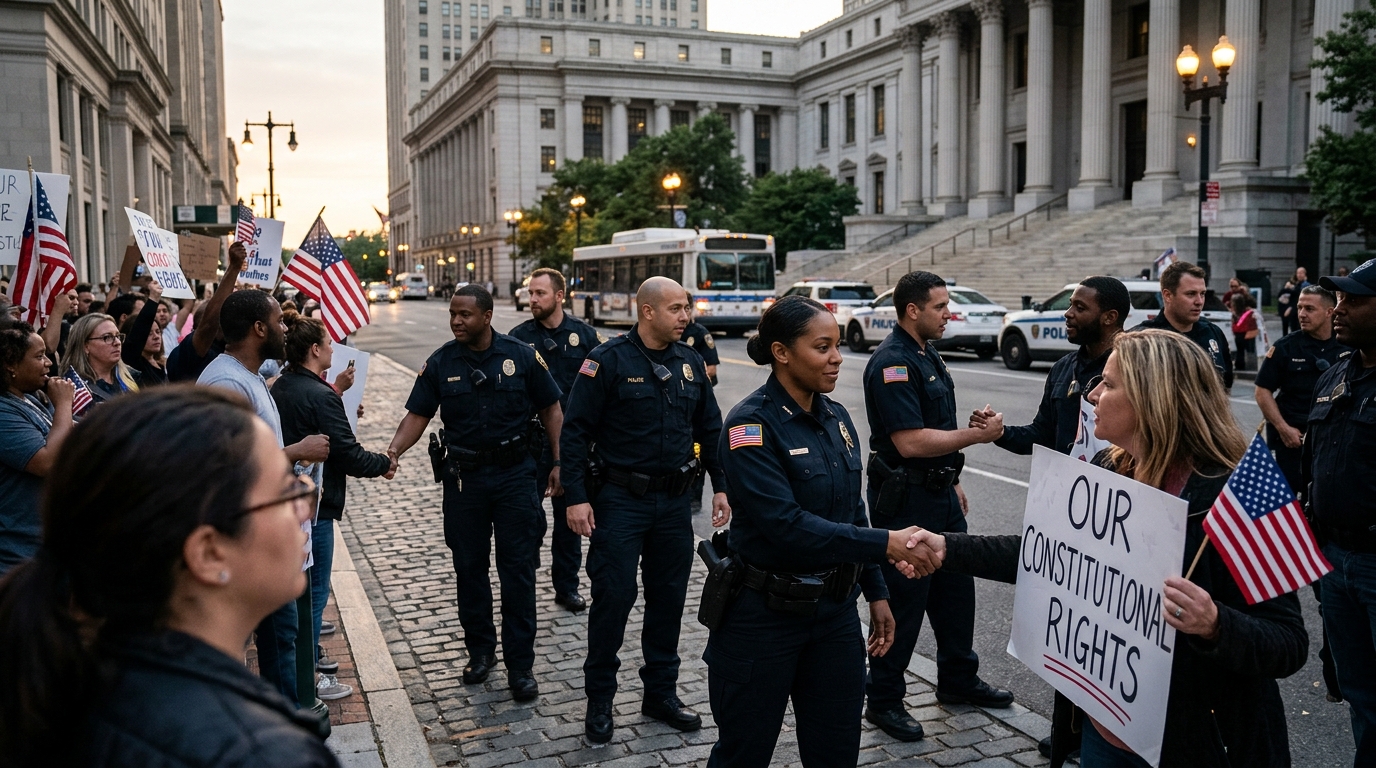
The Dual Mandate of Modern Law Enforcement
The atmosphere surrounding national political conventions, international summits, and major public demonstrations is inherently charged. These massive, large-scale events bring together global leaders, passionate citizens, and intense media scrutiny, creating a profound logistical and security challenge for local law enforcement agencies. At the very heart of this challenge lies a fundamental constitutional mandate: police departments must maintain public order without suffocating the First Amendment rights of those who gather to express their political beliefs.
History provides numerous cautionary tales of law enforcement agencies that, in their zeal to maintain absolute control over a volatile environment, overstepped strict constitutional boundaries. As modern cities prepare to host future high-profile political events, it is critically important to analyze past missteps and chart a modern, highly effective roadmap for policing mass protests. The transition from heavy-handed, militarized tactics to a nuanced, rights-based approach is not just a matter of strict legal compliance; it is essential for preserving the democratic fabric of society.
The Ghost of Conventions Past: Lessons from Heavy-Handed Tactics
To fully understand what law enforcement leaders must avoid during major national events, one only needs to look at the historical failures that resulted in massive civil rights violations and subsequent legal battles. A glaring historical example of “what not to do” occurred during the 2004 Republican National Convention in New York City. Operating under the guise of counter-terrorism and strict crowd control measures, the police department executed sweeping, indiscriminate mass arrests of over 1,800 individuals. Those detained included not only peaceful protesters but also credentialed journalists, impartial legal observers, and entirely unsuspecting bystanders.
The dismal conditions of confinement further exacerbated the crisis. Many arrestees were held for prolonged periods in a makeshift detention center that severely lacked basic hygiene and operational facilities. Nearly a decade later, the immense fallout of these aggressive, zero-tolerance tactics culminated in a massive financial toll for the municipality. In 2014, the city agreed to pay an $18 million legal settlement to resolve dozens of high-profile civil rights lawsuits stemming directly from the unlawful arrests made at the 2004 convention .
This historical precedent serves as a powerful reminder that an overzealous policing strategy is ultimately self-defeating and highly destructive. Mass arrests that lack specific, individualized probable cause directly violate the Fourth Amendment protections against unreasonable seizure and expose local municipalities to crippling financial liability. More importantly, such authoritarian tactics severely damage the core relationship between law enforcement and the communities they are sworn to serve, breeding a lingering atmosphere of resentment and public distrust.
Deconstructing the “Escalated Force” Paradigm
For several decades, the standard law enforcement response to large-scale demonstrations was firmly rooted in the “escalated force model.” This archaic approach prioritized an overwhelming show of police presence, with officers often deployed in full riot gear, heavily supported by armored tactical vehicles and heavily barricaded perimeters. The underlying philosophy was based on the flawed assumption that a formidable display of physical power would deter unruly behavior and force immediate, unquestioning compliance from the crowd.
However, modern sociological research into crowd dynamics tells a distinctly different story. Leading organizations, such as the Police Executive Research Forum (PERF), along with academic researchers studying crowd psychology, have concluded that militarized policing often acts as a dangerous accelerant rather than a pacifying deterrent. When police officers meet a peaceful, democratic assembly with riot shields, extended batons, and kinetic impact projectiles, it inevitably sends a hostile message that can provoke immense anxiety, deep anger, and rapid defensive reactions among the crowd . A militarized posture inherently criminalizes the act of protesting, transforming citizens exercising their democratic rights into perceived enemy combatants.
The indiscriminate use of less-lethal crowd-control tools—such as chemical irritants, flash-bang grenades, and rubber bullets—further complicates this volatile dynamic. When deployed blindly into a massive crowd to disperse a small handful of isolated agitators, these weapons inflict severe collective punishment on peaceful participants. This deeply violates the core tenets of constitutional policing and frequently escalates minor skirmishes into full-blown urban riots.
The Legal and Ethical Fallacy of “Free Speech Zones”
Another highly controversial and legally dubious tactic frequently employed at high-profile political events is the establishment of “free speech zones”—remote, highly restricted geographic areas designated specifically for demonstrators. While municipal authorities and federal security agencies often argue that these isolated zones are absolutely necessary to ensure the physical safety of political delegates and visiting dignitaries, civil liberties advocates rightly condemn them as a profound and calculated dilution of fundamental First Amendment rights.
The United States Constitution firmly guarantees not only the right to speak but the fundamental right to be heard and seen by the intended target audience. When authorities quarantine passionate protesters in temporary chain-link enclosures situated several blocks or even miles away from the main convention event, they effectively silence the political message. The judicial courts have long established that the government may legally impose reasonable “time, place, and manner” restrictions on public assemblies, but these restrictions must be strictly content-neutral, narrowly tailored to serve a significant governmental interest, and importantly, must leave open ample alternative channels for direct communication.
Pushing political dissent entirely out of public sight miserably fails this critical constitutional test. True democratic engagement requires that elected political leaders and the general public are directly confronted with opposing viewpoints and grievances. Law enforcement agencies must actively work to facilitate peaceful protests within the immediate sight and sound of the primary convention venues, rather than treating free expression as an unseemly public nuisance that must be hidden away behind fortified concrete barriers.
The Chilling Effect of Preemptive Surveillance
In the tense months leading up to major political conventions, the administrative impulse to aggressively gather intelligence on potential public threats is entirely understandable. Counter-terrorism and broad public safety are highly valid municipal concerns. However, the delicate legal line between actively investigating credible criminal threats and unconstitutionally surveilling lawful political activity is easily and frequently blurred.
In the past, various law enforcement intelligence agencies have faced intense public scrutiny for covertly infiltrating peaceful activist groups, aggressively monitoring the private social media accounts of political organizers, and compiling extensive dossiers on individuals with absolutely no criminal records. This broad, unwarranted surveillance casts a massive chilling effect over everyday democratic participation. When private citizens genuinely believe that attending a political rally or organizing a peaceful street march will directly result in their permanent addition to a government watchlist, many will simply choose to stay home in fear.
Law enforcement intelligence operations must remain strictly and undeniably tethered to the reasonable suspicion of actual criminal activity. Monitoring grassroots groups purely based on their political ideologies or their loud opposition to government policies is a dangerous, fundamentally un-American infringement on civil liberties.
Comparing Protest Policing Models
Understanding the stark operational differences between outdated crowd control methods and modern rights-based approaches is crucial for contemporary law enforcement leadership.
| Operational Feature | Escalated Force Model (Outdated) | Negotiated Management Model (Modern) |
|---|---|---|
| Primary Tactics | Mass sweep arrests, heavy riot gear, physical barricades | Continuous de-escalation, targeted singular arrests, open communication |
| Police Posture | Highly militarized, aggressive, and adversarial | Neutral, facilitative, and community-oriented |
| View of Protesters | Treated as immediate threats to public order | Respected as citizens exercising democratic rights |
| Expected Outcome | High crowd tension, frequent civil litigation, civil rights violations | Lower tension, safely protected free speech, drastically reduced liability |
A Modern Blueprint: Best Practices for Constitutional Crowd Management
If the escalated force model and indiscriminate mass arrests represent “what not to do,” how should modern law enforcement agencies approach the monumental, complex task of policing mass demonstrations? The definitive answer lies in universally adopting the “negotiated management model,” a proven strategic framework built on proactive communication, constant de-escalation, and a fundamental, unwavering respect for human rights.
- Pre-Event Communication and Collaboration: The absolute most successful protest management strategies begin long before the very first demonstrator arrives on the scene. Police departments should proactively and respectfully engage with protest organizers to clearly understand their core goals, planned marching routes, and expected crowd turnout. This open, honest dialogue helps establish mutually agreeable ground rules, build genuine mutual respect, and identify dedicated civilian liaisons who can directly help de-escalate tensions if they suddenly arise during the event.
- Targeted Enforcement over Sweep Arrests: During any incredibly large public gathering, there is always the statistical potential for a small, rogue faction of individuals to actively engage in property damage or physical violence. Law enforcement teams must employ a highly surgical approach, isolating and arresting only the specific individuals visibly breaking the law without declaring the entire peaceful assembly unlawful. Broad dispersal orders should always remain an absolute last resort, communicated clearly, audibly across multiple channels, and with ample time and completely safe exit routes heavily provided.
- Prioritizing De-escalation: Officers actively deployed on the ground must be continuously trained in psychological de-escalation techniques. Instead of initially relying on intimidating riot gear, police departments should intentionally deploy “soft-hat” officers in standard daily uniforms for all primary crowd interaction. Specialized tactical response units should remain entirely out of sight, held in strategic reserve only for severe, life-threatening emergencies, thereby drastically reducing the initial psychological friction between the police line and the protesters.
- Comprehensive First Amendment Training: It is not nearly enough for elite command staff to understand complex constitutional limits; every single line officer must be thoroughly and continuously educated on the First Amendment. Routine training must emphatically stress that sworn officers are neutral, impartial facilitators of free speech, duty-bound to aggressively protect the constitutional rights of individuals regardless of whether the individual officers personally agree or disagree with the protesters’ political messaging.
Conclusion
As major cities continuously prepare for upcoming national political events, the international spotlight will inevitably fall on the brave men and women in uniform tasked with keeping the democratic peace. It is a profoundly difficult responsibility that demands a highly delicate, perfectly calibrated balance. Public protests are not a disruptive bug of the American political system; they are a fundamental, vital feature of it. When modern law enforcement agencies willfully abandon militarized tactics, firmly reject the unconstitutional concept of isolating “free speech zones,” and prioritize constant de-escalation and targeted criminal enforcement, they fulfill their highest, most honorable calling. By effectively protecting broad public safety and aggressively defending the First Amendment simultaneously, modern police departments can actively help ensure that constitutional democracy thrives exactly where it was meant to—in the open streets, loud, visible, and entirely free.
Frequently Asked Questions
What is the “negotiated management model” in modern policing?
The negotiated management model is a highly progressive approach to crowd control that actively prioritizes open communication, pre-event planning, and continuous de-escalation. Instead of relying on overwhelming shows of physical force, law enforcement agencies work directly collaboratively with protest organizers to facilitate completely safe and entirely lawful demonstrations, ensuring both security and free expression are maintained.
Are designated “free speech zones” considered constitutional?
While the government is legally permitted to implement reasonable “time, place, and manner” restrictions on public gatherings, severely restricting protesters to isolated, distant “free speech zones” is widely challenged by civil rights experts. To remain fully constitutional, any geographical restriction must guarantee that the protesters’ message can still be directly seen and audibly heard by their intended target audience.
Why did New York City pay an $18 million settlement following the 2004 RNC?
New York City agreed to the massive $18 million settlement after facing numerous lengthy civil rights lawsuits regarding the indiscriminate mass arrests of over 1,800 individuals during the 2004 convention. The federal courts and plaintiffs successfully highlighted that many arrests blatantly lacked individualized probable cause, unconstitutionally violating the civil rights of completely peaceful demonstrators, journalists, and innocent bystanders.
How can law enforcement protect officers while still allowing peaceful protests?
Law enforcement can maintain excellent officer safety by heavily utilizing strategic intelligence to identify specific, genuine threats of violence, rather than broadly treating entire peaceful crowds as dangerous adversaries. Deploying well-trained “soft-hat” officers for primary community interaction while keeping specialized tactical units in hidden reserve allows police to thoroughly de-escalate tensions while remaining fully prepared for severe emergencies.
References
- $18M settlement for RNC arrests lawsuits in NYC — Associated Press. 2014-01-15. https://apnews.com/
- Rethinking the Police Response to Mass Demonstrations: 9 Recommendations — Police Executive Research Forum (PERF). 2020-07-28. https://www.policeforum.org/
- Policing Protests: Lessons from the Occupy Movement, Ferguson & Beyond: A Guide for Police — Harry Frank Guggenheim Foundation / E.R. Maguire. 2020-01-01. https://www.hfg.org/
Similar Articles








Read full bio of Sneha Tete




