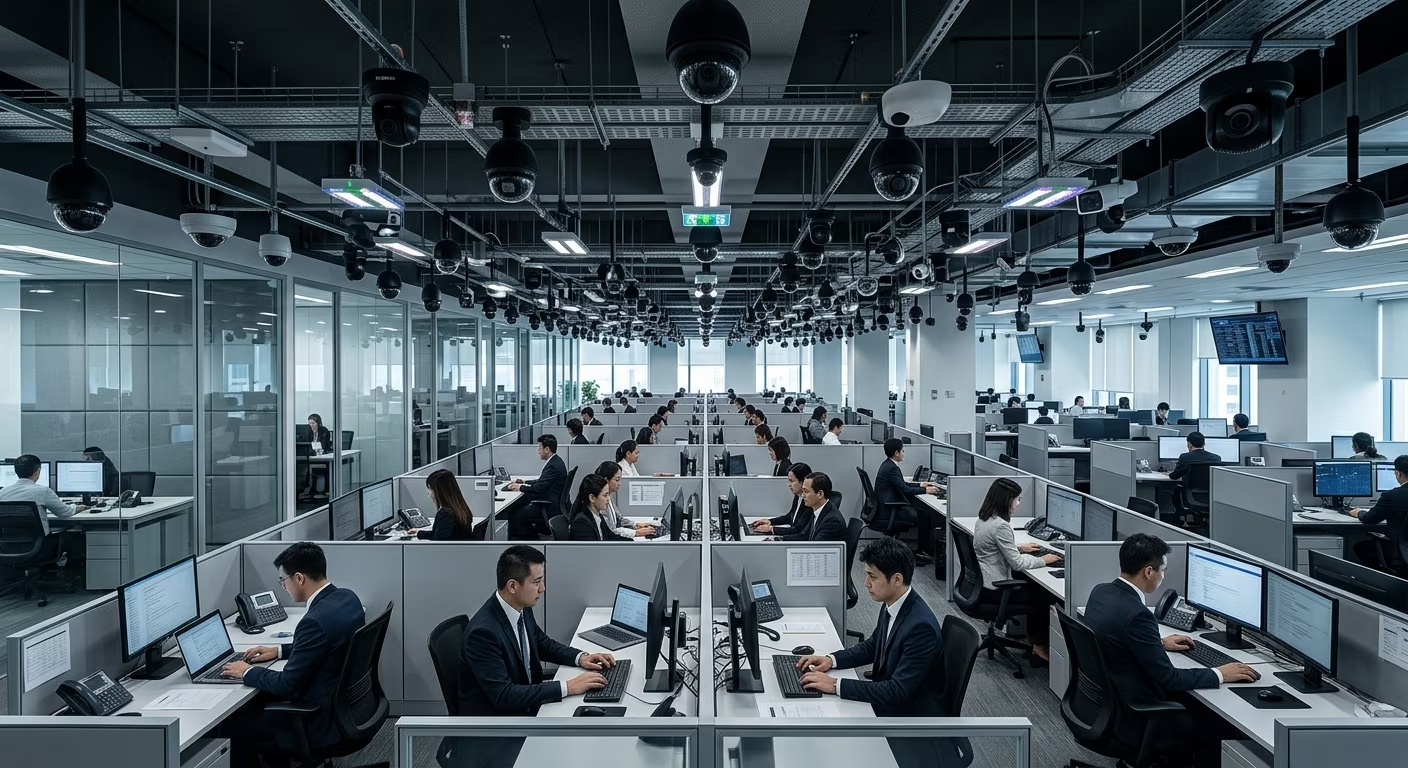
The Invisible Watcher: Welcome to the New Workplace
For decades, the physical boundary of the office provided a natural limitation on how closely an employer could watch their workforce. Management by walking around allowed supervisors to gauge productivity through brief visual checks, a system that, while imperfect, afforded workers a baseline level of autonomy and dignity. Today, that physical boundary has evaporated. The modern office has expanded into our living rooms, dining tables, and mobile devices, and unfortunately, so have our managers. The rapid integration of advanced tracking software—often colloquially termed “bossware”—has ushered in an era of unprecedented corporate surveillance, transforming the standard employer-employee dynamic into something resembling a digital panopticon.
The unchecked proliferation of these workplace surveillance technologies represents a profound shift in labor dynamics. What began as rudimentary time-tracking systems has evolved into a multi-billion-dollar industry built on the continuous extraction of worker data. Employers argue that these tools are necessary to maintain productivity, secure proprietary information, and streamline remote operations. However, the reality on the ground paints a much darker picture: one of eroded trust, systemic privacy violations, and a workforce suffering under the immense psychological weight of constant observation. As we navigate this heavily monitored landscape, we must critically examine whether the supposed benefits of total visibility are worth the cost of our fundamental right to privacy at work.
From Punch Cards to Algorithmic Overlords
The desire to measure and maximize labor efficiency is not a new phenomenon. During the industrial revolution, the time-punch card revolutionized factory management, reducing a worker’s value to the precise number of hours they spent on the assembly line. Later, Frederick Taylor’s principles of scientific management introduced the stopwatch into the workplace, breaking tasks down to the second to extract maximum output. Yet, these historical methods required physical proximity and immense administrative effort.
The turning point for modern surveillance arrived with the global shift toward remote work during the early 2020s. Faced with empty office buildings, many corporate leaders experienced a profound anxiety over unseen employees, accelerating the adoption of digital monitoring tools. According to investigations by major financial publications, the market for “tattleware” and office spyware exploded overnight, morphing from a niche IT security requirement into a mainstream management strategy. What was once framed as a temporary emergency measure to maintain operations during a global crisis has now been permanently integrated into standard business operations, even as employees return to hybrid or fully in-person schedules.
Peeling Back the Curtain: The Arsenal of Monitoring Technology
To understand the sheer scale of the privacy loss, one must examine the tools currently deployed across various industries. Modern bossware goes far beyond simple time-logging; it captures an intricate, microscopic portrait of an employee’s daily life.
Keystroke Logging and Screen Capture
Among the most invasive software are applications that track every single keystroke made on a company-issued device. These tools can capture personal passwords, private messages, and unedited drafts of communications. Coupled with automated screen capture—where the software takes random screenshots of a worker’s display every few minutes—employees are effectively denied any digital breathing room. The anxiety of knowing that a stray click onto a news website might be immortalized in a screenshot creates a persistent state of hyper-vigilance.
Biometric and Physical Surveillance
The surveillance net is not limited to desk workers. In logistics, delivery, and construction sectors, employees are frequently subjected to physical and biometric monitoring. Wearable devices measure heart rates, GPS systems track precise delivery routes to the second, and AI-powered dashboard cameras scan drivers’ faces for signs of fatigue or distraction. While often marketed under the guise of occupational health and safety, these tools generate massive repositories of sensitive biometric data, leaving workers vulnerable to automated disciplinary actions if they fail to meet algorithmically generated quotas.
Communication Scrubbing and Sentiment Analysis
Advanced artificial intelligence is now being deployed to analyze the tone and content of internal communications. Sentiment analysis algorithms scrub emails, direct messages, and video conference transcripts to gauge employee morale or flag potential dissent. This level of monitoring represents a chilling intrusion into the emotional lives of workers, effectively policing their attitudes and private frustrations in real-time.
Common Bossware Capabilities
| Technology Type | Data Collected | Primary Stated Purpose | Privacy Implication |
|---|---|---|---|
| Keystroke Tracking | Typing speed, active time, exact text typed | Productivity measurement | Captures personal passwords and private conversations |
| Screen Surveillance | Randomized screenshots, application usage logs | Time theft prevention | Exposes sensitive background information and personal files |
| Location Tracking | GPS coordinates, Wi-Fi triangulation | Asset tracking, attendance | Monitors off-the-clock movements and precise whereabouts |
| Sentiment Analysis | Tone of text, facial expressions via webcam | Employee engagement, safety | Policing of emotional states and natural human reactions |
The Psychological Toll on the Workforce
The consequences of pervasive monitoring extend far beyond abstract concepts of data privacy; they manifest as tangible psychological harms. Being watched continuously induces a phenomenon known as the Hawthorne Effect, where individuals alter their behavior simply because they know they are being observed. In the modern workplace, this translates to performative productivity. Workers find themselves continuously jiggling their computer mice, keeping screens awake, or randomly typing to satisfy the tracking software, rather than engaging in deep, meaningful work.
This relentless pressure cooker inevitably leads to elevated stress, anxiety, and burnout. When algorithms dictate bathroom breaks or flag employees for looking away from their screens to think, the workplace becomes inherently hostile. Furthermore, the loss of privacy strips away a worker’s dignity, implicitly communicating that they are fundamentally untrustworthy. Trust is the bedrock of any successful organization; when management replaces trust with surveillance, morale plummets, and employee turnover skyrockets.
There is also a profound chilling effect on collective action. When every message and movement is tracked, workers are significantly less likely to discuss labor conditions, report workplace harassment, or attempt to organize unions. The digital panopticon effectively silences dissent by ensuring that management is an invisible participant in every conversation.
Labor Rights vs. Employer Interests: The Evolving Legal Landscape
The rapid deployment of bossware has vastly outpaced the legal frameworks designed to protect workers. In the United States, federal labor laws established decades ago were not written with artificial intelligence or keystroke logging in mind. However, regulatory bodies are beginning to recognize the inherent dangers of unchecked surveillance.
The National Labor Relations Board (NLRB) has indicated a strong stance against electronic monitoring that infringes upon workers’ rights to organize and engage in protected concerted activities. Memorandums from the NLRB emphasize that intrusive surveillance technologies have a direct tendency to interfere with fundamental labor rights, signaling a critical push toward applying existing laws to modern digital practices. Similarly, federal entities like the Office of Science and Technology Policy (OSTP) have initiated comprehensive reviews regarding automated worker surveillance, seeking to understand its impact on safety and civil rights.
Despite these federal ripples, much of the legal burden currently rests on state legislatures. While some states have introduced laws requiring employers to disclose the use of electronic monitoring tools, disclosure alone is arguably insufficient. Knowing you are being watched does not mitigate the harm of the surveillance itself, especially when employment is entirely contingent on accepting the monitoring. True consent is an illusion when the alternative is losing one’s livelihood.
Restoring the Balance: An Ethical Path Forward
To reclaim privacy in the digital age, a comprehensive reimagining of workplace policies is urgently required. The conversation must shift from how employers can legally deploy tracking tools to whether they should use them at all. Organizations must prioritize human-centric management philosophies that evaluate performance based on actual outcomes and deliverables, rather than metrics of raw activity and screen time.
From a regulatory perspective, there is an immediate need for robust legislation that establishes strict boundaries on digital surveillance. Policy frameworks should enforce the principle of data minimization, ensuring employers only collect information that is strictly necessary for specific, legitimate business functions. Furthermore, blanket bans should be placed on the most invasive technologies, such as facial recognition for sentiment analysis or off-hours GPS tracking, which offer negligible business value at the cost of immense personal intrusion.
Transparency must also be mandatory and ongoing. Employees deserve clear, accessible documentation explaining exactly what data is being collected, how long it is stored, who has access to it, and how it informs management decisions. Furthermore, workers must be granted the right to appeal automated decisions made by algorithmic management systems, ensuring that human oversight remains the final arbiter of employment status and disciplinary action.
Conclusion
The nightmarish reality of modern workplace surveillance is not an inevitable byproduct of technological advancement; it is a conscious management choice. As artificial intelligence and monitoring software become increasingly sophisticated, the temptation for total corporate oversight will only grow. However, treating employees as mere data points to be optimized ignores the fundamental human elements of creativity, trust, and well-being that drive genuine innovation.
We stand at a critical crossroads concerning the future of labor and privacy. If we allow the current trajectory to continue unchallenged, the boundary between our professional obligations and our private lives will completely dissolve. It is imperative that workers, regulators, and ethical business leaders collaborate to establish strict safeguards, ensuring that the technology of the future is used to empower the workforce, rather than to shackle it in digital chains.
Frequently Asked Questions (FAQs)
What exactly is “bossware”?
Bossware is a term used to describe a broad category of employee monitoring and surveillance software. These tools are installed on corporate or personal devices to track an employee’s activities, often logging keystrokes, capturing screenshots, tracking idle time, and monitoring web browsing history.
Can my employer legally track my location?
In many jurisdictions, if you are using a company-issued device or driving a company vehicle, your employer can legally track your location during work hours. However, laws vary significantly by region, and tracking employees during their off-hours or on personal devices without explicit consent often violates privacy laws.
Does monitoring actually increase employee productivity?
Research indicates that while surveillance might enforce short-term compliance, it rarely boosts long-term productivity. In fact, constant monitoring often leads to “performative work” where employees focus on appearing busy to satisfy software metrics, rather than producing meaningful results. It is also heavily linked to increased burnout and decreased morale.
What can I do if I feel my workplace surveillance is abusive?
If you suspect that your employer’s monitoring practices violate labor laws or your employment contract, you can start by reviewing your company’s employee handbook and state privacy laws. You may also consult with a labor union representative or an employment lawyer to discuss potential infringements on your rights, especially if the surveillance interferes with your ability to organize or communicate about workplace conditions.
References
- Request for Information; Automated Worker Surveillance and Management — Office of Science and Technology Policy, Federal Register. 2023-05-03. https://www.federalregister.gov/documents/2023/05/03/2023-09353/request-for-information-automated-worker-surveillance-and-management
- NLRB General Counsel Issues Memo on Unlawful Electronic Surveillance and Automated Management Practices — National Labor Relations Board. 2022-10-31. https://www.nlrb.gov/news-outreach/news-story/nlrb-general-counsel-issues-memo-on-unlawful-electronic-surveillance-and
- GAO-25-107126, Digital Surveillance: Potential Effects on Workers and Roles of Federal Agencies — US Government Accountability Office. 2025-09-02. https://www.gao.gov/products/gao-25-107126
- The grim world of office spyware — Financial Times. 2023-01-28. https://www.ft.com/content/011cf874-566b-4e08-963a-bbdd27fa4b1b