
Postal Banking: 5.6M Unbanked Households And Policy Solutions
Could your local post office solve America's growing unbanked crisis?
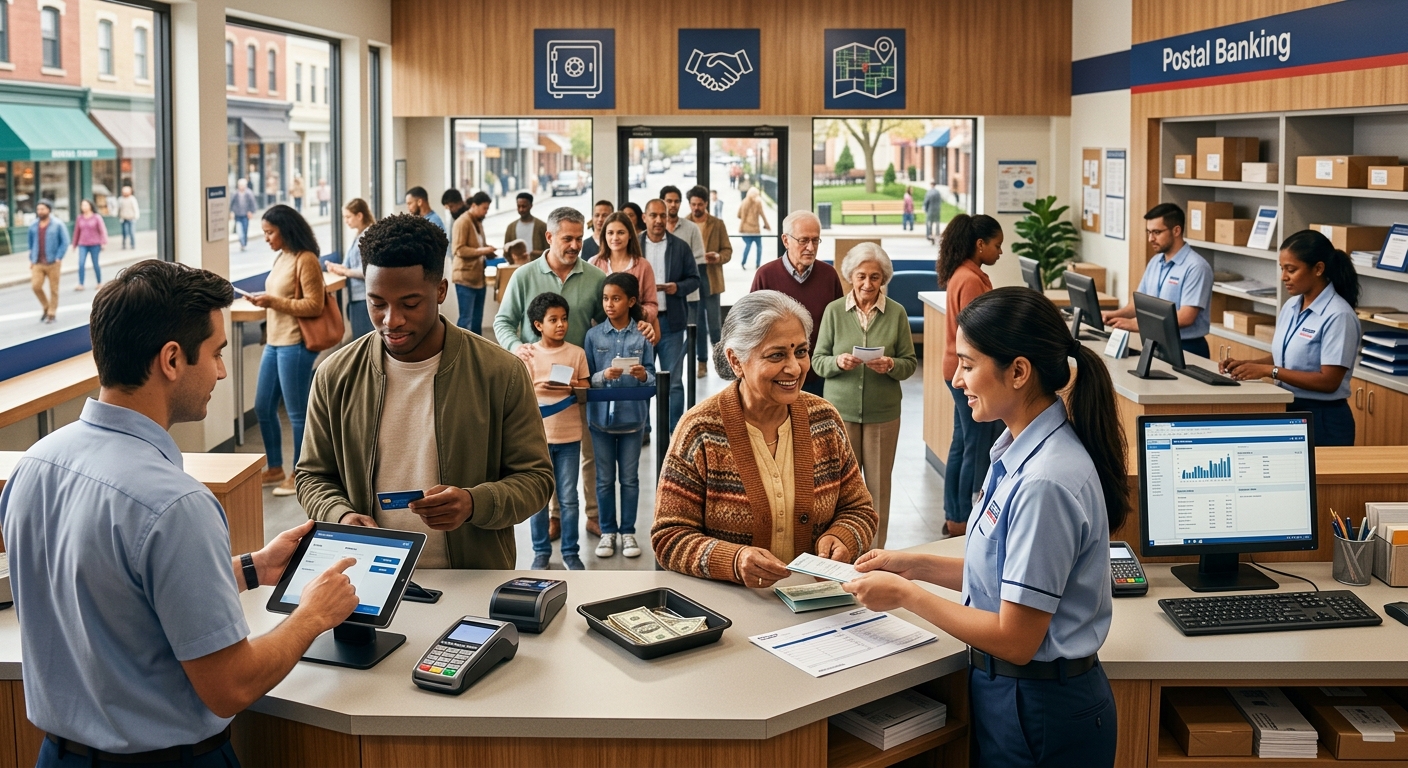
Access to fundamental financial services is often taken for granted in a modern economy dominated by direct deposits, mobile payment applications, and contactless credit cards. For the majority of citizens, keeping money in a secure account, acquiring a small loan, or simply cashing a paycheck is a seamless, virtually invisible process. However, beneath the surface of this digitized financial landscape lies a profound crisis of exclusion. Millions of individuals navigate the economy completely outside the traditional banking sector, relying instead on a costly, fragmented network of alternative financial services. As financial institutions increasingly retreat from low-income and rural areas, a powerful, historically proven solution is gaining renewed traction among economists and policymakers: utilizing the universal infrastructure of the local post office to provide basic banking services.
The Hidden Crisis of Bank Deserts in Modern America
The contemporary financial landscape has grown increasingly centralized and profit-driven, leading to the rapid proliferation of “bank deserts.” These are geographic areas, both urban and rural, where commercial banks have shuttered their physical branches. Following the 2008 financial crisis, the consolidation of massive national banks accelerated this trend. Branches in lower-income neighborhoods and sparsely populated rural counties were deemed insufficiently profitable and systematically closed, leaving millions of residents without localized access to financial institutions.
The statistical reality of this exclusion is stark. According to the 2023 FDIC National Survey of Unbanked and Underbanked Households, approximately 4.2 percent of U.S. households—representing about 5.6 million households—remain completely unbanked. This means no one in the home possesses a basic checking or savings account. An even larger demographic falls into the category of “underbanked,” possessing an account but still heavily relying on alternative financial products like money orders, rent-to-own services, or payday loans to survive. When conventional banks retreat, marginalized communities are severed from the foundational tools required for economic stability and upward mobility, forced instead into a shadow economy of high-fee services.
The Heavy Price Tag of Being Unbanked
Predatory Lenders and the Cycle of Debt
The absence of traditional banking options does not eliminate the need for financial services; it simply creates a vacuum that predatory industries are eager to fill. Without a bank account, an individual cannot easily cash a paycheck, securely store savings, or access affordable credit in the event of an emergency. Instead, they must turn to storefront check cashers, title loan companies, and payday lenders. These alternative financial providers are notorious for imposing exorbitant fees and punitive interest rates that trap vulnerable individuals in endless cycles of debt.
A comprehensive report by the United States Postal Service Office of Inspector General (USPS OIG) highlighted the staggering financial toll of this dynamic, revealing that the average underserved household spends roughly $2,412 annually on fees and interest for alternative financial services. For families already living on the margins, losing nearly ten percent of their income merely to access their own money is devastating. Payday loans, in particular, frequently carry annualized percentage rates (APRs) exceeding 400 percent. When borrowers cannot repay the loan within the brief window provided, they are forced to “roll over” the debt, incurring additional fees that quickly surpass the original loan amount. This dynamic essentially criminalizes poverty, making basic economic survival disproportionately expensive for those who can least afford it.
What Exactly is Postal Banking? A Retrospective Look
The 1911–1966 Era of U.S. Postal Savings
While the concept of receiving a loan or opening a savings account at the post office might sound radical to modern sensibilities, it is deeply rooted in American history. From 1911 to 1966, the United States successfully operated the Postal Savings System. This program was initially established to provide a secure depository for immigrants who mistrusted commercial banks following a series of financial panics, and to bring cash out of hiding to stabilize the national economy.
During its peak, particularly during the Great Depression when faith in private financial institutions plummeted, the Postal Savings System held billions of dollars in deposits. It provided a completely reliable, government-backed haven for the savings of ordinary workers. The system eventually declined and was dissolved in the 1960s, largely due to the establishment of the Federal Deposit Insurance Corporation (FDIC), which successfully restored public trust in commercial banks, alongside the rise of higher-yield private savings options. However, as the contemporary banking sector increasingly fails to serve low-income populations, the historical precedent of postal banking demonstrates that the government possesses the capacity to successfully intermediate public finance.
Mechanics of a Modern Postal Financial Framework
Services the USPS Could Offer Today
A modern postal banking initiative would not require the United States Postal Service (USPS) to transform into a high-risk commercial lending giant or investment firm. Rather, advocates propose a streamlined suite of basic, low-cost financial utilities tailored to the needs of the unbanked. These services would serve as a public option, ensuring baseline financial inclusion without seeking aggressive profit margins.
- Check Cashing and Bill Pay: Allowing individuals to cash payroll or government checks for a flat, minimal fee, bypassing the predatory rates of independent check cashers.
- Small-Dollar Loans: Offering modest, short-term loans (e.g., $500) at reasonable interest rates to help families navigate sudden emergencies like car repairs or medical bills without resorting to payday lenders.
- Basic Savings and Checking Accounts: Providing simple accounts with no minimum balance requirements and no hidden overdraft fees.
- ATM Access and Wire Transfers: Facilitating secure, low-cost domestic and international money transfers, crucial for immigrant communities sending remittances.
Comparing Financial Landscapes
| Feature | Traditional Commercial Banks | Alternative Lenders (Payday/Check Cashers) | Proposed Postal Banking |
|---|---|---|---|
| Target Demographic | Middle to upper-income earners, large businesses | Low-income, unbanked, credit-invisible individuals | Universal access, focusing on underserved communities |
| Fee Structure | High overdraft fees, minimum balance requirements | Exorbitant flat fees, massive APRs (often 300%+ ) | Low, transparent flat fees covering operational costs |
| Accessibility | Declining physical presence in rural/urban areas | Concentrated heavily in low-income neighborhoods | Ubiquitous presence via 30,000+ local post offices |
The Infrastructure Advantage: Why the Post Office?
The primary argument for integrating financial services into the postal system is unparalleled infrastructure. The USPS operates an expansive physical network of over 30,000 retail locations across the country, reaching from the most remote rural outposts to the densest urban neighborhoods. In many rural counties and inner-city communities where no commercial bank branch exists, there is almost always a post office. Replicating this physical footprint from scratch would cost billions of dollars, but the USPS already maintains it.
Furthermore, the Postal Service benefits from a profound level of public trust. Historically, the institution is viewed as a reliable, non-predatory entity dedicated to public service rather than shareholder enrichment. For individuals who have been marginalized, misled, or financially burned by the hidden fees of commercial banks, the familiarity and stability of a local postal worker provide a foundation of trust essential for financial engagement.
Dismantling Systemic Inequities and the Racial Wealth Gap
Financial exclusion is not distributed equally. It is deeply intertwined with broader systemic inequities, particularly race and geography. FDIC data consistently reveals that unbanked rates among Black, Hispanic, and Indigenous households are several times higher than those of white households. This disparity is not a coincidence but the legacy of historical practices like redlining, discriminatory lending, and systemic wealth extraction.
When marginalized communities are disproportionately forced to rely on predatory lenders, the resulting financial drain aggressively widens the racial wealth gap. Wealth cannot be accumulated or passed down when a significant portion of an individual’s income is siphoned off by check-cashing fees and exorbitant loan interest. Reviving postal banking represents a tangible, structural intervention to halt this wealth extraction. By providing a safe, accessible entry point into the financial system, a postal public option would empower communities of color to retain their earnings, build savings, and generate long-term economic stability.
Challenges, Roadblocks, and Criticisms
Despite its potential, reviving postal banking faces substantial opposition and logistical hurdles. Unsurprisingly, the most vocal resistance emanates from the financial sector. Traditional banking associations argue that the government should not compete with private enterprise, while the multi-billion-dollar payday lending industry lobbies aggressively against any public alternative that threatens its business model.
Logistically, critics point out that the USPS currently faces its own severe financial and operational challenges, primarily driven by declining First-Class Mail volumes and burdensome pre-funding mandates for retiree healthcare. Skeptics argue that burdening an already strained agency with the complexities of financial regulation, cybersecurity for digital banking, and loan underwriting could exacerbate its organizational struggles. Advocates counter that, historically, financial services have been a highly profitable venture for international postal systems, and introducing these services in the U.S. could generate crucial supplementary revenue to stabilize the USPS.
Frequently Asked Questions (FAQs)
What is the primary goal of postal banking?
The primary goal is to ensure universal financial inclusion by offering fundamental, low-cost banking services—such as check cashing, small savings accounts, and affordable micro-loans—through the existing network of U.S. post offices, targeting the millions of Americans abandoned by commercial banks.
Why did the U.S. stop offering postal banking in 1966?
The original Postal Savings System was phased out largely because commercial banks became highly secure after the introduction of FDIC deposit insurance in the 1930s. As private banks began offering higher interest rates on savings accounts post-World War II, public reliance on the postal system naturally dwindled.
How would postal banking help combat poverty?
By eliminating the need to use predatory payday lenders and check-cashing storefronts. Underserved households currently spend thousands of dollars annually on exorbitant financial fees. Postal banking would provide a not-for-profit alternative, allowing individuals to keep their hard-earned money and begin building wealth.
Can the Postal Service legally offer banking services?
Currently, the USPS has limited legal authority to offer expansive financial products without congressional approval. While they can and do offer money orders, introducing loans or official savings accounts requires legislative action. Several bills have been proposed in Congress to explicitly grant this authority, though none have yet passed into law.
Conclusion
The persistence of financial exclusion in one of the wealthiest nations on earth highlights a profound market failure. As commercial banks continue to prioritize high-net-worth clients and withdraw from low-income communities, the burden falls disproportionately on vulnerable populations trapped by predatory lenders. Reviving postal banking is not an archaic concept, but rather a pragmatic, structurally sound public policy solution. By leveraging the unparalleled infrastructure and public trust of the United States Postal Service, policymakers have the opportunity to democratize finance, foster economic equity, and finally close the door on the poverty traps that have hindered marginalized communities for generations.
References
- 2023 FDIC National Survey of Unbanked and Underbanked Households — Federal Deposit Insurance Corporation (FDIC). 2024-11-14. https://www.fdic.gov/analysis/household-survey
- Providing Non-Bank Financial Services for the Underserved — United States Postal Service Office of Inspector General. 2014-01-27. https://www.uspsoig.gov/reports/white-papers/providing-non-bank-financial-services-underserved
- A Short History of Postal Banking — Mehrsa Baradaran, Digital Commons @ Georgia Law. 2018. https://digitalcommons.law.uga.edu/fac_artchop/1202/
Similar Articles








Read full bio of Sneha Tete


