
Rethinking Guantanamo: The Illusion of Security
Unpacking the legal and moral consequences of normalizing indefinite detention.
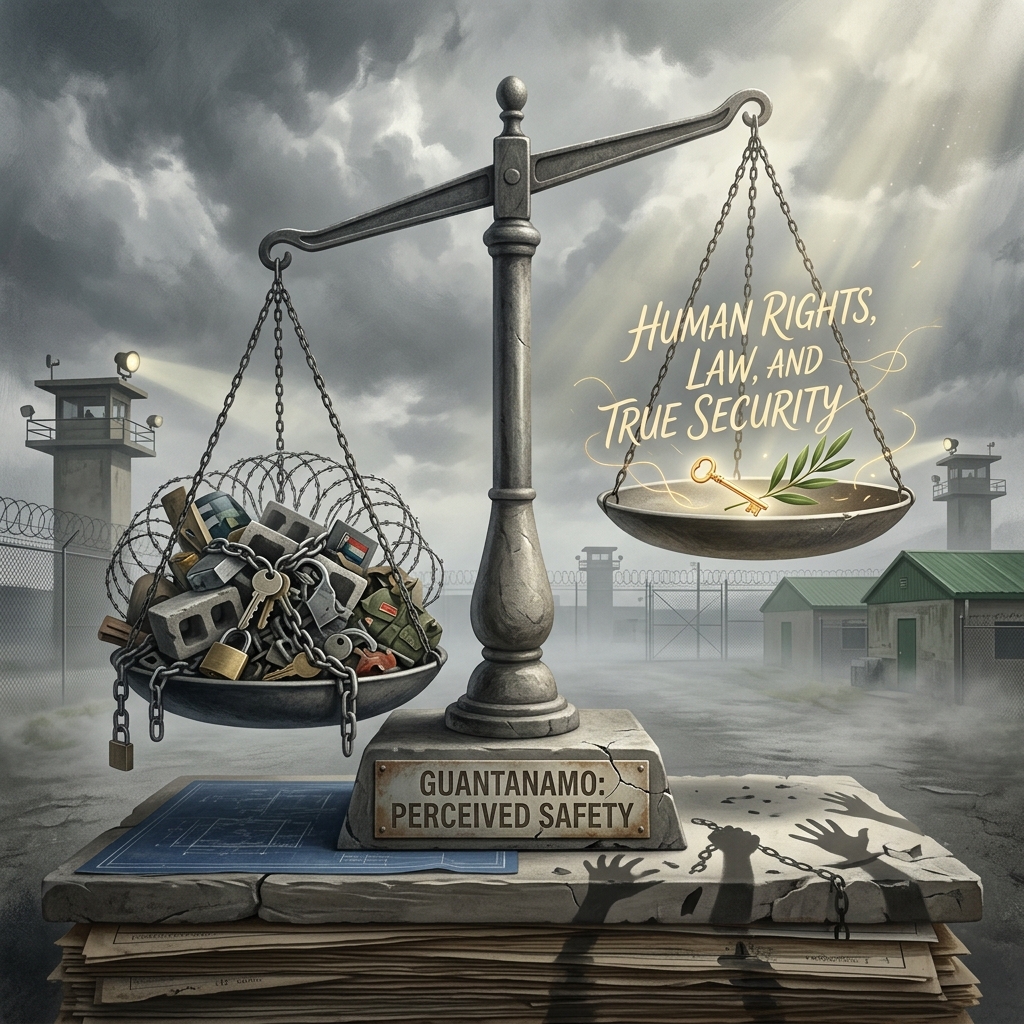
Beyond the Horizon of Due Process: Unpacking the Normalized State of Guantanamo Bay
For over two decades, the United States Naval Station at Guantanamo Bay, Cuba, has occupied a unique, paradoxical space in the American consciousness. What began in the immediate, chaotic aftermath of the September 11, 2001 terrorist attacks as a temporary detention center has quietly calcified into a permanent fixture of the U.S. national security apparatus. The initial shock and widespread outcry from civil liberties advocates regarding extrajudicial detentions gradually gave way to a troubling societal apathy. We have, in many ways, learned to stop worrying about the legal anomalies of Guantanamo and simply accept its shadow over our democratic ideals. However, accepting the normalization of indefinite detention and parallel military justice systems poses a severe threat to the foundational principles of the rule of law. This article explores the evolution of this controversial facility, the enduring human rights crisis it represents, the inefficiencies of its military commissions, and the profound societal and economic costs of maintaining a legal black hole in the name of safety.
The Genesis of a Legal Black Hole
Following the unprecedented tragedies of 9/11, the executive branch sought maximum flexibility to interrogate and hold individuals suspected of terrorism. The geographic selection of the naval base in Cuba was not merely a matter of logistical convenience; it was a deliberate legal strategy. By placing detainees outside of sovereign U.S. territory, the architects of this policy aimed to place them beyond the reach of the United States Constitution and the federal judiciary, particularly the fundamental right of habeas corpus.
The initial years saw hundreds of individuals—captured primarily in Afghanistan and Pakistan—transported to the facility, labeled as “enemy combatants” rather than prisoners of war. This novel classification was specifically designed to bypass the protections guaranteed by the Geneva Conventions. Over time, as the immediate threat environment evolved, the rationale for keeping the facility operational shifted. Successive administrations faced immense political hurdles, congressional roadblocks, and fear-mongering narratives that made closing the detention center politically toxic. As a result, the temporary measure became an entrenched reality, fundamentally altering the trajectory of American jurisprudence and setting a dangerous global precedent for the treatment of detainees in asymmetric conflicts.
Military Commissions Versus the Federal Judiciary
At the heart of the Guantanamo controversy is the system of military commissions established to try detainees. Designed as a parallel track to the established Article III federal court system, these commissions have proven to be exceptionally sluggish, legally fraught, and deeply controversial. The Military Commissions Act, which provides the statutory basis for these proceedings, has faced continuous legal challenges regarding the admissibility of evidence, the use of classified information, and, most alarmingly, the introduction of statements obtained through coercion or torture.
In stark contrast to the federal courts, which have successfully and securely prosecuted hundreds of international terrorism cases since 2001, the military commissions have yielded a dismal track record. Consider the key differences between the two systems:
- Evidentiary Standards: Federal courts operate under strict rules of evidence that protect defendants from hearsay and coerced testimonies. Military commissions operate under more relaxed rules, often struggling with how to handle classified intelligence without violating the accused’s right to a fair trial.
- Precedent and Experience: U.S. federal judges possess decades of established precedent for handling complex criminal conspiracies, whereas military commissions are constantly litigating the very rules by which they operate, causing years of pre-trial delays.
- Transparency: Regular courts are open to the public, fostering accountability. Military commissions are geographically isolated, subject to strict media coverage rules, and frequently rely on closed-circuit feeds and classified sessions, severely limiting public oversight.
The persistent failure to bring individuals to trial in a timely, transparent manner not only denies justice to the accused but also to the families of the victims of terrorism, who have waited decades for resolution.
The Ongoing Human Rights Emergency
Beyond the legal mechanics, Guantanamo Bay represents a profound, ongoing human rights emergency. International bodies, including the United Nations and the Inter-American Commission on Human Rights, have repeatedly condemned the facility. According to UN independent human rights experts, the continuing practice of indefinite detention without charge or trial constitutes arbitrary detention and violates fundamental international human rights law.
For the men who remain incarcerated, the physical and psychological toll is devastating. Many detainees have been held for over twenty years without ever facing formal charges. They exist in a state of virtual legal limbo, isolated from their families and the outside world. The aging prison population is now facing severe health vulnerabilities, exacerbated by the trauma of their initial captures and, in many documented cases, their subjection to “enhanced interrogation techniques” that independent observers categorize as torture. The prolonged uncertainty of indefinite detention—not knowing if or when one will ever be released or tried—is recognized by mental health professionals and human rights advocates as a form of cruel, inhuman, and degrading treatment. The facility stands as a stark contradiction to the United States’ historical role as a global champion of human rights.
The Economic Realities: A Monumental Burden on Taxpayers
The moral and legal arguments against the detention center are frequently met with national security rhetoric, but the economic realities of maintaining Guantanamo Bay are staggeringly indefensible. It is, by all available metrics, the most expensive prison facility in the world. Operating an isolated, high-security detention center on a naval base requires immense logistical support, including the continuous deployment of hundreds of military personnel, private contractors, and specialized medical teams to care for an aging, shrinking detainee population.
A comparative look at the financial burden highlights the extreme inefficiency of this system:
| Metric | Guantanamo Bay Detention Facility | U.S. Federal Supermax Prison (e.g., ADX Florence) |
|---|---|---|
| Annual Cost Per Detainee/Inmate | Approximately $2.7 Million to over $13 Million (depending on population size) | Approximately $78,000 to $85,000 |
| Judicial Efficiency | Decades of pre-trial hearings; minimal convictions. | Efficient, timely processing of complex terrorism cases. |
| Infrastructure Status | Aging “temporary” facilities requiring constant, costly upgrades and maintenance. | Permanent, highly secure facilities integrated into the federal system. |
The hundreds of millions of taxpayer dollars spent annually to sustain this parallel justice system divert crucial resources away from authentic national security priorities, military readiness, and vital domestic programs. The refusal to utilize the dramatically more cost-effective and legally sound federal prison system underscores how politics, rather than pragmatism or security, dictates the continued operation of the facility.
The Psychology of Apathy: How We Learned to Stop Worrying
Perhaps the most alarming aspect of the Guantanamo legacy is not the facility itself, but the American public’s gradual acceptance of it. In the early 2000s, the concept of holding individuals indefinitely without trial sparked fierce domestic and international debate. Major protests were held, legal scholars penned vehement rebukes, and the Supreme Court weighed in on multiple occasions to assert that the executive branch could not operate entirely free from judicial scrutiny.
Yet, over two decades later, the outrage has largely dissipated. This phenomenon can be attributed to several factors. First, the geographic isolation of the base keeps the reality of indefinite detention out of sight and, consequently, out of mind for the average citizen. Second, the framing of the issue as a zero-sum game between civil liberties and national survival proved highly effective in shutting down critical discourse. Politicians who advocated for closing the facility were routinely branded as “soft on terror.”
Furthermore, the complexity of the military commission process creates a barrier to public understanding. When legal proceedings are mired in classification disputes and procedural arcana, media coverage naturally wanes. This collective apathy is dangerous. When a society learns to tolerate exceptions to its highest democratic principles—due process, habeas corpus, and the prohibition of cruel punishment—those exceptions risk becoming the rule. The normalization of Guantanamo lowers the threshold for future overreaches of executive power.
Charting a Path Forward: Reclaiming Democratic Values
Closing the detention center at Guantanamo Bay is not merely a logistical challenge; it is a moral imperative necessary for restoring the integrity of the American justice system. Achieving this requires a multifaceted approach, characterized by political courage and a renewed commitment to the rule of law.
First, the government must expedite the transfer of detainees who have already been cleared for release by military and intelligence agencies. Keeping men imprisoned years after they have been deemed not to pose a significant security threat is an egregious violation of justice. Diplomatic efforts must be intensified to repatriate these individuals or resettle them in secure third-party countries where their human rights will be respected.
Second, for those who are legitimately accused of crimes, the administration must abandon the fundamentally flawed military commissions and transfer their cases to Article III federal courts. The federal judiciary has proven unequivocally capable of handling classified evidence under the Classified Information Procedures Act (CIPA) and has successfully secured convictions against some of the most dangerous international terrorists in history.
Finally, closing Guantanamo requires a fundamental shift in the national security narrative. Leaders must articulate that adherence to constitutional principles and international human rights law does not weaken the state; it strengthens it. True security is achieved not through the projection of unconstrained power, but through the consistent application of justice. By finally closing this chapter, the United States can begin to repair its global standing and reaffirm its commitment to the democratic ideals it claims to champion.
Frequently Asked Questions (FAQs)
What was the original purpose of the Guantanamo Bay detention camp?
The detention camp was established in January 2002 to hold individuals suspected of involvement in international terrorism, particularly those associated with Al-Qaeda and the Taliban, outside of the standard jurisdiction of the U.S. federal court system.
Why are military commissions used instead of federal courts?
Military commissions were established with the intention of handling wartime offenses and protecting classified intelligence. However, critics argue they were primarily designed to secure convictions more easily by using relaxed evidentiary standards, a strategy that has largely backfired due to endless legal challenges, appeals, and concerns over due process.
Is it legal to hold someone indefinitely without trial?
International human rights bodies, including the United Nations, maintain that prolonged, indefinite detention without trial is arbitrary and violates international law and the Geneva Conventions. The U.S. Supreme Court has ruled that detainees have the right to challenge their detention (habeas corpus), though the practical application of this right remains heavily restricted in practice.
How much does it cost to operate the prison facility?
It is widely considered the most expensive prison in the world. Reports from government accountability agencies and congressional committees estimate that the cost per detainee ranges from $2.7 million to over $13 million annually, far exceeding the cost of the most secure federal prisons within the United States.
Why hasn’t the facility been closed yet?
Closure has been persistently obstructed by domestic political opposition, legislative restrictions passed by Congress that prevent the transfer of detainees to U.S. soil for any reason, and the complex diplomatic challenges of repatriating or resettling detainees to third countries.
References
- Close ‘disgraceful’ Guantánamo camp – UN experts urge incoming US administration — UN Office of the High Commissioner for Human Rights (OHCHR). 2021-01-11. https://www.ohchr.org/en/press-releases/2021/01/close-disgraceful-guantanamo-camp-un-experts-urge-incoming-us-administration
- Guantánamo Bay: Accessing Detainee Medical Records as Part of Military Commissions’ Proceedings — U.S. Government Accountability Office (GAO). 2022-06-28. https://www.gao.gov/products/gao-22-105021
- The Cost of Detention at Guantanamo Bay — House Armed Services Committee – Democrats. 2013-06-05. https://democrats-armedservices.house.gov/news/press-releases/the-cost-of-detention-at-guantanamo-bay
- Submission of the Government of the United States to the UN Committee Against Torture — U.S. Department of State. https://2009-2017.state.gov/j/drl/rls/233040.htm
Similar Articles








Read full bio of Sneha Tete


