
Rethinking Campus Safety: The Call for Police Divestment
Exploring the movement to replace armed campus police with holistic support.
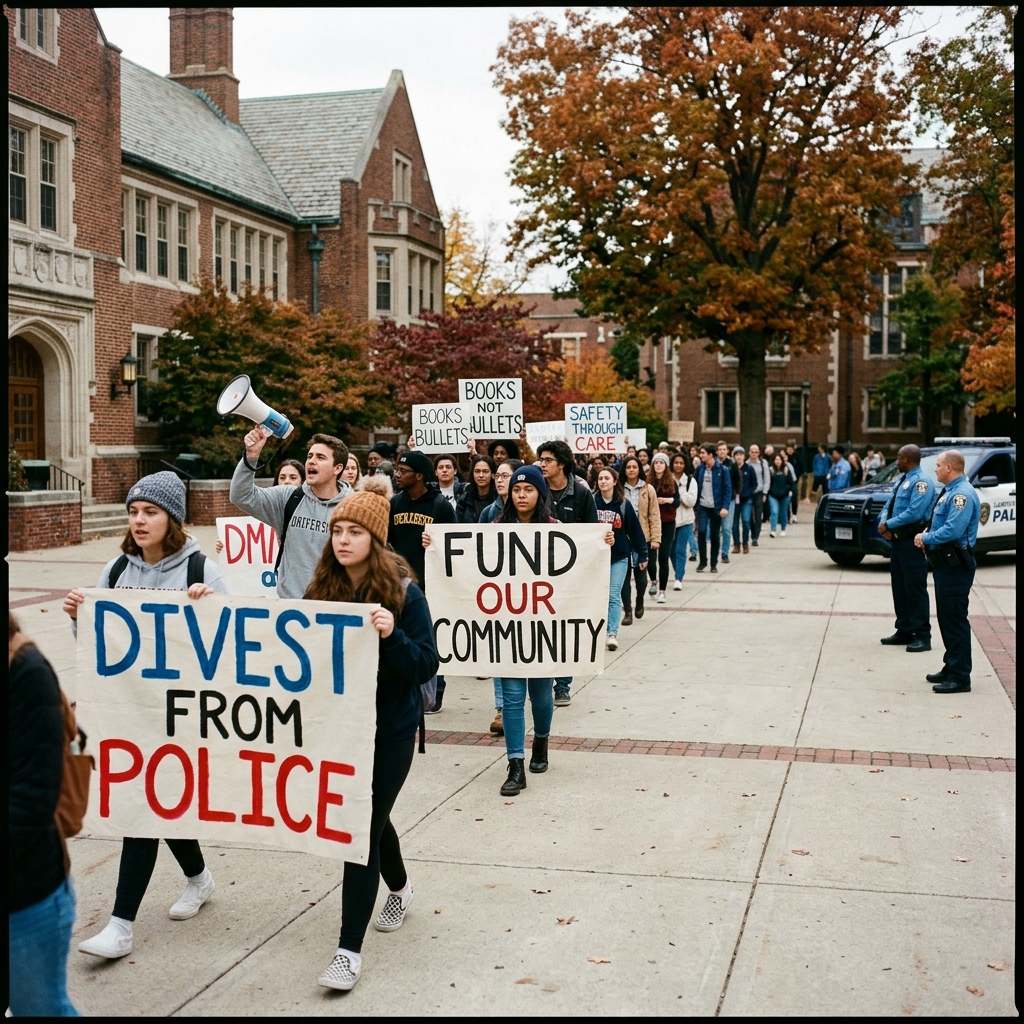
Rethinking Campus Safety: The Movement to Reevaluate University Policing
The idyllic image of the American college campus—often associated with lush quads, brick libraries, and intellectual freedom—stands in stark contrast to the flashing lights of police cruisers that frequently patrol these spaces. In recent years, a critical dialogue has emerged surrounding the role of armed law enforcement within educational institutions. As the broader national conversation on criminal justice reform and police accountability intensifies, universities are facing mounting pressure to scrutinize their own security apparatuses.
For decades, higher education institutions have heavily invested in private, sworn law enforcement agencies to maintain order and protect their populations. However, a growing coalition of students, faculty, and civil rights advocates argue that this reliance on traditional policing is fundamentally at odds with the educational mission. The movement for university police divestment seeks not only to reduce the footprint of armed officers on campus but to fundamentally redefine what it means to keep a community safe, prioritizing holistic support over punitive enforcement.
The Evolution and Expansion of Campus Law Enforcement
To understand the current push for divestment, one must first examine how campus police departments evolved into their modern, often militarized forms. In the early to mid-twentieth century, campus security primarily consisted of unarmed night watchmen and building monitors. Their duties were largely administrative, focusing on locking doors, managing parking, and ensuring fire safety.
However, the late 1960s and early 1970s marked a pivotal shift. In response to widespread civil rights demonstrations, anti-war protests, and student activism, university administrators sought greater control over their campuses. Over the subsequent decades, these departments grew exponentially in both size and scope. Today, many university police departments mirror municipal police forces in structure, training, and equipment. According to data from the U.S. Department of Justice’s Bureau of Justice Statistics, the vast majority of four-year universities with 2,500 or more students employ sworn police officers who carry firearms and possess full arrest powers.
The expansion of these forces has transformed campuses into heavily surveilled environments, fundamentally altering the dynamic between the institution and its student body. Militarization has been fueled by federal grants supplying tactical gear and specialized weaponry. As these departments have grown, their budgets have consistently consumed a significant portion of university resources—funds that advocates argue could be better spent on direct student services.
The Clery Act and Institutional Risk Management
The Jeanne Clery Disclosure of Campus Security Policy and Campus Crime Statistics Act, signed into federal law in 1990, fundamentally altered the landscape of university safety. Enacted following the tragic rape and murder of a student at Lehigh University, the Clery Act mandates that all colleges and universities participating in federal financial aid programs maintain and disclose detailed information about crime on and near their respective campuses.
While the law was specifically designed to increase transparency and empower students with vital safety information, it inadvertently catalyzed the further professionalization and expansion of campus police departments. The institutional pressure to publicly report crime statistics created a hyper-focus on traditional, visible policing metrics—such as arrests, citations, and high-visibility patrols—often at the expense of investing in preventative, community-based safety measures. Consequently, the Clery Act, while rooted in a genuine demand for institutional accountability and student protection, provided the administrative justification for the robust, heavily armed campus police forces that exist today, complicating modern student efforts to defund or scale back these very departments.
Jurisdictional Overlap and Accountability Challenges
One of the most complex and troubling aspects of modern campus policing is the blurred line between university and municipal jurisdictions. Campus police officers frequently do not confine their patrols to the geographical boundaries of the university. Through mutual aid agreements and memorandums of understanding with local city or state police departments, university officers often hold jurisdiction over surrounding neighborhoods, off-campus housing, and adjacent commercial districts.
This extensive reach means that campus police regularly interact with non-student community members, often operating in historically marginalized neighborhoods that border large institutions. The overlap creates a confusing web of legal authority where it becomes difficult to determine who is policing whom, and which agency holds ultimate responsibility for officer conduct.
Furthermore, accountability mechanisms for campus police are notoriously opaque and difficult to navigate. While public university police departments are generally subject to state open records laws, private institutions often claim complete exemption from the Freedom of Information Act (FOIA). This lack of transparency shields private university forces from public scrutiny, making it nearly impossible to obtain use-of-force reports or demographic data on student arrests. Without robust, independent oversight, patterns of misconduct and civil rights violations can remain hidden behind closed campus doors.
The Disproportionate Impact on Marginalized Students
The deployment of armed law enforcement on college campuses does not impact all students equally. Much like municipal policing, campus law enforcement disproportionately affects Black, Indigenous, and People of Color (BIPOC) students. Reports of racial profiling, unwarranted stops, and excessive scrutiny are commonplace among minority students simply navigating their own campuses.
Moreover, the intersection of mental health and campus policing presents a critical, life-threatening danger. The pressures of higher education—combined with financial stress, social isolation, and rigorous academic demands—contribute to a rising mental health crisis among college students nationwide. When students experience psychological distress or suicidal ideation, the default institutional response is frequently to dispatch armed campus police officers.
Having armed law enforcement serve as the primary first responders to mental health crises is a proven recipe for tragic escalation. Police officers are generally trained to command situations, demand immediate compliance, and enforce the law—tactics that can deeply traumatize individuals who are experiencing a psychiatric emergency. In some documented instances, these encounters have resulted in the unnecessary use of physical force, involuntary hospitalizations that permanently disrupt academic progress, or even fatal outcomes. The movement for divestment argues passionately that behavioral health emergencies require the nuanced expertise of trained crisis counselors and social workers, not the intimidating presence of firearms and handcuffs.
Student Activism Driving Institutional Change
The call to divest from campus policing is not a new phenomenon, but it has gained unprecedented momentum in recent years, largely driven by relentless, highly organized student activism. Building on the broader national uprisings for racial justice and criminal justice reform, student organizers have successfully localized the demand to defund the police, focusing their efforts directly on the institutions they inhabit.
In the spring of 2024, college campuses across the United States saw a massive surge in coordinated protests. Students established encampments, organized sit-ins, and occupied administrative buildings to demand divestment from various entities, prominently including military-industrial complex ties and campus police forces. The Associated Press reported that thousands of students were arrested during these intense demonstrations at prominent institutions. In many of these instances, university administrators chose to rely heavily on the very police forces being protested to forcibly dismantle the peaceful encampments. They present administrators with comprehensive, actionable demands: severing contracts with local municipal police departments, fully disarming campus officers, drastically reducing police operating budgets, and reinvesting those diverted funds into community-centered safety and support networks.
The Shift Toward Comprehensive Student Support
If universities choose to divest from armed policing, how do they maintain a genuinely safe environment? The answer lies in shifting the institutional paradigm from punitive law enforcement to proactive community care. Advocates for police divestment propose holistic safety models that address the root causes of harm, conflict, and vulnerability, rather than simply responding to isolated incidents with state-sanctioned force.
A comprehensive student support model recognizes that true campus safety comes from ensuring basic human needs are consistently met. This means reallocating police funds to provide highly accessible mental health services, emergency housing for students facing unexpected homelessness, reliable food security programs, and robust conflict resolution centers. Many forward-thinking institutions are already exploring non-police crisis response teams. Modeled after successful municipal programs, these specialized university teams consist entirely of unarmed medics, mental health professionals, and trained peer counselors who are explicitly dispatched to non-violent emergencies, student welfare checks, and noise complaints. By completely removing the looming threat of arrest or armed confrontation, these non-police teams can effectively de-escalate tense situations and connect struggling students directly with the long-term resources they desperately need.
Comparing Traditional and Community-Based Safety Models
To visualize this transition, it is helpful to compare the stark differences in approach:
| Feature | Traditional Campus Policing | Holistic Community-Based Safety |
|---|---|---|
| First Responders | Armed, sworn police officers. | Trained mental health professionals, social workers, and peer mediators. |
| Approach to Conflict | Punitive enforcement, citations, and arrests. | Restorative justice, mediation, and root-cause intervention. |
| Budget Focus | Weapons, tactical gear, surveillance tech, and officer salaries. | Counseling centers, emergency housing, food pantries, and educational resources. |
| Mental Health Crises | Potential escalation, involuntary holds, use of force. | De-escalation, psychological support, and ongoing care coordination. |
Frequently Asked Questions (FAQs)
What does it mean to divest from campus police?
Divestment involves intentionally reducing the budget, scope, and physical presence of armed law enforcement on a college campus. It represents a strategic reallocation of financial resources away from punitive policing systems and toward services that directly support student well-being, such as mental health care, affordable housing, and educational resources.
How do universities handle emergencies without armed officers?
Proponents of divestment advocate for tiered emergency response systems. For mental health crises, substance abuse issues, or interpersonal conflicts, unarmed crisis response teams comprising social workers and medical professionals are dispatched. For severe emergencies involving a direct, active threat of violence, specialized external teams can be utilized, but the everyday patrol and presence of armed officers is eliminated.
Are campus police different from local city police?
In many practical ways, they are identical. At most public universities and many private institutions, campus police are sworn state officers with full, unrestricted powers of arrest. They carry firearms, drive marked police cruisers, and undergo the same academy training as municipal officers. However, they are directly employed, funded, and overseen by the educational institution itself.
Conclusion
The growing movement to divest from university policing represents a profound, necessary reimagining of what a safe and supportive educational environment should actually look like. By genuinely listening to the voices of marginalized students and critically examining the massive footprint of campus police, universities have a unique opportunity to lead the nation in redefining public safety. True security on a college campus is not achieved through pervasive surveillance and the constant threat of force, but through robust, unwavering investment in the health, dignity, and intellectual potential of every single student.
References
- College protests: More than 2,100 arrested during pro-Palestinian protests on US college campuses — Associated Press. 2024-05-02. https://apnews.com/article/college-protests-palestinian-israel-arrests-eb4e019a58b29f79b69b596e1a49938c
- Survey of Campus Law Enforcement Agencies [United States] Series — Bureau of Justice Statistics, U.S. Department of Justice. 2015-08-13. https://catalog.data.gov/dataset/survey-of-campus-law-enforcement-agencies-united-states-series
- Policing the College Campus: History, Race, and Law — University of Florida Law Scholarship Repository. 2022-10-14. https://scholarship.law.ufl.edu/cgi/viewcontent.cgi?article=2541&context=facultypub
Similar Articles








Read full bio of medha deb




