
The Resurgence of Anti-Mask Legislation and Its Impact on Civil Liberties
How archaic laws originally designed to unmask hate groups are being weaponized against modern activists.
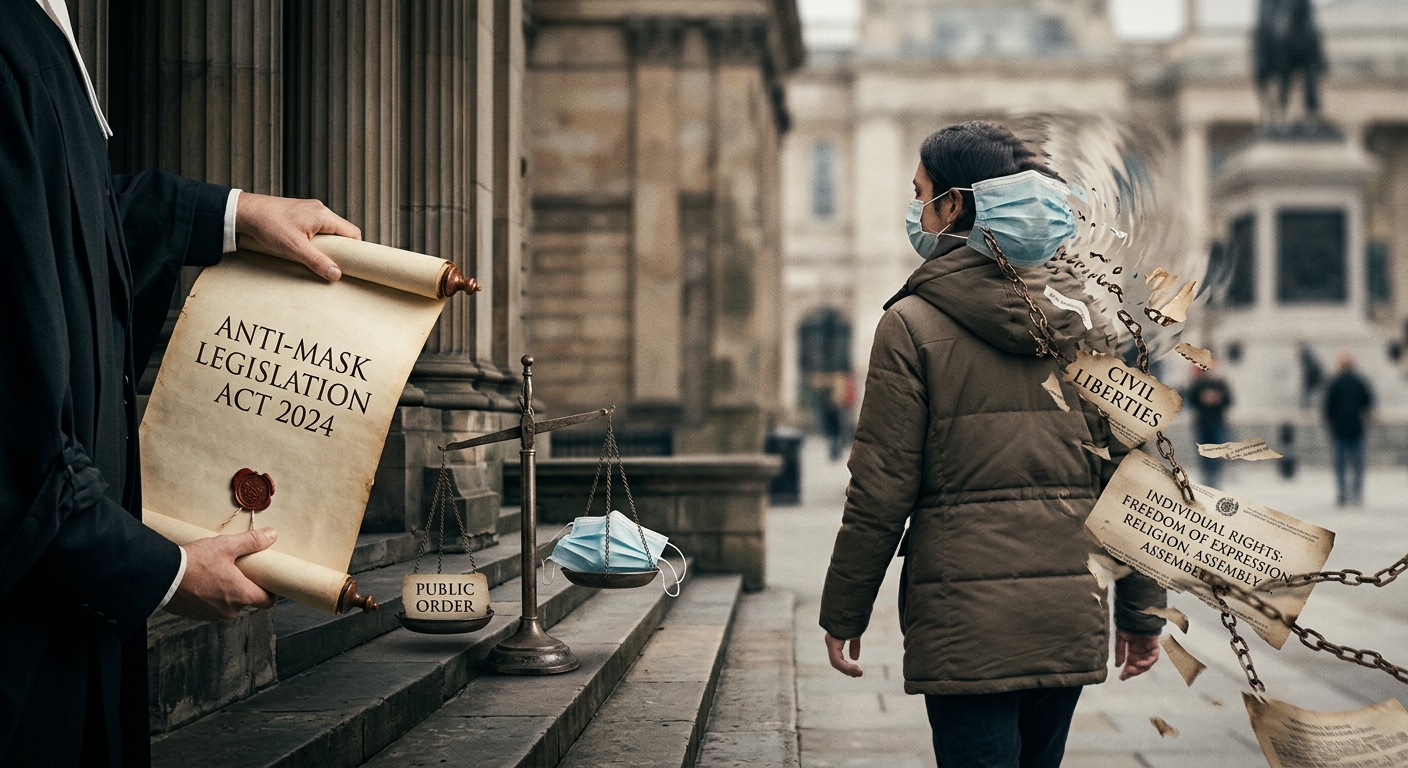
An Unlikely Revival: The Paradox of Modern Mask Bans
The right to assemble and speak out against the government is a foundational pillar of democratic societies. For centuries, physical protests have served as the primary vehicle for marginalized or dissenting groups to demand societal change. However, a troubling legal trend is sweeping across jurisdictions in the United States: the aggressive revival of archaic anti-mask laws. Initially drafted decades ago to combat organized hate groups, these statutes are suddenly being pulled from the dusty shelves of legal history and repurposed to arrest, intimidate, and penalize modern demonstrators. This legislative pivot has sparked intense debate among civil rights advocates, constitutional scholars, and public health officials.
The irony of this situation is palpable. Just a few years ago, governments worldwide mandated the use of facial coverings to curb the spread of a deadly respiratory virus. Today, those same governments are threatening citizens with arrest for continuing to wear them in public spaces. While lawmakers pushing for these bans argue that masks embolden individuals to commit property damage and evade accountability during demonstrations, critics counter that criminalizing face coverings severely undermines digital privacy, suppresses First Amendment rights, and jeopardizes public health. To understand the gravity of this legislative whiplash, one must examine the historical context of mask bans, the constitutional protections surrounding anonymous speech, and the chilling realities of modern surveillance technology.
The Historical Precedent: Unmasking the Ku Klux Klan
To grasp how anti-mask laws operate today, it is essential to explore their origins. The vast majority of these laws were not born out of a general desire for public transparency; rather, they were specific, targeted legislative weapons . While a handful of anti-mask statutes date back to the mid-19th century, the most prominent wave of this legislation occurred between the 1920s and the 1950s. During this era, state and local governments enacted strict mask prohibitions as a direct response to the domestic terrorism perpetrated by the Ku Klux Klan.
The KKK relied heavily on the anonymity provided by their white hoods and robes to carry out campaigns of intimidation, harassment, and violence against Black Americans, immigrants, and religious minorities. By passing laws that made it illegal to conceal one’s identity in public, lawmakers successfully stripped the Klan of its protective veil, making it easier for law enforcement to identify and prosecute violent perpetrators. For decades, these laws were widely viewed as successful tools for dismantling organized hate groups and protecting vulnerable communities from anonymous terror.
However, the legal landscape has shifted dramatically. The contemporary application of these laws rarely involves white supremacists. Instead, these statutes are increasingly deployed against grassroots activists, environmental defenders, and individuals protesting international conflicts—most notably, those participating in recent pro-Palestinian demonstrations. By severing the laws from their original historical context, authorities are effectively weaponizing a tool designed to protect the marginalized against the marginalized themselves.
Constitutional Friction: Anonymity and the First Amendment
The revival of anti-mask legislation immediately collides with robust constitutional protections regarding anonymous speech and association. The United States possesses a rich tradition of protecting the right of its citizens to express unpopular or controversial ideas without attaching their names to them. From the Founding Fathers publishing the Federalist Papers under the pseudonym “Publius” to civil rights activists organizing in hostile environments, anonymity has long been recognized as a necessary shield against societal retaliation and government overreach .
The Supreme Court has repeatedly affirmed that the First Amendment protects the right to anonymous speech and association. In the landmark 1958 case NAACP v. Alabama, the Court ruled that the state could not force the NAACP to disclose its membership lists, recognizing that revealing the identities of the members would subject them to economic reprisal, physical threats, and public hostility. Similarly, in the 1995 case McIntyre v. Ohio Elections Commission, the Court struck down a law prohibiting the distribution of anonymous campaign literature, explicitly stating that anonymity is a shield from the tyranny of the majority.
When applied to modern protests, the prohibition of masks essentially strips demonstrators of this constitutional shield. In an era of intense political polarization, activists who publicly advocate for controversial causes face severe risks, including online doxxing, harassment, and termination from their employment. By outlawing face coverings, the state forces individuals to choose between exercising their fundamental right to free expression and protecting their livelihoods and personal safety. This creates a profound “chilling effect,” deterring law-abiding citizens from participating in the democratic process out of fear of exposure and retaliation.
The Surveillance State: Facial Recognition and Digital Privacy
The constitutional debate over anti-mask laws cannot be fully understood without examining the explosive growth of modern surveillance technology. In the 1950s, the primary risk of unmasking was physical identification by a local police officer or a hostile bystander. Today, the unmasked face is immediately ingested into an invisible, ubiquitous network of digital surveillance, powered by artificial intelligence and facial recognition technology (FRT) .
Law enforcement agencies at the local, state, and federal levels frequently deploy FRT systems to monitor crowds, track individuals, and catalog attendees at political rallies. Companies like Clearview AI have controversially scraped billions of images from social media platforms to build massive biometric databases, which are subsequently sold to police departments. When a protester attends a rally without a mask, their face can be instantly captured by police drones, body cameras, or closed-circuit television networks, and run against these databases to ascertain their identity, home address, and social network.
For modern activists, the medical mask or cloth face covering serves as a critical, analog defense against this digital dragnet. It is one of the few accessible methods for citizens to protect their biometric data from unwarranted government collection. Furthermore, privacy advocates and civil rights organizations continually highlight the severe flaws inherent in FRT. Algorithms are notoriously less accurate when identifying people of color, women, and non-binary individuals, leading to a high risk of false matches and wrongful arrests. By enforcing anti-mask laws, authorities are effectively mandating that citizens submit their biometric data to flawed, racially biased systems simply for the act of stepping into the public square.
Public Health and Disability Rights Intersections
Beyond privacy and speech, the blanket enforcement of anti-mask laws introduces a severe public health crisis, particularly for vulnerable populations. Despite the end of federal emergency declarations, the SARS-CoV-2 virus continues to circulate, alongside influenza and respiratory syncytial virus (RSV). The Centers for Disease Control and Prevention (CDC) continues to recommend the use of high-quality respirators, such as N95 and KN95 masks, for individuals at high risk for severe illness, those who are immunocompromised, and individuals attempting to prevent the spread of respiratory droplets .
When municipalities draft sweeping anti-mask legislation to target protesters, they rarely include adequate, easily provable exemptions for medical necessity. Even when health exemptions exist on paper, they are difficult to operationalize on the street. A police officer managing a dynamic crowd is not equipped to verify an individual’s medical history before deciding whether to make an arrest for a mask violation. This ambiguity places the burden of proof entirely on the disabled or immunocompromised citizen.
This dynamic creates an inherent violation of disability rights. For an immunocompromised individual, wearing a mask is not a political statement; it is a life-saving medical necessity. By criminalizing the wearing of masks at public gatherings, the government is effectively barring disabled Americans from participating in civic life. Forcing an individual to choose between protecting their immune system and exercising their First Amendment right to assembly is a discriminatory practice that disproportionately impacts the most medically vulnerable members of society.
The Perils of Selective Enforcement
One of the most dangerous aspects of reviving obscure, broadly written laws is the inevitability of selective enforcement. When a law prohibits “wearing a mask with the intent to conceal one’s identity,” it grants individual police officers vast discretionary power to determine a person’s inner intent. How does an officer distinguish between a protester wearing a surgical mask to avoid facial recognition, a protester wearing it to avoid catching a cold, and a pedestrian wearing one because it is a chilly afternoon?
Historically, when law enforcement is granted this level of subjective discretion, the resulting enforcement is heavily skewed against marginalized communities and unpopular political movements. If anti-mask laws are dusted off specifically in response to pro-Palestinian demonstrations or racial justice protests, but ignored during celebratory sports parades or cold-weather gatherings, the law becomes a tool for viewpoint discrimination. This selective application undermines the rule of law and transforms a supposedly neutral public safety measure into an instrument of political repression.
Comparison of Anti-Mask Law Paradigms
| Feature | Historical Context (1920s-1950s) | Modern Context (2020s) |
|---|---|---|
| Primary Target | The Ku Klux Klan and violent hate groups. | Grassroots activists, students, and political protesters. |
| Goal of Law | Prevent anonymous domestic terrorism and protect marginalized groups. | Deter property damage, track demonstrators, and discourage assembly. |
| Technology Factor | Identification relied entirely on visual, human recognition. | Identification relies on AI, facial recognition, and digital databases. |
| Health Considerations | Negligible; infectious disease masking was not normalized in the West. | Massive; masks remain vital for immunocompromised individuals post-pandemic. |
Conclusion
The sudden resurrection of anti-mask laws represents a profound threat to the delicate balance between public safety and civil liberties. While the prevention of crime and property damage during protests is a valid governmental interest, achieving this through the blanket criminalization of face coverings is a blunt and unconstitutional instrument. These laws strip citizens of their constitutional right to anonymity, force vulnerable populations out of the public sphere, and feed the insatiable appetite of an unregulated surveillance state. If democracy relies on the ability of the people to safely and freely petition their government, then the right to protest—whether barefaced or behind a mask—must be vigorously defended against legislative overreach.
Frequently Asked Questions (FAQ)
- Why were anti-mask laws originally created?
Most anti-mask laws in the United States were enacted between the 1920s and 1950s specifically to combat the Ku Klux Klan. The laws were intended to strip hate group members of their anonymity, making it easier for law enforcement to identify those committing acts of terror against marginalized communities. - Does the First Amendment protect the right to wear a mask?
The First Amendment heavily protects anonymous speech and association, as established in cases like NAACP v. Alabama. While the Supreme Court has not explicitly ruled on a universal right to wear masks, many legal scholars argue that mask bans violate the First Amendment by stripping individuals of the anonymity required to safely express controversial views. - How do facial recognition technologies relate to mask bans?
Law enforcement agencies frequently use AI-driven facial recognition to identify protesters. Masks block these algorithms from capturing biometric data. By banning masks, governments force citizens to expose their faces to massive, often unregulated biometric surveillance databases. - Are there health exemptions to anti-mask laws?
While some states include medical exemptions in their anti-mask statutes, they are notoriously difficult to enforce fairly on the street. Critics argue these laws place an unfair burden on disabled or immunocompromised individuals, potentially violating the Americans with Disabilities Act (ADA) by preventing them from safely participating in public life.
References
- The Resurgence of Anti-Mask Laws: Is There a Constitutional Right to Conceal Your Identity? — BrooklynWorks, Brooklyn Law School. 2026-04-22. https://brooklynworks.brooklaw.edu/cgi/viewcontent.cgi?article=2308&context=blr
- Anonymous Speech — The First Amendment Encyclopedia, Middle Tennessee State University. 2023-08-03. https://firstamendment.mtsu.edu/article/anonymous-speech/
- Face Surveillance and Biometrics — EPIC (Electronic Privacy Information Center). 2026-04-28. https://epic.org/issues/surveillance-oversight/face-surveillance-biometrics/
- Science Brief: Community Use of Masks to Control the Spread of SARS-CoV-2 — Centers for Disease Control and Prevention (CDC). 2021-12-06. https://www.cdc.gov/coronavirus/2019-ncov/science/science-briefs/masking-science-sars-cov2.html
Similar Articles








Read full bio of Sneha Tete


