
Rental Delinquency Patterns and What They Reveal
Understanding who falls behind on rent, how late fees evolve over time, and why new payment data changes what we know about rental risk.
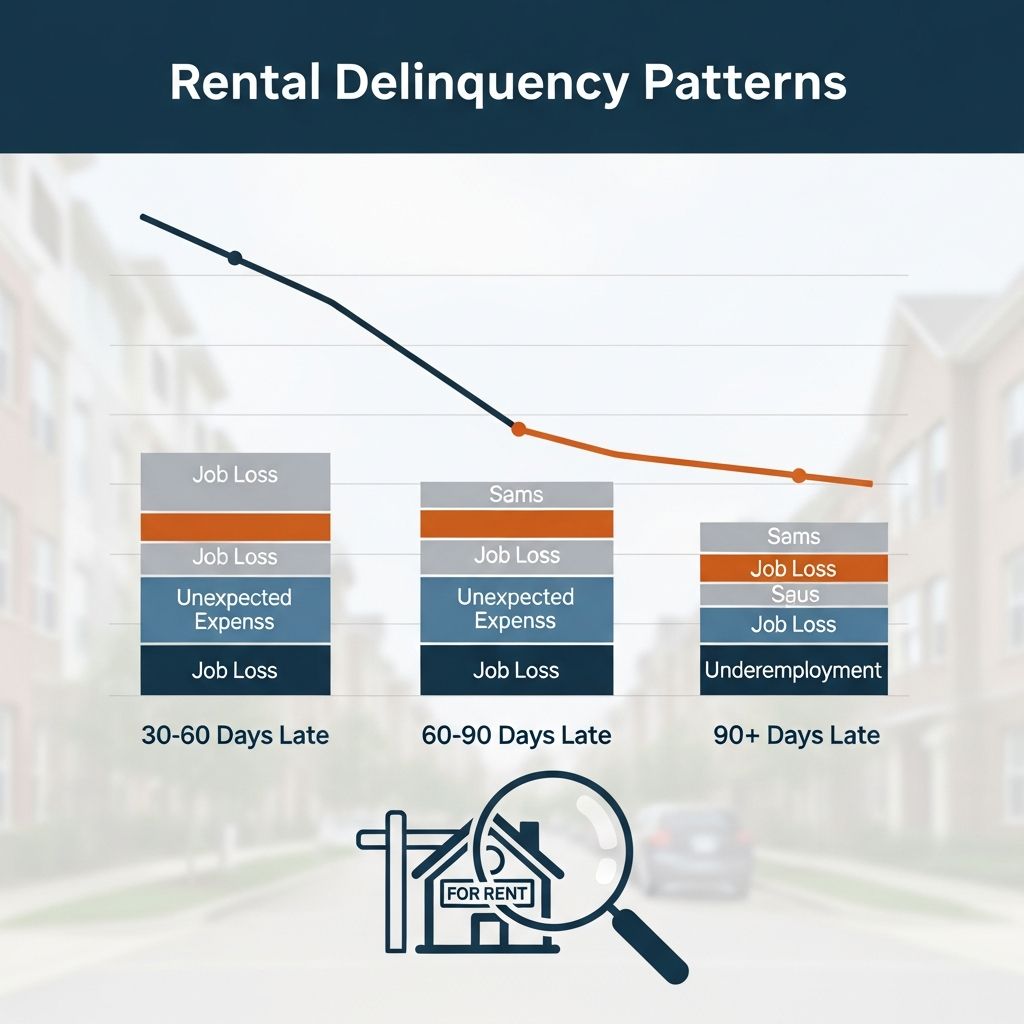
New rental payment datasets are changing how researchers, policymakers, and industry stakeholders understand who falls behind on rent, how often it happens, and what late payments mean for long-term housing stability. Instead of relying only on surveys or eviction records, these data capture real monthly payment behavior, including late fees, partial payments, and missed months.
This article uses that emerging evidence to explain key trends in rent delinquency, how they have evolved since the pandemic, and why they matter for families, landlords, and the broader housing system.
Why Rental Payment Data Matters
Historically, analysts understood rental distress mainly through:
- Household surveys asking whether renters are caught up on rent
- Eviction court records and filings
- Landlord and property manager reports
Each of these sources is useful but incomplete. Surveys rely on self-reports, and eviction filings capture only the most extreme cases. New granular payment data from property management systems fills the gap by tracking:
- Whether rent is paid on time, late, or not at all
- How often late fees are charged
- How quickly or slowly renters recover after a missed payment
- Patterns across properties, locations, and time
Similar administrative data have long been used to track mortgage delinquencies, which helps explain risks in owner-occupied housing. Applying this kind of detail to the rental market allows for a more precise view of financial strain among renters.
Key Measures of Rental Delinquency
Rental payment data typically distinguish several types of delinquent status, each signaling a different level of risk.
| Delinquency Status | Simple Definition | Risk Signal |
|---|---|---|
| On-time | Rent paid in full by the due date or grace period | Stable payment behavior |
| Late with fee | Rent paid after the grace period, triggering a late fee | Short-term cash flow problems or budgeting challenges |
| Unpaid for month | No full rent payment recorded for the cycle | Elevated risk of arrears and possible eviction |
| Persistent delinquency | Multiple consecutive or frequent late/unpaid months | Chronic financial distress, high housing-instability risk |
The research highlighted in the Consumer Financial Protection Bureau (CFPB) report focuses particularly on late fees as a widely observed signal of delinquency in rental payment data.
Trends in Late Fees Over Time
Using a large portfolio of professionally managed rental properties, researchers observed sharp changes in the share of renters incurring late fees over the past several years.
- The share of renters who had at least one late fee in the prior year rose substantially from late 2021 to early 2023, suggesting heightened financial stress as pandemic supports waned.
- By late 2024, that share had fallen below its earlier peak, indicating some easing of acute distress but not necessarily a full return to pre-pandemic norms.
These patterns align with broader credit markets, where mortgage delinquency rates also rose modestly from 2024 into 2025 after an extended period of historically low distress. The parallel suggests that both renters and homeowners are navigating a tighter financial environment as savings buffers built during the pandemic decline and living costs remain elevated.
What Happens After the First Late Fee?
A central question is whether a late fee is a temporary blip or an early warning of deeper trouble. The new payment data allow researchers to follow renters month by month after their first late charge.
Three broad paths tend to emerge:
- Rapid recovery: Renters who return to paying on time and do not show recurring issues.
- Recurring lateness: Renters who repeatedly incur late fees without fully catching up, often juggling multiple bills.
- Non-recovery or exit: Renters who progress toward persistent delinquency, move out, or disappear from the dataset.
Evidence from the CFPB analysis shows that about half of renters who incur a late fee manage to return to paying on time, while the remainder either stay in some delinquent status or are no longer observed in the system. This split highlights how a single late fee can mark a turning point for some households but a temporary disruption for others.
Late Fees as a Financial Burden
Late fees are intended to encourage on-time payment and compensate landlords for administrative costs, but for cash-constrained households they can deepen financial strain.
Emerging payment data show that a significant fraction of renters who incur one late fee will incur another in the very next month. That pattern suggests:
- Households lack sufficient reserves to absorb small shocks, such as overtime cuts or unexpected expenses.
- Once behind, fees and arrears can snowball, making it harder to get current.
- Even relatively modest charges may represent a large share of disposable income for low- and moderate-income renters.
Research on broader credit usage finds that late fees and penalty charges on financial products disproportionately affect lower-income consumers, reducing their ability to build savings and increasing reliance on high-cost credit. While the rental context is distinct, the mechanism is similar: fees convert a timing problem into a deeper affordability problem.
Comparing Rental Delinquencies to Mortgage Delinquencies
Although renters and homeowners occupy different segments of the housing market, comparing delinquency metrics offers useful context.
- Residential mortgage delinquency rates at commercial banks have remained relatively low, around the high-1-percent range in 2024–2025, though they ticked up slightly from 2023.
- Industry surveys show that mortgage delinquencies on one-to-four-unit properties increased modestly in 2025, with particular stress among FHA borrowers who tend to have lower incomes and weaker credit profiles.
- In the multifamily space, serious delinquency rates on certain commercial mortgage-backed securities (CMBS) loans and portfolios have been higher, reflecting pressure on apartment owners facing both rising costs and uneven rent collection.
Rental delinquency statistics are not directly comparable to mortgage metrics, but the broader picture is that housing-related distress is present across both renter and owner sectors, especially among financially vulnerable groups. This underscores the value of detailed rental payment data to complement long-standing mortgage surveillance tools.
Who Is Most at Risk of Falling Behind?
The granular payment data used in recent research can be linked to property characteristics, rent levels, and sometimes neighborhood information, helping identify where risk is concentrated.
Several patterns tend to emerge:
- Lower-income renters and those in more affordable segments of the market are more exposed to late fees because even small disruptions can destabilize tight budgets.
- Households with variable income (hourly workers, gig workers, and those in seasonal roles) often show more frequent late payments, reflecting income volatility rather than persistent inability to afford rent.
- High-cost regions and markets with rapidly rising rents may show elevated rates of late fees as incomes fail to keep pace with housing costs.
- Smaller property owners may have less room to absorb late payments, sometimes pursuing faster escalation to collections or eviction than large institutional operators.
These patterns echo findings from broader studies on housing cost burdens, which show that renters spend a larger share of income on housing than homeowners and have fewer liquid assets to buffer shocks.
Implications for Renters
For individual households, the new evidence offers practical lessons on how late payments can cascade into larger problems.
Financial Consequences of Repeated Late Fees
- Accumulating debt: Late fees add to rent owed, increasing the amount needed to become current.
- Credit impacts: While not all landlords report to credit bureaus, collections activity and judgments can show up on credit records, affecting access to future credit and housing.
- Screening barriers: Payment histories kept by landlords or screening companies can affect whether applicants are approved for new rentals.
- Stress and instability: Persistent fear of eviction or displacement can take a toll on mental and physical health.
Steps Renters Can Consider
- Talking early with landlords about short-term payment plans or due date adjustments
- Exploring emergency rental assistance or local relief programs when facing a sudden income loss
- Using low-fee or no-fee payment channels to avoid added charges associated with certain payment methods
- Monitoring rental payment histories and correcting any inaccuracies in screening reports
Understanding that a first late fee can be a warning sign—rather than an isolated event—may help renters prioritize repayment plans before arrears become unmanageable.
Implications for Landlords and Property Managers
For owners and managers, late payments translate into operational and financial risks. Industry surveys indicate that rising renter delinquency increases bad debt, legal costs, and staff workload.
Using detailed payment data, operators can:
- Identify emerging risk by tracking clusters of late fees or unpaid months at specific properties or among specific renter segments.
- Evaluate policies such as grace periods, late-fee amounts, and payment options to see how they affect delinquency patterns.
- Test interventions like reminder systems, flexible payment schedules, or hardship programs, and compare outcomes across similar properties.
- Coordinate with lenders and investors, especially where debt covenants are sensitive to rent collection performance.
Evidence from multifamily finance shows that higher renter delinquencies can ultimately feed through to mortgage delinquency on income-producing properties, especially when combined with higher interest costs and operating expenses. Proactive use of payment analytics can help mitigate those risks.
Policy and Regulatory Considerations
New rental payment data also inform public-sector decisions. Regulators and policymakers can use this information to better target support and assess the impact of existing rules.
Key policy questions include:
- How do late-fee caps or grace-period requirements affect delinquency patterns and renter recovery?
- Which markets show the most persistent delinquency, and how does that align with local wages, employment trends, and rental supply?
- What role should rental payment histories play in credit reporting, and under what consumer protections?
- How effective are emergency rental assistance or voucher programs at preventing the transition from late fees to eviction?
Regulators such as the CFPB have emphasized the importance of fair, transparent fee practices across consumer financial products, including housing, and have highlighted concerns where “junk fees” may obscure true costs or exploit vulnerable consumers. Detailed rental data help distinguish between policies that promote timely payment and those that primarily extract revenue from financially stressed households.
Using Data Responsibly
While the analytic value of rental payment data is clear, its use raises privacy and fairness considerations.
- Data protection: Payment records are sensitive and must be secured and governed by clear access rules.
- Bias and fairness: Algorithms using payment histories to predict risk can embed or amplify existing inequities if not carefully tested.
- Consumer awareness: Renters should know what information is collected, how it is used, and how to dispute errors.
These issues echo long-standing debates about credit reporting and scoring more broadly, where regulators and consumer advocates have stressed accuracy, fairness, and the right to correction.
Frequently Asked Questions (FAQs)
Q: What counts as rental delinquency in payment data?
A: Rental delinquency typically refers to any status where rent is not paid in full by the end of the grace period, including late payments that trigger a fee, partial payments, or missed months. Different datasets and landlords may define thresholds slightly differently, but late fees are one of the most consistently tracked indicators.
Q: Does one late fee usually mean a renter will be evicted?
A: No. Many renters who incur a single late fee return to on-time payments afterward. However, research using new payment data shows that a substantial share experience repeated lateness or remain in some form of delinquent status, which can increase the risk of eventual eviction or forced move-out.
Q: How are late rent payments different from mortgage delinquencies?
A: Mortgage delinquency is defined and tracked in standardized ways by lenders and regulators, with clear stages such as 30-, 60-, and 90-day delinquent. Rental delinquency lacks a single national standard, and data coverage is less comprehensive. However, new administrative datasets are bringing rental tracking closer to the level of detail long available for mortgages.
Q: Do late rent payments always show up on my credit report?
A: Not always. Many landlords do not furnish data directly to credit bureaus. However, if debt is sent to collections or a court judgment is issued, that information may appear in your credit file and affect your credit standing and access to future housing.
Q: What can policymakers do to reduce harmful rental delinquencies?
A: Policy options include strengthening emergency rental assistance, promoting predictable and transparent fee structures, supporting mediation or payment-plan programs to prevent eviction, and using anonymized payment data to target help to communities experiencing persistent distress.
References
- Behind on Rent? Examining Rental Housing Delinquencies in New Payment Data — Consumer Financial Protection Bureau. 2024-12-12. https://www.consumerfinance.gov/data-research/research-reports/behind-on-rent-examining-rental-housing-delinquencies-in-new-payment-data/
- Mortgage Delinquencies Increase in the Third Quarter of 2025 — Mortgage Bankers Association. 2025-11-14. https://www.mba.org/news-and-research/newsroom/news/2025/11/14/mortgage-delinquencies-increase-in-the-third-quarter-of-2025
- Delinquency Rate on Single-Family Residential Mortgages, Booked in Domestic Offices, All Commercial Banks (DRSFRMACBS) — Board of Governors of the Federal Reserve System (FRED series). 2025-11-21 (updated). https://fred.stlouisfed.org/series/DRSFRMACBS
- Commercial and Multifamily Mortgage Delinquency Rates Mixed in Third Quarter 2025 — Mortgage Bankers Association. 2025-12-04. https://www.mba.org/news-and-research/newsroom/news/2025/12/04/commercial-and-multifamily-mortgage-delinquency-rates-mixed-in-third-quarter-2025
- Multifamily Earnings Highlights Q1 2025 — Fannie Mae. 2025-05-01. https://multifamily.fanniemae.com/doing-business-us/financial-information/multifamily-earnings-highlights-q1-2025
- 2025 State of Renter Delinquency and Default — National Apartment Association / TheGuarantors. 2025-07-01. https://naahq.org/2025-state-renter-delinquency-and-default
Similar Articles








Read full bio of medha deb


