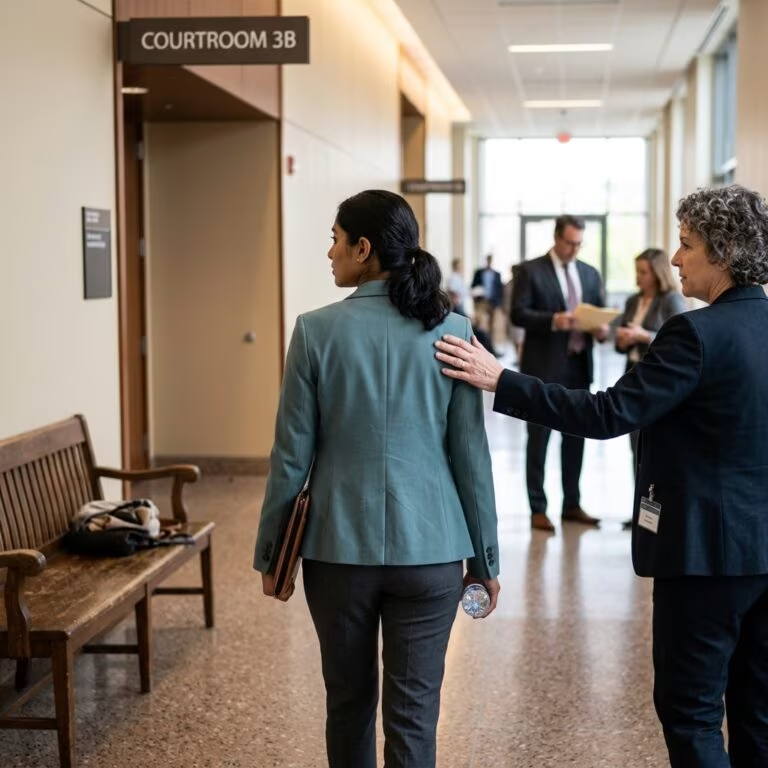
In the high-stakes arena of criminal justice, a defendant’s emotional response to their actions can sway the scales of justice. Genuine expressions of regret often serve as a powerful mitigating element during sentencing, potentially leading to lighter penalties. However, the authenticity of such displays remains a contentious issue for judges and juries alike.
The Psychological and Legal Foundations of Remorse
Remorse transcends mere apology; it embodies a deep-seated acknowledgment of wrongdoing coupled with a commitment to change. Psychologically, it signals an offender’s potential for rehabilitation, aligning with retributive, deterrent, rehabilitative, and restorative theories of punishment. Legal systems, particularly in the U.S., have long recognized this factor, embedding it in federal guidelines like USSG § 3E1.1, which allows reductions in sentencing levels for defendants demonstrating acceptance of responsibility.
Judges frequently cite remorse as a key determinant in penalty severity. Research involving interviews with criminal judges reveals broad consensus on its relevance, though opinions diverge on precise definitions and applications. For victim-involved offenses, remorse carries heightened weight, as it addresses harm inflicted on others, contrasting with victimless crimes where its impact may be muted.
How Courts Evaluate Defendant Remorse
Assessing remorse is no straightforward task. Courts scrutinize verbal statements, nonverbal cues, and behavioral patterns. A defendant’s allocution at sentencing— their opportunity to address the court directly—often becomes the focal point. Sincere apologies, coupled with specifics about the harm caused, resonate strongly.
Nonverbal indicators prove equally vital. Studies with mock jurors highlight that body language, such as lowered gaze, slumped posture, or tearful eyes, outweighs spoken words in conveying authenticity. Incongruent signals, like a flat affect during a verbal apology, can undermine credibility.
- Verbal Cues: Explicit admissions of guilt, expressions of empathy for victims, and outlines of preventive steps.
- Nonverbal Cues: Authentic emotional displays, avoiding rehearsed gestures.
- Behavioral Evidence: Pre-sentencing actions like restitution payments or cooperation with authorities.
In federal cases, early guilty pleas exemplify acceptance, frequently yielding a two- or three-level guideline reduction. Yet, this benefit hinges on judicial discretion; inconsistent conduct, such as denying fault post-plea, can nullify it.
Benefits of Demonstrating Remorse at Sentencing
Expressing remorse yields tangible advantages. It humanizes the defendant, fostering perceptions of redeemability. Judges report leniency for remorseful offenders, pushing sentences toward the lower end of ranges. In capital cases, juries view it as a mitigator, potentially sparing lives.
| Context | Potential Benefit | Example |
|---|---|---|
| Federal Sentencing | 2-3 level reduction | USSG § 3E1.1 application |
| State Courts | Reduced incarceration | Judicial discretion in victim impact |
| Jury Trials | Lenient verdicts/sentences | Mock juror studies |
| Parole/Probation | Earlier release | Post-conviction evaluations |
Beyond immediate sentencing, remorse influences ancillary decisions like probation eligibility and parole hearings, underscoring its enduring role.
Dangers of Perceived Lack of Remorse
Conversely, apparent remorselessness invites harsher outcomes. Prosecutors leverage it to advocate maximum penalties, portraying defendants as unrepentant threats. The case of Hannah Gutierrez-Reed illustrates this peril: post-conviction jail calls decrying personal hardships without victim empathy led to an 18-month maximum sentence, as the judge deemed her unremorseful.
Judges distinguish between stoic demeanor and defiant endorsement of crimes. Mere silence post-conviction rarely aggravates, protected by due process rights to assert innocence. However, active blame-shifting or victim-blaming crosses into punitive territory.
Strategic Considerations for Defense Counsel
Attorneys must navigate remorse tactically. For clients pleading not guilty, trial expressions risk implying culpability, potentially biasing juries toward conviction. Thus, remorse typically emerges post-verdict at sentencing.
Preparation involves coaching authentic delivery without scripting, which courts detect as insincere. Mental health factors complicate matters; defendants with conditions may struggle with emotional displays, warranting contextual explanations to avoid misinterpretation.
- Assess client genuineness early.
- Time expressions appropriately (post-conviction).
- Supplement with character evidence.
- Address cultural/emotional barriers.
Challenges in Authentically Conveying Remorse
True remorse unfolds gradually, involving internal reflection rather than performative acts. Legal contexts demand immediacy, creating tension. Cultural variances affect expression; what appears remorseless in one backdrop may signify respect in another.
Empirical data underscores perceptual biases. High need-for-affect jurors respond more favorably to emotional displays, while others prioritize consistency. Reforms propose structured guidelines for evaluation, reducing subjectivity.
Remorse Across Case Types and Stages
Its applicability varies. In violent crimes, it mitigates profoundly; in white-collar offenses, restitution pairs effectively. Sentencing phases dominate, but echoes appear in plea negotiations and clemency bids.
For juveniles or mentally ill defendants, courts weigh developmental factors, cautioning against over-penalizing limited expressiveness.
Frequently Asked Questions (FAQs)
What constitutes genuine remorse in court?
Genuine remorse includes verbal apologies, empathy for victims, nonverbal emotional cues, and rehabilitative actions like restitution.
Can lack of remorse increase a sentence?
Yes, particularly if it signals defiance rather than innocence assertion; judges may impose harsher penalties.
Does a guilty plea automatically show remorse?
It demonstrates acceptance but requires corroboration through statements and behavior for full credit.
How do nonverbal cues affect perceptions?
They often trump verbal ones; incongruence leads to skepticism and stricter sentences.
Should remorse be shown during trial?
Generally no, to preserve innocence presumption; reserve for sentencing.
Broader Implications for Justice Reform
While remorse aids equitable outcomes, its subjective assessment risks disparity. Proposals include jury instructions clarifying criteria, training for evaluators, and de-emphasizing in ambiguous cases. Balancing individual accountability with fair process remains paramount.
In practice, defendants benefit from remorse when authentic, but forced displays backfire. Legal teams must prioritize holistic defenses integrating character, circumstances, and post-offense conduct.
References
- Acceptance of Responsibility at Sentencing — Conaway & Strickler. 2023. https://www.conawayandstrickler.com/blog/acceptance-of-responsibility-at-sentencing/
- Judging Remorse — N.Y.U. Review of Law & Social Change. 2012. https://socialchangenyu.com/review/judging-remorse/
- Defendant remorse, need for affect, and juror sentencing decisions — PubMed. 2012-03-01. https://pubmed.ncbi.nlm.nih.gov/22396340/
- Remorse and Criminal Justice — Susan A. Bandes. 2016. https://www.susanbandes.com/wp-content/uploads/2017/03/remorsebandesER-3.pdf