
Religious Tests in Politics: Why the Constitution Says No
Why true democracy demands separating faith and public office.
Introduction
The intersection of faith and political power remains one of the most intensely debated subjects in American public life. From local town halls to the highest echelons of the federal government, the personal religious beliefs of candidates are constantly placed under a microscope. While it is natural for voters to seek leaders who reflect their own moral compass, the United States Constitution establishes an unyielding boundary: religion can never be a legal prerequisite for holding public office. This principle is enshrined in the No Religious Test Clause of Article VI. It serves as a bedrock for American civil liberties, ensuring that civic duty transcends personal theology. When it comes to demanding a specific faith as a qualification for public trust, the Constitution’s answer is absolute: no means no.
The Founders’ Vision: Breaking from European Tradition
To understand the gravity and necessity of the No Religious Test Clause, one must look back to the historical context in which the Framers drafted the Constitution. In seventeenth and eighteenth-century Europe, state-sponsored religion was the norm. England enforced various Test Acts, which legally required government officials, military officers, and even university students to take communion in the Church of England and swear oaths of loyalty to the Crown as the head of the church. These laws effectively disenfranchised Catholics, nonconformist Protestants, Jews, and non-believers, barring them from public life.
When the delegates gathered at the Constitutional Convention in 1787, they were acutely aware of the bloodshed and political disenfranchisement caused by centuries of European religious conflicts. On August 20, 1787, Charles Pinckney, a delegate from South Carolina, introduced a revolutionary proposal to ban religious tests for federal officeholders. Pinckney recognized that a true republic must be founded on Enlightenment principles, where individual reasoning and civic capability are valued over adherence to a central state dogma. Although some delegates initially believed the prevailing spirit of religious tolerance made such a clause unnecessary, the convention ultimately adopted Pinckney’s proposal, making it a foundational element of the new government.
Deconstructing Article VI, Clause 3
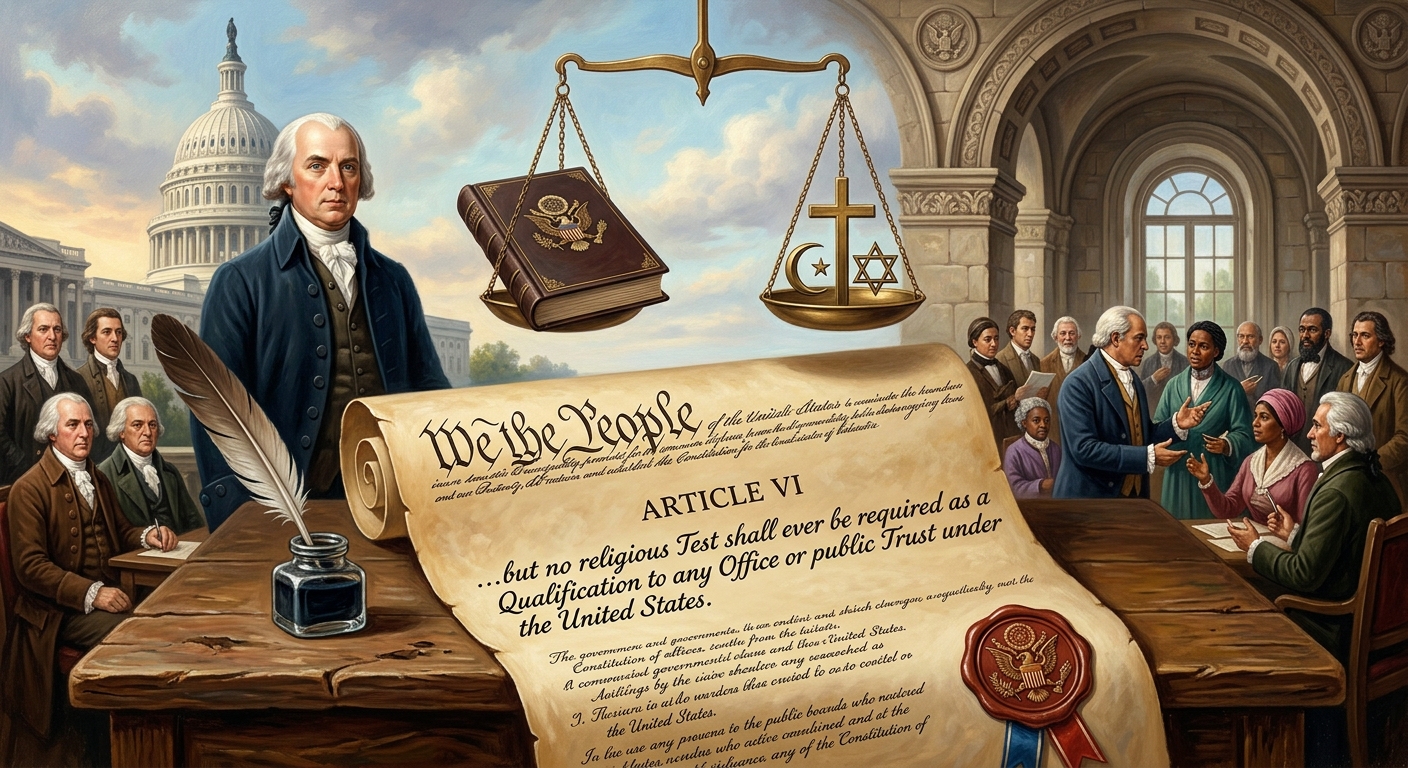
The precise phrasing of Article VI, Clause 3 is brief but remarkably comprehensive. It states that all executive and judicial officers, as well as members of the legislature at both the federal and state levels, “shall be bound by Oath or Affirmation, to support this Constitution; but no religious Test shall ever be required as a Qualification to any Office or public Trust under the United States.”
This text accomplishes two major constitutional objectives. First, it requires a secular commitment to the rule of law. Officeholders must pledge allegiance to the Constitution itself, not to a monarch or a deity. The inclusion of the word “Affirmation” was a deliberate and inclusive accommodation for groups like the Quakers, whose religious convictions forbade them from swearing oaths.
Second, the clause explicitly bans any examination of a candidate’s religious beliefs as a condition of employment in public service. The government cannot demand that an individual profess a belief in God, adhere to a specific denomination, or disavow any particular faith. A candidate’s theology is entirely irrelevant to their legal eligibility to serve the public.
The Supreme Court Steps In: Torcaso v. Watkins
For much of early American history, the prohibition on religious tests applied strictly to the federal government. Several state constitutions continued to enforce their own religious prerequisites. However, the legal landscape shifted dramatically in the mid-twentieth century, culminating in the landmark 1961 Supreme Court case, Torcaso v. Watkins.
The controversy began when Roy Torcaso, a resident of Maryland, was appointed to serve as a notary public. When it came time to receive his commission, Torcaso was denied because he refused to declare a belief in God, a requirement explicitly mandated by the Maryland State Constitution. Torcaso sued, arguing that the state’s requirement violated his constitutional rights.
The Supreme Court ruled unanimously in Torcaso’s favor. Justice Hugo Black, writing for the Court, stated that neither a state nor the federal government can constitutionally force a person to profess a belief or disbelief in any religion. The Court held that Maryland’s religious test invaded the appellant’s freedom of belief and religion, thereby violating the First Amendment, which applies to the states via the Fourteenth Amendment. Torcaso v. Watkins firmly established that the spirit of Article VI extends to all levels of government in the United States, effectively rendering state-level religious tests unconstitutional and unenforceable.
De Facto Tests: When Voters Demand Faith
While de jure (legal) religious tests are undeniably unconstitutional, de facto (practical or informal) religious tests remain a pervasive reality in American politics. Even though the government cannot legally demand a declaration of faith, political parties, interest groups, and voters frequently scrutinize candidates’ religious backgrounds. In many regional elections, a candidate’s failure to demonstrate adherence to a dominant local religion can act as an unofficial disqualifier in the eyes of the electorate.
Perhaps the most famous confrontation with a de facto religious test occurred during the 1960 presidential election. John F. Kennedy, a Roman Catholic, faced intense skepticism from Protestant voters who feared his allegiance would be to the Pope in Rome rather than to the American people. To address this head-on, Kennedy delivered a historic speech to the Greater Houston Ministerial Association. He unequivocally stated,
“I believe in an America where the separation of church and state is absolute; where no Catholic prelate would tell the President—should he be Catholic—how to act, and no Protestant minister would tell his parishioners for whom to vote.”
Kennedy’s speech successfully neutralized the political religious test of his era, but similar dynamics persist today. Modern candidates are frequently pressured to prove their “Christian values” or are subjected to intense media scrutiny if they belong to minority faiths, such as Islam, Hinduism, or Mormonism. Some politicians and commentators have even controversially suggested that belief in monotheism should be a necessary qualification for high office. These informal tests, while not legally enforceable, violate the very spirit of Article VI and the Framers’ intent to separate civic capability from personal theology.
The Synergy with the First Amendment
Article VI does not exist in a constitutional vacuum; it operates in perfect synergy with the First Amendment. The First Amendment provides that “Congress shall make no law respecting an establishment of religion, or prohibiting the free exercise thereof.” These two clauses—the Establishment Clause and the Free Exercise Clause—complement the No Religious Test Clause to create a robust wall of separation between church and state.
If the government were permitted to require a religious test for public office, it would inherently be establishing a preferred religion, directly violating the Establishment Clause. Furthermore, forcing an individual to profess a belief they do not hold, or denying them employment based on their authentic beliefs, would constitute a severe infringement on their right to freely exercise their religion (or lack thereof).
Together, these constitutional provisions ensure that American democracy remains a marketplace of ideas rather than a theocracy. They protect the rights of the non-religious just as fiercely as they protect the rights of the devout, ensuring that no citizen is treated as a second-class participant in the republic due to their spiritual convictions.
Why “No Means No” Matters in Modern Democracy
In an increasingly pluralistic society, the enforcement of the No Religious Test Clause is more critical than ever. The United States is home to a vast tapestry of beliefs, including a growing population of individuals who identify as atheists, agnostics, or religiously unaffiliated. For the government to truly represent “We the People,” public offices must be accessible to individuals of all faiths and no faith at all.
The rise of Christian nationalism in certain political factions poses a direct threat to the principles enshrined in Article VI. When political leaders suggest that the United States is fundamentally a “Christian nation” and imply that only Christians are fit to govern, they are attempting to resurrect the very exclusionary practices the Founders explicitly rejected. Defending the No Religious Test Clause is not about silencing religious voices in the public square; it is about ensuring that the public square remains open to everyone. True religious liberty is only possible when the state remains strictly neutral, evaluating its public servants on their character, competence, and commitment to the Constitution, rather than their theological doctrines.
Frequently Asked Questions (FAQs)
What exactly constitutes a religious test for public office?
A religious test is any legal or official requirement that forces an individual to profess a specific religious belief, adhere to a particular denomination, or disavow a faith in order to qualify for a government position or public trust.
Do elected officials have to swear their oath of office on a Bible?
No. While many officials choose to use a Bible for ceremonial reasons or personal significance, the Constitution explicitly allows for an “Affirmation” instead of an oath. Officials have legally been sworn in using the Quran, the Hebrew Bible, secular law books, or nothing at all.
Does the No Religious Test Clause apply to state and local governments?
Yes. Although Article VI originally applied to federal offices, the Supreme Court’s 1961 ruling in Torcaso v. Watkins clarified that state-level religious tests violate the First and Fourteenth Amendments, making them unconstitutional across all levels of government.
Can voters apply their own religious tests at the ballot box?
Voters are free to cast their ballots based on any criteria they choose, including a candidate’s religion. The Constitution restricts the government from imposing legal religious requirements, but it cannot police the private motivations of individual voters.
Conclusion
The architects of the American republic understood that intertwining religious orthodoxy with governmental power is a recipe for tyranny and division. By embedding the No Religious Test Clause into Article VI of the Constitution, they made a profound statement that civil rights and civic leadership are not contingent upon divine belief. While informal religious pressures continue to echo through the halls of modern campaigns, the legal standard remains unshakeable. The constitutional promise that “no means no” regarding religious tests ensures that the United States remains a democracy governed by the consent of the governed, not by the dictates of a state-sanctioned faith.
References
- ArtVI.C3.2.1 Historical Background on Religious Test for Government Offices — Constitution Annotated, Congress.gov. 2022-08-15. https://constitution.congress.gov/browse/essay/artVI-C3-2-1/ALDE_00013346/
- The Constitution of the United States: A Transcription — National Archives. 2025-12-19. https://www.archives.gov/founding-docs/constitution-transcript
- Torcaso v. Watkins, 367 U.S. 488 (1961) — Justia U.S. Supreme Court Center. 1961-06-19. https://supreme.justia.com/cases/federal/us/367/488/
- John Cogley Oral History Interview — John F. Kennedy Presidential Library and Museum. 1968-02-20. https://www.jfklibrary.org/asset-viewer/archives/JFKOH/Cogley%2C%20John/JFKOH-JC-01/JFKOH-JC-01
Similar Articles








Read full bio of medha deb


