For generations, the default societal response to nearly every form of community disturbance, crisis, or conflict has been to dial 911 and dispatch armed law enforcement officers. However, a growing consensus among sociologists, community organizers, public health professionals, and legal scholars suggests that traditional policing models may not be the most effective—or the safest—method for handling many of our most pressing social issues. The modern conversation has moved beyond mere procedural reform. It now involves a fundamental reimagining of what public safety looks like. This paradigm shift involves questioning whether a significant portion of police responsibilities, and the accompanying funding, could be transitioned to specialized, unarmed professionals who are better equipped to address the root causes of community instability. The discourse surrounding the reallocation of police funding or the implementation of alternative models is often charged with political rhetoric. Yet, at its core, it is a practical policy discussion about resource management, specialized care, and the prevention of harm.
The Expanding Footprint of Modern Law Enforcement
Over the past several decades, the scope of police work has expanded exponentially. Law enforcement officers are now routinely dispatched to respond to mental health crises, substance abuse overdoses, homelessness complaints, noise violations, and even school disciplinary matters. This phenomenon, often referred to as “mission creep,” has positioned police officers as society’s catch-all solution to complex socio-economic and public health failures. Following the widespread deinstitutionalization of mental health facilities in the latter half of the 20th century, communities failed to build a sufficient network of community-based care, leaving the police as the de facto front-line mental health workers.
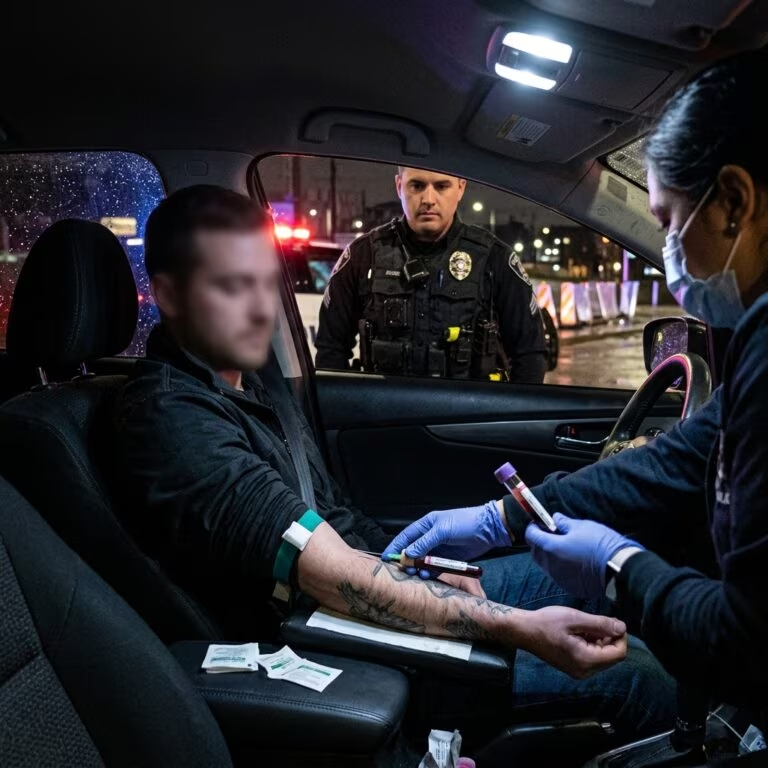
Expecting police officers to serve as ad-hoc social workers, psychologists, and medical responders is unfair to both the officers and the communities they are sworn to serve. Law enforcement training is primarily focused on enforcing the law, investigating crimes, utilizing force, and maintaining immediate order. When an officer whose primary tool is the threat of arrest or physical force arrives at the scene of a behavioral health crisis, the intervention can sometimes escalate the situation. The presence of a uniform, flashing lights, and weapons can trigger severe anxiety or paranoia in a person experiencing a psychotic episode, transforming a medical emergency into a fatal encounter.
The criminalization of poverty is a direct consequence of this expanded footprint. When a city lacks adequate public restrooms, shelter beds, or safe consumption sites, the inevitable public health issues that arise are treated as criminal infractions. Police officers are forced to issue citations for loitering, public urination, or sleeping in parks—actions that do not improve public safety but merely funnel the destitute into a labyrinthine legal system from which it is extraordinarily difficult to escape. This dynamic creates a revolving door of incarceration that exhausts municipal resources and demoralizes both the public and the officers tasked with enforcing these systemic failures.
Examining the Fiscal Reality: Municipal Budgets and Priorities
At the heart of the debate over redefining public safety is the reality of municipal finance. Police department budgets frequently consume a massive portion of city general funds—often ranging from 25% to over 40% of discretionary spending in major metropolitan areas. Meanwhile, vital social services, public health initiatives, affordable housing, and educational programs remain perpetually underfunded. The argument for reallocating resources is largely an economic and administrative one. It asks a straightforward public policy question: What if a portion of the billions spent on reactive policing and incarceration were invested proactively in community infrastructure that prevents crime from occurring in the first place?
The opportunity cost of bloated law enforcement budgets is staggering. Every dollar spent on military-grade equipment or police overtime is a dollar that cannot be spent on after-school programs, community centers, or addiction treatment facilities. When cities prioritize law enforcement funding over social safety nets, they are effectively choosing to manage the symptoms of poverty and trauma through the criminal justice system rather than treating the underlying causes.
This economic strain is further compounded by the continuous payout of civil settlements related to police misconduct. Major cities spend tens of millions of dollars annually settling lawsuits for excessive force and civil rights violations, funds that come directly from taxpayers. This financial drain underscores the urgent need for a more sustainable approach to community management. Furthermore, the reliance on federal grants often locks municipalities into militarized policing patterns, as equipment acquisitions stipulate certain tactical deployments. By decoupling local safety from federal law enforcement subsidies, cities can reclaim their autonomy to design systems that truly serve their unique demographic needs.
| Expenditure Category | Traditional Budget Focus | Reimagined Budget Focus | Expected Community Outcome |
|---|---|---|---|
| Crisis Response | Sworn armed officers | Unarmed crisis workers / EMTs | Reduced lethal force incidents, better health outcomes |
| Housing | Arrests for public camping | Transitional housing & support | Reduction in chronic homelessness |
| Substance Abuse | Criminalization & incarceration | Harm reduction & rehab centers | Lower recidivism, decreased overdose rates |
| Youth Services | School resource officers | Counselors & mentorship | Higher graduation rates, dismantling the school-to-prison pipeline |
Systemic Disparities and the Catalyst for Change
A critical driver of the movement to rethink policing is the extensive, empirical documentation of racial disparities within the criminal justice system. Studies continually demonstrate that marginalized communities, particularly Black and Hispanic neighborhoods, experience disproportionate rates of police contact, use of force, and arrests. The Stanford Open Policing Project, which analyzed nearly 100 million traffic stops across the United States, provided profound evidence of these disparities. The researchers utilized the “veil of darkness” test, finding that Black drivers were disproportionately stopped during daylight hours when their race was visible to officers, suggesting clear bias in stop decisions. Furthermore, the bar for searching Black and Hispanic drivers was consistently lower than that for white drivers, even though contraband was found at lower rates among minority drivers.
These disparities are not merely the result of isolated individual biases; they are systemic issues rooted in the history of American policing and the geographic concentration of patrols. Research published in The Review of Economics and Statistics utilizing smartphone data revealed that police officers spend considerably more time in Black neighborhoods compared to other areas with similar socioeconomic demographics and crime rates. When certain neighborhoods are heavily and consistently policed, the residents are naturally subjected to more stops, searches, and low-level citations. This creates a self-fulfilling cycle of criminalization that damages community trust, hinders economic mobility, and perpetuates the cycle of mass incarceration.
Moreover, these disparities translate into massive socio-economic disparities over time. An arrest record, even for a non-violent misdemeanor, can permanently alter an individual’s trajectory. It acts as a barrier to securing employment, obtaining federal student aid, and finding stable housing. Because minority communities are subjected to heightened ambient police presence, they bear a disproportionate burden of these lifelong collateral consequences. The call to rethink policing is thus intimately connected to broader movements for civil rights and economic equity. Advocates argue that true justice requires dismantling the structures that disproportionately surveil and penalize communities of color.
Innovative Community-Response Models
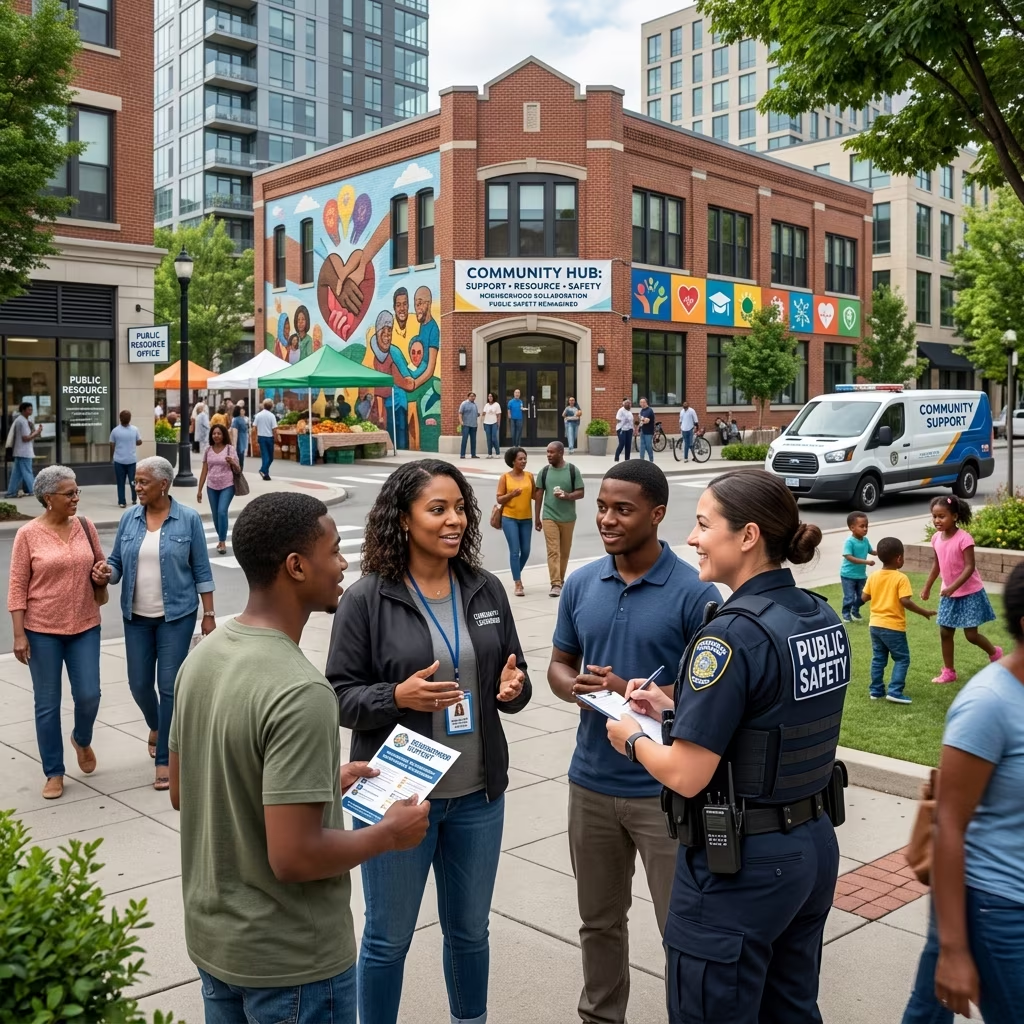
Instead of relying exclusively on armed officers, several forward-thinking municipalities have successfully piloted and scaled alternative crisis response programs. These models prove that a significant percentage of 911 calls do not require a law enforcement presence. By changing the dispatch protocols, cities can send the right professional to the right situation, preserving police resources for severe, violent crimes while providing better care for individuals in distress.
One of the most prominent examples is the CAHOOTS (Crisis Assistance Helping Out On The Streets) model, which has been operating in Eugene, Oregon, for over three decades. The CAHOOTS program dispatches teams consisting of a medic (nurse, paramedic, or EMT) and a crisis worker (who has substantial training and experience in the mental health field) to behavioral health emergencies, intoxication, and homelessness-related calls. The program diverts thousands of calls from the police department each year and boasts a remarkable safety record, requiring police backup in only a tiny fraction of total responses. Furthermore, it saves the city millions of dollars annually in police and emergency medical service costs.
Similarly, the STAR (Support Team Assisted Response) program in Denver, Colorado, pairs mental health clinicians with paramedics to respond to low-risk, public health-related 911 calls. A study supported by the National Institutes of Health evaluated the STAR program and found compelling results. The deployment of mental health workers led to a dramatic 34% reduction in low-level criminal offenses in the targeted precincts during the pilot phase, without any corresponding increase in violent crime.
- De-escalation: Mental health crises are managed by trauma-informed clinicians rather than armed personnel, significantly reducing the likelihood of a violent outcome.
- Cost Efficiency: Dispatching a two-person civilian team costs significantly less per incident than deploying police officers, fire trucks, and ambulances.
- Reduced Incarceration: Vulnerable individuals are diverted away from jails and emergency rooms and connected directly to long-term care, housing, and rehabilitation resources.
- Enhanced Police Focus: Law enforcement officers are freed from handling low-level public health nuisances, allowing them to focus their time and resources on investigating and solving serious violent crimes.
Shifting the Paradigm: From Punitive to Restorative
Redesigning public safety also necessitates a deep philosophical shift from a punitive framework to a restorative one. The traditional American legal system is inherently adversarial and punitive; it focuses almost entirely on determining guilt and administering punishment. This model rarely addresses the needs of the victim and does little to rehabilitate the offender, often leading to high rates of recidivism.
Restorative justice, on the other hand, prioritizes repairing the harm caused by crime and addressing the root causes of anti-social behavior. By investing in communities, supporting trauma-informed care, and utilizing mediation, society can address the underlying socioeconomic drivers of crime. Community mediation centers, youth diversion programs, and victim-offender dialogues offer a path to accountability that does not rely on cages. When communities are equipped with the resources to heal themselves—through robust educational systems, accessible healthcare, and economic opportunity—the reliance on an expansive, militarized police force naturally diminishes. True public safety is not achieved through the threat of force; it is achieved through the presence of resources and the cultivation of healthy, supported communities.
Frequently Asked Questions (FAQ)
What is the difference between “defunding” and “abolishing” the police?
While both terms advocate for a shift away from traditional policing, they represent different points on the reform spectrum. “Defunding” generally refers to the reallocation of municipal funds from police department budgets into social services, mental health care, and community resources. The goal is to reduce the police footprint by limiting their responsibilities. “Abolition” is a broader, long-term vision that seeks to completely dismantle the current punitive justice system and replace it with community-led safety models and restorative justice practices, arguing that the existing system is inherently flawed and cannot be effectively reformed.
If police funds are reduced, who responds to violent crimes?
Advocates for reimagining public safety generally agree that as long as violent crime exists, there will be a need for specialized responders trained to handle dangerous situations. Reallocating funds is about removing police from the 80% to 90% of calls that do not involve violence (like traffic enforcement, mental health checks, and neighbor disputes), thereby allowing a smaller, more specialized force to focus exclusively on severe threats to public safety.
Do alternative crisis response programs actually save taxpayers money?
Yes. Extensive data from programs like CAHOOTS in Oregon and STAR in Colorado demonstrate that civilian response teams operate at a fraction of the cost of traditional police responses. Furthermore, by keeping individuals out of emergency rooms and the jail system—both of which represent massive burdens on taxpayers—these programs offer significant downstream economic savings for municipalities.
References
- A large-scale analysis of racial disparities in police stops across the United States — Stanford Open Policing Project. 2017-07-01. https://openpolicing.stanford.edu/
- A community response approach to mental health and substance abuse crises reduced crime — National Institutes of Health (NIH). 2022-06-08. https://www.ncbi.nlm.nih.gov/pmc/articles/PMC9188032/
- Smartphone Data Reveal Neighborhood-Level Racial Disparities in Police Presence — The Review of Economics and Statistics. 2023-10-25. https://direct.mit.edu/rest/article/doi/10.1162/rest_a_01404/118118
- Federal (De)Funding of Local Police — Georgetown Law Journal. 2022-01-01. https://www.law.georgetown.edu/georgetown-law-journal/in-print/volume-110/federal-defunding-of-local-police/