
Reimagining Crisis Response: Ending Legal Shields in Law Enforcement
To prevent tragedies involving individuals in psychiatric distress, we must rethink police accountability and abolish outdated legal immunities.
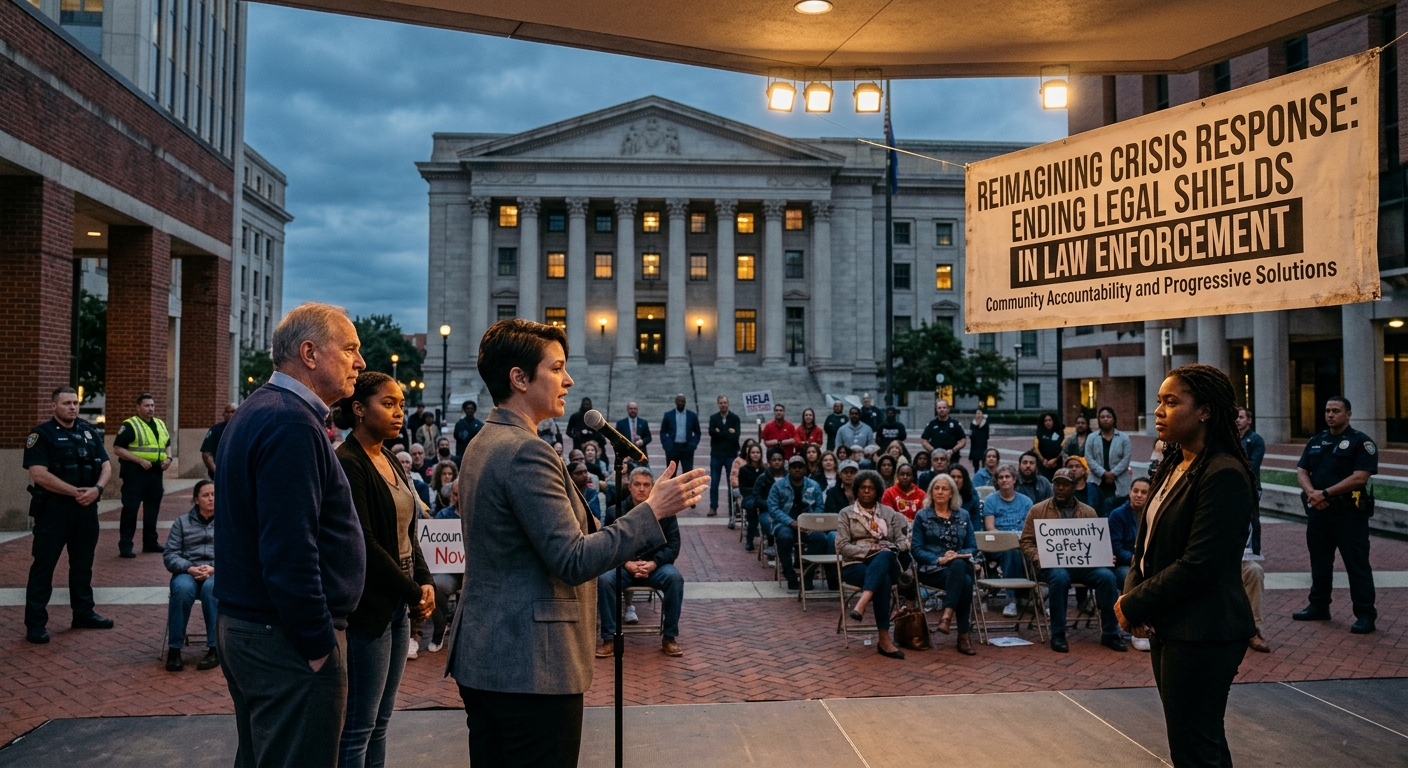
The Fatal Intersection of Mental Health and Law Enforcement
When a family member experiences a sudden, severe medical emergency like a heart attack, the expected response is the immediate arrival of trained paramedics equipped to stabilize and heal. However, when an individual experiences a severe psychiatric emergency, the response is often radically and dangerously different. Instead of medical professionals, the 911 dispatch system routinely sends armed law enforcement officers. For decades, this paradigm has resulted in a staggering number of tragic, entirely preventable deaths. The heartbreak experienced by families is often compounded by a legal system that heavily insulates state actors from accountability. At the center of this systemic failure is a complex judicial doctrine known as qualified immunity.
Qualified immunity serves as a formidable legal shield, protecting government officials—including police officers—from being held personally liable for constitutional violations. While its original proponents argued it was necessary to protect public servants from frivolous lawsuits, in practice, it has evolved into a nearly impenetrable barrier to justice. This legal defense disproportionately impacts the most vulnerable members of society, particularly those suffering from untreated severe mental illness, who often exhibit unpredictable behaviors that are misinterpreted as intentional threats.
The Disproportionate Toll on the Vulnerable
To understand the urgency of legal reform, one must first confront the alarming statistics regarding police encounters with individuals in psychiatric distress. The traditional law enforcement toolkit is built around a command-and-control philosophy. Officers are trained to assert authority, issue loud verbal commands, and demand immediate compliance. When an individual is experiencing psychosis, severe depression, or a manic episode, they are often neurologically incapable of processing these commands or responding rationally. The introduction of sirens, shouting, and drawn weapons typically triggers a primal fight-or-flight response, rapidly escalating the situation.
The outcomes of these mismatched responses are grim. According to comprehensive data from the Treatment Advocacy Center, individuals with untreated severe mental illness are estimated to be 16 times more likely to be killed during a police encounter than other civilians. Furthermore, an ongoing database maintained by The Washington Post reveals that approximately one-quarter of all fatal police shootings since 2015 have involved victims who were experiencing a mental health crisis. These are not merely statistics; they represent systemic failures where medical crises were treated as criminal acts, ending in lethal force rather than therapeutic intervention.
Demystifying the Legal Barrier
To grasp why these tragedies rarely result in civil liability, we must examine the mechanics of civil rights litigation in the United States. Following the Civil War, Congress enacted the Civil Rights Act of 1871, now widely known as 42 U.S.C. Section 1983. This statute was specifically designed to allow citizens to sue state and local officials who deprive them of their constitutional rights. For over a century, it stood as a primary mechanism for civil rights accountability.
However, the modern landscape of Section 1983 litigation was radically altered by the Supreme Court. In the 1982 case Harlow v. Fitzgerald, the Court established the modern framework for qualified immunity. The doctrine dictates that an official is immune from civil damages unless their conduct violated “clearly established statutory or constitutional rights of which a reasonable person would have known.” While this standard sounds reasonable in theory, its practical application has created a labyrinthine obstacle course for plaintiffs seeking justice for excessive force.
The “Clearly Established” Catch-22
The core dysfunction of qualified immunity lies in how the courts define “clearly established.” To overcome the immunity defense, a plaintiff must typically point to a previously decided case with nearly identical factual circumstances where a court ruled that the officer’s actions were unconstitutional. If no such identical precedent exists, the officer is granted immunity, the case is dismissed, and crucially, no new precedent is established for future victims.
This creates a bizarre and deeply unjust Catch-22. Because courts frequently dismiss cases on immunity grounds without ever ruling on whether the underlying action was actually unconstitutional, the body of “clearly established” law stagnates. For individuals in mental health crises, this requirement is particularly devastating. Psychiatric emergencies are inherently chaotic, unique, and highly fluid. Finding a prior court case with the exact same sequence of erratic behaviors, environmental factors, and police responses is virtually impossible. Consequently, officers who use lethal force against individuals exhibiting severe psychiatric symptoms are almost routinely granted immunity, regardless of how unnecessary or reckless their actions may have been.
How Legal Shields Stifle Systemic Reform
The impact of qualified immunity extends far beyond individual lawsuits; it acts as an anchor dragging down systemic municipal reform. In the ecosystem of local government, financial liability is one of the most potent catalysts for institutional change. When municipalities are forced to pay substantial damages for the unconstitutional actions of their employees, risk management departments are incentivized to overhaul training, revise use-of-force policies, and implement safer protocols.
By effectively cutting off the threat of financial liability, qualified immunity removes the economic pressure required to force systemic evolution. If a city knows that civil rights lawsuits stemming from fatal mental health calls will likely be dismissed before trial, there is little financial urgency to invest in alternative response models. The legal shield effectively subsidizes the dangerous status quo, allowing cities to continue relying on armed law enforcement as the default, and often only, response to psychiatric emergencies.
Alternative Response Models: A Path Forward
Abolishing or heavily modifying these legal shields would undoubtedly accelerate the adoption of non-police crisis response models. Across the country, progressive jurisdictions are proving that mental health emergencies do not require a law enforcement presence. Programs that dispatch unarmed teams of licensed clinical social workers, paramedics, and peer support specialists have shown immense success in de-escalating crises without the use of force.
| Feature | Traditional Law Enforcement Response | Civilian Crisis Response Teams |
|---|---|---|
| Primary Goal | Establish control, secure the scene, enforce laws | De-escalate distress, provide medical/psychiatric care |
| Tools & Equipment | Firearms, tasers, handcuffs, sirens | Medical kits, therapeutic communication, transport vans |
| Training Focus | Command presence, threat neutralization, criminal code | Trauma-informed care, psychology, harm reduction |
| Typical Outcome | Arrest, involuntary commitment, or use of force | Stabilization in place, voluntary transport to clinics |
By removing the protective blanket of qualified immunity, municipalities would be forced to calculate the true cost of deploying armed officers to medical events. The inherent risk of constitutional violations and subsequent liability would make civilian crisis response teams not just a moral imperative, but a fiscal necessity.
Legislative Pathways to Change
While the courts created this doctrine, legislative bodies possess the power to dismantle it. Reform efforts are actively being pursued at both the federal and state levels. Federally, legislation has been proposed repeatedly to amend Section 1983, explicitly stating that qualified immunity is not a defense to civil rights violations. Such a sweeping federal change would restore the original intent of the 1871 Civil Rights Act and provide a uniform standard of accountability across the nation.
In the absence of federal action, several states have taken the initiative to bypass the federal doctrine entirely. States like Colorado and New Mexico have passed landmark legislation creating state-level civil rights causes of action that explicitly prohibit the use of qualified immunity as a defense. These state-level reforms provide a critical blueprint, proving that the sky does not fall when law enforcement officers are held to the same standards of legal accountability as ordinary citizens.
Conclusion
The intersection of severe mental illness and law enforcement is one of the most perilous crossroads in the American justice system. We cannot continue to treat psychiatric illness as a crime, nor can we accept the collateral damage of a system that shields unnecessary violence from legal scrutiny. Ending qualified immunity is not about punishing police; it is about restoring balance, honoring civil rights, and ensuring that families can seek meaningful justice. Only by dismantling these outdated legal barriers can we truly incentivize a shift toward compassionate, health-centered crisis response models that save lives rather than take them.
Frequently Asked Questions
What exactly is qualified immunity?
It is a judicial doctrine created by the Supreme Court that protects government officials, including police officers, from being sued for civil damages. An official is immune unless a plaintiff can prove that the official violated a “clearly established” statutory or constitutional right, which usually requires finding a nearly identical prior court case.
Why are police currently the primary responders to mental health crises?
Historically, the United States has chronically underfunded community-based mental health infrastructure. As psychiatric hospitals closed and community clinics failed to receive adequate funding, the 911 dispatch system and local police departments became the default social safety net by necessity, despite lacking the appropriate medical training.
How does ending qualified immunity help people with mental illness?
Removing this legal shield allows victims and their families to hold officers and municipalities financially accountable for excessive force. This threat of liability forces cities to rethink their strategies, heavily incentivizing them to deploy unarmed medical professionals and social workers to psychiatric calls instead of armed police officers.
Can Congress eliminate this doctrine?
Yes. Because qualified immunity is a judicial interpretation of a federal statute (42 U.S.C. Section 1983), Congress has the absolute authority to pass new legislation amending the law to explicitly forbid the use of the immunity defense in civil rights cases.
References
- Overlooked in the Undercounted: The Role of Mental Illness in Fatal Law Enforcement Encounters — Treatment Advocacy Center. 2015-12-01. https://www.treatmentadvocacycenter.org/storage/documents/overlooked-in-the-undercounted.pdf
- Fatal Force Database — The Washington Post. 2024-12-31. https://www.washingtonpost.com/graphics/investigations/police-shootings-database/
- Qualified immunity — Legal Information Institute (LII), Cornell Law School. https://www.law.cornell.edu/wex/qualified_immunity
- Qualified Immunity Cases — Constitution Annotated, Congress.gov, Library of Congress. https://constitution.congress.gov/browse/essay/amdt4-7-4/ALDE_00013727/
Similar Articles








Read full bio of medha deb




