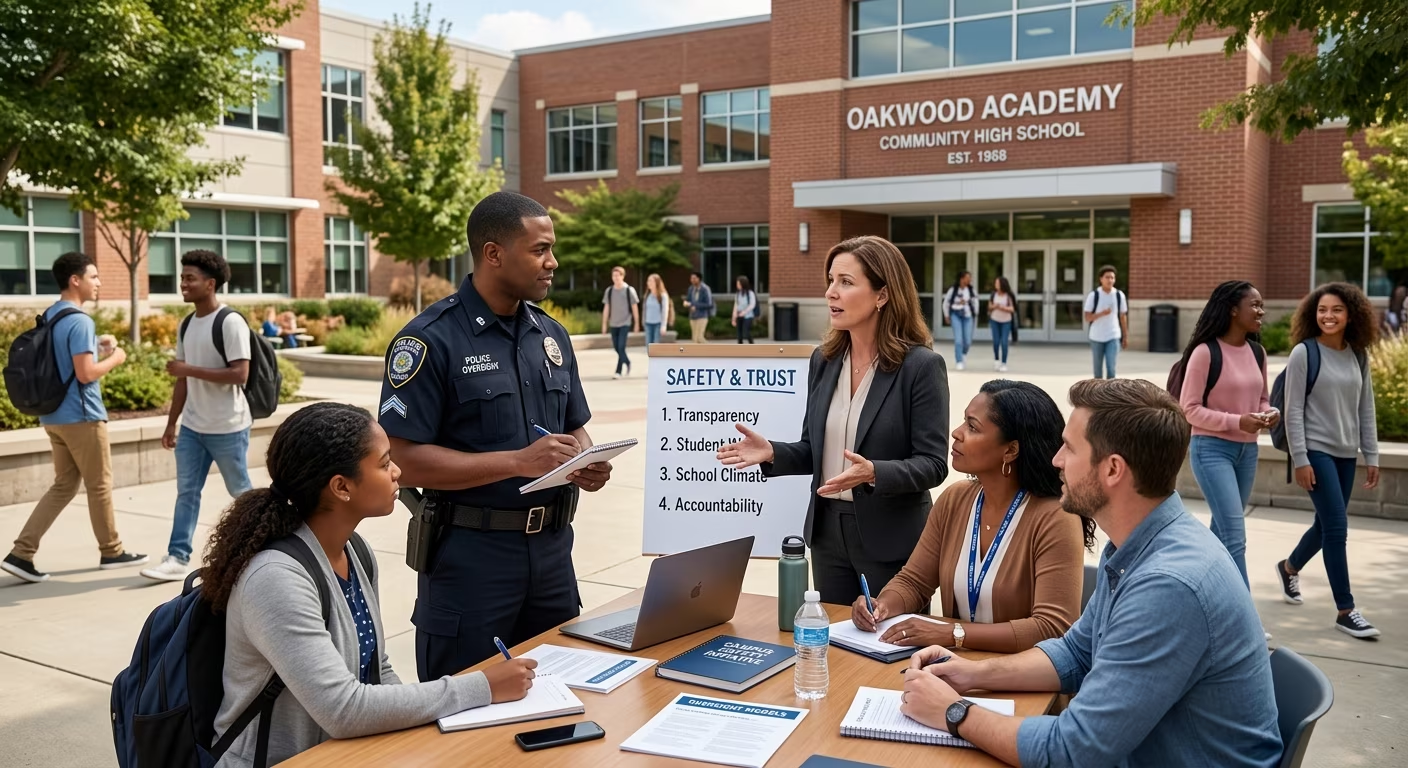
The fundamental right to a safe, supportive, and nurturing educational environment is a cornerstone of a functional society. However, the methods utilized to achieve this safety have become a subject of intense national scrutiny. Over the past few decades, the traditional paradigm of school discipline—once managed internally by principals, teachers, and guidance counselors—has been increasingly outsourced to armed law enforcement. The presence of sworn law enforcement personnel in educational settings, commonly referred to as School Resource Officers (SROs), has fundamentally transformed the atmosphere of the modern public school.
While the stated objective of integrating police into schools is to protect students from external threats and internal violence, the reality of this integration is far more complex. Without rigorous oversight, transparent accountability metrics, and clearly defined operational boundaries, the deployment of police in schools frequently undermines the educational mission. It shifts the institutional focus from academic development and emotional support to surveillance, control, and criminalization, creating a system that disproportionately harms the most vulnerable student populations.
The Historical Context: How Police Entered Our Classrooms
The widespread presence of police in schools is a relatively modern phenomenon. Prior to the 1990s, the vast majority of student behavioral issues were handled through internal administrative channels. However, a combination of high-profile tragic events and federal funding initiatives designed to increase community policing dramatically altered the landscape of school security. According to the Bureau of Justice Statistics, the deployment of SROs expanded rapidly, effectively intertwining local municipal police departments with daily educational operations across thousands of school districts .
Schools began to resemble secure facilities, complete with metal detectors, surveillance cameras, and uniformed, armed officers patrolling the hallways. This environmental shift had a profound psychological impact on the student body. Instead of viewing the school as a safe harbor for learning and personal growth, many students, particularly those in underfunded urban districts, began to experience their educational environment as an extension of the criminal justice system. The normalization of an armed presence within the learning environment inherently altered the relationship between youth and authority, setting the stage for systemic issues related to discipline and punishment.
Navigating the Realities of the School-to-Prison Pipeline
At the heart of the debate over police accountability in schools is the concept of the “school-to-prison pipeline.” This term describes the systemic and institutionalized funneling of youth out of mainstream public schools and directly into the juvenile and adult criminal justice systems. The pipeline is not a singular policy, but rather a culmination of zero-tolerance disciplinary practices and the heavy reliance on law enforcement to manage student behavior .
The consequences of this pipeline are devastatingly unequal. The U.S. Department of Education’s Office for Civil Rights, through its comprehensive Civil Rights Data Collection (CRDC), consistently reveals glaring disparities in how discipline is administered . Data robustly demonstrates that Black, Indigenous, and Hispanic students, alongside students possessing physical or cognitive disabilities, face a vastly disproportionate rate of suspensions, expulsions, and school-related arrests compared to their white, non-disabled peers. These marginalized students are frequently penalized more harshly for the exact same subjective infractions, such as insubordination or disrespect. When an SRO is involved, what might have been a routine trip to the principal’s office rapidly escalates into a formal criminal citation or physical arrest, permanently altering a student’s life trajectory.
The Thin Line: Routine Discipline Versus Criminalization
One of the most critical issues surrounding SROs is the blurring of lines between routine adolescent misbehavior and actual criminal conduct. Adolescence is a period of significant neurological and emotional development. Teenagers are biologically prone to testing boundaries, experiencing mood swings, and displaying poor impulse control. Historically, educators trained in pedagogy and child development managed these behaviors through detention, parent-teacher conferences, or counseling.
However, when sworn police officers are tasked with maintaining order in a classroom or hallway, they often apply the only tools they are extensively trained to use: the penal code and physical force. Research supported by the National Institute of Justice highlights that SROs frequently experience profound “role conflict” . Officers trained in traditional, street-level enforcement tactics are suddenly placed in environments requiring nuanced, de-escalation strategies tailored for minors. Consequently, a minor physical scuffle between two students can result in assault and battery charges. A student refusing to hand over a mobile phone or arguing with a teacher can lead to an arrest for disorderly conduct or resisting a public officer. This criminalization of normative adolescent behavior introduces children to the justice system at a vulnerable age, severely increasing the likelihood of future incarceration and significantly decreasing their chances of graduating high school.
Core Pillars of Accountability: The Necessity of Formal Agreements
When police departments operate inside educational institutions, ambiguity is inherently dangerous. To mitigate the risks associated with an armed presence on campus, schools and law enforcement agencies must establish robust accountability frameworks. The most fundamental tool for this is a Memorandum of Understanding (MOU). An MOU is a formal, legally binding contract that explicitly defines the roles, responsibilities, and limitations of law enforcement personnel operating within the school environment. Without a stringent MOU, SROs often operate in a jurisdictional gray area, possessing the power of a police officer but lacking the educational mandate of a teacher.
A comprehensive and effective MOU must include several critical components:
- Clear Jurisdictional Boundaries: The agreement must explicitly state that SROs are not school disciplinarians. They must be prohibited from intervening in routine code-of-conduct violations, dress code issues, or minor classroom disruptions.
- Mandatory Data Transparency: Accountability requires visibility. MOUs should mandate the regular, public reporting of all stops, searches, use of force incidents, and arrests. Crucially, this data must be disaggregated by race, gender, and disability status to monitor and address systemic biases.
- Specialized Training Requirements: A badge and a firearm do not equate to pedagogical expertise. Officers stationed in schools must be required to complete extensive, ongoing training in adolescent brain development, trauma-informed care, conflict resolution, and specific de-escalation techniques for youth in mental health crises.
- Strict Interrogation Protocols: The rights of minors must be fiercely protected. MOUs should guarantee that parents or legal guardians are immediately contacted and physically present before any student is questioned or interrogated by law enforcement on school grounds.
A New Vision: Alternative Frameworks for Student Well-Being
Recognizing the inherent risks of the traditional policing model in schools, a growing coalition of educators, psychologists, and civil rights advocates are proposing alternative frameworks for student well-being. This movement argues that the millions of dollars currently allocated to municipal police contracts could be far more effectively spent on supportive, rather than punitive, resources. By investing in mental health professionals, guidance counselors, social workers, and school psychologists, districts can proactively address the root causes of behavioral issues.
Many behavioral outbursts are symptoms of underlying trauma, poverty, food insecurity, or undiagnosed learning disabilities. An armed officer cannot arrest away trauma, but a qualified counselor can provide the necessary interventions to help a student thrive. Furthermore, schools are increasingly adopting restorative justice practices. Instead of utilizing exclusionary punishments that isolate and marginalize students, restorative models focus on accountability, mediation, and repairing the harm caused to the community. This approach fosters emotional intelligence and empathy, creating a genuinely safer and more cohesive school climate.
Comparative Overview of Campus Safety Paradigms
To understand the shift in educational strategy, it is helpful to contrast the traditional SRO model with restorative support frameworks.
| Core Aspect | Traditional SRO Policing Model | Restorative & Supportive Framework |
|---|---|---|
| Primary Response to Conflict | Exclusionary discipline, citations, physical arrests, and court referrals. | Mediation, peer counseling, behavioral intervention, and repairing harm. |
| Underlying Philosophy | Punitive: Focuses on establishing order through the threat of legal consequences. | Rehabilitative: Focuses on understanding root causes and fostering emotional growth. |
| Resource Allocation | Municipal police contracts, security hardware, and surveillance systems. | Hiring school psychologists, licensed social workers, and behavioral therapists. |
| Long-Term Impact on Student | Increased likelihood of dropout, recidivism, and permanent criminal records. | Higher graduation rates, improved emotional regulation, and stronger community ties. |
Community Advocacy and the Path Forward
The push for police accountability within schools is not happening in a vacuum; it is driven by relentless grassroots advocacy. Across the nation, parents, student-led organizations, and civil rights groups are challenging the status quo at local school board meetings and state legislatures. They are demanding comprehensive audits of SRO programs, fighting for the implementation of strict MOUs, and pushing back against the deeply entrenched narratives that equate police presence with student safety.
In several progressive districts, this advocacy has led to historic decisions to entirely sever contracts with local police departments, reallocating those critical funds directly into student support services. The path forward requires a fundamental societal shift in how we view our youth. If the ultimate goal of the educational system is to nurture well-rounded, capable, and healthy citizens, then the methods used to protect them must align with those educational values. Accountability cannot stop at the schoolhouse door; it must be the foundation upon which all campus safety policies are built.
Frequently Asked Questions (FAQs)
What exactly is a School Resource Officer (SRO)?
A School Resource Officer is a sworn law enforcement officer, typically employed by a local police department or sheriff’s office, who is assigned to work within a public school. Unlike private security guards, SROs have full arrest powers and carry firearms. While their stated goal is campus security, their involvement in daily school activities frequently leads to the criminalization of standard student misconduct.
How does the school-to-prison pipeline disproportionately affect students with disabilities?
Students with physical, emotional, or cognitive disabilities often exhibit behaviors that are symptoms of their conditions, such as sudden outbursts or difficulty regulating emotions. Without properly trained special education staff, schools often rely on SROs to manage these situations. Because SROs generally lack training in special education and trauma-informed care, they frequently respond with physical force or legal citations, punishing the student for manifestations of their disability.
Why is an MOU critical for school safety?
A Memorandum of Understanding (MOU) serves as the rulebook for police operating in schools. Without an MOU, officers operate with immense discretion, which often leads to over-policing and rights violations. An MOU protects students by strictly separating school discipline from criminal law, mandating specialized youth training for officers, and requiring transparent data collection to identify and eliminate racially biased policing practices.
Can restorative justice effectively prevent violence in schools without police?
Yes. Extensive research indicates that restorative justice programs, when fully funded and properly implemented, significantly reduce behavioral incidents and recidivism. By addressing the root causes of conflict—such as interpersonal trauma, bullying, or resource insecurity—restorative justice creates a culture of mutual respect and accountability. It prevents violence by fostering a supportive community environment, whereas traditional policing merely reacts to violence after it occurs, often exacerbating the underlying tensions.
References
- 2020-21 Civil Rights Data Collection A First Look — U.S. Department of Education Office for Civil Rights. 2023-11-15. https://civilrightsdata.ed.gov/
- School Resource Officers, 2019–2020 — Bureau of Justice Statistics. 2023-11-14. https://bjs.ojp.gov/library/publications/school-resource-officers-2019-2020
- The Alignment Between Community Policing and the Work of School Resource Officers — National Institute of Justice. 2022-01-01. https://nij.ojp.gov/library/publications/alignment-between-community-policing-and-work-school-resource-officers
- Breaking the School-To-Prison Pipeline: Implications of Removing Police from Schools — Office of Justice Programs. 2024-01-01. https://www.ojp.gov/library/publications/breaking-school-prison-pipeline-implications-removing-police-schools-racial