
Can You Skip Mandatory Service Fees on Your Bill?
Unpack the legal rules surrounding mandatory gratuities in restaurants: when they're enforceable, your rights to dispute them, and smart strategies for diners.
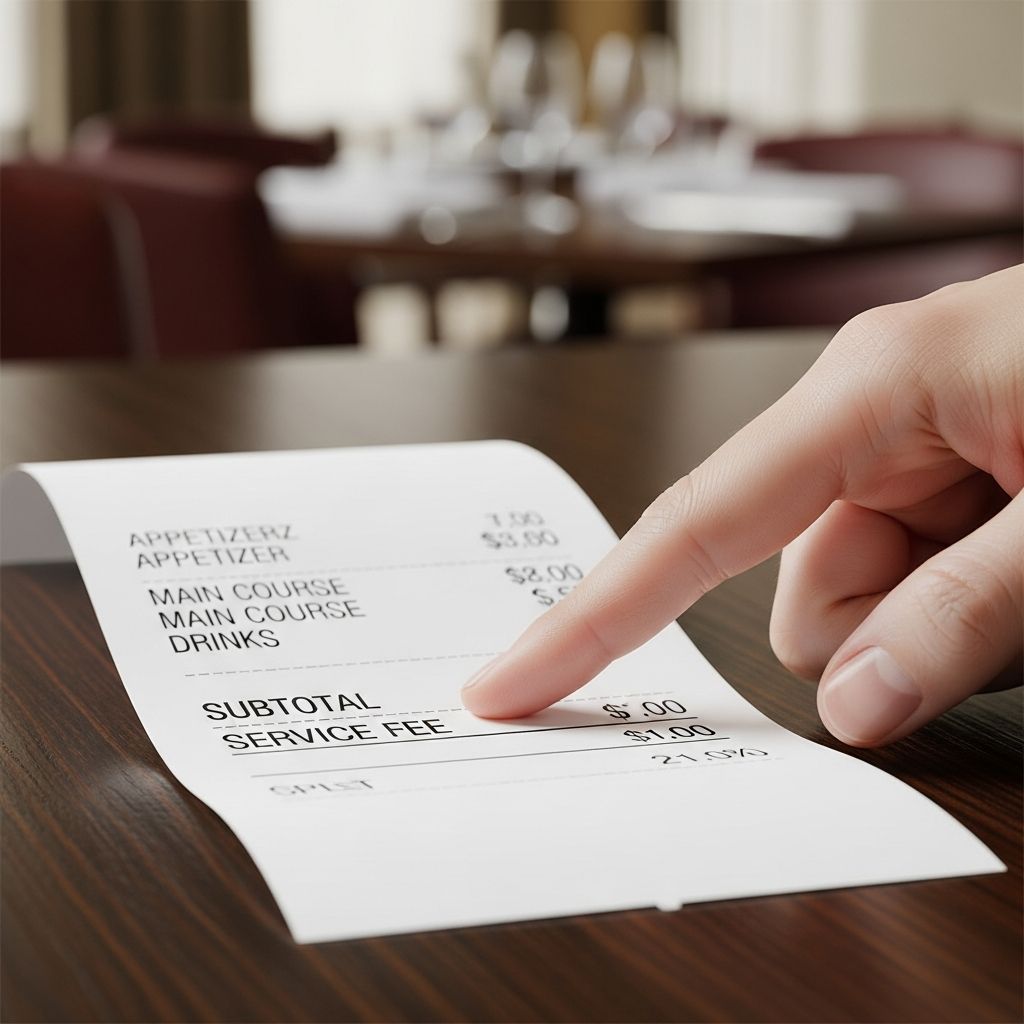
Mandatory service fees, often labeled as auto-gratuities or service charges, appear on many restaurant bills, particularly for large groups. While traditional tipping remains voluntary, these fees raise questions about diner obligations and legal recourse. Federal law under the Fair Labor Standards Act (FLSA) distinguishes service charges from tips, treating the former as business revenue rather than employee property. This means restaurants can enforce them if properly disclosed, but diners have options if disclosure fails or disputes arise.
Understanding Service Charges vs. Voluntary Tips
Service charges differ fundamentally from tips. A voluntary tip belongs solely to the employee, while a service charge is the restaurant’s property, even if distributed to staff. Restaurants commonly add 18-20% fees for parties of six or more, or at events, to cover operational costs amid low base wages for tipped workers.
Federal guidelines allow employers to pay tipped employees a base wage of $2.13 per hour, with tips covering the difference to reach $7.25 minimum wage via ‘tip credit’. Service charges do not count toward this credit, as they aren’t tips. This distinction affects enforceability: undisclosed fees may be contestable, but advertised ones typically stand.
- Voluntary Tip: Customer choice, employee-owned, 15-20% customary.
- Mandatory Service Charge: Restaurant-imposed, business revenue, must be pre-disclosed on menus.
Legal Framework Governing Gratuities
The FLSA, amended in 2020, prohibits employers, managers, or supervisors from retaining tips and regulates tip pooling. Tip pools can include back-of-house staff if no tip credit is taken, but service charges remain separate. States layer additional rules: some ban tip credits entirely, requiring full minimum wage plus tips.
| State Example | Tip Credit Allowed? | Key Rule |
|---|---|---|
| California | No | Full minimum wage; no credit card fee deductions from tips. |
| Connecticut | Yes | $6.38 base for servers + up to $9.97 credit. |
| Texas | Federal Only | $7.25 min via FLSA; no state wage law. |
| Hawaii | Yes | Tips + wage must exceed min by $7.00. |
Enforceability hinges on notice: menus, signs, or verbal warnings must alert customers before service. Absent disclosure, courts may reclassify the charge as a tip, granting diners refusal rights.
When Restaurants Can Legally Add Fees
Restaurants in tourist areas frequently impose fees for large groups to offset unfamiliarity with U.S. norms, where servers rely on tips for 70-80% of income. Federal law permits this if transparent. For instance, a 20% fee on an $800 group bill ($160) is binding if menu-stated.
Post-2020 FLSA rules clarify: mandatory gratuities aren’t tips, so employers can retain them fully, unlike voluntary gratuities. However, mislabeling a service charge as a ‘tip’ triggers tip laws, making it employee property and potentially refundable if refused.
Diner Rights: Refusing or Negotiating Fees
You cannot unilaterally refuse a properly disclosed mandatory fee without consequences, as it’s part of the contract upon ordering. Attempting to walk out risks trespass charges or collections. Strategies include:
- Review menus pre-order for fee notices.
- Request fee removal politely if service was poor, though success varies.
- Dispute with credit card issuer if undisclosed; chargeback success rates high for surprise fees.
- Leave extra if service exceeds, atop the fee.
Courts uphold fees with proof of notice (receipts, menus). In disputes, evidence like photos bolsters claims of non-disclosure.
State-by-State Variations in Tipping Rules
U.S. tipping lacks uniformity. Seven states (AK, CA, MN, MT, NV, OR, WA) mandate full minimum wage without tip credits. Others cap credits or exclude pooling. Tip pooling laws: mandatory only among tipped staff; managers excluded.
In credit card scenarios, some states prohibit fee deductions from tips. For 2025-2026, federal min remains $7.25, tipped $2.13, unchanged since 2009 despite inflation.
Tip Pooling and Employer Controls
Employers can’t retain tips but can require pooling among tipped employees. 2018 CAA amendments allow broader pools (cooks, dishwashers) sans tip credit. Violations invite DOL penalties. Service charges bypass pooling, going to restaurant discretion.
Common Pitfalls and Real-World Scenarios
Scenario 1: Group of 8. Menu notes 18% fee; bill includes it. Payment required; add more voluntarily.
Scenario 2: Undisclosed Fee. No menu mention; contest at register or chargeback.
Scenario 3: Poor Service. Fee stands if disclosed; tip adjustments only affect voluntary portions.
Wage theft claims arise if service charges substitute tips without wage compliance. Diners report issues to state labor departments.
Evolving Trends and No-Tip Movements
Some establishments eliminate tipping, paying full wages ($15+), passing costs via higher prices. This sidesteps fee disputes but remains minority. Internationals face ‘tip anxiety’ from 20-25% expectations.
Frequently Asked Questions
What if the mandatory fee isn’t on the menu?
It’s disputable; request removal or chargeback, as lack of prior notice voids enforceability.
Can restaurants chase me for non-payment?
Yes, for disclosed fees; refusal may lead to denied future service or legal action on large bills.
Are service charges taxable as tips?
No, they’re business income, not reported as employee tips.
Does poor service excuse the fee?
Not legally if mandatory and disclosed; negotiate, but no automatic waiver.
What’s the standard tip atop a service charge?
None required; customary to add 0-5% extra for exceptional service.
Practical Advice for Diners and Servers
Diners: Scan for fees, tip generously where voluntary. Servers: Know state laws to avoid disputes. Both benefit from transparency.
In summary, mandatory fees are legal with notice, distinct from tips under FLSA. Stay informed to navigate confidently.
References
- Tipping Etiquette in the United States — RelocateUSA. 2023. https://relocateusa.com/tipping-etiquette-in-the-united-states/
- Tipping Laws by State Library — Tiphaus. 2025. https://www.tiphaus.com/resources/tip-regulations-by-state/
- Your guide to tipping laws by state (2025) — Workforce.com. 2025-01-01. https://workforce.com/news/your-guide-to-tipping-laws-by-state
- Tipping and gratuity — EBSCO Research Starters. 2024. https://www.ebsco.com/research-starters/economics/tipping-and-gratuity
- Are Tips Illegal in the United States? — Morgan & Morgan (For The People). 2025-04-25. https://www.forthepeople.com/blog/are-tips-illegal-united-states/
- Tipping in America: The Ultimate Guide for 2024 — Qantas Travel Insider. 2024. https://www.qantas.com/travelinsider/en/travel-tips/gratuities-and-tipping-in-america.html
- Tip Regulations under the Fair Labor Standards Act (FLSA) — U.S. Department of Labor. 2025. https://www.dol.gov/agencies/whd/flsa/tips
Similar Articles








Read full bio of Sneha Tete


