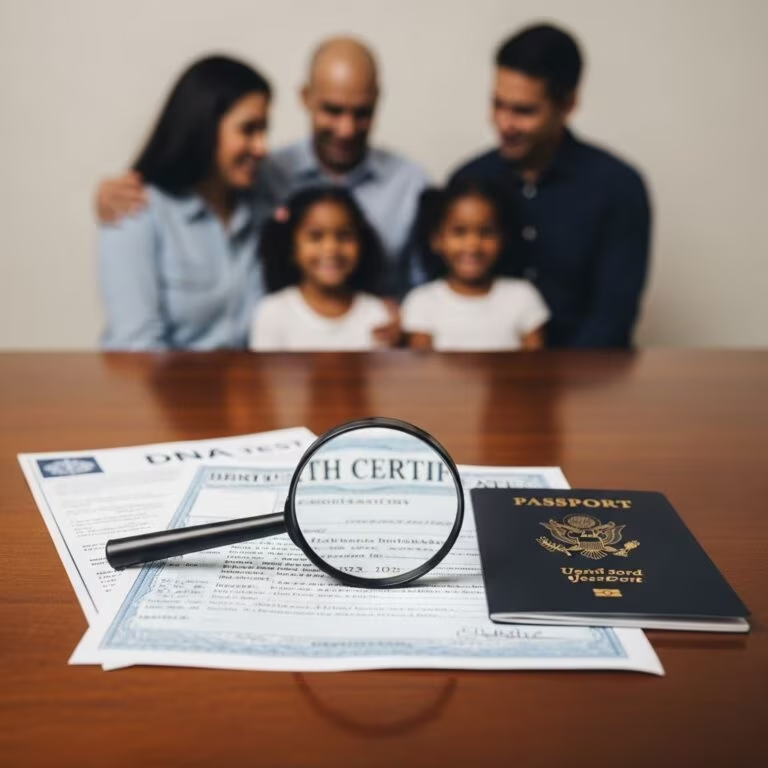
For over a decade, the American political discourse surrounding immigration reform has been heavily anchored to a specific, deeply sympathetic image: the “Dreamer.” These young people, brought to the United States as children, have been the focal point of the Deferred Action for Childhood Arrivals (DACA) program and countless legislative battles. They have been portrayed as valedictorians, military service members, and essential workers who know no other home than the United States. While their fight for permanent legal status remains fundamentally critical, framing the entirety of the immigration reform movement around this single demographic has created unintended consequences.
The modern immigrant rights movement is currently undergoing a massive paradigm shift. Activists, policy experts, and community leaders are pushing back against the narrow media narratives that divide undocumented immigrants into “deserving” and “undeserving” categories. True justice, they argue, cannot leave out the parents who brought those Dreamers across the border. It cannot exclude the millions of essential laborers who pick crops, clean buildings, and build infrastructure but lack formal education credentials. And it absolutely must address the intersecting forces of the criminal justice system and immigration enforcement that disproportionately target marginalized communities. This comprehensive vision requires us to look past the carefully curated faces of immigration reform and confront the systemic realities of a broken policy framework.
Re-evaluating the “Good Immigrant” Paradigm
The narrative of the “good immigrant” is a powerful political tool. By highlighting the exceptional achievements of young, educated DACA recipients, advocates successfully captured the hearts of the American public. However, this strategy inherently casts a shadow over those who do not fit the mold. When policies are drafted solely to protect young people with clean records and high school diplomas, they implicitly suggest that older immigrants, those who work in low-wage sectors, or individuals who have had minor encounters with law enforcement are unworthy of protection.
This dichotomy is not only morally fraught but strategically limiting. It ignores the fundamental reality that families are interconnected ecosystems. A DACA recipient may have temporary protection from deportation, but their parents, siblings, and extended family members might remain entirely vulnerable. A movement that fails to advocate for the whole family unit ultimately fails to provide genuine security. The push for a more holistic approach demands that policymakers recognize the inherent human dignity of all undocumented individuals, regardless of their economic output, age of entry, or educational attainment.
By the Numbers: The Reality of the Unauthorized Population
To understand the necessity of broadening the movement, one must look at the demographic realities of the United States. According to the Pew Research Center, an estimated 14 million unauthorized immigrants lived in the United States in 2023, reflecting significant demographic shifts and the complex nature of global migration .
Within this massive population, DACA recipients represent only a fraction. As of recent estimates, roughly 600,000 individuals actively hold DACA status, and researchers at KFF note that the broader DACA-eligible population is aging and becoming increasingly precariously situated as legislative solutions stall . If the immigration reform movement restricts its legislative capital to saving only this fraction, it leaves over 13 million people in a permanent state of legal limbo.
These millions are deeply embedded in American society. They are homeowners, taxpayers, and consumers. They have American citizen children and spouses. The data clearly shows that the unauthorized immigrant population is not a transient group; it is a permanently settled demographic that has established deep roots in communities from rural agricultural hubs to major metropolitan centers. Addressing their status is not merely a matter of border policy, but a crucial element of domestic social stability and human rights.
The Backbone of the Economy: Undocumented Labor
Any serious conversation about immigration reform must acknowledge the profound economic integration of undocumented workers. According to the Bureau of Labor Statistics (BLS), foreign-born workers—a category that includes naturalized citizens, lawful permanent residents, and undocumented immigrants—make up a critical and growing segment of the civilian labor force . While the BLS does not disaggregate undocumented workers entirely, demographic analyses consistently reveal that unauthorized immigrants participate in the labor force at incredibly high rates, filling essential societal roles.
The American economy relies heavily on this workforce to sustain vital industries. From construction and agriculture to hospitality and domestic care, undocumented laborers fill physically demanding roles that are essential to the nation’s supply chains and daily operations. Yet, because of their lack of legal status, these workers are uniquely vulnerable to exploitation. Unscrupulous employers can easily suppress wages, ignore safety regulations, and threaten deportation if workers attempt to unionize or report severe labor violations.
Comprehensive immigration reform is, therefore, intrinsically linked to labor rights. Providing a pathway to legal status is the most effective way to raise the floor for all workers in the country. When undocumented immigrants can legally advocate for fair wages and safe conditions without fear of reprisal, the standards for the entire industry improve. Recognizing the economic contributions of the broader undocumented population moves the conversation away from charity and towards fundamental economic fairness and systemic stability.
The Dangers of Systemic Criminalization
Perhaps the most urgent reason to expand the scope of the immigration reform movement is the escalating criminalization of immigrant communities. For decades, federal enforcement policies have increasingly intertwined the criminal legal system with immigration enforcement. This convergence has created a dual system of punishment where minor infractions can result in permanent exile and the destruction of families.
Human Rights Watch has extensively documented the devastating impact of this criminalization, particularly through the lens of the “war on drugs.” Reports show that thousands of immigrants, including those with legal permanent residency, are deported every year for minor drug offenses—some of which are no longer even considered crimes under modern state laws . This framework systematically penalizes Black and Latino immigrants, who are already disproportionately targeted by domestic policing, and subjects them to double jeopardy: they serve their criminal sentences only to be subsequently handed over to immigration authorities for prolonged detention and deportation.
When the immigration movement focuses solely on “perfect” victims, it leaves these individuals behind. Grassroots organizers are working tirelessly to dismantle the narrative that individuals with a minor criminal record deserve to be permanently banished from their families and communities. True reform requires decoupling local law enforcement from federal immigration enforcement, ending the use of for-profit detention centers, and recognizing that a past mistake should not equal a life sentence of family separation.
Grassroots Power: Intersectionality in the Fight for Reform
The shift away from a narrow, single-issue focus has been driven largely by grassroots organizers who understand that immigration does not exist in a vacuum. Today’s movement is deeply intersectional, drawing critical connections between immigrant rights, racial justice, labor equality, and climate activism.
Local community groups are leading the charge by emphasizing that the fight for immigrant rights is inextricably tied to the fight against systemic racism. Black undocumented immigrants, for example, face incredibly high risks of deportation due to the over-policing of marginalized neighborhoods. By centering these overlapping vulnerabilities, the movement is building broader, much more formidable coalitions. Labor unions are partnering with immigrant rights organizations to fight for workplace safety and fair wages across the board. Civil rights groups are joining forces to combat discriminatory policing that feeds the deportation pipeline. This solidarity is creating a more resilient and powerful political force that demands comprehensive solutions rather than piecemeal, conditional legislative concessions.
Charting the Path to Comprehensive Immigration Reform
What does a truly inclusive vision for the future look like? The Migration Policy Institute notes that the concept of Comprehensive Immigration Reform historically involves a delicate balance of enhanced border security, modernization of the visa system, and a pathway to legal status for the unauthorized population . However, the modern movement demands that reform go much further than the restrictive legislative compromises of the past.
First, a realistic pathway to citizenship must be broad and accessible, without arbitrary cutoffs based on educational attainment or perfectly unblemished records. It must account for the realities of over-policing in minority communities. Second, reform must address the massive backlogs in the current legal immigration system, which keep families arbitrarily separated for decades while waiting for visas. Third, it requires a fundamental rethinking of border policy—shifting away from hyper-militarization and mass detention toward a system that respects international asylum laws, basic human rights, and inherent human dignity.
Ultimately, the goal is to build an immigration system that reflects the complex reality of modern human migration. It is about acknowledging that the millions of individuals living in the shadows are not abstract political pawns; they are neighbors, essential workers, and integral members of the American fabric.
Frequently Asked Questions (FAQ)
What is the difference between a DACA recipient and an undocumented immigrant?
DACA (Deferred Action for Childhood Arrivals) is a specific administrative program that provides temporary protection from deportation and work authorization to certain individuals who were brought to the U.S. as children. All DACA recipients lack permanent legal status, but they make up only a small fraction of the total undocumented population in the United States.
Why is focusing only on “Dreamers” considered problematic by some advocates?
Focusing exclusively on “Dreamers” creates a “good immigrant versus bad immigrant” narrative. It implies that only those who came as children and achieved specific educational goals are worthy of legal protection, leaving out their parents, older laborers, and individuals who may have minor criminal records due to systemic over-policing.
How does immigration enforcement intersect with the criminal justice system?
Local law enforcement often collaborates with federal immigration agencies. This means that a minor traffic stop or a low-level misdemeanor can trigger a deportation proceeding, a system that disproportionately impacts marginalized communities who already face higher rates of domestic policing.
What does “Comprehensive Immigration Reform” mean?
Comprehensive Immigration Reform (CIR) refers to broad legislative efforts to overhaul the U.S. immigration system. Historically, it includes creating a pathway to citizenship for undocumented immigrants, updating the legal visa system to meet labor and family needs, and adjusting border enforcement strategies to be more humane and efficient.
References
- Record 14 Million Unauthorized Immigrants Lived in the US in 2023 — Pew Research Center. 2025-08-21. https://www.pewresearch.org/short-reads/2025/08/21/record-14-million-unauthorized-immigrants-lived-in-the-us-in-2023/
- Key Facts on Deferred Action for Childhood Arrivals (DACA) — KFF. 2025-02-11. https://www.kff.org/racial-equity-and-health-policy/issue-brief/key-facts-on-deferred-action-for-childhood-arrivals-daca/
- Foreign-Born Workers: Labor Force Characteristics – 2025 — Bureau of Labor Statistics. 2026-05-19. https://www.bls.gov/news.release/forbrn.nr0.htm
- “Disrupt and Vilify” General Fact Sheet — Human Rights Watch. 2024-11-26. https://www.hrw.org/news/2024/11/26/disrupt-and-vilify-general-fact-sheet
- Comprehensive Immigration Reform — Migration Policy Institute. 2026-05-09. https://www.migrationpolicy.org/topics/comprehensive-immigration-reform