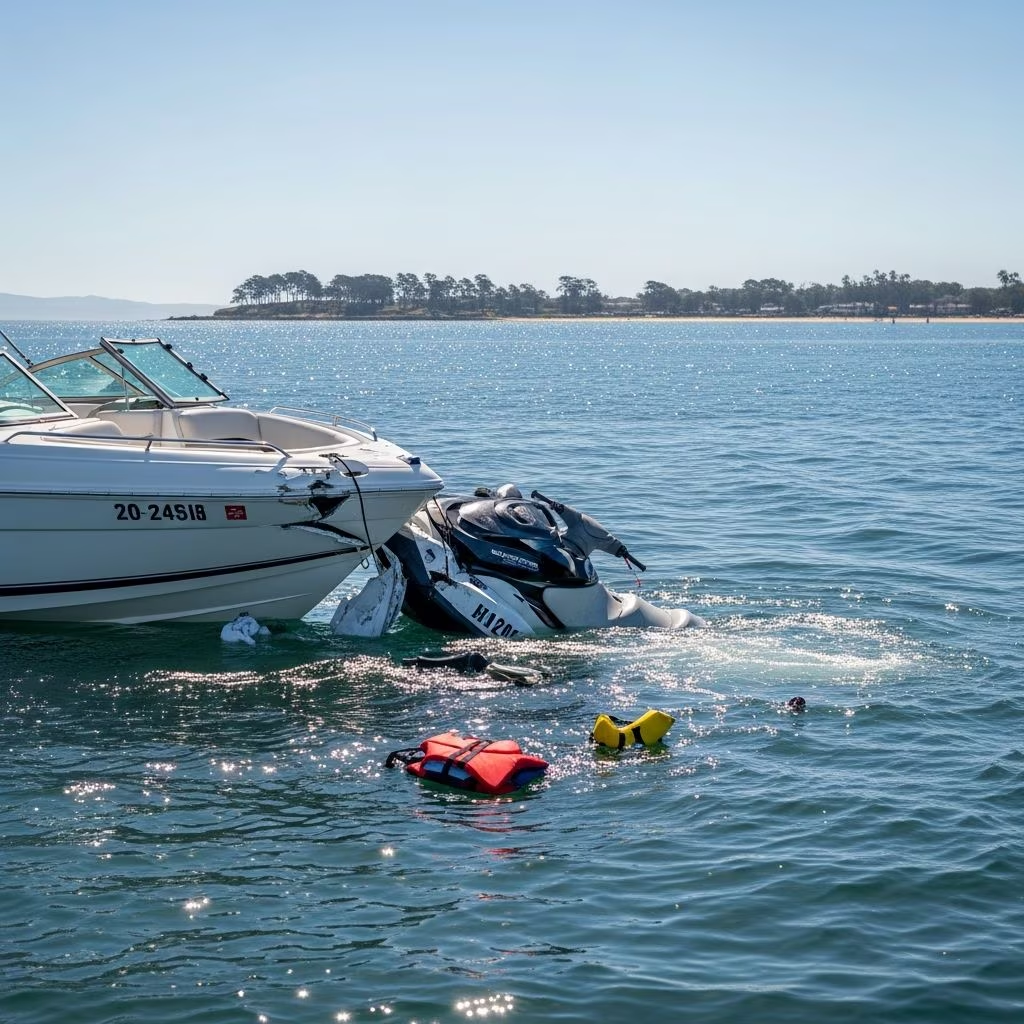
Thousands of people are injured or killed every year in recreational boating accidents in the United States, often during what was supposed to be a relaxing day on the water. When a collision, capsize, or other incident causes harm, questions quickly arise about who is at fault, which laws apply, and how injured people can be compensated for their losses.
This guide explains, in clear language, how recreational boating accident liability works, when maritime law comes into play, and what steps injured passengers, operators, and families can take after an incident.
1. Why Recreational Boating Accidents Are a Serious Legal Issue
Recreational boats include motorboats, sailboats, personal watercraft (such as jet skis), pontoons, and rented or privately owned vessels used mainly for leisure. When accidents happen, they often involve a mix of state boating rules, federal maritime law, and insurance coverage, making claims more complex than a typical car crash.
Common consequences of boating accidents include:
- Serious injuries such as fractures, spinal trauma, and traumatic brain injury
- Drowning or near-drowning events
- Property damage to boats, docks, or shoreline structures
- Long-term medical costs and lost income
Because watercraft are often used across state lines and on navigable waters, many incidents may fall under federal maritime jurisdiction, adding another layer of legal rules to consider.
2. Key Laws and Jurisdictions in Boating Accident Cases
Liability for a recreational boating accident is not governed by a single law. Instead, several overlapping legal frameworks may apply depending on where and how the incident occurred.
2.1 State Boating Laws and Negligence Principles
Each state has its own statutes defining safe operation, reporting duties, and equipment requirements for recreational boats. For example, some states explicitly provide that the owner and operator of a watercraft can be jointly liable for injuries caused by negligent operation, subject to limited defenses such as lack of consent to use the vessel.
Generally, to prove negligence under state law, an injured person must show:
- Duty of care – the operator had an obligation to act as a reasonably careful boater would
- Breach – the operator violated that duty (for example, by speeding, ignoring no-wake zones, or boating while impaired)
- Causation – the breach directly led to the accident and the injuries
- Damages – the victim suffered quantifiable harm such as medical bills, lost wages, or pain and suffering
2.2 Federal Maritime (Admiralty) Law
Maritime law typically applies to boating accidents that occur on navigable waters, meaning waters that are used or can be used for interstate or foreign commerce, such as oceans, major rivers, and many coastal or border lakes.
When maritime law applies to a recreational boating accident:
- Claims may be brought in federal court under admiralty jurisdiction.
- General maritime law governs liability and damages for non-seamen recreational users.
- Comparative negligence usually applies, so an injured person’s compensation is reduced by their percentage of fault rather than eliminated entirely.
Certain federal statutes, like the Limitation of Liability Act, may also affect the maximum exposure of vessel owners in some circumstances, although courts closely scrutinize such attempts to limit liability.
2.3 Special Federal Statutes (Commercial Contexts)
Although most recreational cases involve non-commercial passengers, some incidents overlap with commercial operations, charter services, or crew members. In those situations, additional federal laws may come into play:
- Jones Act – allows seamen injured in the course of employment to sue their employer for negligence.
- Longshore and Harbor Workers’ Compensation Act (LHWCA) – covers certain shore-based maritime workers like dockworkers and shipbuilders injured on or near navigable waters.
These worker-focused statutes generally do not apply to recreational passengers, but they may become relevant if crew members or marina workers are hurt in incidents involving leisure boats.
3. Who Can Be Held Liable After a Boating Accident?
Liability often extends beyond the person physically steering the boat. Several individuals or entities may share legal responsibility depending on how the accident occurred.
3.1 Primary Responsibility of the Boat Operator
In most cases, the operator is the first party scrutinized for fault. Operator negligence is one of the leading causes of recreational boating accidents, and can include:
- Operating under the influence of alcohol or drugs
- Excessive speed or unsafe maneuvers
- Failure to keep a proper lookout
- Ignoring navigation rules or posted restrictions
- Overloading the vessel or improper seating
If an operator fails to exercise reasonable care, they can be held financially responsible for injuries and property damage.
3.2 Potential Liability of Boat Owners
Even when they are not on board, owners may be liable if they allowed someone to operate their vessel and that person causes an accident. Some state laws make owners and operators jointly and severally liable for injuries resulting from negligent operation, with exceptions if the boat was used without the owner’s consent.
Owners may also be liable for:
- Poor maintenance leading to equipment failure
- Knowingly allowing an unqualified or intoxicated person to operate the boat
- Failing to provide required safety gear, such as life jackets and fire extinguishers
3.3 Passengers, Rental Companies, and Third Parties
Other parties can share responsibility, including:
- Passengers – if they interfere with safe operation, distract the operator, or intentionally engage in dangerous behavior that contributes to the accident.
- Rental or charter companies – if they fail to maintain equipment, ignore safety defects, or provide inadequate instructions to renters.
- Manufacturers or repairers – if a design defect, manufacturing flaw, or negligent repair causes mechanical failure.
- Other boat operators – in multi-vessel collisions, more than one captain may be partially at fault for not following right-of-way rules or lookout duties.
3.4 Shared Fault and Comparative Negligence
In many jurisdictions, fault can be allocated among multiple parties based on their percentage of responsibility. Under comparative negligence principles commonly used in maritime law and many states, an injured person’s recovery is reduced in proportion to their share of blame rather than barred entirely.
| Negligence Rule | Effect on Injured Person’s Compensation |
|---|---|
| Pure Comparative Negligence (common in maritime law) | Recovery reduced by the person’s percentage of fault, even if they are mostly at fault. |
| Modified Comparative Negligence | Recovery allowed only if the injured person’s fault is below a set threshold (often 50% or 51%). |
| Contributory Negligence (few states) | Any negligence by the injured person may bar recovery entirely. |
4. Common Causes and Types of Recreational Boating Accidents
Understanding what typically goes wrong on the water helps clarify how liability is assessed.
4.1 Frequent Causes of Accidents
- Operator inattention or distraction – failing to maintain a proper lookout for other vessels, swimmers, or hazards.
- Impaired operation – boating under the influence significantly increases the risk of collisions and falls overboard.
- Speeding and reckless maneuvers – especially in congested areas or near swimmers.
- Inexperience – lack of formal boating education or unfamiliarity with local waters.
- Insufficient safety gear – missing or inaccessible life jackets, lack of flares, or no fire extinguishers can worsen injuries and outcomes.
- Mechanical failures – engine, steering, or fuel system defects caused by poor maintenance or product defects.
4.2 Typical Accident Scenarios
Some of the most common incident types include:
- Collisions between vessels – both operators may share fault if they fail to follow navigation rules or maintain a proper lookout.
- Collisions with fixed objects – such as docks, buoys, or pilings, often tied to inattention or excessive speed.
- Falls overboard – sometimes related to alcohol use, overcrowding, or unsafe seating.
- Capsizing or swamping – caused by overloading, sudden maneuvers, or rough conditions.
- Propeller strikes – when swimmers or fallen passengers come too close to running engines.
5. Reporting Duties and Evidence After a Boating Accident
Reporting requirements and timely evidence collection can significantly impact the success of any later legal claim.
5.1 Federal and State Reporting Requirements
Under federal law, the operator or owner of a vessel must file a boating accident report with the appropriate state authority when certain thresholds are met, such as:
- A death occurs
- A person disappears under circumstances indicating possible death or injury
- Someone requires medical treatment beyond first aid
- Property damage exceeds a specified dollar amount (for example, $2,000)
- The vessel is a total loss
States also commonly require operators to share identifying information and report accidents to law enforcement or natural resources authorities, who then transmit statistics to agencies like the U.S. Coast Guard.
5.2 Preserving Evidence to Support a Claim
Evidence can quickly disappear on the water, so prompt action is important. Where it is safe and feasible, injured people or their companions should try to:
- Photograph the boats, damage, visible injuries, and weather or water conditions
- Obtain names and contact information for all operators, passengers, and witnesses
- Record registration numbers and insurance information for each vessel
- Note the exact location (e.g., GPS coordinates or landmarks) and time of the incident
- Preserve damaged equipment, life jackets, or other physical evidence
Official reports filed with state agencies or the Coast Guard frequently become key pieces of evidence in later personal injury cases.
6. Compensation Available to Injured Boaters and Passengers
Whether a claim is brought under state negligence law or maritime law, injured victims may seek compensation for a range of losses.
6.1 Categories of Damages
- Medical expenses – emergency treatment, surgeries, hospitalizations, rehabilitation, and future medical care.
- Lost income – wages lost during recovery and, in serious cases, diminished future earning capacity.
- Pain and suffering – physical pain, mental anguish, and loss of enjoyment of life.
- Property damage – repair or replacement costs for boats or personal property.
- Wrongful death damages – where permitted by law, surviving family members may seek funeral costs and other losses related to a fatal accident.
Under general maritime law, non-economic damages like pain and suffering are commonly available to injured passengers and recreational boaters.
6.2 Insurance and Limitations of Liability
Compensation is often paid through a combination of insurance policies and, in some cases, personal assets of responsible parties. Sources can include:
- Boat owner’s liability insurance
- Renter or charter company policies
- Umbrella or homeowner’s insurance (if it covers watercraft incidents)
In certain circumstances, vessel owners may attempt to invoke the Limitation of Liability Act, which can cap their financial responsibility at the value of the vessel and its freight, provided they lacked knowledge of the negligence that caused the accident. Courts carefully examine these claims and may deny limitation if the owner knew or should have known about the dangerous conditions.
7. Practical Steps After a Recreational Boating Accident
Immediate and thoughtful actions can protect both health and legal rights.
- Prioritize safety – move people out of immediate danger, provide flotation devices, and call for emergency help if needed.
- Seek medical evaluation – even seemingly minor injuries should be checked, as some conditions, including head injuries or internal trauma, may not be immediately obvious.
- Report the accident – comply with state reporting laws and Coast Guard requirements where applicable.
- Gather information – document the scene, identify all vessels and operators, and obtain witness details.
- Avoid speculative statements – when speaking with insurers or investigators, stick to facts and avoid admitting fault before all circumstances are known.
- Consult a qualified attorney – because boating cases can implicate complex maritime rules and multiple defendants, legal advice is often essential.
Frequently Asked Questions (FAQs)
Q1: Does maritime law always apply to recreational boating accidents?
No. Maritime law typically applies only when the accident occurs on navigable waters used for interstate or foreign commerce, such as oceans, major rivers, and some lakes. Accidents on small, landlocked lakes that are not navigable for commerce may be governed solely by state law.
Q2: Can an injured passenger sue the operator of the boat they were riding in?
Yes. Injured passengers generally may bring claims against any at-fault boat operator, including the one piloting their own vessel. Passengers are rarely found at fault themselves, so their recovery is usually not reduced on that basis.
Q3: What happens if more than one person is at fault for the accident?
In many states and under maritime law, fault can be divided among multiple parties under comparative negligence rules. Each party’s financial responsibility is often proportionate to their share of blame, and an injured person’s compensation may be reduced but not eliminated if they are partially at fault.
Q4: Is the boat owner always liable for an accident involving their vessel?
Not always. While owners can be held liable for negligent entrustment, poor maintenance, or statutory owner-operator liability, they may avoid responsibility if the boat was operated without their express or implied consent or if state law limits owner liability in certain situations.
Q5: Do I have to file a boating accident report if no one was seriously hurt?
You may still have to file a report if the incident meets certain criteria, such as causing property damage above a threshold amount or destroying a vessel. Federal regulations and state statutes specify when a report is mandatory, so operators should always review and follow local requirements.
References
- Federal Laws Regarding Recreational Boating Accidents — Hoffman & Associates (summarizing federal admiralty jurisdiction and limitation of liability). 2023-05-01. https://hoffmanandassoc.com/newsletter/personal-injury/federal-laws-regarding-recreational-boating-accident/
- Minnesota Statutes, Section 86B.341: Watercraft Owners and Operators — Minnesota Revisor of Statutes. 2023-01-01. https://www.revisor.mn.gov/statutes/cite/86B.341
- Recreational Boating Accidents Leading to Legal Claims — Justia. 2022-08-10. https://www.justia.com/admiralty/recreational-boating-accidents/
- When Maritime Law Applies in Boating Accidents — Frank D. Butler, P.A. 2024-03-15. https://www.888boatlaw.com/when-maritime-law-applies-in-boating-accidents/
- Who Is Liable After a Recreational Boating Accident? — BoatLaw, LLP. 2023-11-02. https://www.boatlaw.com/news/boating-accident-liability/
- Is the Boat Operator Responsible? Examining Liability in Boating Accidents — Del Rio & Caraway, P.C. 2025-07-10. https://www.delriolawoffice.com/blog/2025/july/is-the-boat-operator-responsible-examining-liabi/