
Audio and Video Recording in Educational Settings
Understand your rights and obligations when recording in classrooms and virtual learning environments.
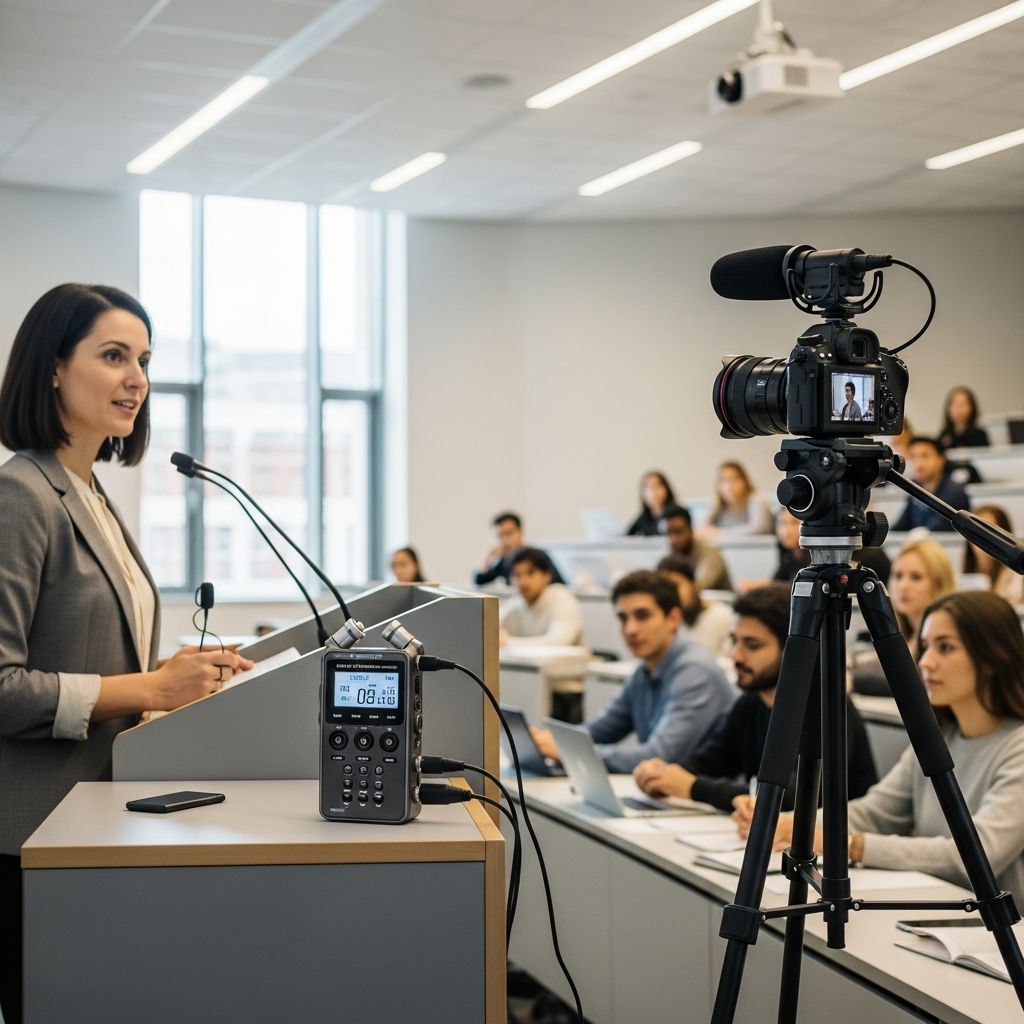
Understanding Recording Laws in Academic Environments
The question of whether students can legally record their teachers or professors does not have a simple yes-or-no answer. The legality of recording classroom interactions depends on multiple factors, including your geographic location, the specific policies of your educational institution, and the nature of what you are recording. As educational institutions increasingly incorporate technology into their programs—particularly with the rise of hybrid and remote learning—understanding these legal considerations has become essential for students, faculty, and administrators alike.
Recording teachers and professors can serve legitimate purposes, such as helping students with learning disabilities review course material, documenting unfair treatment, or preserving important lectures for future reference. However, these potential benefits must be weighed against privacy concerns and legal requirements that protect all parties in the educational setting. Both state laws and institutional policies govern classroom recordings, and violations can result in serious consequences ranging from disciplinary action to criminal charges.
The Role of State Consent Laws in Recording Decisions
The foundation of recording law in the United States is built on state-level consent requirements. States fall into two broad categories: one-party consent states and two-party consent states. Understanding which category your state belongs to is the first step in determining whether you can legally record a classroom interaction.
In one-party consent states, the majority of jurisdictions across the country, any participant in a conversation can legally record that conversation without informing or obtaining permission from other participants. This means that if you are present in a classroom, you can record the lecture or class discussion as long as you are a party to the conversation. The logic behind this rule is straightforward: if you are actively participating in a conversation, you have consented to being part of it, and therefore you can document it.
However, being in a one-party consent state does not automatically mean you can record freely without consequences. Your school or university may have its own policies that are more restrictive than state law. Additionally, other legal frameworks, such as federal privacy protections, may still apply to your recording activity.
In two-party consent states, sometimes called all-party consent states, every participant in a conversation must knowingly agree to being recorded. Recording someone without their explicit consent—even if you are part of the conversation—is illegal and can result in criminal charges. In these states, if you secretly record your professor without their knowledge, you could face both academic disciplinary action from your institution and legal action in the form of civil lawsuits or criminal prosecution. Some students have faced significant legal consequences, including being sued, for violating two-party consent laws.
How Institutional Policies Override or Supplement State Law
Educational institutions maintain considerable authority to establish their own recording policies, regardless of what state law permits. Universities and schools can impose stricter requirements than state law mandates, and students and faculty must comply with these institutional rules even if they are more restrictive.
A concrete example illustrates this principle: Princeton University, located in New Jersey, which is a one-party consent state, recently established a comprehensive policy prohibiting the recording of conversations occurring in educational, residential, research, or workplace settings without the consent of all parties involved. Under New Jersey law alone, such recordings would be legal. However, because of the university’s policy, anyone at Princeton who makes these recordings without obtaining consent from all parties violates university rules and can face disciplinary action, including suspension or expulsion.
This pattern is common across higher education institutions. Most colleges and universities have adopted policies requiring students to obtain permission before recording classes, lectures, or any interactions with faculty members. Some institutions provide explicit language in their student codes of conduct or syllabi prohibiting unauthorized recordings. The rationale for these policies includes protecting student privacy, ensuring that classroom discussions remain frank and open, and preventing the unauthorized distribution of recorded material.
In the K-12 setting, most school districts have formal policies requiring written parental consent before students can be recorded. Teachers who bypass these requirements, even in states where recording would legally be permissible, risk serious professional consequences including disciplinary action, suspension, or termination of employment.
Federal Privacy Protections for Student Information
Beyond state consent laws, the Family Educational Rights and Privacy Act (FERPA) creates an additional layer of legal protection relevant to classroom recordings. FERPA is a federal statute that governs how educational institutions handle student educational records and sensitive information.
The critical question under FERPA is whether a classroom recording constitutes a student educational record. A recording is considered a student educational record—and thus protected by FERPA—if it captures personally identifiable information about students, such as their names, voices, images, or any communications they make during class, including asking questions, making presentations, or participating in discussions.
If a classroom recording contains student voices, images, or identifiable participation, the institution cannot share that recording with anyone outside the original class without obtaining written consent from the affected student (or parent in K-12 settings). This restriction applies even if the initial act of recording was perfectly legal under state law. For example, a professor in a one-party consent state might legally record a class discussion that includes student participation, but FERPA prevents that professor from sharing the recording with other classes or external parties without student consent.
Conversely, if a recording contains only the instructor’s voice and image, or student voices that are completely non-identifiable, FERPA does not restrict its use, and it is not considered a protected educational record. This distinction has important practical implications for how faculty can utilize classroom recordings in their teaching, professional development, and instructional materials.
Distinct Legal Considerations for Faculty Recording Students
When faculty members record students, several important legal considerations apply. Professors often record classes for legitimate educational purposes: to provide content for students who miss classes, to support their own professional development, to analyze student engagement, to create course materials, or to document their own conduct and protect themselves against allegations of misconduct.
In one-party consent states, professors can legally record their students because they are parties to the classroom conversation. However, they must still comply with FERPA requirements and their institution’s specific policies regarding how recorded material can be used and shared. A professor who records without following school procedures or without obtaining consent as required by institutional policy—even when state law permits it—may face disciplinary action.
In two-party consent states, professors cannot record students without their consent, regardless of the educational purpose. Even well-intentioned recording for beneficial purposes such as student accommodation or documentation is illegal without explicit consent.
Additionally, professors must establish secure systems for storing recorded material and clear protocols for eventually deleting recordings. Best practices include having professional development programs that educate faculty about recording requirements in their specific state, step-by-step procedures for obtaining consent, and data management protocols.
Distinct Legal Considerations for Students Recording Faculty
Students who wish to record their professors encounter a different legal landscape. Students record their classes for various reasons: to support their learning, to accommodate disabilities, to document perceived unfair treatment, or to preserve important instructional content. Understanding the legal framework that applies to student recording is essential for avoiding serious consequences.
In one-party consent states, students can legally record their professors because the student is a party to the classroom conversation and has inherently consented to being part of it. Since the student is present and participating, they can document the interaction. However, this legal permission does not shield students from other consequences. Schools can still enforce policies prohibiting personal device recording or unauthorized recording, and students who violate these institutional rules face disciplinary action even though the recording itself is legal under state law.
In two-party consent states, the situation is significantly more serious. Students cannot legally record their professors without obtaining explicit consent. Attempting to secretly record a professor is a criminal violation in these jurisdictions. Students who proceed with unauthorized recording face not only school discipline—ranging from warnings to expulsion—but also potential criminal charges and civil lawsuits brought by the affected professor.
Students with documented disabilities or learning accommodations that specifically authorize audio or video recording may have exceptions to general prohibitions. However, even students with these accommodations must typically notify their instructor of the recording authorization, and they are absolutely prohibited from distributing the recordings to other students or posting them online.
Considerations for Virtual Learning and Video Conferencing
The rapid expansion of remote and hybrid learning has created new contexts where recording questions arise. Video conferencing platforms like Zoom are now ubiquitous in education, and they introduce both technical and legal considerations regarding recording.
Zoom and similar platforms have built-in recording features that notify all participants when recording begins. Some legal observers have suggested that this notification might constitute implicit consent, but this interpretation does not override state law or institutional policy. If your state law requires all-party consent, or if your institution prohibits recording, the Zoom notification feature does not provide legal cover for unauthorized recording.
The same state consent laws, institutional policies, and FERPA protections that apply to in-person classroom recordings apply equally to virtual classroom environments. Recording a Zoom class without permission in a two-party consent state is just as illegal as recording an in-person lecture without permission. Recording without following your institution’s policies can result in the same disciplinary consequences whether the class is held in a physical classroom or via video conference.
Potential Consequences of Unauthorized Recording
Understanding the potential consequences of unauthorized recording should inform decision-making about whether to proceed with recording. These consequences can be severe and long-lasting.
Academic Consequences: Students who record without authorization or in violation of school policy face potential discipline ranging from warnings to suspension or expulsion. The severity typically depends on factors such as whether the recording was distributed, the specific circumstances, the student’s prior disciplinary record, and the language in the institution’s code of conduct.
Legal Consequences: In two-party consent states, unauthorized recording is a criminal offense. Students can be prosecuted, potentially resulting in fines or jail time. Additionally, affected professors or classmates may pursue civil lawsuits seeking damages.
Professional Consequences: For teachers and professors who record without proper authorization, consequences can include loss of employment, revocation of teaching licenses, and damage to professional reputation that extends beyond the immediate institution.
Common Questions About Recording in Educational Contexts
Q: Can I record my professor if I tell them I am recording right before class starts?
A: In a one-party consent state, technically yes under state law, but you should still follow your school’s policies, which may require advance written permission rather than last-minute notification. In a two-party consent state, notification at the moment of recording is not sufficient; you need prior express consent. Your institution’s policy may require even more formal written authorization procedures.
Q: If my school does not explicitly prohibit recording, can I assume it is permitted?
A: No. The absence of an explicit prohibition does not constitute permission. You should review your student handbook, course syllabus, and any institutional policy documents. If you are unsure, contact your institution’s legal affairs office or student conduct office to clarify the policy before recording.
Q: Can I share a recorded lecture with classmates if I have a disability accommodation that permits recording?
A: No. Disability accommodations that authorize recording are strictly for your personal educational use. Sharing recordings with classmates violates FERPA protections for student voices and discussions captured in the recording. Distribution of recorded material can result in serious disciplinary consequences.
Q: What should I do if I need a recording of a class for accommodation purposes?
A: Contact your institution’s disability services office or accessibility center. They can work with your instructor to authorize recording for your specific educational needs. The institution may provide the recording themselves or formally authorize you to record with specific restrictions on use and distribution.
Q: Does recording a Zoom class have different legal rules than recording an in-person class?
A: No. The same state consent laws, institutional policies, and federal privacy protections apply to virtual classes as to in-person classes. The platform’s recording notification feature does not change your legal obligations.
Q: Can a professor record a class and share it with students enrolled in a future semester?
A: Generally, this requires additional consent or de-identification of any student participation. Showing a recording to students in a future semester who were not present for the original recording is treated as disclosure to a third-party audience and requires compliance with FERPA through written consent or removing student identifiable information.
Q: What if I record a professor who is treating students unfairly—can I use the recording as evidence?
A: Even if your motive is to document misconduct, the method of obtaining the evidence matters legally. In two-party consent states, illegally obtained recordings may not be admissible as evidence and could result in your own criminal charges. Work through official channels: report concerns to administrators, student conduct offices, or legal compliance offices who can investigate appropriately.
Best Practices for Recording in Educational Settings
If you wish to record in an educational setting, follow these practical steps to ensure compliance with laws and policies:
- Research your specific state’s recording consent requirements and identify whether your state is one-party or two-party consent
- Review your institution’s complete policies on classroom recording, including any information in student handbooks, course syllabi, or on the legal affairs website
- Contact your instructor or your institution’s legal affairs or student conduct office if you need clarification about whether recording is permitted in a specific context
- If you have a disability requiring accommodation, work through official channels with disability services rather than recording independently
- Obtain explicit written permission before recording if your institution requires it, even in a one-party consent state
- Never distribute or share recordings without permission, as this may violate FERPA and institutional policies
- If you discover a recording was made without authorization, report it to your institution’s administration
Conclusion: Navigating a Complex Legal Landscape
Recording teachers and professors exists at the intersection of state criminal law, federal privacy law, and institutional policy. While students in some states have legal rights to record under state law, these rights are not absolute and must be exercised within the constraints of federal privacy protections and school policies. Educational institutions have valid reasons for restricting recordings, including protecting student privacy, maintaining confidential educational discussions, and preventing unauthorized distribution of instructional material.
Before recording in any educational setting, determine your state’s consent requirements, consult your institution’s recording policies, and consider the specific context. When in doubt, seek permission from your instructor or contact your institution’s legal affairs office. Taking these steps protects you from serious legal, academic, and professional consequences while respecting the privacy rights of everyone in the educational environment.
References
- Classroom Recordings: Legal Guidelines and Privacy Rights — Allen Harris Law. 2024. https://www.allenharrislaw.com/classroom-recordings-legal-guidelines-and-privacy-rights/
- Classroom Recordings & FERPA: FAQs — Office of Legal Affairs, University of North Carolina at Charlotte. 2024. https://legal.charlotte.edu/legal-topics/classroom-policies-and-practices/classroom-recordings-ferpa-faqs/
- A Quick Primer on Federal Guidelines for Class Recordings — Metropolitan State University of Denver. 2024. https://early-bird.msudenver.edu/a-quick-primer-on-federal-guidelines-for-class-recordings/
- Can I Get in Trouble for Recording My Professor on a Zoom Call? — JD Supra. 2021. https://www.jdsupra.com/legalnews/can-i-get-in-trouble-for-recording-my-3359474/
- Recording Class Activities: (Some) Rules of the Road — University of Michigan Safe Computing. 2024. https://safecomputing.umich.edu/protect-privacy/privacy-u-m/videoconferencing/recording-privacy-concerns
Similar Articles








Read full bio of medha deb


