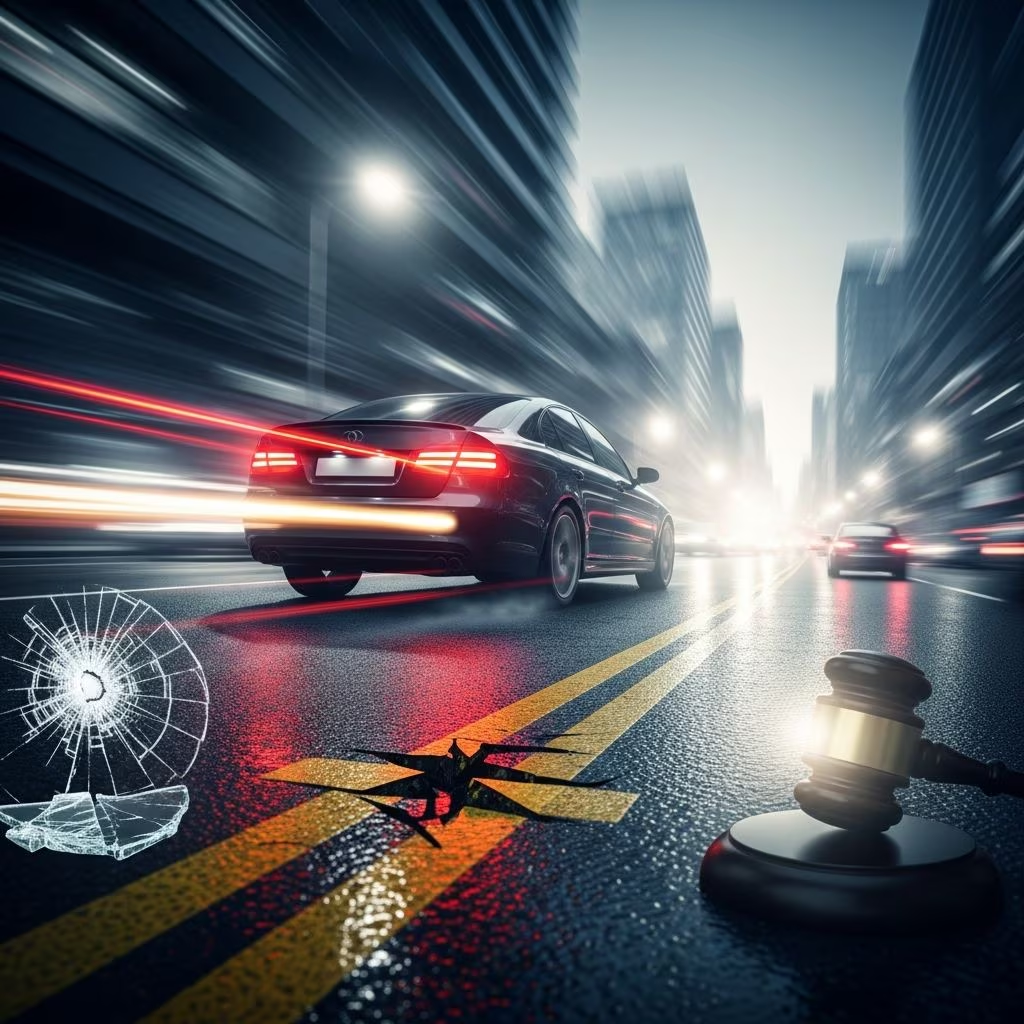
Reckless driving is more than a routine traffic ticket. In many states, it is treated as a criminal offense that can lead to fines, possible jail time, points on your license, higher insurance premiums, and even suspension of your driving privileges. Understanding how the law defines reckless driving and what you can do after receiving a citation is critical to protecting your record and your future.
How the Law Generally Defines Reckless Driving
Although each state writes its own statute, reckless driving laws usually share a common theme: the driver is accused of operating a vehicle in a way that poses an unreasonable risk to others or seriously interferes with the safe use of the roadway. This goes beyond ordinary negligence or a simple mistake.
Core Legal Elements
Most reckless driving statutes require proof of one or more of the following:
- Dangerous manner of driving that creates a substantial and unjustifiable risk of harm to others on the road.
- Unreasonable interference with the normal, safe use of public streets or highways, such as driving in a way that forces other drivers or pedestrians to take evasive action.
- Awareness or disregard of the risk, often described as willful, wanton, or reckless conduct rather than mere carelessness.
Prosecutors typically must show more than a minor traffic infraction—there must be evidence that the driving conduct represented a clear departure from what a reasonably careful driver would do in the same situation.
Examples of Conduct That May Lead to a Reckless Driving Charge
Specific examples vary by state, but conduct that commonly draws reckless driving charges includes:
- Driving at a speed dramatically higher than the posted limit, especially when traffic or weather conditions make that speed unsafe.
- Weaving aggressively through lanes, tailgating at high speed, or cutting off other vehicles.
- Running red lights or stop signs in a way that obviously endangers cross-traffic or pedestrians.
- Racing other vehicles on public roads.
- Making sudden U-turns or other abrupt maneuvers across multiple lanes.
- Combining alcohol or drug use with additional dangerous driving behaviors, even if a separate DUI charge is not filed.
In some jurisdictions, driving more than a certain number of miles per hour above the speed limit is presumed or explicitly defined as reckless, especially when speeds reach highway racing levels.
Reckless Driving vs. Careless or Negligent Driving
Many states distinguish reckless driving from lesser offenses such as careless, inattentive, or negligent driving. That distinction can have a major impact on penalties and your long-term record.
| Feature | Reckless Driving | Careless / Negligent Driving |
|---|---|---|
| Level of risk | High and obvious risk to others or roadway safety | Lower level of risk; often a lapse in attention |
| Mental state | Disregard for a substantial and unjustifiable risk | Simple mistake or ordinary negligence |
| Legal classification | Often a misdemeanor criminal offense | Usually a non-criminal traffic infraction |
| Typical penalties | Higher fines, possible jail, more points, potential license suspension | Lower fines, few or no points, rarely any jail time |
| Impact on record | May appear on a criminal record and driving record | Generally appears only on driving record |
Because the difference between reckless and careless can be significant, defense attorneys sometimes negotiate to have a reckless charge reduced to a lesser traffic offense that carries fewer long-term consequences.
Typical Criminal and Administrative Penalties
Reckless driving penalties depend on the state, prior record, and the facts of the incident. However, several types of consequences appear across many jurisdictions.
Criminal Classification and Possible Jail Time
In numerous states, reckless driving is classified as a misdemeanor rather than a mere traffic infraction. That means a conviction can lead to:
- A criminal record that may show up on background checks for employment, housing, or professional licensing.
- Possible jail terms that escalate for repeat offenses, such as up to 30 days for a first conviction and substantially more for later convictions within a set time frame.
- Probation, community service, or mandated driving education courses, depending on the court and the circumstances.
Judges may consider whether there was an accident, whether anyone was injured, and whether alcohol or drugs were involved when deciding whether to impose jail time.
Fines, Court Costs, and Financial Assessments
A reckless driving conviction nearly always involves a financial hit. Depending on the jurisdiction and prior record, a driver may face:
- Base fines that can climb from a few hundred dollars for a first conviction to more than a thousand dollars for repeat offenses.
- Court costs, surcharges, and administrative fees on top of the underlying fine.
- State “driver responsibility” or similar assessments that require additional annual payments for several years after conviction in some jurisdictions.
These financial penalties are often separate from any civil damages you might owe if the reckless driving incident caused a crash and someone sues for injuries or property damage.
License Points and Suspension Risks
State motor vehicle agencies typically use a points system to track traffic violations. Reckless driving is usually assigned a high point value compared with minor infractions. For example, in some states, a single reckless driving conviction can add five demerit points to your driving record.
Accumulating too many points within a specified period can lead to:
- Short-term license suspension or revocation.
- Mandatory driver improvement or safety courses.
- Probationary or restricted driving privileges.
In addition, a court that convicts a driver of reckless driving may directly order suspension or revocation of the driver’s license in serious or repeat cases.
Insurance Consequences
Insurance companies typically treat reckless driving as a significant red flag. A conviction can result in:
- Substantial premium increases because insurers view reckless driving as a marker of high risk.
- Loss of access to preferred or low-cost coverage tiers.
- Non-renewal or cancellation of your policy, forcing you to seek high-risk coverage.
These insurance-related costs can continue for several years after the conviction, often making them one of the most expensive long-term consequences of a reckless driving case.
Aggravating Factors That Can Make Penalties Worse
Courts and prosecutors consider certain facts as aggravating circumstances that justify harsher treatment. These may include:
- Prior convictions for reckless driving or other serious traffic offenses within a defined lookback period.
- High-risk driving combined with impairment from alcohol or drugs, even if the case is not charged or resolved as a formal DUI.
- Accidents causing injuries or death, which can elevate charges, increase fines, and greatly increase the risk of jail.
- Excessive speed, such as driving at highway racing speeds or far beyond the posted limit.
- Reckless driving in sensitive areas, including school zones, construction areas, or places with heavy pedestrian traffic.
Serious accidents or repeat offenses may lead to felony-level charges in some states, with correspondingly higher penalties.
Common Defense Strategies in Reckless Driving Cases
Every case is unique, but defense approaches generally fall into several categories. An experienced traffic or criminal defense attorney can help tailor these strategies to the specific facts and state law.
Challenging the Evidence of Recklessness
A central element in any reckless driving case is whether your conduct truly rose to the level of reckless or willful disregard of safety. Potential arguments include:
- Insufficient proof of risk: The driving may have been negligent, but not so dangerous as to justify a criminal conviction.
- Challenging speed or distance measurements: Attacking the accuracy of radar, lidar, or officer estimates when excessive speed is the main basis for the charge.
- Highlighting road or weather conditions: Showing that conditions did not make your speed or maneuver unreasonably dangerous.
- Demonstrating necessity or emergency: In rare situations, arguing that an emergency justified otherwise risky driving.
Questioning Law Enforcement Procedures
Defenses may also focus on whether the officer followed legal and technical requirements:
- Attacking the legality of the traffic stop if there was no reasonable suspicion or probable cause.
- Disputing the officer’s line of sight or vantage point when observing the alleged violations.
- Raising chain-of-custody or calibration issues for speed detection devices.
If key evidence is excluded because it was obtained improperly, the prosecution may have difficulty proving reckless driving beyond a reasonable doubt.
Negotiating a Reduction to a Lesser Offense
In many cases, the practical goal is to avoid a criminal conviction, jail exposure, or a large number of points on your record. Attorneys often negotiate with prosecutors to:
- Reduce a reckless driving charge to a non-criminal traffic infraction, such as careless or improper driving.
- Agree to attend defensive driving courses in exchange for a reduction.
- Obtain a plea to a lower-point offense to protect your license and insurance rates.
The likelihood of a favorable negotiation often improves for drivers with a clean record and incidents that did not involve injuries or property damage.
Steps to Take If You Receive a Reckless Driving Ticket
How you respond immediately after being cited can influence both the legal and practical outcomes of your case.
1. Read the Citation Carefully
Your ticket or charging document usually lists:
- The exact statute or code section you are accused of violating.
- Your court date and location.
- Whether appearance in court is mandatory or whether certain options (such as mailing a payment) exist.
Failing to appear or respond on time can result in additional penalties, including a potential warrant or automatic license suspension.
2. Document the Circumstances
As soon as practical, write down everything you remember about the incident:
- Road, traffic, and weather conditions.
- Your speed and lane position to the best of your recollection.
- What the officer said, where the officer was positioned, and any statements you made.
- Names and contact details for any passengers or witnesses who can support your account.
Photographs of the area, skid marks, signage, or obstructions can be valuable later when discussing the case with an attorney.
3. Consult a Qualified Attorney
Because reckless driving is often a criminal offense carrying significant penalties—especially for repeat offenses—many drivers choose to consult with a traffic or criminal defense lawyer who regularly handles these cases.
An attorney can:
- Explain how your state’s specific laws and point system apply to your situation.
- Evaluate whether the facts truly satisfy the legal standard for reckless driving.
- Negotiate with prosecutors to reduce or dismiss charges where appropriate.
- Represent you in court and help manage deadlines, paperwork, and procedural requirements.
Long-Term Impact on Your Record and Daily Life
A reckless driving conviction can follow you long after the fine is paid.
- Criminal history: Because many states treat reckless driving as a misdemeanor, the conviction may appear in criminal background checks.
- Employment concerns: Jobs that involve driving, operating machinery, or holding a security clearance may consider a reckless driving conviction particularly serious.
- Professional licensing: Certain licensed professionals may be required to report criminal convictions to a licensing board.
- Future traffic stops: Prior reckless driving convictions can influence how both law enforcement and courts treat later incidents, increasing the risk of enhanced penalties.
Some states provide mechanisms to expunge or seal certain misdemeanor convictions after a waiting period if specific conditions are met, but eligibility and timing vary widely.
Frequently Asked Questions About Reckless Driving
Q: Is reckless driving always a criminal offense?
A: In many jurisdictions, reckless driving is classified as a misdemeanor criminal offense, not just a civil traffic infraction. However, the exact classification and maximum penalties differ from state to state.
Q: Can I go to jail for a first reckless driving conviction?
A: Yes. In several states, even a first conviction can legally carry up to 30 days or more in jail, although not every first-time offender is sentenced to jail time. Courts consider factors such as your driving history and whether an accident or injuries occurred.
Q: How many points does a reckless driving conviction add to my license?
A: Point values are set by each state’s motor vehicle agency. In some states, reckless driving adds as many as five demerit points in a single incident, which can rapidly push drivers toward suspension thresholds.
Q: Will my insurance go up after a reckless driving ticket?
A: Almost always. Insurers typically treat reckless driving as a major violation and may significantly raise premiums or even cancel coverage, especially if combined with other infractions or accidents.
Q: Can a reckless driving charge be reduced to a lesser offense?
A: Often, yes. Depending on the facts and your record, your attorney may negotiate with prosecutors to reduce reckless driving to a lesser traffic violation, such as careless or improper driving, which may carry lower fines, fewer points, and no criminal record.
References
- The Consequences of Reckless Driving in New York State — Andrews, Bernstein, Maranto & Nicotra, PLLC. 2023-07-14. https://www.wny-lawyers.com/2023/07/the-consequences-of-reckless-driving-in-new-york-state/
- New York’s Reckless Driving Laws and Penalties — DrivingLaws.org / Nolo. 2023-05-01. https://www.drivinglaws.org/resources/new-york-reckless-driving-laws-penalties.htm
- Reckless Driving Penalties in New York — Brill Legal Group, P.C. 2022-11-10. https://www.dwilawyer-ny-nj.com/blog/what-are-the-penalties-for-reckless-driving-in-new-york/
- Reckless Driving — The Fast Law Firm, P.C. 2023-03-02. https://fastlawpc.com/criminal-defense/vehicular-crimes/reckless-driving/
- Reckless Driving in NY: Consequences and Defense Strategies — Law Office of Michael S. Arbeit, P.C. 2023-04-18. https://michaelarbeitattorneyny.com/reckless-driving-in-new-york-consequences-and-defense-strategies/
- Reckless Driving, New Jersey — Lento Law Firm. 2022-09-05. https://www.njcriminaldefensellc.com/reckless-driving
- What is Considered Reckless Driving? — Rosenberg & Gluck, LLP. 2023-01-12. https://www.lilawyer.com/blog/what-is-considered-reckless-driving/