The Manufactured Crisis of In-Person Voter Fraud
In the modern era of American democracy, few legislative topics have sparked as much intense debate as the implementation of strict voter identification laws. Across the nation, lawmakers have fiercely debated the necessity of mandating government-issued photo identification at the ballot box. Proponents of these measures argue that they are essential to maintaining election integrity and preventing fraudulent voting. However, a rigorous examination of the empirical evidence reveals a persistent disconnect between the perceived threat of in-person voter fraud and the reality of how elections function in the United States. Often, the push for restrictive voting protocols is described by political analysts and civil rights advocates as a mechanism designed to solve a problem that simply does not exist.
To understand the debate surrounding voter ID laws, one must first isolate the specific type of fraud these laws are designed to prevent: in-person voter impersonation. This occurs when an individual walks into a polling place and attempts to cast a ballot under the name of another registered voter. Comprehensive investigations into American elections have repeatedly demonstrated that this specific form of fraud is statistically microscopic. In a seminal nationwide analysis conducted by the Brennan Center for Justice, researchers concluded that it is statistically more likely for an American to be struck by lightning than to impersonate another voter at the polls. Despite these findings, the narrative of widespread election rigging via voter impersonation continues to drive significant legislative action across various states.
The Legislative Landscape: How Identification Mandates Swept the Nation
The movement to require specific forms of identification at the polls is a relatively recent phenomenon in American political history. Prior to the 2006 midterm elections, no state required a voter to produce a government-issued photo ID as an absolute condition for casting a ballot. However, the legislative landscape shifted dramatically in the early 21st century. According to recent data from the National Conference of State Legislatures (NCSL), 36 states now require some form of identification at the polls, with 24 of those states explicitly requiring a photo ID.
These laws vary significantly in their strictness. In “strict” photo ID states, voters who do not possess the required identification must vote on a provisional ballot, and their vote will only be counted if they return to an election office within a few days to present an acceptable ID. In “non-strict” states, voters without an ID may be permitted to vote via a regular ballot if they sign an affidavit of identity, or if a poll worker can personally vouch for them. The rapid expansion of strict ID mandates has fundamentally altered the procedural reality of voting for millions of citizens, introducing new bureaucratic hurdles to the franchise.
The Landmark Ruling: Crawford v. Marion County Election Board
The legal foundation for the modern era of voter ID legislation was cemented in 2008 by the United States Supreme Court in the landmark case Crawford v. Marion County Election Board. The case centered on a 2005 Indiana statute—often described at the time as the most restrictive voter ID law in the country—which required citizens voting in person to present government-issued photo identification.
Opponents of the law argued that it placed an unconstitutional burden on the right to vote, disproportionately affecting elderly, disabled, minority, and low-income citizens who were statistically less likely to possess a driver’s license or passport. However, in a fractured 6-3 decision, the Supreme Court upheld the Indiana law. Writing for the plurality, Justice John Paul Stevens concluded that the state possessed a valid, neutral interest in protecting the integrity and reliability of the electoral process. Crucially, the Court acknowledged that the record contained virtually no evidence of in-person voter impersonation actually occurring in Indiana at the time. Nevertheless, the Justices ruled that the state’s interest in preventing potential future fraud, modernizing elections, and safeguarding public confidence was sufficient to justify the burdens placed on voters.
The Crawford decision effectively gave states the constitutional green light to pursue strict identification requirements, so long as the laws appeared facially neutral. This ruling, combined with the later 2013 Shelby County v. Holder decision which dismantled the preclearance formula of the Voting Rights Act of 1965, triggered a massive wave of new voting restrictions throughout the Southern and Midwestern United States.
Collateral Damage: The Disproportionate Burden on Eligible Voters
While voter ID laws apply to all citizens equally on paper, the practical realities of obtaining government-issued identification are inherently unequal. Civil rights organizations and public policy researchers have long documented that these requirements disproportionately impact specific demographic groups. National surveys indicate that approximately 11% of U.S. citizens—equivalent to more than 20 million voting-age Americans—do not possess current, unexpired government-issued photo identification. This demographic is not evenly distributed; it is heavily skewed toward marginalized communities.
The barriers to acquiring a “free” government ID are multifaceted and often costly. Even when a state offers a complimentary voter identification card to comply with constitutional prohibitions against poll taxes, the underlying documentation required to secure that ID is rarely free. The hidden costs of compliance include:
- Document Procurement: Citizens must often present certified copies of birth certificates, marriage licenses, or naturalization papers. These documents can cost anywhere from $15 to over $100 to order, and obtaining them can take weeks or months.
- Transportation Logistics: Many rural counties have limited Department of Motor Vehicles (DMV) or state ID offices. In some regions, citizens must travel dozens of miles—without access to public transportation—simply to reach an office that may only be open a few days a month.
- Lost Wages and Time: Hourly workers often cannot afford to take time off during standard business hours to wait in line at a government facility. The bureaucratic friction of navigating different agencies acts as a de facto penalty on low-income employment.
- Name Discrepancies: Elderly women frequently face severe difficulties matching their birth certificates to their current legal names due to marriages, divorces, and maiden name changes that occurred decades ago before digitized record-keeping.
For a voter who is disabled, elderly, or living in extreme poverty, the journey to obtain a state-issued photo ID is not a mere inconvenience; it is an insurmountable administrative wall that effectively disenfranchises them.
Empirical Evidence: Turnout Suppression and Democratic Integrity
Beyond theoretical burdens, the empirical impact of strict voter ID laws on electoral participation has been thoroughly analyzed. A comprehensive 2014 report published by the U.S. Government Accountability Office (GAO) provided a rigorous statistical evaluation of the effect of these laws. By comparing turnout in states that had recently implemented strict photo ID laws (such as Kansas and Tennessee) against states that had not, the GAO isolated the variable of the ID requirement.
The findings were striking: strict photo ID laws were associated with a statistically significant reduction in voter turnout, typically lowering participation by 2 to 3 percentage points. In tight statewide or national elections, a 2 to 3 percent margin is often the difference between victory and defeat. Furthermore, the GAO noted that this decrease in turnout was most pronounced among African American and younger voters. When democratic participation is artificially depressed among specific cohorts, the resulting electoral outcomes may fail to accurately reflect the true will of the populace.
Categorizing the Severity of Voter ID Laws
To understand the variance in state approaches to election security, it is helpful to categorize the types of identification laws currently in operation across the nation.
| Type of ID Law | Legislative Description | Impact on Voter Access |
|---|---|---|
| Strict Photo ID | Voters must present a government-issued photo ID. No alternate documents are accepted. Provisional ballots are only counted if the voter returns with ID post-election. | High burden. Directly correlates with measurable turnout drops among low-income, minority, and elderly populations. |
| Non-Strict Photo ID | Photo ID is requested, but voters without one can sign an affidavit under penalty of perjury or have a poll worker vouch for their identity to cast a regular ballot. | Moderate burden. Provides a critical fail-safe for citizens lacking identification, preserving franchise access while deterring casual fraud. |
| Strict Non-Photo ID | Voters must present a specific document (e.g., utility bill, bank statement) proving name and address. A photo is not strictly required. | Moderate-to-low burden. Highly dependent on housing stability and banking access, negatively impacting unhoused or transient populations. |
| No Document Required | Voters verify identity by stating their name, address, and signing the poll book. Signatures are matched against registration records. | Minimal burden. Maximizes voter participation. Security is maintained through robust back-end registration cross-checks. |
Striking a Balance: Security Without Disenfranchisement
The pursuit of secure elections is a fundamental necessity for a healthy republic. Citizens must trust that their votes are counted accurately and that the system is safe from corruption. However, election integrity cannot be achieved at the expense of voter access. Implementing draconian restrictions to combat the phantom menace of in-person voter impersonation disrupts the delicate balance of democratic governance.
Election experts and civil liberties advocates point out that there are far more effective ways to secure elections without disenfranchising marginalized communities. Upgrading voting machine technology, implementing universal risk-limiting audits, securing the chain of custody for absentee ballots, and standardizing signature verification software are all methods that enhance election security without targeting the individual voter. Furthermore, if states are to require photo identification, they bear the democratic responsibility of making that identification universally accessible, proactively delivering IDs to citizens, and subsidizing all associated costs.
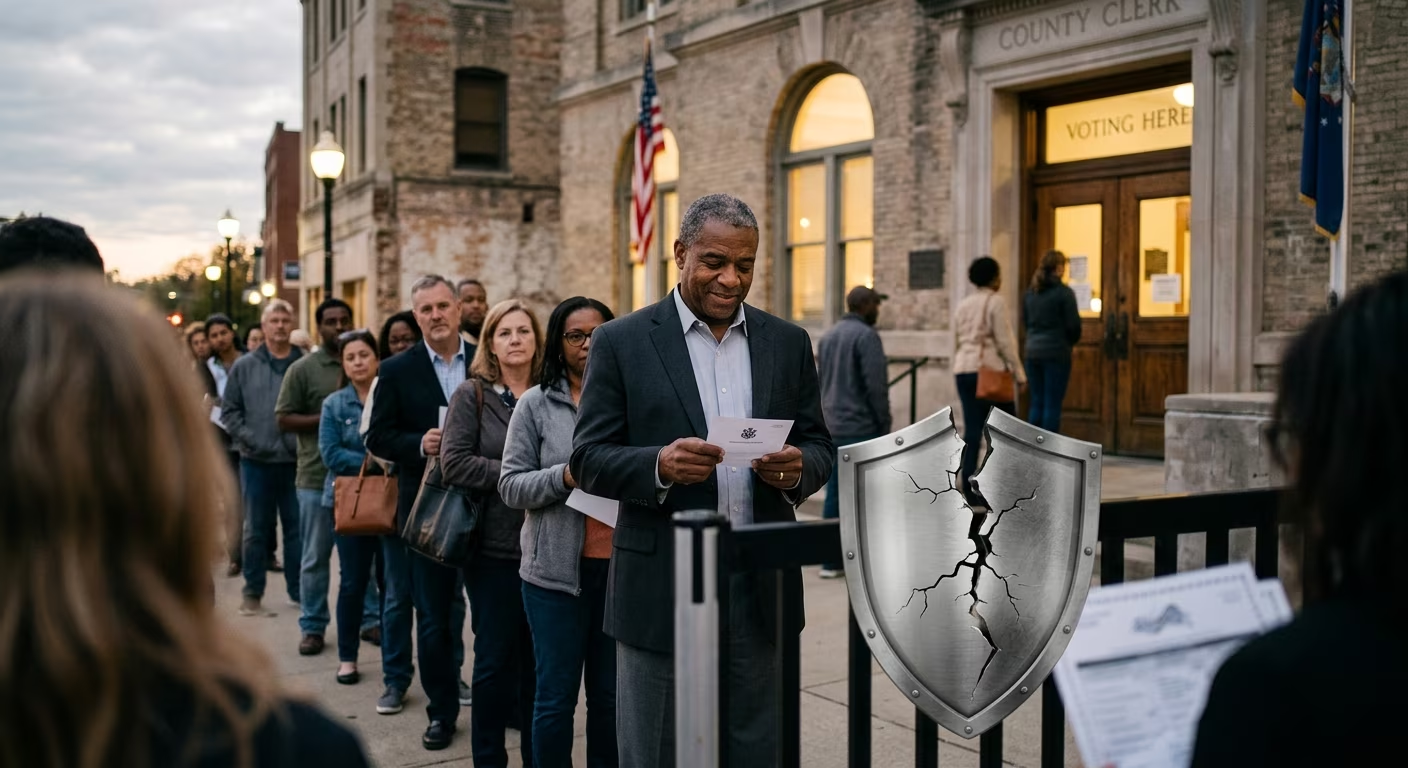
Ultimately, a robust democracy is not measured solely by how well it locks its doors against theoretical threats, but by how widely it opens them to eligible citizens. Laws that “fix what isn’t broken” by disenfranchising legitimate voters do not protect the integrity of the ballot box; they undermine the very foundational principles of representative government.
Frequently Asked Questions (FAQ)
What is in-person voter fraud?
In-person voter fraud, or voter impersonation, occurs when an individual goes to a polling place and claims to be someone else in order to cast a ballot. Multiple academic and government studies have proven that this specific type of fraud is exceptionally rare, largely because the penalty (felony charges, fines, and prison time) vastly outweighs the minimal benefit of casting a single fraudulent vote.
Why don’t some citizens have government-issued photo ID?
Obtaining an ID requires underlying documents like a birth certificate, which costs money. It also requires navigating government bureaucracy during work hours and traveling to a DMV, which can be difficult for people without vehicles, individuals with disabilities, the elderly, and rural residents.
What was the significance of Crawford v. Marion County Election Board?
In this 2008 decision, the Supreme Court ruled that Indiana’s strict photo ID law did not violate the Constitution. The Court decided that the state’s interest in preventing voter fraud and modernizing elections outweighed the burdens placed on voters, setting a precedent that allowed many other states to implement similar restrictive laws.
Do voter ID laws lower election turnout?
Yes. Empirical studies, including a major 2014 analysis by the Government Accountability Office (GAO), have found that strict photo ID laws reduce voter turnout by approximately 2 to 3 percentage points, with the negative effects disproportionately impacting voters of color and young voters.
References
- The Truth About Voter Fraud — Brennan Center for Justice. 2007-11-09. https://www.brennancenter.org/our-work/research-reports/truth-about-voter-fraud
- Elections: Issues Related to State Voter Identification Laws (GAO-14-634) — U.S. Government Accountability Office. 2014-09-19. https://www.gao.gov/products/gao-14-634
- Crawford v. Marion County Election Board, 553 U.S. 181 — Supreme Court of the United States / Justia. 2008-04-28. https://supreme.justia.com/cases/federal/us/553/181/
- Voter Verification Without ID Documents — National Conference of State Legislatures. 2026-05-26. https://www.ncsl.org/elections-and-campaigns/voter-id