
New York Quitclaim Deed: 7 Required Filing Elements
Complete guide to transferring property through quitclaim deeds in New York State.
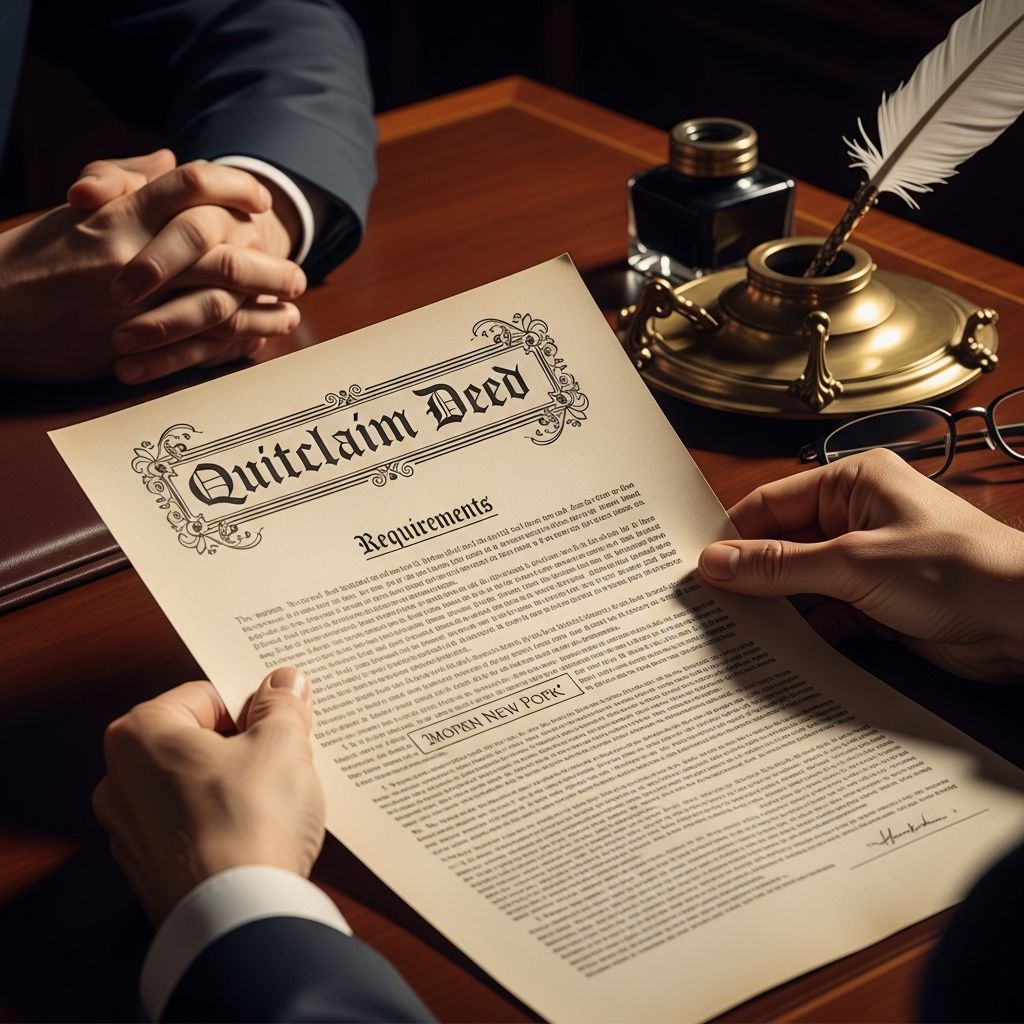
Understanding Property Transfer Through Quitclaim Deeds in New York
Property ownership transfer in New York requires adherence to specific legal frameworks designed to protect both parties involved in the transaction. When individuals seek to convey real property—whether through sale, gift, or court order—they must employ a formal written instrument that complies with state law. Among the available options for property transfer, three primary deed types are commonly utilized: bargain and sale deeds, warranty deeds, and quitclaim deeds. Each type serves different purposes and carries distinct implications regarding the grantor’s obligations and representations about property ownership.
A quitclaim deed represents one approach to property conveyance that differs fundamentally from other deed types in terms of the guarantees it provides. Understanding the mechanics, requirements, and implications of this instrument is essential for anyone considering this method of property transfer in New York.
What Constitutes a Quitclaim Deed
A quitclaim deed functions as a legal document through which the grantor—the person transferring ownership—relinquishes all rights, claims, and interests in a property to the grantee, the person receiving ownership. However, a critical distinction separates quitclaim deeds from other transfer instruments: this document contains no warranties or guarantees regarding actual ownership. The grantor makes no representation that they actually own the property being conveyed, nor do they guarantee that the property is free from liens, encumbrances, or claims by third parties.
This lack of warranty creates important practical implications. If a grantor executes a quitclaim deed for a property they do not genuinely own, the grantee receives whatever interest the grantor actually possessed—which may be nothing. This characteristic makes quitclaim deeds particularly suited for transfers between family members or in situations where the grantor’s ownership is already well-established and undisputed. Conversely, purchasers acquiring property through quitclaim deeds assume greater risk regarding title clarity and should conduct thorough due diligence before accepting such a deed.
Fundamental Writing Requirements
New York law mandates that all quitclaim deeds exist in written form; oral agreements to transfer property are entirely insufficient and legally unenforceable. The written document must contain specific information to satisfy statutory requirements and ensure its validity.
The deed must include the following essential components:
- Complete legal description of the property, including lot and block numbers if applicable
- Street address of the property
- County where the property is situated
- Date of the transfer transaction
- Full name of the grantor (person transferring the property)
- Full name of the grantee (person receiving the property)
- The consideration amount, representing any price paid or, if applicable, notation that the transfer is a gift
These elements ensure that the deed provides sufficient clarity regarding the parties involved, the specific property affected, and the circumstances of the transfer. Omitting any of these details could render the document ambiguous or legally vulnerable to challenge.
Signature and Notarization Procedures
The grantor must personally sign the quitclaim deed in the presence of a notary public. Importantly, New York law does not require the grantee to sign the document, though some grantees may choose to do so for their own records or to acknowledge acceptance of the property.
Notarization by a qualified notary public is mandatory for the deed to be legally valid. The notary serves a crucial function by verifying the grantor’s identity and confirming that the signature affixed to the document genuinely belongs to the stated grantor. This official verification authenticates the document and provides evidence of the grantor’s intent to execute the transfer. All signatures on the deed must be original; facsimiles or electronically reproduced signatures are not acceptable for recording purposes.
Following proper notarization, the completed deed must be delivered to the grantee. While New York law does not mandate written acceptance of the deed by the grantee, documenting such acceptance through a separate acknowledgment can provide beneficial protection and clarity for both parties regarding the transfer’s completion.
Required Forms for New York Filings
Beyond the quitclaim deed itself, New York requires the submission of additional forms with the county clerk or city registrar. The specific forms depend on the property’s location within the state.
Forms for Properties Outside New York City
Individuals filing quitclaim deeds for properties located in counties outside New York City must submit the Real Property Transfer Report, designated as Form RP-5217. This form serves as a state reporting mechanism documenting the property transfer. Simultaneously, filers must complete Form TP-584, which functions as a Combined Real Estate Transfer Tax Return. These forms must accompany the quitclaim deed when filed with the county clerk’s office.
Forms for New York City Properties
The filing requirements differ slightly for properties situated within New York City’s five boroughs. Filers must complete and submit Form RP-5217 NYC and Form TP-584 NYC, which are city-specific versions of the statewide forms. These modified versions account for New York City’s unique recording system and tax requirements. For properties in New York City, filers may utilize the Automated City Register Information System (ACRIS), which permits online submission of documents rather than requiring in-person or mail filing.
The Filing Process and County Clerk Requirements
After the quitclaim deed has been properly signed and notarized, it must be filed with the appropriate county clerk’s office or city registrar where the property is physically located. This filing step is essential to making the deed effective against third parties who might otherwise claim ownership rights to the same property.
The filing process involves the following sequence:
- Contact the county clerk’s office in the jurisdiction where the property is located to confirm current requirements and procedures
- Prepare all required forms and the notarized quitclaim deed
- Submit the documents through the acceptable method—either in person, by mail, or online where available
- Pay the applicable filing fee
- Retain the recorded deed or certificate of recording for your records
One critical consideration involves timing: quitclaim deeds should be filed as promptly as possible following execution. If multiple quitclaim deeds concerning the same property are filed by different parties, the deed recorded first in time takes precedence. A grantor could potentially execute conflicting deeds, and the first-filed deed provides the superior claim. Delaying filing creates vulnerability to such complications and may generate legal disputes regarding which party has legitimate title to the property.
Filing Fees and Associated Costs
The expense of filing a quitclaim deed varies according to the county and property classification. As of the most recent standardized fee schedules, the basic filing fee for residential or farm property is $125, while filing fees for all other property types reach $250. These base fees apply specifically to the RP-5217 form filing.
However, the total cost to file a quitclaim deed typically exceeds these base amounts, as additional fees apply:
| Fee Category | Description |
|---|---|
| Base Recording Fee | $125 (residential/farm) or $250 (other properties) |
| TP-584 Form Fee | Nominal additional charge for combined tax return form |
| General Recording Fee | County-specific fee for processing the recording |
| Per-Page Fee | Additional nominal cost for each page of documents filed |
Because fee structures vary by county and can change periodically, individuals should contact their specific county clerk’s office to obtain current, accurate fee information before preparing to file. Some counties may have implemented online filing options with different fee structures than traditional in-person or mail filings.
Special Considerations and Legal Implications
Several important considerations should inform decisions regarding quitclaim deed usage. First, the grantor must possess at least some legitimate ownership interest in the property before executing a quitclaim deed, even if that interest is only partial. A grantor cannot transfer what they do not possess.
Second, individuals relocating from New York or those subject to New York State’s personal income tax may face additional reporting requirements. Form IT-2663 must be completed by grantors who reside outside New York State and are reporting personal income tax implications resulting from property sale gains. Non-residents should consult with tax professionals to understand their specific obligations.
Third, a quitclaim deed does not expire once recorded. However, the principle of “first in time, first in right” means that if the same grantor records multiple conflicting quitclaim deeds affecting the same property, the deed recorded first creates the superior claim. This underscores the importance of immediate filing.
Finally, individuals should understand that accepting a quitclaim deed carries inherent risks. The grantee receives no guarantee regarding title quality, ownership validity, or freedom from liens or encumbrances. Purchasers or recipients of quitclaim deeds should obtain title insurance or conduct comprehensive title searches to identify any potential claims or issues affecting the property.
When to Engage Legal Professionals
While New York law does not prohibit individuals from preparing and executing quitclaim deeds without attorney assistance, the complexities of property law and the significance of permanent title transfers make legal guidance advisable. Attorneys can ensure that:
- The deed contains all legally required information with appropriate specificity
- The legal description of the property is accurate and complete
- Local county requirements are satisfied
- Forms are properly completed and submitted
- The transaction complies with all applicable state and local regulations
- Title concerns are identified and addressed
Given the permanence of recorded deeds and the potential for costly title disputes, retaining experienced real estate counsel represents a prudent investment for most property transfers.
Common Questions About New York Quitclaim Deeds
Q: Does the grantee need to sign the quitclaim deed?
A: No, New York law does not require the grantee’s signature on the quitclaim deed. Only the grantor must sign before a notary public. However, some grantees choose to sign to acknowledge receipt and acceptance.
Q: What happens if I file a quitclaim deed but don’t actually own the property?
A: The grantee receives only whatever interest you actually possess in the property. If you own nothing, the grantee receives nothing, despite holding a recorded quitclaim deed. This illustrates why grantees should conduct thorough title searches.
Q: Can I file a quitclaim deed online in New York?
A: Online filing through ACRIS is available for properties in New York City and certain other jurisdictions. Properties outside these areas require in-person or mail filing with the county clerk.
Q: How long does it take for a quitclaim deed to be recorded?
A: Processing times vary by county and filing method. In-person filings may be recorded within days, while mail filings may require several weeks. Contact your county clerk for specific timeframes.
Q: What’s the difference between a quitclaim deed and a warranty deed?
A: A warranty deed includes the grantor’s guarantee that they own the property and can transfer clear title. A quitclaim deed provides no such warranties; the grantee assumes the risk that the grantor may not actually own the property.
Q: Are there tax implications for transferring property via quitclaim deed?
A: Yes, property transfers may trigger transfer taxes and have income tax implications, particularly for non-residents. Consult with a tax professional or accountant regarding your specific situation.
References
- New York State Department of Taxation and Finance — Real Property Transfer Report (RP-5217) Instructions — New York State. https://www.tax.ny.gov/pdf/current_forms/orpts/rp5217ins.pdf
- Suffolk County New York — How to Record a Deed and Avoid Rejections — Suffolk County Clerk’s Office. https://suffolkcountyny.gov/Elected-Officials/County-Clerk/Recording/Deed-Fee-Schedule/How-to-Record-a-Deed-and-Avoid-Rejections
- Understanding Quitclaim Deeds in New York Real Estate — Avenue Law Firm. https://www.avenuelawfirm.com/what-is-a-quitclaim-deed-in-new-york/
- New York Real Estate Deed Filing Requirements — eSign. https://esign.com/deeds/ny/quit-claim/
- How Do I File a Quit Claim Deed in New York — Moshes Law. https://mosheslaw.com/quit-claim-deed-lawyer/
Similar Articles








Read full bio of medha deb


