
The Invisible Human Rights Crisis: Puerto Rico’s Struggle
Unpacking the systemic disenfranchisement and legal battles facing Puerto Rico.
The Invisible Human Rights Crisis: Puerto Rico’s Struggle for Equity
Puerto Rico, an archipelago located in the Caribbean, is home to over three million United States citizens. Despite holding U.S. passports, serving in the military, and contributing significantly to the national economy, the residents of Puerto Rico find themselves trapped in a multi-faceted human rights crisis. This emergency is characterized by systemic disenfranchisement that impacts nearly every aspect of civilian life. From an inability to participate fully in democratic processes to suffocating economic austerity measures and faltering public infrastructure, the daily reality for Puerto Ricans reflects an enduring democratic deficit.
Understanding the depth of this crisis requires looking beyond postcard-perfect imagery to examine the complicated legal framework that governs the island. Operating as an “unincorporated territory” of the United States since 1898, Puerto Rico occupies a permanent liminal space. It belongs to the United States but is not treated as an equal part of the federal union. This structural inequality is the bedrock upon which subsequent economic and humanitarian disasters have been built. The complexities of Puerto Rico’s status affect millions of individuals, trickling down into the local economy, healthcare systems, and educational frameworks.
While the world’s focus frequently shifts to high-profile geopolitical conflicts, the slow erosion of civil liberties and economic stability in Puerto Rico remains largely marginalized in mainstream political discourse. This systemic marginalization demands rigorous scrutiny, as it challenges the core democratic principles that the United States purports to uphold on the global stage. For decades, federal policymakers and the broader global community have often turned a blind eye to the systemic neglect faced by the island’s residents, allowing human rights violations to persist under the guise of territorial administration.
The Democratic Deficit: Citizenship Without Equal Voice
At the core of Puerto Rico’s human rights dilemma is the stark reality of political disenfranchisement. The United States champions democratic representation globally, yet it denies full voting rights to millions of its own citizens residing in Puerto Rico. Although the Jones-Shafroth Act of 1917 granted U.S. citizenship to Puerto Ricans, it did not grant them the political power to effectively influence federal laws.
Residents cannot vote for the President of the United States in the general election, nor do they have voting representation in Congress. The island is represented by a single Resident Commissioner in the House of Representatives, a delegate who can draft legislation and serve on committees but is barred from voting on the final passage of bills on the House floor. The U.S. Senate, responsible for ratifying treaties and confirming federal judges, has zero representation from Puerto Rico.
This lack of representation creates a profound imbalance of power. Federal laws, trade regulations, environmental standards, and welfare program structures are imposed upon the island by a government in which Puerto Ricans have no electoral voice. This democratic deficit is not a theoretical flaw; it has tangible impacts on the distribution of federal resources, emergency funding, and long-term economic planning. Citizens are subject to federal authority without the reciprocal democratic right to hold that authority accountable.
The Legal Roots: Institutional Inequality and the Insular Cases
To comprehend how such a democratic deficit is legally permissible, one must look to the early 20th century. The legal foundation for Puerto Rico’s unequal treatment was cemented by the Supreme Court in a series of controversial rulings known as the Insular Cases. Decided starting in 1901, these cases established the legal doctrine of the “unincorporated territory.”
Heavily influenced by the racial prejudices and imperialist attitudes of the era, the Supreme Court determined that the Constitution did not apply in its entirety to the territories acquired from the Spanish-American War. In cases like Downes v. Bidwell, justices utilized overtly discriminatory language, referring to the inhabitants as “alien races.” The Court ruled that only “fundamental” constitutional rights applied to unincorporated territories, leaving Congress with plenary power to decide which, if any, additional rights to extend.
Over a century later, the Insular Cases remain the bedrock of federal territorial law. They continue to be cited as the legal justification for treating Puerto Rico unequally compared to the fifty states. This framework has permitted the federal government to deny residents parity in crucial social safety net programs. Federal benefits like Supplemental Security Income (SSI), Medicare, and Medicaid are either unavailable or capped at significantly lower levels than those afforded to mainland residents. Civil rights organizations and legal scholars continuously challenge these Jim Crow-era precedents, yet the judicial system has repeatedly declined to explicitly overrule them, cementing second-class citizenship for millions.
Economic Strangulation: The Toll of the PROMESA Board
The structural inequalities imposed on Puerto Rico have inevitably manifested in severe economic distress. By 2016, prolonged economic stagnation, the expiration of key federal manufacturing tax incentives, and decades of unsustainable borrowing culminated in a catastrophic debt crisis. Puerto Rico’s government accumulated over $70 billion in public debt alongside massive unfunded pension liabilities, with no legal avenue to declare bankruptcy.
In response, Congress enacted the Puerto Rico Oversight, Management, and Economic Stability Act (PROMESA). While providing a mechanism for debt restructuring, it stripped the island of significant self-governance. PROMESA established the Financial Oversight and Management Board (FOMB)—an unelected, federally appointed entity equipped with sweeping powers over Puerto Rico’s budget and financial planning.
The implementation of PROMESA introduced an era of severe austerity that has deeply impacted the daily lives of Puerto Ricans. In its push to satisfy creditors, the Oversight Board mandated draconian cuts to essential public services. The public healthcare system faced severe budget constraints, the education system witnessed the closure of hundreds of schools, and the University of Puerto Rico saw its funding drastically slashed.
The imposition of these austerity measures sparked widespread protests across the island. Citizens and labor unions argued that they were being forced to bear the brunt of a crisis manufactured by decades of fiscal mismanagement and predatory lending, over which they had little control. Small businesses suffered as consumer spending plummeted in the face of rising utility costs and slashed public sector wages. Consequently, the brain drain accelerated, with thousands of young professionals, medical workers, and educators relocating to the mainland United States in search of stability.
Although Puerto Rico officially exited bankruptcy in early 2022, completing the largest public debt restructuring in U.S. history, the socio-economic scars remain. Critics argue that prioritizing debt repayment over the welfare and human rights of the residents has hollowed out Puerto Rico’s public infrastructure and severely complicated the island’s long-term prospects for economic revitalization.
Disaster Vulnerability and Federal Neglect
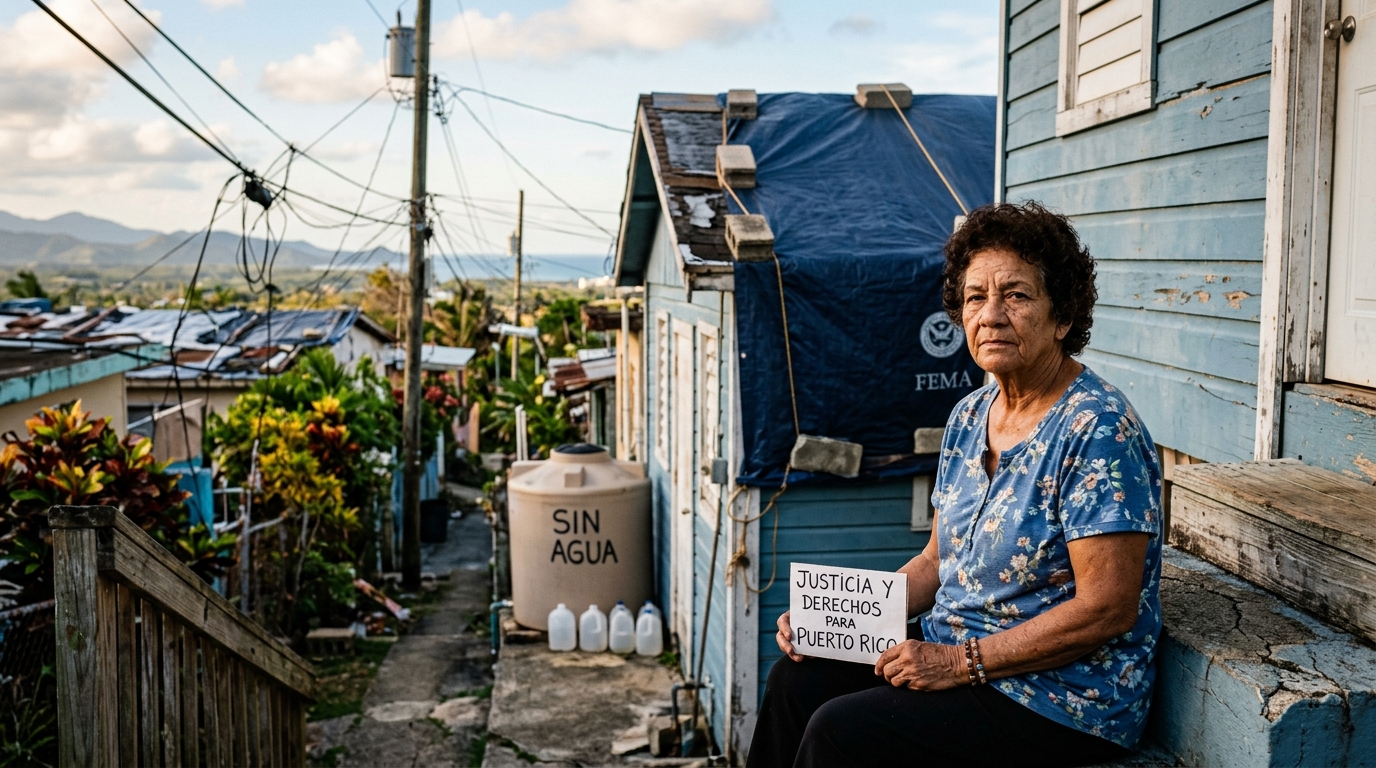
The underlying fragility of Puerto Rico’s infrastructure, compounded by years of austerity, transformed natural disasters into prolonged humanitarian catastrophes. When Hurricane Maria, a Category 4 storm, struck in 2017, it exposed the dire consequences of systemic neglect. The storm decimated the power grid and destroyed critical infrastructure, resulting in thousands of deaths and leaving communities isolated without essential resources.
The federal response was widely criticized as sluggish and plagued by bureaucratic red tape. Even years after the storm, and following subsequent destructive earthquakes in late 2019 and early 2020, the recovery process remains agonizingly slow. According to a 2024 report by the U.S. Government Accountability Office (GAO), while the Federal Emergency Management Agency (FEMA) has awarded billions for permanent recovery work, local agencies face substantial hurdles in utilizing these funds. The GAO highlighted that subrecipients struggle with administrative bottlenecks and rising construction costs, meaning only a fraction of approved permanent infrastructure projects have been completed.
Furthermore, the intersection of delayed funding and ongoing economic austerity meant that crucial infrastructure, such as the power grid overseen by the Puerto Rico Electric Power Authority (PREPA), was left vulnerable for years. Rolling blackouts remain a common occurrence, disrupting daily life, hindering business operations, and jeopardizing the health of vulnerable populations reliant on medical equipment. This cascading failure illustrates how the denial of robust federal support directly undermines the foundational human rights of safety, health, and an adequate standard of living. The slow pace of reconstruction not only impedes economic recovery but also leaves the island perilously exposed to future climate events.
The Role of the International Community
The human rights crisis in Puerto Rico has drawn attention on the global stage, though meaningful intervention remains elusive. The United Nations Special Committee on Decolonization consistently reviews the political status of Puerto Rico. Despite the territory being removed from the UN’s official list of Non-Self-Governing Territories in 1953 following the adoption of a local constitution, the committee continues to hold annual hearings regarding its status.
During these hearings, activists, legal experts, and political leaders present testimonies highlighting the colonial nature of the U.S.-Puerto Rico relationship. The committee has repeatedly adopted resolutions affirming the right of the Puerto Rican people to self-determination and calling upon the United States to address the issue transparently. However, these international declarations remain largely symbolic, as the U.S. government has historically dismissed the committee’s resolutions, treating Puerto Rico’s status as an entirely domestic matter immune to international pressure.
Conclusion: The Urgent Need for True Self-Determination
Turning a blind eye to the human rights crisis in Puerto Rico is no longer tenable. The overlapping challenges of political disenfranchisement, legal discrimination rooted in the Insular Cases, crippling economic austerity, and faltering disaster recovery are symptoms of a fundamentally broken territorial relationship. Addressing the crisis requires more than piecemeal disaster aid; it demands a comprehensive reevaluation of Puerto Rico’s political status. Until the United States engages in a binding process of self-determination that allows the people of Puerto Rico to decide their own future—whether that be statehood, independence, or a formalized sovereign free association—the island will remain relegated to second-class status, and its systemic human rights crisis will endure.
Frequently Asked Questions (FAQs)
- What is Puerto Rico’s current political status?
Puerto Rico is an “unincorporated territory” of the United States. Its residents are U.S. citizens but do not have voting representation in Congress and cannot vote for the U.S. President in general elections. This status leaves them subject to federal laws without the democratic power to influence how those laws are drafted or applied. - What are the Insular Cases?
The Insular Cases are a series of Supreme Court decisions from the early 1900s that established the doctrine of unincorporated territories. They ruled that full constitutional rights do not automatically extend to all U.S. territories. Legal scholars often criticize these decisions for being rooted in the racial prejudices of the era, yet they remain binding precedent today. - How did the PROMESA Act affect Puerto Rico’s economy?
Enacted in 2016 to address a $70 billion debt crisis, PROMESA created an unelected oversight board that imposed strict economic austerity measures, leading to severe funding cuts for public education, pensions, and healthcare. While it allowed Puerto Rico to exit bankruptcy in 2022, the austerity severely impacted the island’s standard of living. - Why is the United Nations involved in discussions about Puerto Rico?
The UN Special Committee on Decolonization holds annual hearings on Puerto Rico because human rights advocates recognize its territorial status as a colonial relationship requiring a binding process of self-determination. These hearings result in non-binding resolutions urging the United States to adhere to international human rights standards.
References
- Puerto Rico exits bankruptcy after grueling debt negotiation — The Associated Press (AP News). 2022-03-15. https://apnews.com/article/business-caribbean-puerto-rico-bankruptcy-san-juan-00508d0e7e8346e9d05e24b519e917d0
- PUERTO RICO DISASTERS: Progress Made, but the Recovery Continues to Face Challenges (GAO-24-105557) — U.S. Government Accountability Office (GAO). 2024-02-13. https://www.gao.gov/products/gao-24-105557
- Reexamining the Insular Cases. Again. — Harvard Law School. 2024-05-03. https://hls.harvard.edu/today/reexamining-the-insular-cases-again/
- Decolonization at the UNGA: Algeria and Puerto Rico — Carnegie Council for Ethics in International Affairs. 2024-11-21. https://www.ethicsandinternationalaffairs.org/online-exclusives/decolonization-at-the-unga-algeria-and-puerto-rico
Similar Articles








Read full bio of Sneha Tete


