
Carrying Swords in Public: U.S. Laws Explained
Navigate the complex landscape of sword carrying laws across U.S. states, from open carry rules to penalties and exceptions.
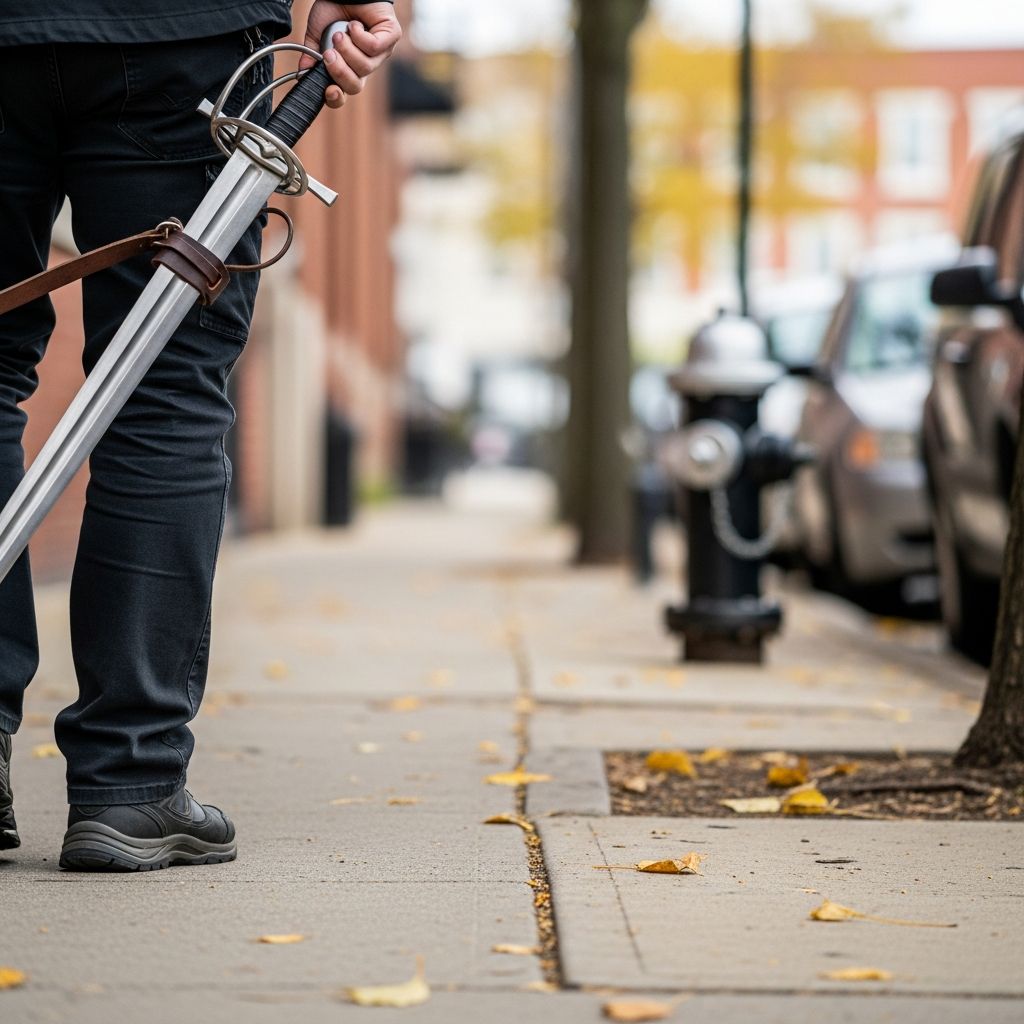
Owning swords is permitted in all 50 U.S. states, but transporting or displaying them openly in public spaces triggers a patchwork of regulations that differ significantly by jurisdiction. These rules stem from broader concerns over public safety, concealed weapons, and local ordinances, often treating swords like extended knives or dangerous instruments. Understanding these laws requires examining federal baselines, state statutes, and municipal codes to avoid unintended criminal charges.
Foundational Legal Principles for Blades in Public
U.S. weapon laws prioritize distinguishing between ownership, possession, and public carry. While federal law does not outright ban swords, it imposes restrictions on interstate transport, such as requiring them in checked luggage for air travel with proper declaration. States classify swords—defined as thrusting, striking, or cutting weapons with blades longer than typical knives, like katanas or machetes—under knife or dangerous weapon statutes. “Plain view” carry means the item is visible and recognizable, even in a sheath, but this does not guarantee legality everywhere.
Key principles include prohibitions on concealed carry of fixed-blade weapons and bans on blades exceeding certain lengths in public areas. Local governments frequently enact stricter rules than states, creating a layered regulatory environment. For instance, urban areas often restrict any visible bladed weapon to prevent disturbances.
State-by-State Breakdown of Sword Carry Regulations
Laws vary widely, with some states embracing permissive open carry post-reforms, while others maintain tight controls. Below is a comparative overview of select states highlighting blade length limits, open carry status, and notable exceptions.
| State | Open Carry Allowed? | Blade Length Limit | Key Restrictions/Exceptions |
|---|---|---|---|
| Texas | Yes (post-2017) | Over 5.5 inches permitted openly | Banned in schools, government buildings; historical demos allowed |
| California | Fixed blades in plain view only | No specific sword limit if visible | No concealed or disguised (e.g., cane swords); misdemeanor for violations |
| New York | Generally no | Restricted; disguised blades illegal | First offense misdemeanor, repeats felony |
| Virginia | Ambiguous; local rules apply | No statewide sword ban | May cause public disturbance charges; check ordinances |
| South Carolina | Yes, absent criminal intent | No general ban | Prohibits dueling challenges; school grounds off-limits |
This table illustrates the diversity: Texas liberalized laws via H.B. 1935 in 2017, allowing open carry of long blades except in prohibited zones. In contrast, places like certain California cities demand visibility to avoid concealment charges. Municipal codes, such as one banning plain-view carry of swords in public areas with fines up to $500 or jail time, exemplify local overrides.
Local Ordinances and Municipal Overrides
Cities and counties often impose the strictest barriers. For example, a municipal code explicitly prohibits wearing or carrying any sword in plain view on public streets or facilities, defining “sword” broadly to include rapiers, sabers, and katanas. Exceptions cover law enforcement, armed security, and occupational use, like chefs with knives in dining settings. Penalties include impoundment of the weapon for up to 30 days and infractions escalating to misdemeanors.
In parks or events, ordinances target fixed-blade items over specific lengths to curb violence risks, as upheld in cases like Seattle’s park rules. Sword enthusiasts must consult city codes, as state permission does not supersede local bans. Public perception amplifies risks; even legal carry can prompt 911 calls leading to scrutiny.
Exceptions and Permitted Scenarios
- Law Enforcement and Security: On-duty officers, off-duty with ID, contracted security, and qualified retired officers under 18 U.S.C. § 926C are exempt.
- Occupational Use: Blades for work, such as farming machetes or restaurant knives, are allowed.
- Cultural or Historical Events: Demonstrations, ceremonies, or fencing (non-sharpened foils) bypass restrictions.
- Private Property: Carry is generally unregulated on one’s land or with owner consent, barring posted bans.
- Travel: Checked baggage complies with TSA rules federally.
These carve-outs emphasize intent and context, but misuse voids protections, potentially leading to charges.
Risks of Non-Compliance and Case Studies
Violations range from infractions ($250 fines) to felonies, depending on jurisdiction and priors. Concealed or disguised swords, like cane blades, draw harsher penalties: misdemeanors first, felonies on repeat. In Texas, restricted-area carry yields misdemeanors or felonies.
Real-world cases highlight pitfalls. A Washington incident involved a man with a 24-inch sword in a park, challenged under a broad knife ordinance recast as sword-specific; courts noted overbreadth but upheld safety aims. South Carolina’s last dueling-related case dates to 1843, but modern carry remains lawful without intent. Michigan treats certain double-edged swords as felonious if in vehicles. These underscore researching beyond state lines.
Practical Advice for Sword Owners
To stay compliant:
- Verify state statutes and local codes via official sites like state legislatures or city clerks.
- Opt for sheathed, visible carry where permitted, avoiding urban crowds.
- Document purpose (e.g., event invite) for exceptions.
- If approached by police, remain calm, present ID, and explain knowledge of laws without arguing.
- Avoid self-defense reliance; swords complicate use-of-force claims.
Public alarm often precedes legal issues, so discretion prevents escalation. Joining groups like the American Knife and Tool Institute provides updates.
Frequently Asked Questions About Public Sword Carry
Is sword ownership legal nationwide?
Yes, swords can be owned in all states, but public carry faces restrictions.
Can I open carry a sword for self-defense?
Possibly in permissive states, but self-defense laws vary; consult statutes as use escalates charges.
What defines a ‘sword’ legally?
Typically a long-bladed weapon for cutting/thrusting, excluding unsharpened fencing foils.
Are disguised swords ever allowed?
Rarely; cane swords are often illegal statewide, risking felony charges.
What happens if police stop me with a sword?
Comply calmly, show awareness of laws, and provide intent explanation.
Broader Implications for Weapon Rights
Sword carry debates intersect Second Amendment discussions, with advocates arguing blades as arms. Courts apply knife precedents, rejecting blanket bans as overbroad. As reforms like Texas’s continue, expect evolution, but vigilance on locals remains key. Enthusiasts should prioritize safety and legality to preserve rights.
References
- Open Carry Sword Laws — Swords of Northshire. 2023. https://www.swordsofnorthshire.com/blogs/theblade/open-carry-sword-laws
- CARRYING OR WEARING OF KNIVES, DAGGERS, AND SWORDS — eCode360 (Municipal Code). 2023-09-26. https://ecode360.com/43514123
- Is It Legal to Open Carry a Sword? — BattlBox. 2023. https://www.battlbox.com/blogs/carry-laws/is-it-legal-to-open-carry-a-sword
- Are Swords Legal? Global Sword Laws Explained by Country — Everest Forge. 2023. https://everestforge.com/everest-forge-blog/Global-sword-laws
- Swords and Sensibilities — American Knife and Tool Institute (AKTI). 2023. https://www.akti.org/swords-and-sensibilities/
- Navigating U.S. Sword Cane Laws — WalkingCanes.com. 2023. https://walkingcanes.com/blogs/canes/navigating-u-s-sword-cane-laws
Similar Articles








Read full bio of Sneha Tete


