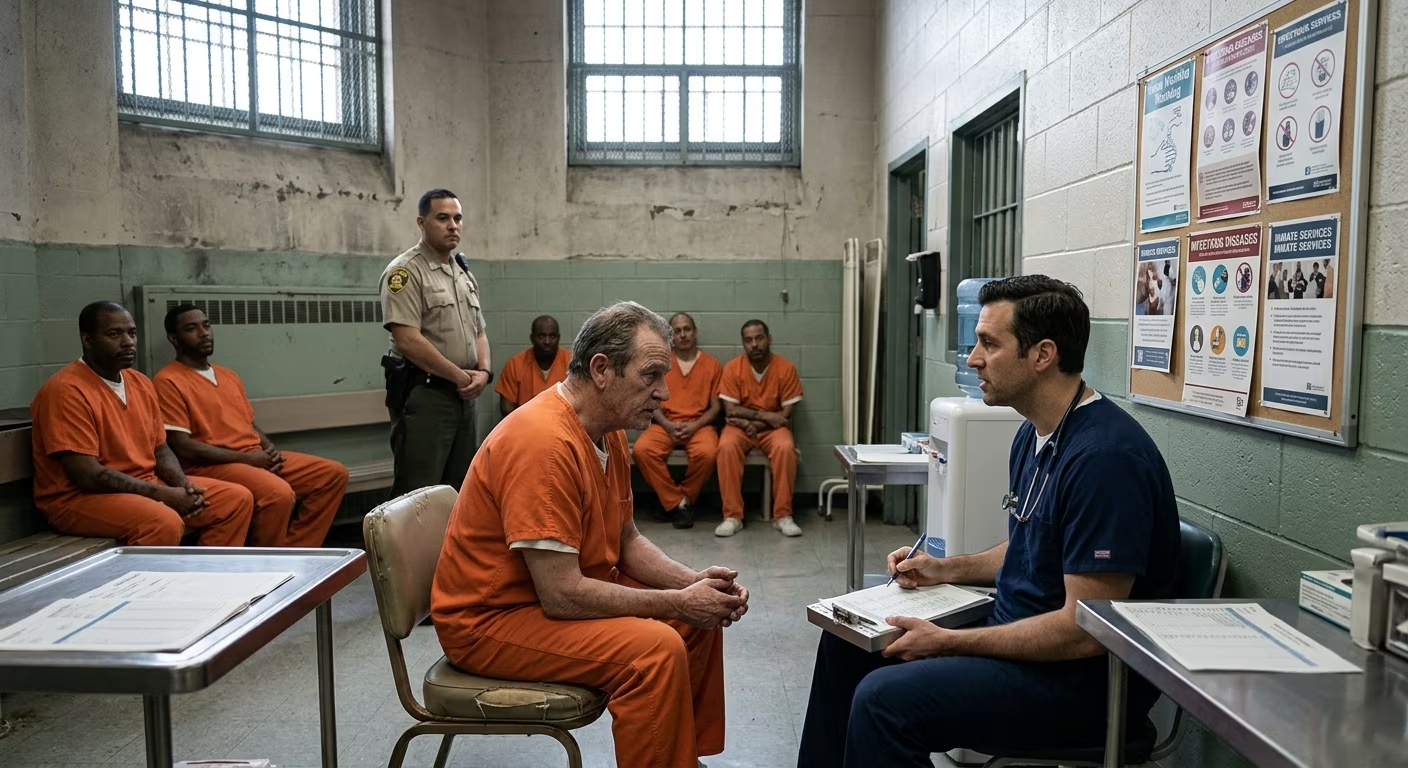
Public health emergencies often expose the most profound fault lines within societal infrastructure, and perhaps nowhere is this more tragically evident than within the walls of correctional facilities. As airborne pathogens sweep across the globe, individuals housed in jails, prisons, and detention centers find themselves on the absolute front lines of epidemiological vulnerability. The historical waves of the COVID-19 pandemic—most notably the highly transmissible Omicron surge—served as a stark reminder that the United States’ reliance on mass incarceration fundamentally conflicts with public health mandates. While the general population was advised to socially distance, work from home, and maintain stringent hygiene practices, these basic protective measures were logistical impossibilities for millions of incarcerated individuals.
The structural realities of confinement mean that when a virus enters a facility, it spreads with aggressive and unyielding velocity. Addressing the nexus of criminal justice and public health is not merely an exercise in institutional or legal reform; it is a critical, life-saving mandate for human rights and community safety. Recognizing the intrinsic link between the health of marginalized populations and the health of the broader public is the very first step toward building a more resilient, equitable society that values human life over punitive confinement.
The Unique Vulnerabilities of Incarcerated Populations
Correctional facilities are inherently congregate settings, meticulously designed to maximize space and security rather than to prioritize health, air circulation, or sanitary living conditions. This architectural and operational reality transforms prisons and local jails into dangerous incubators for respiratory diseases. Incarcerated individuals are often housed in cramped, shared cells or massive open-dormitory configurations, where beds are spaced mere feet or even inches apart. In such restrictive environments, the concept of social distancing is a physical impossibility, rendering residents defenseless against airborne transmission.
Beyond the spatial limitations, the everyday logistics of prison life severely exacerbate vulnerability. Facilities frequently struggle with outdated and poor ventilation systems that merely recirculate stale, contaminated air, trapping airborne particles in completely enclosed spaces for hours. Furthermore, access to essential sanitation supplies is heavily restricted. Hand sanitizer, a ubiquitous tool for infection control in the free world, is routinely classified as contraband due to its alcohol content. Soap is often heavily rationed or must be purchased through the institutional commissary, placing an unfair financial burden on those without external financial support.
These environmental and operational hazards are severely compounded by the demographic profile of the incarcerated population. Statistical data reveals a disproportionately high prevalence of underlying chronic illnesses—such as asthma, advanced diabetes, cardiovascular disease, and compromised immune systems—among those in custody. Decades of marginalization, extreme poverty, and inadequate access to preventative healthcare prior to incarceration mean that this population enters the system already medically vulnerable. When a rapidly mutating pathogen like the SARS-CoV-2 Omicron variant enters a facility with such a dense concentration of immunocompromised individuals, the resulting outbreaks are explosive, leading to exponentially elevated rates of severe illness and completely preventable mortality.
Analyzing the Data: Infection Rates and Outcomes in Custody
A rigorous examination of the epidemiological data unequivocally underscores the catastrophic impact of infectious diseases within confined environments. During the height of the pandemic, the Bureau of Justice Statistics (BJS) closely monitored the collision of the virus with the justice system, revealing unprecedented disruptions and high mortality. Between March 2020 and February 2021, state and federal prisons saw significant demographic shifts and staggering infection rates that far exceeded those documented in free society.
The data illustrates a stark and deeply troubling disparity between correctional environments and the general community. The crude mortality rate in prisons significantly outpaced that of free populations during parallel timeframes. In states where widespread testing was ultimately implemented, positivity rates soared at terrifying speeds. Because jails experience rapid churn—with thousands of individuals being booked and released back into society daily—these facilities served not just as isolated hotspots, but as powerful transmission multipliers that fueled massive community spread.
To fully contextualize the immense disparity, consider the fundamental differences in exposure and mitigation between incarcerated settings and community environments:
| Risk Factor | General Population | Incarcerated Population |
|---|---|---|
| Space & Proximity | Ability to isolate at home, control physical distance, and limit large gatherings. | Overcrowded dorms, multi-person cells, shared bathrooms, and forced congregate dining. |
| Hygiene Access | Unlimited access to soap, alcohol-based sanitizers, highly effective masks, and cleaning supplies. | Rationed soap, totally banned sanitizers, and heavily restricted access to clean, medical-grade PPE. |
| Medical Care | Ability to seek immediate external emergency care or consult specialists. | Subject to slow institutional delays, understaffed medical wings, and dismissed symptoms. |
| Comorbidities | Standard baseline health metrics typical for the region. | Significantly higher rates of chronic disease, untreated conditions, and substance use disorders. |
This table effectively highlights the structural inequities that transform a standard public health threat into a localized, fatal crisis. When highly transmissible variants breach the walls via asymptomatic staff or transferred individuals, the outbreak potential scales exponentially, rapidly overwhelming the highly limited medical infrastructure built into these state and federal institutions.
The Imperative for Decarceration and Population Reduction
Faced with the profound inability to alter the physical architecture of existing prisons quickly, public health experts and top epidemiologists have consistently identified one primary mechanism to mitigate disaster: severe population reduction, commonly referred to as decarceration. Reducing the massive footprint of mass incarceration is not merely a political or legal argument; during a deadly, fast-moving outbreak, it is a scientifically mandated triage strategy. By significantly reducing the number of people inside a facility, administrators can create the essential physical space necessary for medical isolation, quarantine of exposed individuals, and basic physical distancing.
During the initial waves of the COVID-19 crisis, there was a brief but significant movement toward decarceration across multiple jurisdictions. According to data provided by the BJS, the total number of persons in the custody of state, federal, or privately operated prisons decreased by more than 16% in the very first year of the pandemic, translating to hundreds of thousands of lives removed from direct peril. Crucial strategies included expediting the release of individuals nearing the end of their sentences, transferring medically vulnerable and elderly individuals to safe home confinement, and significantly reducing pre-trial jail admissions for low-level offenses.
However, as society acclimatized to the virus over time, many of these vital emergency decarceration efforts were tragically abandoned or reversed. This immediate rollback proved devastating when subsequent, more contagious variants emerged to sweep through populations. Maintaining substantially lower populations within these facilities remains an urgent necessity. Decarceration allows correctional health staff to manage limited resources effectively and prevents local community hospitals from being overwhelmed by a sudden, massive influx of critically ill incarcerated patients. True structural reform requires establishing permanent legal frameworks that allow for the rapid, immediate release of non-violent, vulnerable populations the exact moment a state of public health emergency is officially declared.
Vaccination, Medical Care, and Preventative Protocols
Vaccination rightfully remains the absolute cornerstone of modern infectious disease prevention, yet rolling out comprehensive, timely vaccine programs within correctional facilities presents a unique set of logistical and profound ethical hurdles. The rapid emergence of the Omicron variant vividly demonstrated that even with prior infection, reinfection risks were remarkably high without updated booster immunizations. Crucial studies evaluating the real-world efficacy of mRNA vaccines within massive prison systems showed that hybrid immunity—achieved through a combination of prior infection and robust, ongoing vaccination—provided the absolute strongest defense against severe outcomes and hospitalization.
Despite this overwhelming evidence, incarcerated individuals often face incredibly significant barriers to receiving timely vaccinations and essential boosters. Deep mistrust of prison medical staff, rooted in historical medical abuses and decades of systemic neglect, frequently leads to widespread vaccine hesitancy. To combat this effectively, public health authorities must deploy independent health professionals to administer vaccines and provide transparent, culturally competent education regarding their efficacy and safety, completely independent of the punitive structures of the prison system.
Beyond vaccination, fundamental institutional preventative protocols must be radically overhauled from the ground up. Facilities must invest heavily in high-efficiency particulate air (HEPA) filtration systems to thoroughly improve indoor air quality and ventilation. Routine, mass asymptomatic testing should be a standard, ongoing protocol rather than a delayed, reactive measure initiated only after a massive outbreak is already underway. Furthermore, medical isolation must be distinctly separated from punitive solitary confinement. Historically, prisons have dangerously conflated the two, placing sick, terrified individuals in isolation cells that completely strip them of basic privileges, communication, and human dignity. This inherently punitive approach to healthcare deeply discourages individuals from ever reporting symptoms, thereby accelerating silent transmission networks throughout the facility. Proper, humane medical isolation must fiercely prioritize comfort, continuous medical monitoring, and unhindered access to communication with concerned families.
Impact on Correctional Staff and Surrounding Communities
It is a dangerous and persistent misconception to view prisons and jails as closed, isolated ecosystems. In reality, they are deeply porous institutions connected intrinsically and daily to the surrounding communities. Thousands of correctional officers, medical staff, food service workers, maintenance crews, and administrative personnel cross the threshold of these facilities every single day. If a contagious virus is circulating aggressively within a prison block, it is practically inevitable that staff members will contract it and unwittingly carry it back to their homes, families, and local neighborhoods.
Public health agencies have repeatedly highlighted that large outbreaks in correctional settings frequently precede or heavily amplify outbreaks in the surrounding counties. This deep interconnectedness fundamentally emphasizes that advocating for the health and safety of incarcerated populations is fundamentally an act of broader community defense. Furthermore, the immense stress and high infection rates among correctional staff lead to severe, debilitating workforce shortages, which in turn causes extensive facility lockdowns, dangerous disruptions in food service, and further deadly delays in medical care for those incarcerated. Safeguarding the incarcerated is truly synonymous with safeguarding the public.
Frequently Asked Questions (FAQs)
- Why are infectious diseases so easily spread in prisons and jails?
Prisons and jails are tight, congregate environments characterized heavily by extreme overcrowding, shared living quarters, and woefully poor ventilation. Residents physically cannot socially distance, and vital access to basic hygiene products like strong soap and hand sanitizer is often restricted or monetized, creating an absolutely ideal environment for airborne and surface-transmitted pathogens to spread rapidly and uncontrollably. - What is the main difference between a prison and a jail in the context of a viral outbreak?
Jails generally hold individuals awaiting trial or serving very short sentences, leading to an incredibly high rate of turnover (often called jail churn). This constant influx and outflow make jails highly powerful vectors for spreading disease rapidly back into the local community. Prisons, on the other hand, hold individuals serving much longer sentences, meaning outbreaks can become deeply entrenched, incredibly severe, and devastating over time if the virus breaches the secure facility. - What does decarceration mean, and why is it highly recommended by public health experts?
Decarceration refers directly to the deliberate reduction of the number of people held in custody. During a pandemic, public health experts strongly recommend decarceration because it is virtually the only effective way to create the physical space necessary for social distancing and true medical isolation. Releasing the elderly, the medically vulnerable, and non-violent individuals drastically eases the immense burden on internal medical staff and directly prevents mass fatalities. - Do incarcerated individuals legally have a right to adequate healthcare?
Yes. Under the Eighth Amendment of the U.S. Constitution, which vehemently protects against cruel and unusual punishment, the government has a very strict, non-negotiable obligation to provide adequate medical care to individuals it incarcerates. Willfully failing to protect them from a known, deadly infectious disease can easily be considered a major violation of this constitutional mandate.
Conclusion: A Blueprint for Future Resilience
The relentless waves of the COVID-19 pandemic, punctuated aggressively by highly transmissible variants like Omicron, cast a terribly harsh light on the inherent dangers of mass incarceration. The structural, architectural, and operational constraints of modern jails and detention centers make them fundamentally incompatible with modern public health crisis management and basic epidemiological safety protocols. However, the tragic lessons learned from this defining era provide a clear, undeniable blueprint for the future. Moving forward, lawmakers and policymakers must forcefully prioritize systemic decarceration strategies that can be rapidly deployed during future health emergencies. Furthermore, massive investments must be made to immediately upgrade the deeply deteriorating ventilation and medical infrastructure within these forgotten facilities.
Above all, there must be a profound, lasting paradigm shift in how society views the incarcerated. They are deeply human and not a forgotten population immune to the unyielding laws of epidemiology, nor should their legal sentences ever include an implicit, silent condemnation to preventable disease. Ensuring robust healthcare access, comprehensive vaccination protocols, and humane living conditions behind bars is an absolutely essential pillar of global public health and a fundamental requirement for a civilized, just society.
References
- Impact of COVID-19 on State and Federal Prisons, March 2020–February 2021 — Bureau of Justice Statistics (U.S. Department of Justice). 2022-08-25. https://bjs.ojp.gov/library/publications/impact-covid-19-state-and-federal-prisons-march-2020-february-2021
- Interim Guidance on Management of Coronavirus Disease 2019 (COVID-19) in Correctional and Detention Facilities — Centers for Disease Control and Prevention (CDC). 2021-01-22. https://stacks.cdc.gov/view/cdc/100954
- Protection against Omicron from Vaccination and Previous Infection in a Prison System — National Institutes of Health (PMC / New England Journal of Medicine). 2022-10-26. https://www.ncbi.nlm.nih.gov/pmc/articles/PMC9595292/