
Liquor License Application Process Explained
A practical guide to the steps, checks, and local approvals involved in getting a liquor license.
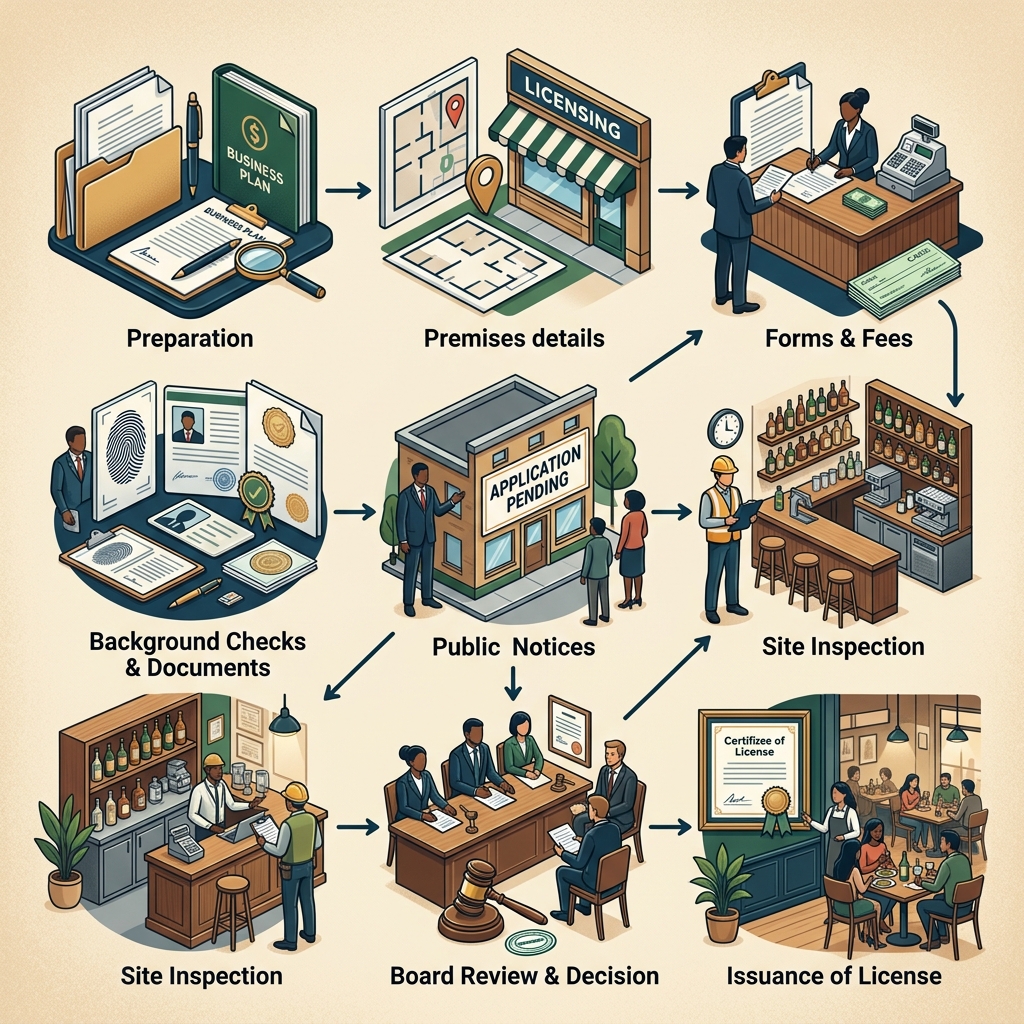
Applying for a liquor license is rarely a single-step filing. In most places, it is a multi-agency review that can involve zoning checks, background investigations, public notice, inspections, and approval from both state and local authorities. The exact rules depend on the jurisdiction, but the underlying process is usually similar: prove the business is eligible, show that the premises are appropriate, and satisfy all licensing conditions before alcohol sales can begin.
Because alcohol sales are tightly regulated, the application process often takes longer than other business permits. Government licensing pages in multiple jurisdictions show that applicants may need to submit forms, fees, site plans, ownership records, and supporting documents before a license is issued, and some jurisdictions also require public hearings or community notice periods.
Why liquor licenses require extra review
A liquor license is not just a business permit; it is authorization to sell a regulated product with public safety implications. That is why licensing authorities commonly look beyond the business name and address. They may review the owners’ backgrounds, the physical location, the legal status of the business entity, and whether the proposed operation complies with local rules.
This extra scrutiny serves several purposes:
- It helps confirm that the applicant is legally eligible to hold a license.
- It allows officials to check whether the site is properly zoned for alcohol sales.
- It gives the public and local government an opportunity to raise objections or conditions.
- It helps ensure the premises can be operated safely and lawfully.
Typical stages in the application process
Although the exact sequence varies, liquor license applications commonly move through several recognizable stages. New Mexico’s alcohol licensing process, for example, includes preliminary review, posting requests, a preliminary hearing, deficiency notices, recommendations, local review, and final approval. Other jurisdictions, such as Chicago, California, and Indiana, also require application submission, supporting documentation, local or district review, and inspections.
| Stage | What usually happens |
|---|---|
| Pre-application review | The applicant confirms the correct license type and checks local eligibility rules. |
| Application filing | Forms, fees, ownership details, and site documents are submitted to the authority. |
| Notice and publication | Public notice may be posted or published so community members can respond. |
| Inspections and review | Agencies may inspect the premises and review compliance with zoning, fire, health, and building rules. |
| Decision | The licensing body approves, denies, or requests corrections before final issuance. |
Choosing the right license category
The first practical step is identifying the correct license type. A restaurant, bar, hotel, grocery store, brewery, caterer, or special event venue may each need a different permit. Indiana’s alcohol permit guidance says applicants should determine what type of permit they seek before starting the process, and California’s licensing guidance similarly directs applicants to the proper district office for the license they need.
Choosing the wrong category can cause avoidable delays. For example, a license intended for on-site consumption may not authorize retail package sales, and a temporary event permit is not the same as an ongoing business license. Applicants should match the license to the actual business model, menu, hours, service style, and premises.
Documents commonly requested
Most liquor license applications require a package of business and property records, not just a standard form. Chicago’s process asks for a written application, a floor plan, and required supporting documents; North Carolina guidance notes that applicants may need identification, background checks, lease or purchase records, and other permits; Georgia advises applicants to gather and save supporting documents as individual PDF files before filing.
Typical documents include:
- Business formation records, such as articles of organization or incorporation
- Ownership and management information for all relevant principals
- Lease agreements, deeds, or purchase contracts for the premises
- Floor plans and site layouts
- Tax identification information and business registration records
- Background check forms, fingerprints, or personal disclosure statements
- State and local permits required for the business location
Some jurisdictions also ask for financial information, character references, proof of insurance, or operational plans. The point is to show that the applicant is organized, legally qualified, and capable of running a compliant alcohol-selling business.
Local approval and community notice
Liquor licensing is often shaped by local government participation. Chicago requires public notice to nearby registered voters and allows a period for comments or objections, while New Mexico’s process includes forwarding the application to the local governing body for notice and a public hearing. Indiana also requires appearance before a local alcoholic beverage board before final consideration by the state commission.
This local layer matters because alcohol sales can affect traffic, noise, neighborhood character, and public safety concerns. A favorable state application may still face local resistance if the proposed operation conflicts with zoning, community standards, or nearby protected uses such as schools or places of worship.
Inspections and compliance checks
Before a license is issued, the physical premises may be inspected. Chicago notes inspections from the health, fire, and buildings departments, including plumbing and ventilation checks. Indiana’s permit process includes a final floor plan inspection of the licensed premises by state excise police. These reviews help confirm that the site matches the approved plan and can safely operate as described.
Common inspection concerns include:
- Compliance with occupancy and fire-safety requirements
- Kitchen, bar, and restroom layout
- Ventilation and plumbing conditions
- Alcohol storage and access control
- Conformity between the submitted floor plan and the real premises
Background checks and eligibility questions
Many licensing systems review the personal history of owners, officers, and managers. North Carolina guidance notes that applicants must satisfy identification and background check requirements, and Georgia indicates that background investigation, tax clearance, and fingerprinting may be required for some licenses. These checks are meant to identify issues such as prior alcohol violations, certain criminal histories, or unresolved tax and compliance problems.
Applicants should answer all disclosure questions carefully. Omissions or inconsistent statements can create greater problems than the underlying issue itself. If a prior violation, ownership interest, or tax matter exists, the best approach is often to disclose it fully and provide the requested records or explanation.
How long the process may take
Timeline depends heavily on the jurisdiction, license type, and completeness of the filing. Published guidance shows a wide range: New York says review for most applications currently takes approximately 22 to 26 weeks; California says many investigations take about 45 to 50 days and original licenses average about 90 days; Indiana says new permits may take 10 to 12 weeks; and Chicago’s process includes multiple waiting periods and a final decision window after all materials are filed.
Delays commonly happen when:
- Documents are missing or incomplete
- The floor plan does not match the premises
- Zoning or location rules are unclear
- Community objections require extra review
- Background or tax issues need follow-up
For that reason, applicants should assume the process will take longer than the shortest advertised timeline and build in time for corrections, hearings, and possible re-submission of materials.
Common reasons applications are delayed or denied
A liquor license application can be delayed for simple paperwork issues or denied for substantive compliance problems. New Mexico’s process includes a notice of deficiencies and gives applicants time to correct missing items, while Chicago warns that negative community response may affect approval. In many systems, a denial may also result from zoning conflicts, incomplete ownership disclosure, poor inspection results, or unresolved legal or tax issues.
Frequent problem areas include:
- Incomplete forms or missing signatures
- Failure to submit required supporting documents
- Inaccurate business entity information
- Location not approved for alcohol sales
- Failed inspections or unmet safety standards
- Community opposition during the notice period
How applicants can improve their chances
Preparation is the most effective way to reduce delays. Before filing, applicants should confirm the correct license category, review local zoning rules, and gather all ownership and site documents. They should also verify that the premises match the submitted floor plan and that all responsible individuals are ready for background review.
A practical filing strategy includes:
- Contacting the licensing agency early to confirm requirements
- Creating a document checklist before submission
- Reviewing local notice, hearing, and publication rules
- Preparing for inspections before the application is filed
- Responding quickly to deficiency notices or agency requests
Frequently asked questions
Do I need a liquor license before opening my business?
Yes, if your business plans to sell alcoholic beverages, you generally must secure the proper license before sales begin. Jurisdictions typically require the license to be approved and issued before lawful alcohol service can start.
Is the state approval the only approval I need?
No. Many systems involve local review as well as state-level review. A city, county, or local board may need to approve the application or provide a recommendation before final issuance.
Can the public object to my application?
Yes. Some jurisdictions require public notice, and community members may submit comments or objections during the notice period.
Why was my application returned for corrections?
Most often, an application is returned because the agency found missing information, incomplete forms, or inconsistencies in supporting records. Some systems issue a formal deficiency notice so the applicant can fix the problem and continue the process.
What should I do if the application is denied?
Denial procedures depend on the jurisdiction. Some systems allow administrative review or appeal, while others require a new filing or additional local action. Applicants should read the denial letter carefully and identify whether the problem is procedural, factual, or legal.
References
- NMRLD | ABC | Apply for Liquor License — New Mexico Regulation and Licensing Department. 2026-07-10. https://www.rld.nm.gov/abc/how-do-i/apply-for/liquor-license/
- Steps in the Liquor License Application Process — City of Chicago. 2026-07-10. https://www.chicago.gov/city/en/depts/bacp/supp_info/steps_in_the_liquorlicenseapplicationprocess.html
- License Application Requirements — California Department of Alcoholic Beverage Control. 2026-07-10. https://www.abc.ca.gov/licensing/apply-for-a-new-license/license-application-requirements/
- Obtaining an Alcoholic Beverage Permit — Indiana Alcohol and Tobacco Commission, IN.gov. 2026-07-10. https://www.in.gov/atc/alcohol-permit-resources/alcohol-permit-information/obtaining-an-alcoholic-beverage-permit
- Apply for a License to Sell Alcohol — Georgia Department of Revenue. 2026-07-10. https://dor.georgia.gov/alcohol/apply-license-sell-alcohol
- Get a License — New York State Liquor Authority. 2026-07-10. https://sla.ny.gov/get-license
Similar Articles








Read full bio of medha deb


