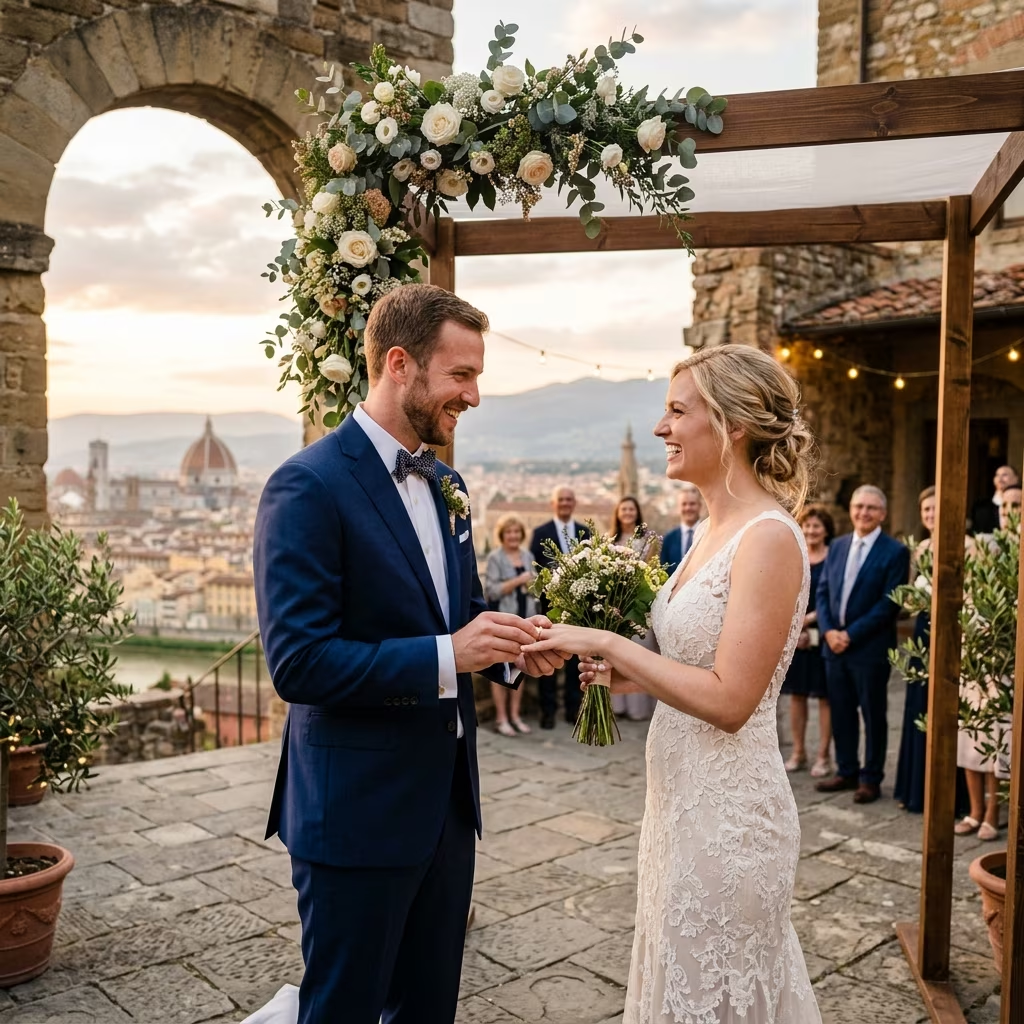
Many U.S. citizens choose to marry in another country, whether for romance, family reasons, culture, or convenience. While destination weddings can be memorable, they also raise important legal questions: Will the marriage be recognized in the United States? What paperwork is required? Can a U.S. embassy perform the ceremony? This guide explains the key legal rules, common procedures, and follow-up steps U.S. citizens should understand before marrying abroad.
Core Legal Principle: The Law of the Place of Celebration
For U.S. immigration and most other federal purposes, the validity of a marriage is determined under the place-of-celebration rule—that is, the law of the jurisdiction where the marriage was performed. If the marriage is valid where it is celebrated, it is generally treated as valid for U.S. federal purposes, subject to limited exceptions.
| Aspect | How It Is Determined |
|---|---|
| Basic validity of the marriage | Controlled by the law of the foreign country or territory where the marriage ceremony took place. |
| Proof of marriage | Typically shown by an official civil marriage certificate issued by the local authority. |
| U.S. recognition | Usually recognized if valid under foreign law, not contrary to strong U.S. public policy, and properly documented. |
Because the foreign country’s law is controlling for the formation of the marriage, understanding the local requirements is essential. U.S. law does not create a separate, federal marriage registration system for marriages performed overseas.
Role and Limits of U.S. Embassies and Consulates
U.S. citizens often assume they can marry directly at a U.S. embassy or consulate abroad. That is a misconception. Under federal regulations, U.S. diplomatic and consular officers are not allowed to perform marriages. Marriages abroad are almost always conducted by local civil or religious officials acting under local law.
Although consular officers cannot officiate, they can assist with documentation, including:
- Administering an affidavit of eligibility or freedom to marry if required by the foreign country.
- Providing general information about local marriage procedures and referring to local authorities or legal counsel.
- Authenticating certain U.S. documents for use abroad, where allowed.
U.S. embassies and consulates do not determine whether your marriage meets the law of the foreign country. That determination belongs to the local authorities. Their primary role is to help you satisfy U.S.-side documentation requirements and, in some cases, notarize statements that foreign officials require.
Understanding Local Requirements in the Foreign Country
Every country sets its own rules for who can marry, what documents are necessary, and how ceremonies must be conducted. Before traveling, you should carefully review these requirements with the foreign embassy or consulate in the United States and, in many cases, the local civil registry in the destination country.
Typical Documents and Conditions
Foreign authorities commonly request several types of documentation from U.S. citizens, such as:
- A valid U.S. passport as proof of identity and nationality.
- An original or certified copy of your birth certificate.
- Evidence that any prior marriage has ended, such as a divorce decree or death certificate for a former spouse.
- A single-status affidavit, affidavit of freedom to marry, or certificate of no impediment, usually sworn before a consular or local official.
- In some jurisdictions, a premarital medical certificate or blood test result.
- Where required, a parental consent document if one party is under the local age of majority.
Countries may also require that U.S. documents be:
- Translated into the local language by a sworn translator.
- Authenticated or provided with an apostille under the Hague Apostille Convention for use abroad.
Some destinations impose a residency period, waiting period, or public notice requirement before the ceremony can take place. Failure to comply with such procedural rules can jeopardize the legal validity of the marriage in that country and, consequently, its recognition in the United States.
Proof of Capacity to Marry and Affidavits
Many civil-law countries will not approve a marriage until both parties demonstrate they have the legal capacity to marry—meaning there is no legal impediment such as an existing marriage, prohibited degree of relationship, or age-based restriction.
Because the United States does not issue a national certificate of no impediment, foreign officials often accept a sworn affidavit of eligibility to marry. According to U.S. Department of State guidance, such affidavits are usually executed before a consular officer at the U.S. embassy or consulate in the country of marriage. The affidavit typically includes:
- Your full legal name and U.S. citizenship.
- Your current marital status (single, divorced, widowed).
- Information about any prior marriages and how they ended.
- A sworn statement that you are legally free to marry under the laws of your U.S. state of residence.
Foreign authorities may rely on this affidavit, together with supporting documents, to confirm there is no known legal barrier to the marriage under U.S. law.
Types of Ceremonies: Civil, Religious, and Dual Ceremonies
Countries differ in how they treat civil and religious ceremonies:
- In some places, only a civil ceremony performed by a government official is legally effective.
- In others, a religious ceremony conducted by a registered officiant may be legally recognized.
- Some jurisdictions require a civil ceremony plus an optional religious ceremony for social or cultural reasons.
To ensure your marriage is legally valid, confirm whether the officiant is authorized under local law and whether a civil registration must follow the ceremony. The U.S. government generally relies on the civil record issued by the foreign authority as proof of marriage, regardless of the type of ceremony.
Obtaining and Preserving the Foreign Marriage Certificate
An official marriage certificate issued by the foreign civil registry is the primary evidence that your marriage was properly performed and recorded. In most U.S. immigration and benefits contexts, a certified marriage certificate is considered prima facie evidence of a valid marriage.
Practical Tips for Documentation
- Request multiple certified copies of the marriage certificate at the time of registration.
- If your marriage certificate is in a foreign language, obtain a certified translation for use in U.S. proceedings.
- When required, obtain an apostille or other authentication to verify the document’s official nature for foreign and U.S. authorities.
- Store originals securely and keep scanned copies in a secure digital location.
In the United States, there is no national registry where you must or can file a foreign marriage certificate simply to make the marriage valid. However, you may need to present the certificate to various entities (such as state motor vehicle offices, Social Security, or immigration authorities) to update your marital status or claim benefits.
U.S. Recognition of Marriages Performed Abroad
In general, a marriage that is legally performed abroad is recognized in the United States if it meets three broad conditions:
- The marriage was valid under the law of the country where it was celebrated (substantive and procedural requirements satisfied).
- The marriage is not contrary to a strong U.S. public policy (for example, certain underage or polygamous marriages may not be recognized).
- Reliable documentation, usually a civil marriage certificate, is available to verify the marriage.
For immigration purposes, U.S. Citizenship and Immigration Services (USCIS) applies the place-of-celebration rule when determining whether a marriage is valid. The agency typically examines:
- The legal authority of the officiant under foreign law.
- Compliance with local requirements such as age, consent, and absence of prior undissolved marriages.
- The authenticity of the marriage certificate and related documents.
If these criteria are satisfied, the marriage will ordinarily be recognized for federal immigration and naturalization processes.
Bringing a Foreign Spouse to Live in the United States
If a U.S. citizen marries a foreign national abroad and wants to live together in the United States, the marriage certificate is only the first step. You must also comply with U.S. immigration procedures. U.S. law provides several pathways, but the most common is the family-based immigrant visa process.
Typical Immigration Path After Marriage Abroad
- File Form I-130, Petition for Alien Relative, with USCIS to establish the qualifying spousal relationship.
- Once the petition is approved and a visa is available, the foreign spouse generally completes consular processing at a U.S. embassy or consulate outside the United States.
- The foreign spouse attends a visa interview, medical examination, and security checks and, if successful, receives an immigrant visa to enter as a permanent resident.
- If both spouses are already in the United States and meet certain conditions, the foreign spouse may apply for adjustment of status instead of consular processing.
Some couples who have not yet married may use a fiancé(e) (K-1) visa, which allows the foreign partner to enter the United States for the purpose of marrying a U.S. citizen within a specified time and then applying for residence.
Special Considerations and Potential Legal Issues
While many marriages abroad are recognized without difficulty, several issues can complicate matters:
Public Policy Exceptions
The United States generally will not recognize foreign marriages that violate particularly strong public policies, such as:
- Polygamous marriages.
- Certain incestuous relationships prohibited by state law.
- Marriages involving parties below a minimum age threshold where consent or protection is legally insufficient.
If a marriage falls into one of these categories, it may be denied recognition for federal or state law purposes even if it was valid where celebrated.
Same-Sex Marriages
Some countries recognize same-sex marriages, while others do not. If the marriage is valid under the foreign law where it was performed, U.S. federal agencies generally recognize it for immigration and other federal purposes, following the place-of-celebration rule. However, couples should confirm both the foreign country’s policies and any local restrictions or conditions that may apply.
Record-Keeping and Lost Certificates
Keeping accurate records is essential. If a marriage certificate is lost, it may be possible to obtain a replacement from the foreign civil registry. In some countries, this process can be slow or complicated, emphasizing the importance of obtaining and safeguarding multiple certified copies early.
Step-by-Step Planning Checklist for U.S. Citizens
The following checklist summarizes key actions U.S. citizens should take before and after marrying abroad:
- Before traveling
- Contact the foreign country’s embassy or consulate in the United States to confirm legal requirements and list of documents.
- Gather originals and certified copies of identity, birth, and prior-marriage documents.
- Arrange for translations and apostilles if required by the destination country.
- Schedule any needed consular appointment to execute an affidavit of eligibility to marry.
- In the foreign country
- Appear before local authorities to apply for a marriage license or registration.
- Observe any waiting or notice periods required by local law.
- Confirm that the officiant is legally authorized and that the ceremony complies with local rules.
- Obtain certified copies of the civil marriage certificate as soon as available.
- After the marriage
- Secure certified translations and, when needed, apostilles for the marriage certificate.
- Use the certificate to update your marital status with relevant U.S. agencies and institutions.
- If one spouse is foreign, consider filing immigration petitions or applications promptly where appropriate.
Frequently Asked Questions (FAQs)
Can I get legally married at a U.S. embassy or consulate overseas?
No. U.S. diplomatic and consular officers are not permitted by regulation to perform marriages. All legally effective marriages abroad are conducted under the authority of local civil or religious officials, subject to local law.
Is my foreign marriage automatically valid in every U.S. state?
Most U.S. jurisdictions recognize marriages that were legally performed abroad if they were valid where celebrated and do not violate fundamental public policies of the forum state. However, specific issues can arise with underage or polygamous unions and similar relationships. State law may vary, so individualized legal advice is often advisable.
Do I need to record my foreign marriage with a U.S. federal agency?
No national marriage registration system exists in the United States. You do not file your foreign marriage certificate with a federal registry just to make the marriage valid. Instead, you use the marriage certificate as proof when dealing with immigration authorities, Social Security, state motor vehicle departments, and other institutions.
What if the foreign country requires a certificate of no impediment and the United States does not issue one?
Because the U.S. does not provide a national certificate of no impediment, foreign countries often accept a sworn affidavit of eligibility to marry executed before a consular officer at the U.S. embassy or consulate. This affidavit, often combined with supporting documents, serves as the functional equivalent of a no-impediment certificate.
How does a foreign marriage affect immigration for my spouse?
If you marry a foreign national abroad and wish to live in the United States, you typically must file an immigrant visa petition (often Form I-130) and complete consular processing or, in some circumstances, adjustment of status. The foreign marriage certificate is essential evidence of the relationship, but it does not itself grant any immigration status.
Do I have to change my name immediately after a foreign marriage?
U.S. law generally allows, but does not require, a name change after marriage. If you choose to change your name, you ordinarily use the foreign marriage certificate as evidence when updating your records with federal and state agencies. Each agency has its own procedures and documentation requirements.
References
- 7 FAM 1450 – Marriage of U.S. Citizens Abroad — U.S. Department of State. 2020-09-30. https://fam.state.gov/fam/07fam/07fam1450.html
- Marriage of U.S. Citizen Abroad (Consular Information) — U.S. Embassy Luanda, Angola. 2023-04-01. https://ao.usembassy.gov/services/marriage-of-u-s-citizen-abroad/
- Chapter 2 – Marriage and Marital Union for Naturalization — U.S. Citizenship and Immigration Services (USCIS) Policy Manual, Volume 12, Part G. 2023-08-01. https://www.uscis.gov/policy-manual/volume-12-part-g-chapter-2
- Issues with Getting Married Overseas — LawInfo. 2021-06-15. https://www.lawinfo.com/resources/family-law/issues-with-getting-married-overseas.html
- Marriage Overseas — Government of Canada, Travel.gc.ca. 2022-05-09. https://travel.gc.ca/travelling/documents/marriage-overseas