
Copyright License: How To Get Permission And Negotiate Terms
Learn how copyright licenses work, when you need permission, how to find owners, negotiate terms, and protect your projects legally.
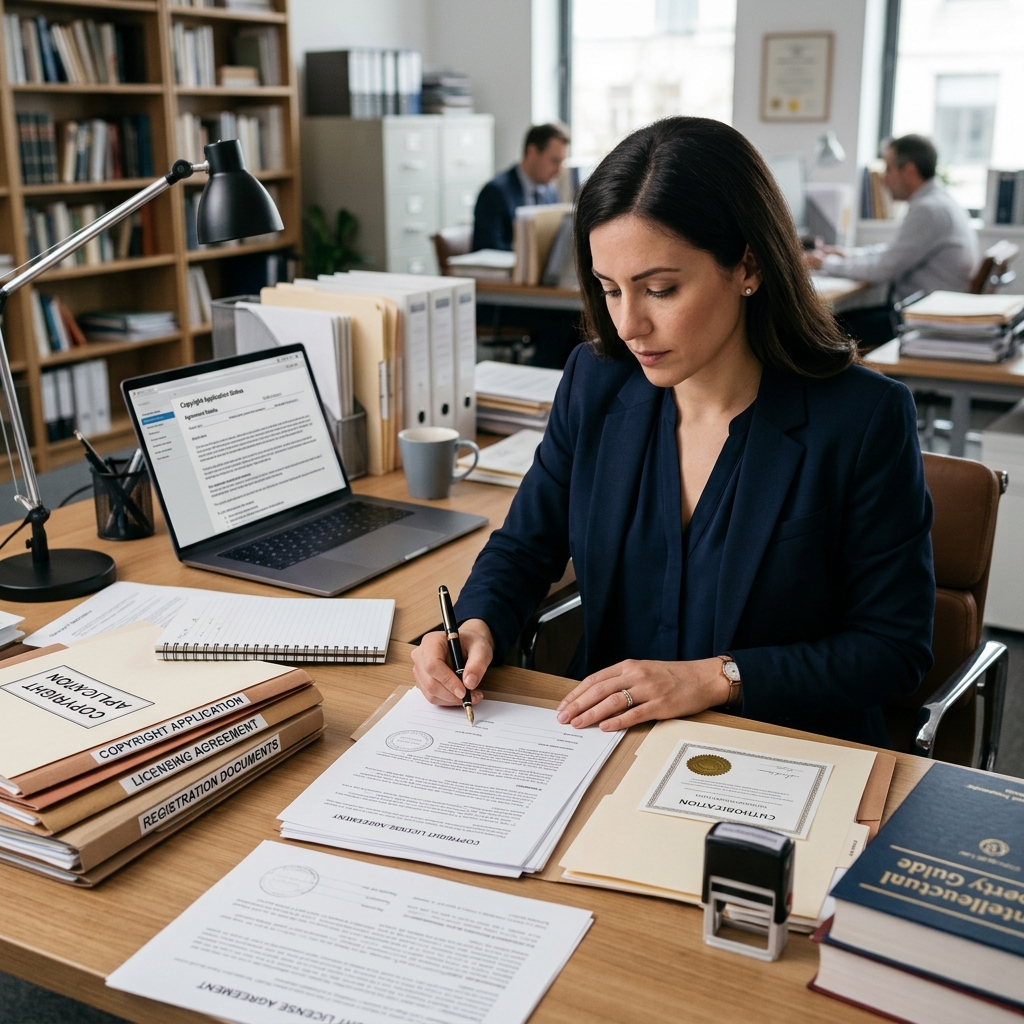
Using someone else’s creative work in your project can add enormous value, but it also raises legal questions. To stay on the right side of copyright law, you may need a copyright license—formal permission from the rights holder to use their work in specific ways. This guide explains what a copyright license is, when you need one, how to get permission, and why working with a lawyer can help you avoid costly mistakes.
1. Copyright Law Basics You Should Know First
Before you ask for a license, it helps to understand what copyright protects and what rights the law gives to the copyright owner.
1.1 What Copyright Protects
Under U.S. law, copyright protects original works of authorship that are fixed in a tangible medium—meaning the work is captured in some physical or digital form (for example, a file, a canvas, a printed book, or a recording). Common examples include:
- Books, articles, blog posts, and other written works
- Music, sound recordings, and song lyrics
- Photographs, illustrations, and graphic designs
- Movies, videos, and multimedia works
- Computer programs and software code
Copyright arises automatically as soon as the work is created and fixed in a tangible form. No registration is required for protection to exist, although registration offers important benefits such as eligibility for statutory damages and the ability to sue for infringement in federal court.
1.2 Exclusive Rights of the Copyright Owner
The copyright owner has exclusive rights to do (or authorize others to do) several key things with the work, including:
- Reproduce the work (make copies)
- Prepare derivative works (adaptations, remixes, translations, etc.)
- Distribute copies to the public
- Publicly perform the work (e.g., plays, music, film screenings)
- Publicly display the work (e.g., images, artwork, text)
- For sound recordings, public performance via digital audio transmission
Because these rights are exclusive, using someone else’s work in any of these ways without permission may constitute infringement unless a specific exception or limitation applies (such as fair use or a statutory license).
2. When You Need a Copyright License
Not every use of a copyrighted work requires a license. Some uses are free, some are covered by standard terms (such as creative commons licenses), and some are exempt under doctrines like fair use. When none of those apply, you likely need permission.
2.1 Common Situations That Require Permission
You will typically need a license if you plan to:
- Include someone else’s photo, artwork, or chart in your book, blog, or marketing materials
- Use music in a podcast, film, video game, or commercial
- Republish a substantial portion of an article, book, or research study
- Translate and distribute someone else’s work in another language
- Create and sell merchandise that features a copyrighted image or text
In each of these cases, you are potentially exercising one or more exclusive rights of the copyright owner, which means you must either fall within an exception or obtain explicit permission.
2.2 When You May Not Need Permission
You may not need a license when:
- The work is in the public domain (usually because copyright has expired or was never obtained)
- You are using the work under a valid open license (such as many Creative Commons licenses), and you comply with its conditions
- Your use qualifies as fair use under the law, such as certain commentary, criticism, news reporting, teaching, scholarship, or research uses
- Your use falls under another statutory exception (for example, certain library or archival uses)
Whether a use is fair use or not is a complex, fact-specific question and often requires legal analysis. When in doubt, many people choose to seek permission to reduce risk.
3. Types of Copyright Licenses
Not all licenses are the same. The type of license you negotiate will determine how broadly you can use the work and what rights the owner retains.
| License Type | Key Feature | Typical Use Cases |
|---|---|---|
| Exclusive license | Only the licensee may use the specified rights in the defined field; owner cannot grant those rights to others during the term. | Distributors, major publishers, large brand campaigns. |
| Nonexclusive license | Owner may grant similar rights to multiple users; licensee gets permission but not exclusivity. | Most day-to-day business uses, websites, smaller publications. |
| Single-use license | Permission for one defined use (e.g., one print run, one ad campaign). | Short-term marketing, one-time event promotions. |
| Broad or blanket license | Covers many works or uses under standardized terms. | Music performance rights for venues, broadcasting organizations. |
Clarifying the type of license you seek is one of the most important steps before you contact the copyright owner.
4. Step-by-Step: How to Obtain a Copyright License
Although each situation differs, most permission requests follow a similar path. Many legal and educational resources describe a three-part process: identify the rights you need, locate the copyright owner, then negotiate and document the license.
4.1 Step One: Define Your Intended Use
Start by clearly describing how you intend to use the work. This will guide your entire request and help the rights holder make an informed decision. Consider these questions:
- What kind of work are you using? (photo, song, article, video, etc.)
- Which rights do you need (reproduction, distribution, adaptation, public performance, display)?
- Where will the work be used? (geographic territory: local, national, worldwide)
- How long do you need the rights (one-time use, fixed term, perpetual)?
- Who is your audience? (internal staff, customers, general public)
- How will you distribute your project? (print, digital download, streaming, social media)
- Do you need exclusivity, or is a nonexclusive license sufficient?
- What is your budget for licensing fees?
Answering these questions in advance will make your request more precise, professional, and easier to evaluate.
4.2 Step Two: Identify and Locate the Copyright Owner
The next step is to figure out who owns the rights and how to contact them. Helpful strategies include:
- Check the work itself for a copyright notice or attribution line.
- Look for the author’s name, publisher, or producer on the work or its packaging.
- For books and articles, note the publisher, ISBN, or ISSN.
- Use search engines to find the creator’s or publisher’s website.
- Consult licensing organizations or collecting societies for certain types of works (for example, collective licensing agencies for written material, or performance rights organizations for music).
You can also search the U.S. Copyright Office records to identify registered copyright owners, although contact information may not always be current. The Office’s registration database can be searched online through its official portal.
4.3 Step Three: Prepare and Send a Permission Request
Once you know whom to contact, you should send a clear, detailed permission request, preferably in writing (email or letter). Educational and publishing industry guidelines recommend including specific information so the owner can evaluate your request efficiently.
Useful information to include:
- Your full name and contact information
- A clear description of the work you want to use (title, creator, publication date, publisher, URL, ISBN/ISSN if applicable)
- The exact portion you want to use (pages, chapters, images, time stamps in audio or video)
- How you plan to use the material (e.g., in a book, on a website, in an online course, in an advertisement)
- The format and distribution method (print, digital, streaming, internal-only, public)
- The anticipated audience size and region (local, national, international)
- Whether you seek exclusive or nonexclusive rights
- The time period for which you need permission
- Whether you plan to modify the work (adaptations, translations, excerpts)
Providing a draft of the relevant portion of your project or mock-ups (if appropriate) can also help the copyright owner understand context.
4.4 Step Four: Negotiate License Terms
If the owner is willing to grant permission, the next stage is negotiating the terms of the license. Typical points to discuss include:
- Scope of rights: Which exclusive rights are you receiving (reproduction, distribution, etc.) and in what formats?
- Territory: Where you may use the work (country, region, worldwide).
- Duration: How long the license lasts (specific dates, number of years, or project-based).
- Exclusivity: Whether your license is exclusive, nonexclusive, or limited to certain channels.
- Financial terms: Flat fee, per-unit fees, royalties, or a combination.
- Attribution requirements: How the owner wants to be credited.
- Limitations: Any restrictions on altering the work or using it in certain contexts.
You may also need to address issues like warranties (for example, the owner’s promise that they hold the rights they are licensing), indemnification, and what happens if either party breaches the agreement.
4.5 Step Five: Document the Agreement in Writing
A copyright license should be put in writing and signed (physically or electronically) by the copyright owner or their authorized agent. A written license:
- Provides clear evidence of the rights you received
- Reduces misunderstandings about scope, duration, and payment
- Helps prevent future disputes about what was or was not authorized
Once you have written permission, you should keep copies with your project records and follow any instructions on how to credit or acknowledge the owner. Publishers and educational resources commonly recommend including acknowledgments in footnotes, credit lines, or source notes, depending on the medium.
5. Key Clauses to Watch in a License Agreement
When you receive a draft license or contract, review it carefully. Some provisions have major business and legal consequences.
5.1 Scope and Limitations
Verify that the description of your permitted use is accurate. Look for:
- Media formats covered (print, web, apps, social media, broadcast, etc.)
- Whether future formats or technologies are included or excluded
- Any restrictions on modifying the work (cropping, color changes, translations)
5.2 Term and Territory
Check the duration and geographic coverage:
- Does the term align with the life of your project?
- Is the territory broad enough for your audience now and in the future?
- Do you need options to renew or expand rights later?
5.3 Payment and Reporting
Understand how you will be charged and whether you must report sales or usage:
- One-time licensing fee versus ongoing royalties
- Minimum guarantees or advances
- Reporting obligations (sales reports, audits)
5.4 Representations, Warranties, and Indemnities
Many agreements include statements by the copyright owner that they have the rights they claim and can license them to you. They may also try to limit their liability or shift risks. These sections are often complex and may benefit from review by an attorney, especially for high-value or high-visibility projects.
6. What Happens If You Use a Work Without a License?
Using copyrighted material without authorization, when no exception applies, can expose you or your business to claims of infringement. Potential consequences include:
- Cease-and-desist demands to stop using the work
- Requests for retroactive license fees or settlements
- Injunctive relief requiring you to remove or recall materials
- Claims for monetary damages, including statutory damages if the work is registered
- Reputational damage or interruption of your project or campaign
Because the stakes can be high, especially for commercial or widely distributed works, obtaining a license or carefully assessing fair use with legal help is a prudent step.
7. When to Consult a Copyright Attorney
Licensing arrangements range from straightforward to highly complex. Consider talking to an intellectual property lawyer when:
- The work is central to your business model or core product
- Substantial money or reputation hinges on using the work
- Multiple parties may hold overlapping rights (for example, in music, film, or software projects)
- You are unsure whether your use qualifies as fair use or falls under an exception
- You are negotiating exclusivity, royalties, or complex grant-of-rights clauses
A lawyer can help you interpret copyright law, structure license terms, and reduce exposure to infringement claims by ensuring the agreement is accurate and enforceable.
8. Practical Tips for Smoother Licensing
- Plan early: Permissions can take time; build licensing into your project timeline.
- Be specific and transparent: Clear requests are more likely to be approved quickly.
- Keep records: Store all correspondence, licenses, and proofs of payment.
- Respect credit requirements: Many creators care deeply about how they are acknowledged.
- Consider alternatives: If a license is too costly or unavailable, look for public domain works or materials under open licenses.
9. Frequently Asked Questions (FAQs)
9.1 Is copyright registration required before I can get a license?
No. Copyright protection exists as soon as the work is created and fixed in a tangible form; registration is not required for ownership or for the owner to grant a license. However, registration with the U.S. Copyright Office provides benefits such as eligibility to pursue certain legal remedies in court.
9.2 Where can I find official copyright information?
The U.S. Copyright Office, part of the Library of Congress, maintains official guidance on copyright basics, registration procedures, and records. Its website also hosts tools to search registration records and submit registration applications online.
9.3 How do I know if a work is in the public domain?
Determining public domain status can be complex. Factors include when the work was created, when and where it was published, and whether copyright was properly renewed for older works. While general rules exist, there is no single definitive list for all works, so many users consult legal counsel or specialized resources when the status is unclear.
9.4 Can I rely on fair use instead of getting a license?
Sometimes. Fair use is a flexible doctrine that allows some unlicensed uses for purposes such as criticism, commentary, news reporting, teaching, scholarship, or research. But it depends on a four-factor analysis and is highly fact-specific. Because fair use is a defense raised after a claim is made, relying on it without legal advice can carry risk.
9.5 What if I cannot find the copyright owner?
When an owner cannot be located despite diligent search, the work is sometimes called an “orphan work.” Using such works without permission still carries risk, because the owner may later come forward. In these situations, some users adjust their plans, use alternative works, or seek legal guidance on risk management.
References
- Copyright basics — U.S. Patent and Trademark Office (USPTO). 2020-03-01. https://www.uspto.gov/ip-policy/copyright-policy/copyright-basics
- How To Get Copyright Permission or a License — Copyright Alliance. 2022-06-15. https://copyrightalliance.org/faqs/copyright-permission-or-license/
- How Do I Get Permission to Use a Copyrighted Work? — Linda Hall Library Research Guides. 2021-09-10. https://guides.lndlibrary.org/copyright/copyrightpermissions
- Copyright Registration Portal — U.S. Copyright Office. 2023-05-05. https://www.copyright.gov/registration/
- Copyright — U.S. Copyright Office (homepage). 2023-05-05. https://www.copyright.gov/
Similar Articles








Read full bio of medha deb


