
Provisional vs Non-Provisional Patents: Key Differences
Unlock the differences between provisional and non-provisional patent applications to strategically protect your inventions effectively.
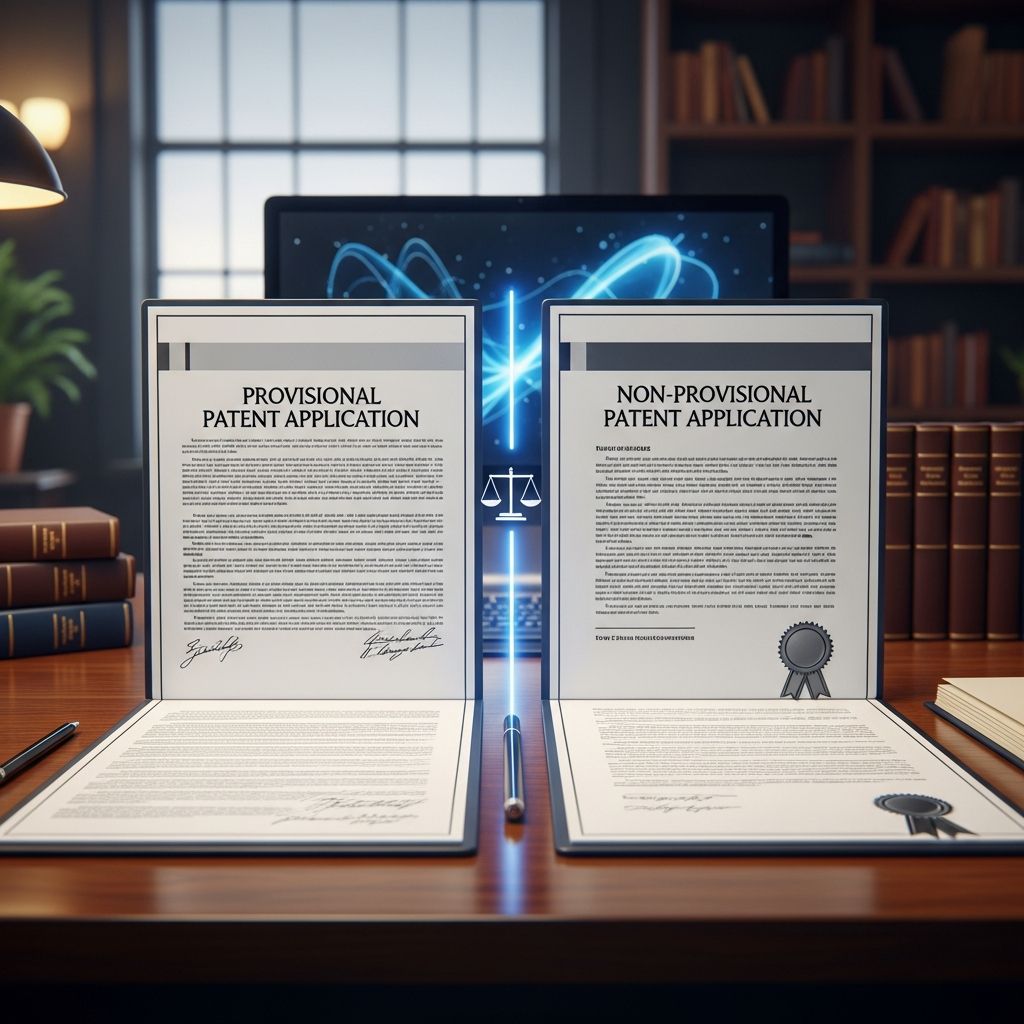
Provisional and non-provisional patent applications serve distinct roles in the U.S. patent system, with the provisional offering a low-cost entry to secure an early filing date and the non-provisional providing the pathway to full patent protection. Understanding these differences helps inventors decide the best approach for safeguarding innovations.
Understanding Provisional Patent Applications
A
provisional patent application
acts as a placeholder filing with the United States Patent and Trademark Office (USPTO), establishing a priority date without undergoing examination. It allows inventors to claim ‘patent pending’ status, deterring competitors while providing 12 months to refine their invention.Key advantages include lower fees—ranging from $65 to $325 as of early 2025—and simplified requirements, omitting formal claims, oaths, or prior art disclosures. This makes it accessible for solo inventors or startups testing market viability.
- Establishes an early priority date recognized internationally under the Paris Convention.
- No publication or examination, keeping details private until a non-provisional is filed.
- Automatically abandons after 12 months, requiring a follow-up non-provisional to claim priority.
To qualify, the application must include a detailed specification enabling a skilled person to replicate the invention, often with drawings if needed. Insufficient detail risks losing priority for later claims.
Exploring Non-Provisional Patent Applications
In contrast, a
non-provisional patent application
is the comprehensive document that undergoes USPTO examination and can mature into an issued patent. It demands formal claims defining the invention’s scope, inventor declarations, and an information disclosure statement of known prior art.Filing fees are substantially higher, and the process spans 18-24 months or more, involving office actions and potential amendments. Successful prosecution grants exclusive rights for 20 years from the filing date.
- Requires precise claims to delineate protected territory.
- Published 18 months after filing (unless non-publication requested).
- Provides enforceable patent rights upon approval.
Core Differences: A Side-by-Side Comparison
The table below summarizes the primary distinctions to guide inventors’ decisions.
| Aspect | Provisional | Non-Provisional |
|---|---|---|
| Examination | No examination; placeholder only | Full USPTO examination |
| Claims Required | No formal claims needed | Detailed formal claims mandatory |
| Filing Fees (as of 2025) | $65-$325 | $800+ (micro-entity discounts apply) |
| Duration | 12 months, then abandons | Leads to patent (20-year term) |
| Publication | Not published independently | Published after 18 months |
| Priority Benefit | Sets priority for follow-up | Claims provisional priority if filed within 12 months |
Filing Requirements for Provisional Applications
USPTO mandates specific elements for provisional filings to secure the date.
- Title and Inventors: Clear invention title and all inventor names with residences.
- Specification: Includes background, summary, detailed description, and drawings where essential. The description must satisfy ‘written description’ and ‘enablement’ standards.
- Cover Sheet: Recommended PTO/SB/16 form for administrative details.
- Fees: Paid at filing; entity size affects amount.
Focus on completeness: describe how to make and use the invention thoroughly.
Strategic Timing and Global Considerations
File a provisional before public disclosures to preserve rights worldwide. The 12-month window allows market testing, investor pitches, and refinements. For international protection, convert to a PCT application within the deadline.
Non-provisionals build on this foundation, claiming the provisional’s date if specifics match. Mismatches can forfeit priority, emphasizing detailed provisional disclosures.
Pros and Cons of Each Approach
Provisional Pros
- Cost-effective entry to patent pending status.
- Time to develop without full commitment.
- Global priority establishment.
Provisional Cons
- No patent issuance; must file non-provisional timely.
- Risk of inadequate description invalidating priority.
- Abandons automatically.
Non-Provisional Pros
- Path to enforceable patent.
- Definitive claim scope.
Non-Provisional Cons
- Higher costs and complexity.
- Lengthy examination.
- Public disclosure risk.
Best Practices for Inventors
Consult patent professionals for robust filings. Use the provisional for early protection, then transition strategically. Track the 12-month deadline rigorously.
For complex inventions, multiple provisionals can cover variations before consolidating.
Frequently Asked Questions
Can a provisional patent be converted directly to a patent?
No, a provisional never issues as a patent; file a non-provisional within 12 months to claim priority.
How detailed must a provisional description be?
Sufficient to enable a skilled artisan to make and use the invention without undue experimentation.
Does filing provisional protect internationally?
Yes, it establishes priority in 150+ countries via the Paris Convention if followed by national filings.
What happens if I miss the 12-month deadline?
The provisional abandons, and priority is lost; a new filing starts fresh.
Are drawings required for provisionals?
Only if necessary for understanding the invention.
References
- Provisional application — Wikipedia. 2025-01-19. https://en.wikipedia.org/wiki/Provisional_application
- Simple Guide to Provisional Patent Application Basics — Thompson Patent Law. Accessed 2026. https://thompsonpatentlaw.com/provisional-patent-basics/
- Provisional Patent Applications: FAQ — Cooley GO. Accessed 2026. https://www.cooleygo.com/provisional-patent-applications-faq/
- Filing a provisional application — USPTO. Accessed 2026. https://www.uspto.gov/sites/default/files/documents/Basics%20of%20a%20Provisional%20Application.pdf
- What is a provisional patent? — IDEA Center, University of Notre Dame. Accessed 2026. https://ideacenter.nd.edu/commercialization-engine/for-researchers/learn/inventors-guide-to-commercialization/what-is-a-provisional-patent/
Similar Articles








Read full bio of medha deb


