
Proving Parent-Child Ties for U.S. Immigration
Essential guide to documenting family bonds for U.S. citizenship claims and green card petitions through vital records and legal proofs.
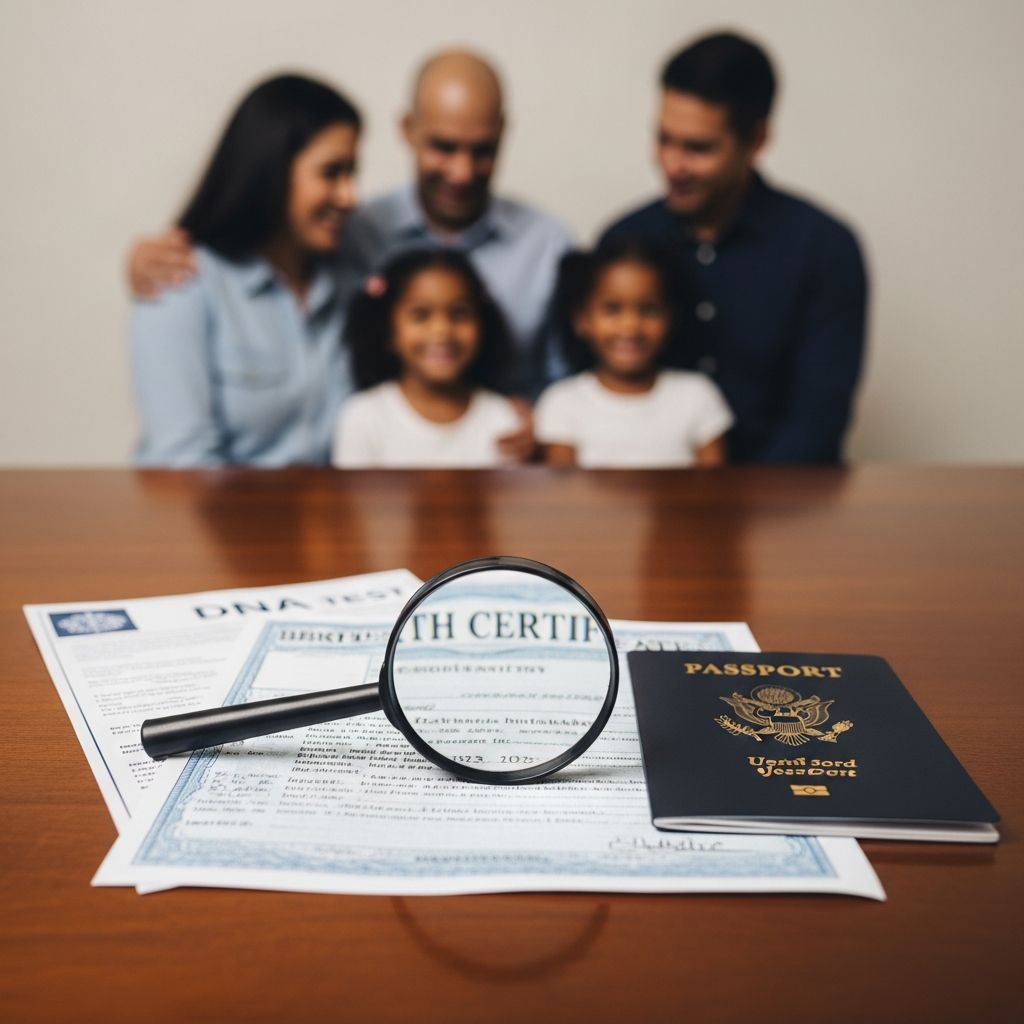
Establishing a valid parent-child connection is a cornerstone of many U.S. immigration processes, whether pursuing citizenship through acquisition or sponsoring a family member for a green card. U.S. Citizenship and Immigration Services (USCIS) demands clear, verifiable documentation to confirm biological or legal bonds, ensuring only genuine relationships receive benefits. This comprehensive guide outlines the necessary evidence, from standard vital records to advanced genetic testing, helping applicants build robust cases.
Core Documents for Maternal Relationships
For mothers seeking to prove their link to a child in immigration contexts, the process centers on straightforward biological evidence. A certified birth certificate remains the gold standard, ideally issued shortly after birth by the relevant government authority. It must list the child’s full name, date and place of birth, the mother’s name matching other records, and official seals or signatures for authenticity.
If the primary certificate is unavailable or inadequate, secondary options strengthen the application:
- Multiple affidavits from witnesses present at the birth, such as midwives, relatives, or neighbors, sworn before a notary.
- Hospital or clinic records detailing the delivery and naming the mother.
- Early school enrollment forms or baptismal certificates linking mother and child names.
These alternatives collectively demonstrate the relationship when originals are lost due to war, natural disasters, or bureaucratic issues in the home country.
Establishing Paternal Connections: Beyond Basic Records
Fathers face stricter scrutiny, as birth certificates alone rarely suffice without additional marital or genetic proof. USCIS requires the certificate to name both parents explicitly, followed by evidence of biology and legal recognition.
| Document Type | Purpose | Key Requirements |
|---|---|---|
| Birth Certificate | Initial family link | Names father and mother; issued by civil registry |
| DNA Test Report | Biological confirmation | 99.5%+ paternity probability from AABB-accredited lab |
| Marriage Certificate | Legitimation proof | Civil record pre-child’s 18th birthday; shared household evidence |
Biological proof mirrors maternal requirements but often incorporates DNA analysis, especially for disputed cases. Paternity tests must come from USCIS-approved labs, with chain-of-custody protocols to prevent fraud.
Legitimation Rules for Children Born Out of Wedlock
Under the Immigration and Nationality Act (INA), legitimation transforms an ‘out-of-wedlock’ child into a legally recognized offspring for immigration. This requires the father to establish full parental rights under the law of their residence or the child’s at the time the child was under 18.
The most reliable path is parental marriage before the child’s 18th birthday, coupled with joint custody. Submit:
- Civil marriage certificate from the issuing jurisdiction.
- Proof of cohabitation, like lease agreements, utility bills, or school records listing both parents.
- If unavailable, non-availability certificates plus religious marriage proofs or affidavits from community leaders.
U.S. authorities reject marriages violating public policy, such as polygamous unions. For non-marital legitimation, provide court orders or equivalent under foreign law granting paternity rights.
DNA Testing: When Genetics Seal the Deal
USCIS may mandate or accept voluntary DNA tests to resolve doubts, particularly in citizenship acquisition (INA 309) or I-130 petitions. Tests compare cheek swabs from alleged parent and child, yielding results with over 99.5% certainty for matches.
Key protocols include:
- Using only Immigration and Customs Enforcement (ICE)-authorized labs.
- Strict sample collection at approved facilities to ensure integrity.
- Full chain-of-custody documentation accompanying results.
Applicants bear costs, typically $400-$800 per test, but success rates soar with positive outcomes. Negative results can derail petitions unless rebutted by overwhelming secondary evidence.
Bona Fide Father-Child Bonds Without Legitimation
If legitimation fails—such as no marriage or post-18 actions—fathers must demonstrate a ‘bona fide’ relationship via sustained personal involvement. USCIS evaluates commitment through financial support, co-residence, and emotional ties.
Compelling evidence includes:
- Bank statements or money transfer receipts for child support.
- Life insurance policies designating the child as beneficiary.
- Correspondence like letters, emails, or call logs spanning years.
- Affidavits from teachers, clergy, or neighbors attesting to public acknowledgment.
Photos from family events, report cards signed by the father, or travel records further illustrate dedication.
Special Scenarios: Adoptions, Step-Parents, and Disputes
Adopted children require final adoption decrees terminating prior parental rights, plus pre-adoption custody proofs if applicable. Step-parent relationships hinge on the marriage certificate between step-parent and biological parent, with evidence of shared life post-marriage.
In disputes, like name discrepancies or delayed registrations, compile a ‘record of evidence’ explaining gaps—e.g., affidavits on cultural naming practices or conflict-era record losses.
Preparing and Submitting Your Evidence Package
Organize documents chronologically, with English translations certified by qualified linguists. Index your submission for USCIS reviewers, covering Form I-130 requirements alongside proofs.
Common pitfalls:
- Submitting unverified photocopies without originals at interviews.
- Ignoring Requests for Evidence (RFEs) within deadlines.
- Overlooking secondary proofs when primaries are weak.
Consult an immigration attorney for complex cases, especially overseas adoptions or foreign legitimation laws.
Frequently Asked Questions
What if my birth certificate doesn’t list the father?
Supplement with DNA tests, legitimation documents, or bona fide relationship evidence as detailed above.
Can religious marriage certificates legitimize a child?
Only as secondary evidence; civil records or court equivalents are primary. Pair with cohabitation proofs.
How long after birth must a certificate be registered?
Preferably soon after; late registrations need supporting affidavits to affirm accuracy.
Is DNA testing mandatory?
No, but USCIS can request it. Voluntary tests proactively resolve doubts.
What about children over 21?
Relationship proofs remain identical; age affects visa category, not documentation standards.
References
- How to Prove a Parent-Child Relationship for Citizenship or Immigration Purposes — Nolo. 2023-05-15. https://www.nolo.com/legal-encyclopedia/how-prove-parent-child-relationship-citizenship-immigration-purposes.html
- Evidence to Support a Family or Marriage Petition for a Green Card — Armstrong Legal. 2024-02-10. https://legalarmstrong.com/evidence-to-support-a-family-or-marriage-petition-for-a-green-card/
- Frequently Asked Questions About DNA Testing — Catholic Legal Immigration Network, Inc. (CLINIC). 2023-11-01. https://www.cliniclegal.org/resources/family-based-immigration-law/frequently-asked-questions-about-dna-testing
- Green Cards for Parents, Children, and Siblings: Who Qualifies? — Ada Vega Law. 2024-08-20. https://www.adanvega.com/green-cards-for-parents-children-and-siblings/
- Civil Documents – Step 7 of the Immigrant Visa Process — U.S. Department of State. 2025-01-10. https://travel.state.gov/content/travel/en/us-visas/immigrate/the-immigrant-visa-process/step-5-collect-financial-evidence-and-other-supporting-documents/step-7-collect-civil-documents.html
Similar Articles








Read full bio of medha deb


