
Proving Landlord Retaliation: A Tenant’s Guide
Learn how to recognize, document, and legally prove retaliatory conduct by your landlord after you assert your rental rights.
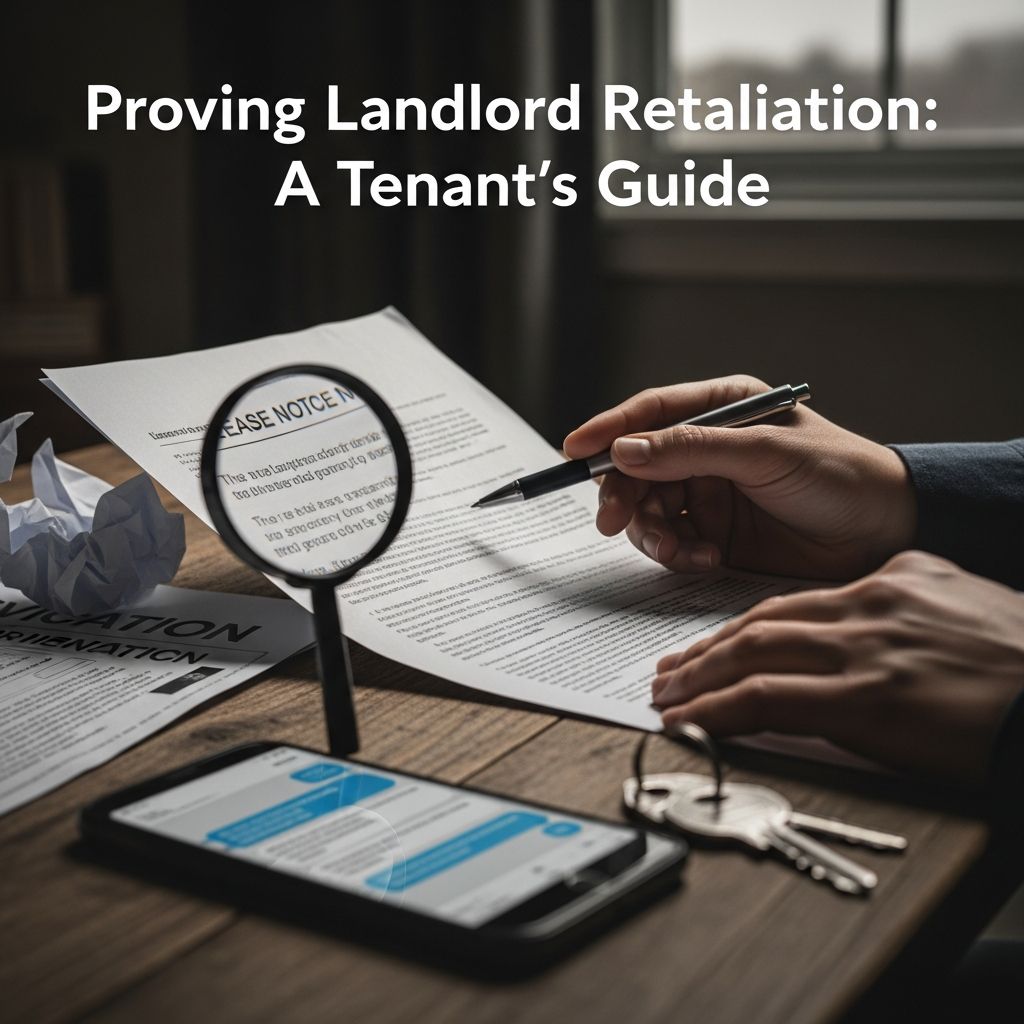
Tenants are generally protected from retaliation when they exercise their legal rights, such as reporting unsafe conditions or organizing with other renters. Many state laws prohibit landlords from punishing tenants for engaging in these protected activities, and some even create presumptions that certain actions are retaliatory when they happen soon afterward. Understanding how to recognize and prove retaliation is essential if you want to keep your housing stable and enforce your rights.
What Is Landlord Retaliation?
Landlord retaliation refers to adverse actions a landlord takes because a tenant exercised a lawful right. These actions attempt to intimidate the tenant, discourage complaints, or force the tenant to move out. Most states restrict such conduct through landlord–tenant statutes or consumer protection laws.
Common forms of retaliatory conduct
Depending on your state, prohibited retaliatory actions may include:
- Filing or threatening a retaliatory eviction after a tenant reports code violations.
- Issuing a notice of nonrenewal or termination soon after the tenant complains.
- Rent increases that closely follow a complaint or inspection request.
- Reducing services, such as utilities, parking, laundry, or maintenance.
- Harassment, frequent baseless inspections, or other conduct meant to pressure the tenant to leave.
States differ in the exact list of prohibited actions, but the underlying idea is the same: landlords may not punish tenants for asserting rights granted by law or by the lease.
Protected Tenant Activities That Often Trigger Retaliation
Retaliation typically arises after a tenant engages in a protected activity. Many statutes specify what these activities include, while others use broader language.
Examples of protected activities
- Reporting building, housing, or health code violations to a government agency.
- Requesting required repairs or asserting the right to a habitable home.
- Participating in a tenant organization or union.
- Filing or joining a lawsuit related to housing conditions, discrimination, or other rights.
- Using legal remedies such as rent escrow or repair-and-deduct procedures where allowed by law.
Many state laws explicitly state that a landlord may not retaliate within a certain period after these activities, often ranging from 90 days to 6 months.
Key Legal Elements: What a Tenant Must Generally Show
To succeed on a retaliation claim or defense, tenants usually need to demonstrate several core elements, although the details vary by jurisdiction.
| Element | What the Tenant Typically Must Show |
|---|---|
| Protected activity | The tenant exercised or tried to exercise a legal right, such as filing a code complaint or requesting habitability repairs. |
| Adverse landlord action | The landlord took an action that negatively affects the tenancy, like eviction, rent increase, or service reduction. |
| Timing | The adverse action followed the protected activity within a time frame that suggests retaliation (e.g., within 90 days or 6 months, depending on state law). |
| Causal link | Evidence that the landlord acted because of the protected activity, not for a neutral, lawful reason. |
Some states make this easier for tenants by creating a rebuttable presumption of retaliation when certain elements are met, shifting some of the burden onto the landlord.
How Presumptions of Retaliation Work
A rebuttable presumption means the court will initially assume the landlord’s action is retaliatory if the tenant shows specific facts, such as a recent complaint followed by an eviction notice. The landlord can then present evidence to counter that presumption.
Typical presumption rules in state law
- When a landlord acts (for example, serves a termination notice or raises rent) within a defined period after a tenant’s complaint, the law may presume retaliation.
- If the tenant was behind on rent or in serious breach of the lease when the notice was given, some laws create the opposite presumption: that the landlord’s action was not retaliatory.
- Some local ordinances place the burden of proof on the landlord to show that the action would have been taken even without the tenant’s complaint.
Because these rules differ significantly between states and cities, tenants should check their jurisdiction’s landlord–tenant statutes or local housing ordinances for exact standards.
Building Your Case: Evidence to Prove Retaliation
Courts rely heavily on documentation. To prove retaliation, you must establish a clear story that connects your protected activity to the landlord’s response.
1. Create a detailed timeline
Start by writing down key events in chronological order:
- Date you reported a problem or asserted a right.
- Date any government inspector visited or issued a report.
- Date you received eviction notices, rent increases, or service reductions.
- Any communications (emails, texts, letters) in between where the landlord references your complaint.
A simple timeline can make the sequence and suspicious timing clear to a judge or mediator.
2. Preserve written communications
Whenever possible, keep interactions in writing. Save copies of:
- Emails and letters requesting repairs or complaining about violations.
- Texts or messages where the landlord mentions your complaint or threatens action.
- Notices of rent increases, nonrenewal, or termination.
- Any written policy changes that apply only to you or selectively to complaining tenants.
Written records are often more persuasive than verbal testimony alone and are easier to present in court.
3. Collect independent documents
Third-party documentation can strongly support your case because it does not come from either side in the dispute. Useful items include:
- Housing or building inspection reports showing code violations.
- Police reports or health department findings related to your complaint.
- Letters or notices from city or county agencies concerning your unit or building.
- Photos or videos of unsafe or unrepaired conditions with clear dates.
Such documents help confirm that your initial complaints were justified and that your actions were protected under state or local law.
4. Obtain witness statements
Witnesses can help corroborate both your protected activity and the landlord’s response. Consider gathering written, dated statements from:
- Neighbors who know you reported issues to authorities.
- Other tenants who experienced similar retaliation after speaking up.
- Maintenance workers or building staff familiar with your requests and the landlord’s reactions.
Multiple tenants describing a pattern of similar conduct can be particularly compelling.
How Landlords Try to Justify Their Actions
Landlords often respond to retaliation claims by arguing that their actions were based on legitimate business reasons rather than the tenant’s complaint. Courts will weigh the landlord’s explanation against the tenant’s evidence.
Common landlord defenses
- Nonpayment of rent: Showing that the tenant was significantly behind on rent when the notice was served.
- Serious lease violations: Documenting noise complaints, property damage, or illegal activity.
- Planned renovations or sale: Arguing that units must be vacant to perform substantial repairs or to prepare for sale, sometimes recognized in statutes as a rebuttal to presumed retaliation.
- Market-based rent increases: Providing data or comparable rents to show that an increase would have occurred regardless of any complaint.
Courts often look at whether the landlord can produce consistent records — such as prior warnings, inspection reports, or written policies — that predate the tenant’s complaint.
Using Retaliation as a Defense or a Claim
Retaliation can arise either as a defense when the landlord sues, or as an independent claim brought by the tenant. Options depend on state law.
Retaliation as a defense
- When a landlord files an eviction case, the tenant may assert retaliation as a defense, asking the court to dismiss the case because the eviction is illegal.
- Some states explicitly allow this in their landlord–tenant statutes; the tenant must typically prove the elements of retaliation and comply with rent obligations, unless rent is lawfully withheld.
Retaliation as an affirmative lawsuit
- In some jurisdictions, tenants can sue landlords for damages caused by retaliatory conduct, including emotional distress, moving expenses, and higher rent elsewhere.
- Certain state laws authorize statutory damages, sometimes up to several months’ rent, plus attorney’s fees and court costs when retaliation is proven.
A local legal aid organization or tenant advocacy group can help determine which remedies are available in your area.
Practical Steps If You Suspect Retaliation
If you believe your landlord is retaliating against you, acting promptly and strategically can protect your rights.
1. Confirm your rent status
Most statutes require that the tenant be current on rent to claim retaliation, unless rent is being withheld under a lawful process. If you are behind, speak with a legal professional about whether your state provides any exceptions or defenses.
2. Put everything in writing
Send a calm, factual letter or email to your landlord stating:
- What protected activity you engaged in (for example, calling code enforcement on a specific date).
- What adverse action they took (such as a notice of nonrenewal or rent increase).
- That you believe this action is retaliatory under your state’s landlord–tenant law.
- That you request withdrawal of the notice or reversal of the action.
Keep a copy of this correspondence; it may demonstrate that you recognized and challenged the retaliation early.
3. Seek legal help or tenant counseling
Consult with:
- A local legal aid office or housing rights clinic.
- State or city tenant hotlines and resource centers.
- Private attorneys who focus on landlord–tenant law.
They can help you interpret your state’s retaliation statutes, prepare evidence, and decide whether to raise retaliation as a defense or file your own claim.
4. Consider negotiation or mediation
In some situations, direct communication or mediation may resolve the issue without litigation:
- Propose a meeting to discuss misunderstandings and clarify expectations.
- Use community mediation services that specialize in housing disputes, if available.
- Discuss alternative solutions (e.g., partial rent reduction instead of eviction) that meet both parties’ needs.
However, do not sign any agreement or release of claims without understanding its legal consequences.
State Law Variations: Why Local Rules Matter
Retaliation protections are state-specific and sometimes city-specific. Although many states share similar themes — such as protecting tenants who report code violations — the details can differ significantly.
- Time windows: Some states use a 90-day period; others use 180 days or six months to create a presumption of retaliation.
- Scope of protected activities: Certain laws cover only complaints to agencies, while others include joining tenant unions, lawsuits, or even informal assertions of rights.
- Available remedies: States vary in whether tenants can recover attorney’s fees, statutory damages, or only use retaliation as a defense against eviction.
- Burden of proof: Some laws favor tenants with presumptions or shifting burdens, while others require tenants to prove retaliation under a standard like “more likely than not.”
Because of these differences, tenants should review their state landlord–tenant code and, where applicable, local ordinances or consumer protection rules.
Frequently Asked Questions (FAQs)
Q: Do I have to prove retaliation was the landlord’s only motive?
In many states, you do not need to show that retaliation was the landlord’s sole motive. It may be enough to prove that the landlord would not have taken the action but for your exercise of a tenant right, even if other factors were involved.
Q: What if I’m behind on rent — can I still claim retaliation?
Often, tenants must be current on rent to raise retaliation, unless they are lawfully withholding rent under a statute or court-approved process. Some laws create a presumption that an eviction is not retaliatory when the tenant is in arrears, so it is important to seek legal advice if you are behind.
Q: Is a rent increase automatically considered retaliation?
No. A rent increase becomes retaliation only if it is imposed because you exercised a protected right and lacks a legitimate, non-retaliatory justification. Courts consider timing, market conditions, and the landlord’s explanations.
Q: Can my landlord refuse to renew my lease after I complain?
A landlord may normally decide not to renew a lease, but many laws prohibit nonrenewal that is motivated by retaliation against a tenant’s protected activity, particularly when it occurs within a specified period after the complaint.
Q: What kind of compensation can I receive if I win?
Available remedies vary by state. Some statutes allow tenants to recover up to several months’ rent in damages, plus attorney’s fees and court costs, while others may limit remedies to stopping the eviction or reversing the retaliatory action.
References
- RCW 59.18.250 – Reprisals or retaliatory action by landlord prohibited — Washington State Legislature. 2023-07-01. https://app.leg.wa.gov/rcw/default.aspx?cite=59.18.250
- Retaliatory Evictions — Maryland People’s Law Library. 2022-08-15. https://www.peoples-law.org/retaliatory-evictions
- Landlord Retaliation Against Tenants — TexasLawHelp.org (Texas Legal Services Center). 2023-05-10. https://texaslawhelp.org/article/landlord-retaliation-against-tenants
- Landlord Retaliation — Tenant Resource Center (Wisconsin). 2022-11-03. https://www.tenantresourcecenter.org/landlord_retaliation
- Landlord Retaliation – Landlord/Tenant Law Guide — State Law Library of Texas. 2023-04-20. https://guides.sll.texas.gov/landlord-tenant-law/problems-retaliation
Similar Articles








Read full bio of medha deb


