
Protesting at Justices’ Homes: Legal Boundaries
Navigating First Amendment rights versus federal laws on demonstrations near judicial residences amid heated political debates.
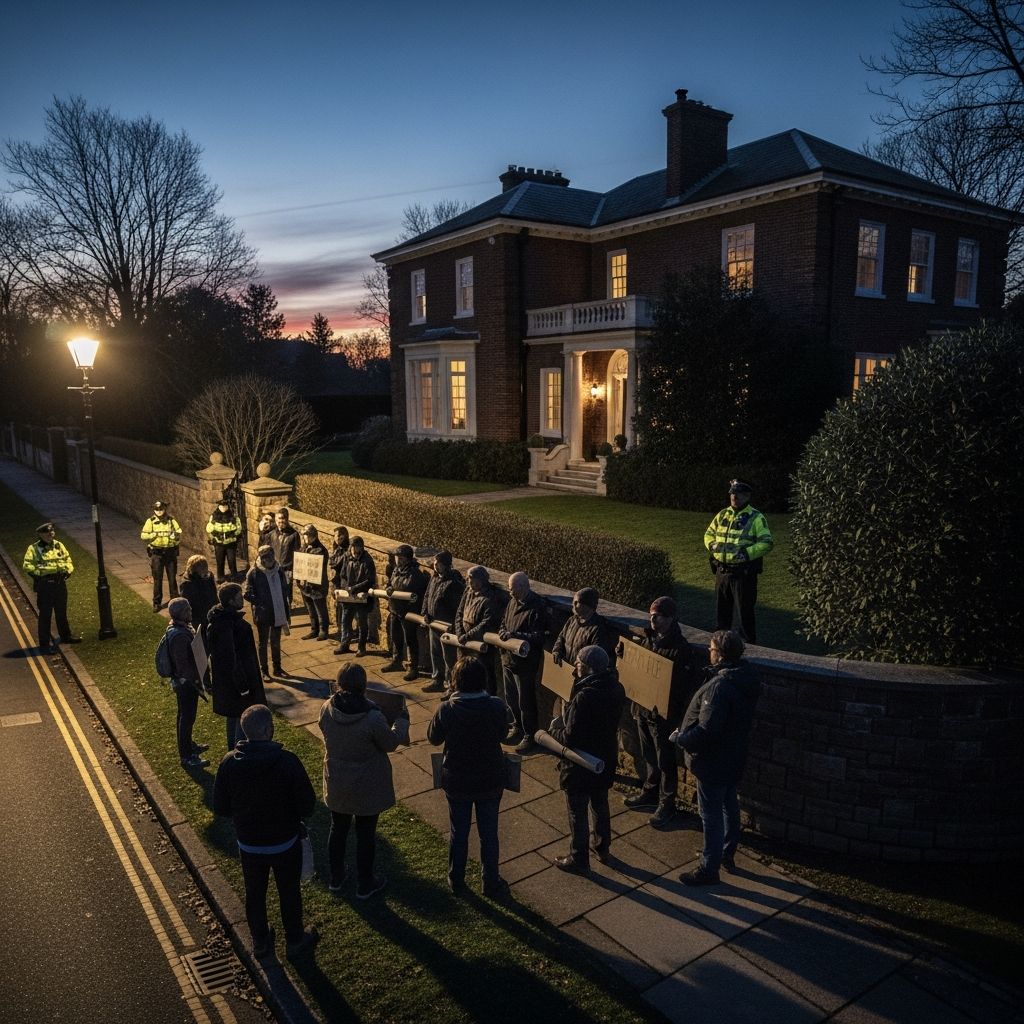
Public demonstrations have long been a cornerstone of American democracy, allowing citizens to voice dissent on critical issues like abortion rights and judicial decisions. However, when these protests target the private residences of Supreme Court justices, they intersect with federal statutes designed to shield the judiciary from undue influence. This tension raises profound questions about the limits of the First Amendment in residential neighborhoods.
Historical Context of Judicial Protests
Protests near judicial figures are not new. In recent years, following leaks of draft opinions on abortion, demonstrators gathered outside homes in Virginia, Maryland, and the District of Columbia. These actions sparked bipartisan concern, leading to enhanced security measures for justices’ families. The gatherings, often peaceful, aimed to express outrage over perceived threats to rights, yet they prompted debates on whether such proximity constitutes intimidation.
Historically, similar demonstrations have occurred during high-stakes cases. Anti-abortion activists previously picketed near abortion clinic staff homes, testing residential protest limits. The Supreme Court has navigated these scenarios, upholding certain restrictions while protecting core speech rights. This backdrop informs current discussions on justices’ homes.
Federal Statute: 18 U.S.C. § 1507 Explained
At the heart of the legality debate is Title 18, United States Code, Section 1507. Enacted in 1950, this law prohibits picketing or parading “in or near any building or residence occupied or used by any judge, juror, witness, or court officer” with the intent to influence their duties or impede justice administration. Violations carry penalties of fines or up to one year imprisonment.
The statute requires proof of intent, a key element. Prosecutors must demonstrate that protesters aimed specifically to sway judicial decisions, not merely vent frustration over past rulings. Organizers have argued their actions target inaccessible justices, but courts scrutinize whether this crosses into prohibited territory.
- Key Elements of § 1507: Intent to influence; proximity to residence; demonstration form (pickets, parades).
- Penalties: Fine, imprisonment under one year, or both.
- Enforcement History: Rarely invoked until recent high-profile cases.
First Amendment Protections in Public Spaces
The First Amendment safeguards assembly and petition rights, particularly on public sidewalks and streets—traditional “public forums.” In United States v. Grace (1983), the Supreme Court struck down restrictions on protests near the Supreme Court building, equating its perimeter sidewalks to any public thoroughfare. This ruling suggests similar protections for streets outside justices’ homes.
However, residential areas warrant nuance. Protests must not harass or block access. Mobile marches through neighborhoods, without halting before specific homes, generally remain protected. Content-neutral laws—those not targeting viewpoints—face lighter scrutiny.
State Laws on Residential Picketing
Justices reside in jurisdictions with tailored restrictions. Virginia and Maryland statutes mirror federal language, banning targeted picketing near dwellings. The District of Columbia’s law is more precise, prohibiting demonstrations intended to obstruct justice near judicial residences.
| Jurisdiction | Key Statute Language | First Amendment Status |
|---|---|---|
| Virginia | Bans picketing “before or about” residences | Uphheld as content-neutral |
| Maryland | Prohibits residential demonstrations | Similar to federal; enforceable |
| D.C. | Targets intent to influence judges | Least likely to violate speech rights |
These laws align with precedents like Frisby v. Schultz (1988), where the Court approved blanket bans on focused residential picketing, emphasizing privacy in homes over transient public expression.
Landmark Supreme Court Precedents
Frisby v. Schultz (1988)
This case validated a municipal ordinance barring picketing targeting particular residences. The Court reasoned that such laws serve significant interests in residential tranquility, remaining narrowly tailored by allowing general neighborhood marches.
United States v. Grace (1983)
Striking a ban on Supreme Court perimeter protests, the ruling affirmed public sidewalks’ role in free expression. Applied to justices’ neighborhoods, it bolsters arguments for protest rights absent intent to intimidate.
Cox v. Louisiana (1965)
Upholding convictions for courthouse demonstrations, the Court distinguished between protected speech and actions undermining judicial processes. This supports restrictions near homes if they insulate decision-making.
Challenges to Enforcement and constitutionality
Critics argue § 1507 oversimplifies intent, risking unconstitutional vagueness. Without individualized proof, mass arrests could chill speech. Selective enforcement claims arise, as past protests at judicial sites went unpunished.
Defenders, including a 2023 Justice Department interim guidance, view repeated gatherings as clear intimidation attempts, urging firm responses to protect judicial independence. Bipartisan legislation expanded family protections, signaling consensus on safety.
Practical Implications for Protesters
Peaceful, non-targeted protests in public spaces are likely lawful. Risks escalate with chants naming justices, overnight vigils, or blocking driveways. Law enforcement may disperse under noise ordinances or safety pretexts.
- Safe Practices: March without stopping; use public forums; avoid personal addresses.
- High-Risk Actions: Stationary pickets; intent-declaring signs; repeated visits.
Arrests are possible, but convictions hinge on proving intent—a high bar.
Comparing Protests: Justices vs. Others
Public figures like justices face a different standard than private citizens. In defamation, they endure greater scrutiny. Yet, the Court permitted anti-abortion protests near clinic workers’ homes, rejecting broad buffer zones. Logically, justices—as officials assuming public scrutiny—may claim even less privacy against peaceful dissent.
Recent Developments and Security Responses
Post-2022 leaks, fencing fortified the Supreme Court, redirecting protests homeward. Congress authorized family security, and governors pressed federal enforcement. The DOJ’s stance evolved toward viewing persistent protests as violations.
Frequently Asked Questions
Is protesting on a public sidewalk outside a justice’s home protected speech?
Yes, if mobile and non-threatening, per First Amendment precedents like Grace. Targeted, stationary pickets risk violating § 1507 or state laws.
Can police arrest protesters without violence?
Yes, for intent to influence under federal law or residential picketing bans. Courts assess case-by-case.
Has § 1507 been successfully enforced recently?
Rarely, but 2023 DOJ guidance signals increased scrutiny amid ongoing cases.
Do justices get more protection than other public officials?
Statutes focus on judicial independence, but precedents suggest comparable residential speech limits apply broadly.
What if protests express anger over decided cases?
Protected as political speech, absent proof of influencing pending matters.
Balancing Rights in a Polarized Era
The clash between expression and judicial sanctity underscores democracy’s fragility. While laws curb intimidation, overreach could silence vital discourse. Future cases may clarify boundaries, ensuring protests challenge power without undermining it.
References
- Protests by Abortion Advocates at Justices’ Homes – Law Review — Syracuse Law Review. 2022. https://lawreview.syr.edu/protests-by-abortion-advocates-at-justices-homes-allowable-free-speech-or-violation-of-current-law/
- Perspective: Does the First Amendment Protect a Right to Protest at Supreme Court Justices’ Homes? — Freedom Forum. 2022. https://www.freedomforum.org/perspective-does-the-first-amendment-protect-a-right-to-protest-at-supreme-court-justices-homes/
- Protesting Outside of Supreme Court Justices’ Homes is Fine, Actually — EarthRights International. 2022. https://earthrights.org/protesting-outside-of-supreme-court-justices-homes-is-fine-actually/
- Picketing Outside the Homes of Judges and Justices — Middle Tennessee State University First Amendment Encyclopedia. N/A. https://firstamendment.mtsu.edu/article/picketing-outside-the-homes-of-judges-and-justices/
- Are the Protests in Front of Supreme Court Justices’ Homes Legal? — Northeastern University News. 2022-05-12. https://news.northeastern.edu/2022/05/12/abortion-protests-supreme-court-justices-homes/
- Protests Supreme Court Justices Residences – Interim Guidance — U.S. Department of Justice. 2023-07-12. https://www.justice.gov/d9/2023-07/07.12.23.%20–%20Protests%20Supreme%20Court%20Justices%20-%20Interim.pdf
Similar Articles








Read full bio of Sneha Tete


