
Traffic Obstruction During Protests: Legal Boundaries
Understanding when protest activities cross the line into illegal traffic obstruction.
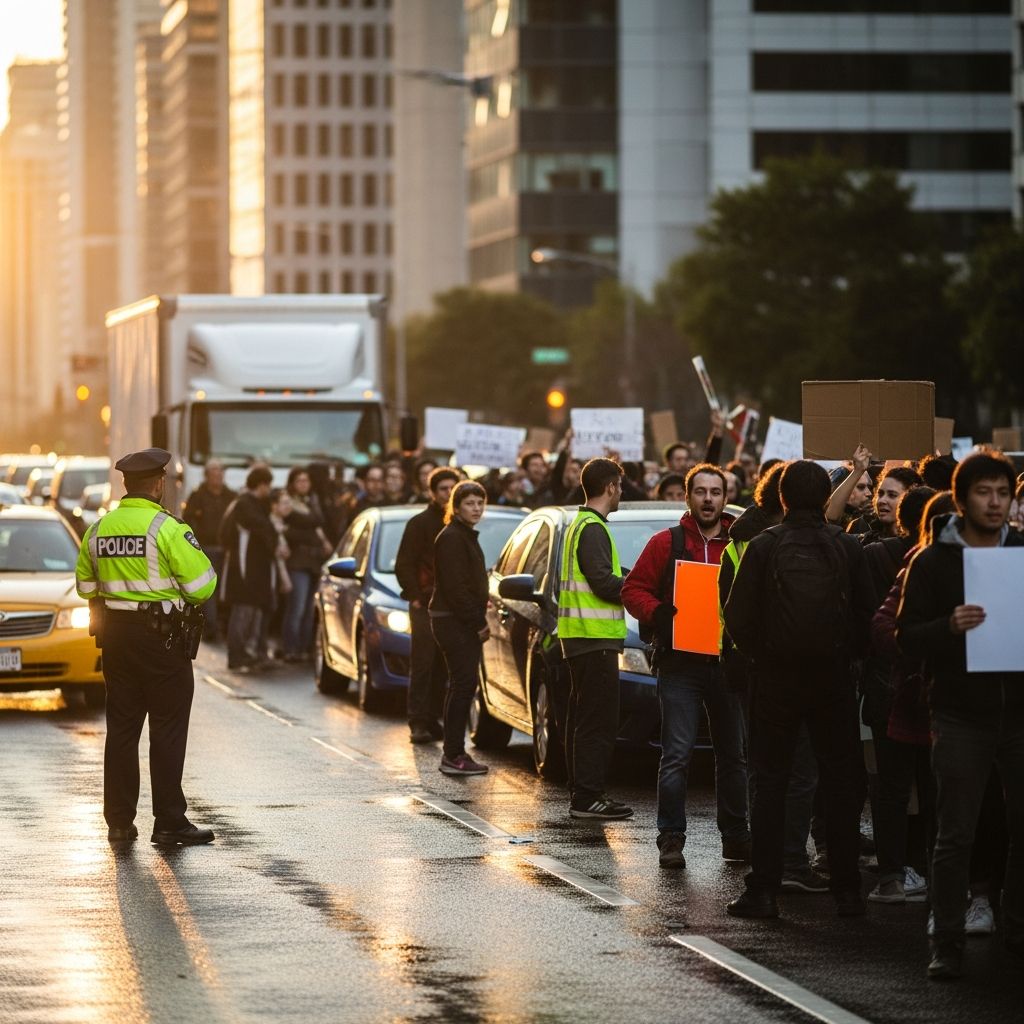
Understanding Protest Rights and Traffic Obstruction
The intersection of constitutional rights and public safety creates a complex legal landscape when protesters exercise their freedom of speech and assembly on public roadways. While the United States Constitution protects the right to peaceful protest, this protection does not extend without limits. One of the most significant restrictions involves the obstruction of vehicular and pedestrian traffic during demonstrations. Understanding the legal boundaries between protected protest activity and unlawful traffic obstruction is essential for anyone participating in demonstrations or organizing protest events.
Traffic obstruction as a protest tactic has deep historical roots in the American tradition of civil disobedience. The deliberate blocking of roadways to draw attention to a cause represents a calculated act of nonviolent resistance, intentionally breaking laws to highlight perceived injustices. However, the legal system distinguishes sharply between the right to protest and the right to disrupt the daily lives of uninvolved citizens by preventing their movement through public spaces.
Constitutional Protections for Demonstrators
The First Amendment of the U.S. Constitution guarantees citizens the right to free speech and the freedom to peacefully assemble. These protections form the constitutional foundation upon which all legitimate protest activity rests. Citizens possess a fundamental right to express their views, advocate for change, and gather in numbers to amplify their message. This protection applies specifically to activity occurring in traditional public forums—locations historically associated with public discourse such as streets, sidewalks, parks, and other publicly owned spaces.
However, the Supreme Court of the United States has consistently ruled that these rights, while robust, are not absolute. The government maintains the authority to impose what legal scholars term “time, place, and manner” (TPM) restrictions on protest activities. These restrictions serve legitimate governmental interests including traffic flow management, public safety maintenance, property protection, environmental conservation, and preservation of governmental functions. Critically, such restrictions must be narrowly tailored, content-neutral, and applied equally to all groups regardless of their message or ideology.
Time, Place, and Manner Restrictions Explained
Time, place, and manner regulations represent the government’s primary mechanism for balancing First Amendment protections with broader public interests. These restrictions do not ban protest activity altogether but instead regulate when, where, and how such activity may occur. The government cannot restrict protest based on the content of the message being conveyed, nor can it selectively enforce regulations against particular viewpoints while permitting others to proceed unimpeded.
Time restrictions might include prohibitions on late-night demonstrations in residential areas or requirements that protests conclude by a specific hour. Place restrictions could designate certain locations as off-limits for demonstrations or require protests to remain within designated zones away from government buildings or sensitive facilities. Manner restrictions typically address the means of expression, such as prohibitions on amplified sound above certain decibel levels or requirements that demonstrators remain on sidewalks rather than spilling into vehicle traffic.
For large-scale protests involving street closures or road blockages, permits represent a standard time, place, and manner restriction. Municipal governments almost universally require permit applications for events that will affect traffic patterns. These permit processes serve administrative purposes, allowing authorities to coordinate public safety resources, manage traffic flow, and prevent conflicts between simultaneous demonstrations. Provided the permit requirements themselves are reasonable and applied consistently across all groups, such regulations withstand constitutional scrutiny.
The Permit Requirement and Its Constitutional Limits
Permit requirements for protests, while generally constitutional, contain important limitations designed to protect free speech rights. Governments cannot deny permits based on disagreement with a protest’s message, the unpopularity of the cause, or concern that the demonstration might provoke opposition. Such content-based denials would violate the First Amendment regardless of the stated governmental justification.
Similarly, permit requirements must not impose such substantial financial burdens that they effectively prevent grassroots organizations from exercising their speech rights. If a municipality requires excessive insurance deposits, bonding, or other fees that make permitting financially impossible for groups lacking significant resources, courts will likely invalidate such requirements as unconstitutional obstacles to free speech.
When permits are properly obtained for a protest involving traffic obstruction, participants operating within the scope of the permit receive legal protection for their activities. However, when protesters move beyond permitted areas or engage in blocking traffic without authorization, they enter legally hazardous territory. This distinction between permitted and unpermitted traffic disruption forms a critical dividing line in protest law.
When Traffic Obstruction Becomes Illegal
The fundamental principle underlying traffic obstruction law is straightforward: without a permit or legal authorization, intentionally blocking, impeding, or obstructing the normal flow of vehicular or pedestrian traffic constitutes illegal activity in virtually all U.S. jurisdictions. This principle applies regardless of the protest’s political message, the protesters’ sincere beliefs, or the worthiness of the cause they champion.
Importantly, this rule reflects not hostility toward protest but recognition that the public possesses a constitutionally protected right to freedom of movement. Just as individuals possess First Amendment rights to protest, they also possess fundamental rights to travel, conduct business, and move freely through public spaces. When protest activity infringes upon these competing rights, the law permits government action to restore traffic flow and protect the public’s freedom of movement.
Walking onto roadways outside designated crosswalks constitutes jaywalking in most jurisdictions, which itself may be prosecuted as a criminal offense. When jaywalking occurs as part of organized traffic obstruction, the conduct typically violates multiple statutes simultaneously. Additionally, jurisdictions with specific ordinances prohibiting traffic obstruction can prosecute protesters under those dedicated statutes rather than relying solely on jaywalking laws.
Common Criminal Charges Against Protesters
When protesters block traffic, law enforcement typically charges them with one or more criminal offenses. The specific charges depend upon the jurisdiction, the nature of the obstruction, and the protester’s response to police orders. Common charges include:
- Disorderly conduct — encompasses a broad category of behavior that disturbs public peace or creates public alarm
- Disturbing the peace — involves conduct intended to provoke a breach of peace or that does provoke public disturbance
- Trespassing — can apply when protesters remain on roadways after police order them to leave
- Obstruction of justice — may apply when blocking traffic interferes with emergency vehicle access or government operations
- Failing to obey police instructions — arises from refusing to comply with lawful dispersal orders
- Resisting arrest — charged when protesters physically resist or flee from police custody
- Assault on a police officer — applies when protesters make physical contact with law enforcement during enforcement actions
These charges carry varying degrees of severity and potential penalties. While many are misdemeanor offenses, circumstances may elevate charges to felony status, particularly when violence or significant property damage accompanies the obstruction or when multiple participants are involved in coordinated mob action.
The Distinction Between Protected and Unprotected Conduct
Not all activity occurring during a protest receives First Amendment protection. The Supreme Court has consistently held that while the message being conveyed may be protected speech, the manner in which that message is delivered may not be. Conduct that disrupts traffic, prevents others from accessing buildings or services, harasses passersby, or forces unwilling audience members to listen to an unwanted message falls outside the constitutional umbrella.
Peaceful protest activity conducted in accordance with applicable laws—such as picketing on sidewalks without blocking pedestrian passage, carrying signs, distributing literature, or speaking to willing listeners—receives robust constitutional protection. Protesters engaged in these activities without obstruction of traffic generally cannot be arrested or prosecuted for exercising their speech rights. However, these same individuals violate the law the moment they step into vehicular traffic lanes or deliberately prevent others from passing through public spaces.
Civil Disobedience and Legal Consequences
Protesters who deliberately block traffic typically understand they are engaging in illegal conduct. This category of protest falls under the historical concept of civil disobedience—the deliberate, public violation of laws believed to be unjust, typically coupled with a willingness to accept legal consequences. Civil disobedience occupies a morally and politically significant place in American history, from abolitionists to civil rights activists. However, civil disobedience receives no legal protection under the First Amendment. Individuals who engage in civil disobedience do so with the knowledge and often the explicit acceptance that they may face arrest and prosecution.
The law makes no exception for protesters whose cause is popular, whose message is sympathetic, or whose motivation stems from moral conviction. Sincerity of belief and social importance of a cause cannot excuse violation of traffic obstruction statutes. This principle applies equally regardless of whether the protest concerns environmental issues, reproductive rights, racial justice, or any other matter of public concern.
Police Authority and Crowd Management
When protesters begin obstructing traffic, law enforcement possesses authority to take action to restore traffic flow. Police may order protesters to disperse and vacate the roadway. Failure to comply with lawful police orders provides independent grounds for arrest beyond the initial traffic obstruction charge. Police retain discretion regarding whether to issue warnings before making arrests, but they have no obligation to do so.
However, police authority to manage protests has limits. Law enforcement cannot use excessive force, cannot target protesters based on the content of their message, and cannot enforce ostensibly neutral traffic regulations selectively against protests they oppose while ignoring traffic violations by others. Additionally, police cannot order lawful protesters to disperse based solely on the proximity of a small number of individuals engaging in unlawful conduct, nor can they use the threat of violence from counter-protesters as justification for dispersing lawful demonstrators.
Special Protections for Access to Facilities
Congress has recognized the importance of protecting public access to certain facilities by enacting the Freedom of Access to Clinic Entrances Act of 1994. This federal statute specifically prohibits using force, threats, or obstruction to interfere with access to reproductive healthcare facilities. This law addresses a particular problem where blocking traffic represented a primary protest tactic aimed at preventing women and doctors from accessing abortion providers.
Similar concerns have led to specific statutory protections for other facilities and services. Courts have upheld laws prohibiting obstruction of government buildings, military installations, and other sensitive locations. These specialized statutes recognize that some obstructions pose heightened threats to important social interests beyond mere traffic disruption.
Factors Influencing Prosecution Decisions
While blocking traffic without a permit is illegal, law enforcement agencies exercise discretion regarding prosecution. Prosecutors evaluate numerous factors when deciding whether to charge traffic obstruction cases. These factors may include the nature and duration of the obstruction, whether the protest was organized or spontaneous, whether violence or property damage occurred, whether emergency vehicle access was prevented, and the overall community impact of the demonstration.
Political considerations, public sentiment, and available resources also influence enforcement decisions. Some prosecutors decline to pursue charges against protesters engaged in largely peaceful, brief traffic blockages. Others aggressively prosecute even short-term disruptions. This variability across jurisdictions means that the legal consequences for identical conduct can differ dramatically depending on location and political circumstances.
Frequently Asked Questions
Q: Do I need a permit to protest on public sidewalks?
A: No permit is typically required for individuals or small groups to stand on public sidewalks with signs, literature, or messages. However, large marches that will affect traffic usually require permits. Additionally, even unpermitted sidewalk protests must not block pedestrian passage, obstruct building entrances, or prevent others from moving freely through the space.
Q: What happens if I’m arrested during a traffic obstruction protest?
A: You will likely be taken into police custody, photographed, and fingerprinted. You may be held pending a bail hearing or released on your own recognizance. You will be informed of charges against you and advised of your rights. You should request an attorney and avoid making statements to police without legal representation present.
Q: Can police arrest me for protesting if counter-protesters are present?
A: Police cannot arrest lawful protesters based solely on the presence of counter-protesters or threats from opposing groups. However, if your protest blocks traffic, police can enforce traffic obstruction laws regardless of counter-protest activity. Police should separate antagonistic groups but allow both to exercise their speech rights in proximity to one another.
Q: What’s the difference between a permit and a legal right to protest?
A: Your constitutional right to protest exists without a permit. However, permits regulate when, where, and how large-scale protests may occur to manage traffic and public safety. Operating a permitted protest within its conditions protects your activity from obstruction charges, while unpermitted traffic obstruction becomes illegal regardless of your message.
Q: Can protesters be charged if they obtain a permit?
A: If you obtain a valid permit allowing street closure or traffic obstruction and operate strictly within the permit’s conditions, you should not face traffic obstruction charges. However, if you exceed the permitted area, time frame, or manner of protest, you may still be prosecuted.
References
- Know Your Rights: Demonstrations and Protests — American Civil Liberties Union. 2021. https://www.aclu.org/sites/default/files/field_pdf_file/kyr_protests.pdf
- When else can government regulate the time, place, and manner of protest? — ACLU of Illinois. https://www.aclu-il.org/en/news/when-else-can-government-regulate-time-place-and-manner-protest
- Protesters’ Rights — American Civil Liberties Union. https://www.aclu.org/know-your-rights/protesters-rights
- Rights of Protesters — ACLU of Arizona. https://www.acluaz.org/rights-protesters/
- Protesters — ACLU of Southern California. https://www.aclusocal.org/know-your-rights/protesters/
- Traffic obstruction — Wikipedia. https://en.wikipedia.org/wiki/Traffic_obstruction
- Is it Legal to Block Traffic While Protesting? — H&P Law. https://courtroomproven.com/blog/is-it-legal-to-block-traffic-while-protesting/
Similar Articles








Read full bio of medha deb


