
Protecting Yourself From Fake Government Checks
Learn how to recognize, verify, and safely handle government checks so scammers never cash in on your money.
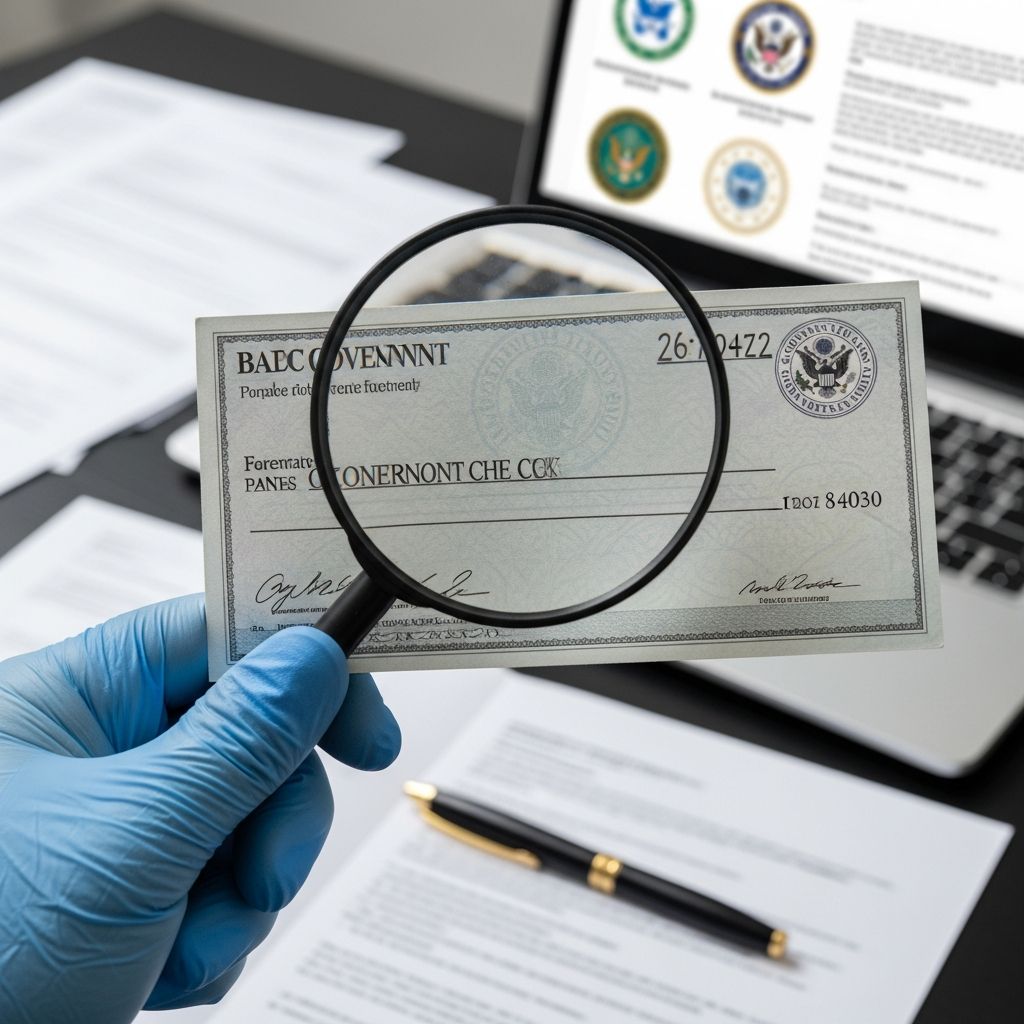
Government payments can be a financial lifeline, whether they are tax refunds, benefits, or special relief checks. Unfortunately, scammers know this and design schemes that use fake government checks to steal your money or personal information. This guide explains how government payments really work, how to spot scams, and what to do if you suspect fraud.
1. How Legitimate Government Payments Are Sent
Before you can recognize a scam, it helps to understand how real government payments are usually delivered.
- Most federal payments are sent by direct deposit into your bank or credit union account.
- Paper checks are still used in some cases, but they are becoming less common.
- Payments are issued by specific federal agencies, such as the IRS, Social Security Administration, or the Department of the Treasury.
In many programs, direct deposit is encouraged because it is faster, more secure, and harder for thieves to intercept than paper checks.
Common Types of Federal Checks
| Type of Payment | Typical Issuing Agency | Usual Delivery Method |
|---|---|---|
| Tax refunds | Internal Revenue Service (IRS) | Mostly direct deposit; some paper checks. |
| Social Security and SSI benefits | Social Security Administration (SSA) | Primarily direct deposit or prepaid card. |
| Veterans benefits | Department of Veterans Affairs (VA) | Mainly direct deposit. |
| Other federal benefits or relief checks | U.S. Department of the Treasury / specific agencies | Direct deposit or paper Treasury checks. |
2. Why Government Check Fraud Is So Common
Crooks target government checks for a simple reason: these payments are guaranteed funds. Once a check is cashed or deposited, the money is real, even if the check itself later turns out to be counterfeit.
According to Federal Reserve data, tens of millions of government checks worth over a trillion dollars are processed annually, making them an attractive target for fraud. This huge volume makes it easier for fake or altered checks to slip through if people and institutions are not careful.
Typical Goals of Government Check Scams
- Convince you to send money back or forward part of the check amount before the bank discovers it is fake.
- Trick you into revealing personal or financial information (such as Social Security numbers, bank account numbers, or login credentials).
- Pressure you to pay bogus fees, taxes, or processing costs to receive a payment that does not exist.
3. Recognizing a Legitimate U.S. Treasury Check
If you receive what appears to be a government check, do not assume it is real just because it looks official. Authentic U.S. Treasury checks have specific security features built into the paper and printing.
Key Security Features on Real Treasury Checks
- Watermark: Genuine checks are printed on watermarked paper that reads “U.S. Treasury” when held up to the light. The watermark should be visible from both the front and the back. If you do not see a watermark, or you can see it without holding the check to the light, treat the check as suspicious.
- Microprinting: Very small text is printed in various locations that is difficult to reproduce accurately. On real checks, this microprinting will be clear under magnification, not blurred or smeared.
- Ultraviolet overprinting: Under UV light, genuine checks show specific protective patterns, such as lines and seals that glow in certain ways.
- Security threads: Some check paper contains embedded threads that glow under UV light, another indicator that the check is printed on authorized stock.
Understanding the Information Printed on the Check
U.S. Treasury checks include both visible information and a special line of numbers at the bottom known as the MICR line. Each part provides details about the payment and helps institutions verify that the check was actually issued by the government.
- Issue date: When the payment was created.
- Payee name: The person or entity authorized to receive the funds.
- Check symbol and serial number: Unique identifiers used to track and verify the check.
- Issue amount: The authorized payment amount printed on the face of the check.
- Routing number for Treasury checks: A special routing number in the MICR line that identifies the U.S. Treasury.
If any of this information appears altered, mismatched, or unusually formatted, do not cash or deposit the check until it has been verified by a trusted source.
4. How to Verify a Government Check Safely
Visual inspection is only the first step. To be confident that a government check is legitimate, use official verification tools and trusted contacts.
Use the Treasury Check Verification System (TCVS)
The U.S. Department of the Treasury provides an official tool called the Treasury Check Verification System (TCVS) that allows financial institutions and others to confirm check information.
- TCVS checks issue data (such as check number, symbol, and amount) against Treasury records.
- If the details do not match what the system expects, that is a strong sign the check could be fake or altered.
You can ask your bank or credit union if they use TCVS or other official verification methods before making funds available. Many institutions rely on real-time or batch verification services to reduce the chance that counterfeit Treasury checks are accepted.
Contact the Agency That Issued the Payment
Another safe way to verify a payment is to contact the agency that supposedly sent the check. Use contact information from official government websites or past correspondence, not phone numbers or links provided in unsolicited messages.
- For tax refunds, contact the IRS using information from IRS.gov.
- For Social Security or SSI payments, contact the Social Security Administration using SSA.gov.
- For other benefit payments, start at the central government portal and follow links to the appropriate agency.
When you call or write, have the check number, amount, and date available so the agency can help confirm whether the payment is genuine.
5. Red Flags That Your Government Check Might Be a Scam
Real government payments do not ask you to pay money to receive money. If the check comes with instructions that sound strange or urgent, treat it as a likely scam.
Warning Signs in the Letter, Email, or Call
- Being told you must pay a fee, tax, or processing cost to receive or keep the check.
- Pressure to act immediately or risk losing the payment.
- Requests for personal information such as your full Social Security number, bank account login, or debit card PIN.
- Instructions to send part of the money back using wire transfer, gift cards, cryptocurrency, or a payment app.
- Contact from someone claiming to be a government official calling or texting from an unexpected number or personal email address.
Suspicious Features on the Check Itself
- Misspellings of agency names or obviously incorrect logos.
- Poor print quality, blurred microprinting, or missing watermark.
- Amounts that are much larger than you expect, especially if you are told you must return a portion.
- A different payee name than yours, with instructions to deposit it anyway and send the money on.
6. Safe Steps to Take If You Receive an Unexpected Check
If you receive a government check you did not expect, pause before you cash or deposit it. Taking a few careful steps can prevent significant loss.
Checklist Before You Cash the Check
- Do not spend the money immediately. Wait until your bank confirms that the check has fully cleared and is legitimate. Remember that funds may appear in your account before the bank discovers a check is fake.
- Inspect security features. Look for the watermark, clear microprinting, and overall print quality.
- Ask your bank to verify it. Request that your financial institution use official tools such as TCVS or other verification methods to confirm the check with the Treasury.
- Contact the supposed issuing agency. Use only phone numbers and websites you find yourself on official .gov pages.
If the Check Is Clearly Fraudulent
- Do not attempt to cash or deposit it.
- Keep copies of the check, envelope, and any letters, emails, or text messages you received.
- Report the fraud to your bank or credit union and to the relevant federal agency.
- Consider filing a complaint with law enforcement or a national fraud reporting center.
7. Protecting Your Personal and Financial Information
Many government check scams are really attempts at identity theft. Even if the check itself is never cashed, criminals can use the information they collect to open accounts, file fake tax returns, or steal benefits in your name.
Best Practices to Reduce Your Risk
- Never give out Social Security numbers, bank account details, or login credentials in response to an unsolicited call, text, or email.
- Do not click links in unexpected messages that claim to come from the IRS, Social Security, or Treasury; instead, type the agency’s official address into your browser yourself.
- Enroll in account alerts at your bank or credit union so you receive notifications of unusual transactions.
- Use strong, unique passwords and, where possible, multi-factor authentication for your financial and government-related accounts.
8. Frequently Asked Questions (FAQs)
Q1: How can I quickly check if a government check is real?
Start by examining the watermark, microprinting, and print quality. Then ask your bank or credit union to verify the check using official tools such as the Treasury Check Verification System, and contact the issuing agency using information from an official government website.
Q2: The bank made the money from a check available. Does that mean the check is genuine?
Not necessarily. Banks are often required to make deposited funds available quickly, even before a check has fully cleared or been confirmed as legitimate. If the check turns out to be counterfeit, you can be held responsible for the money. Always verify suspicious checks before spending the funds.
Q3: Who should I contact if I never received a federal payment I was expecting?
You should report a lost, missing, or stolen federal check or direct deposit directly to the agency that issued the payment, such as the IRS for tax refunds or the Social Security Administration for benefits. Use contact information listed on official .gov websites.
Q4: Can the IRS or another agency call me and demand I pay a fee to release my refund or benefit check?
Legitimate federal agencies do not demand immediate payment by gift cards, wire transfer, cryptocurrency, or payment apps to release a check. Requests for upfront fees or payment by unusual methods are strong signs of a scam.
Q5: What should I do if I think I already deposited a fake government check?
Contact your bank or credit union immediately and explain the situation. Ask whether the check has fully cleared and whether any steps can be taken to protect your account. Then report the incident to the appropriate federal agency and any national consumer fraud reporting service so others can be warned.
References
- Government checks and payments — USA.gov. 2024-04-15. https://www.usa.gov/government-checks-payments
- How to Identify Treasury Checks — Administration for Children & Families, U.S. Department of Health & Human Services. 2022-10-01. https://acf.gov/css/outreach-material/how-identify-treasury-checks
- U.S. Treasury Check Security Features — Bureau of the Fiscal Service, U.S. Department of the Treasury. 2020-12-01. https://fiscal.treasury.gov/files/reference-guidance/gold-book/check-security-poster.pdf
- Treasury Check Verification System (TCVS) — Bureau of the Fiscal Service, U.S. Department of the Treasury. 2023-06-01. https://tcvs.fiscal.treasury.gov
- Treasury Check Verification System: Preventing Check Fraud — Abrigo. 2024-03-12. https://www.abrigo.com/blog/u-s-treasury-check-verification-fight-tax-season-fraud/
- Protect Yourself from U.S. Treasury Check Fraud — United Texas Credit Union. 2023-05-10. https://utxcu.com/protect-yourself-from-us-treasury-check-fraud/
- The Practical Guide to Treasury Check Payee Verification and Fraud Prevention — Advanced Fraud Solutions. 2023-09-01. https://advancedfraudsolutions.com/blog/the-practical-guide-to-treasury-check-payee-verification-and-fraud-prevention-2/
Similar Articles








Read full bio of medha deb


