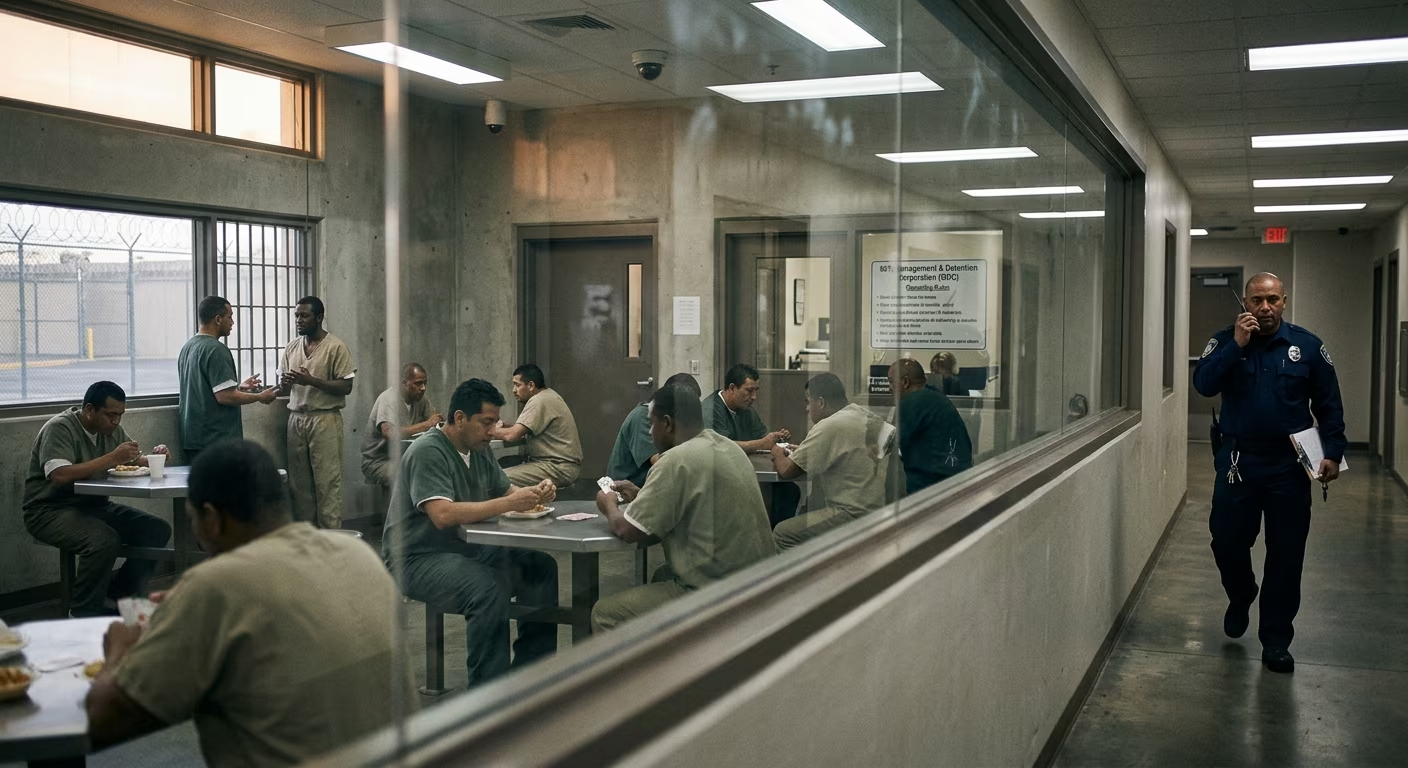
The intersection of immigration enforcement and private industry represents one of the most contentious policy domains in modern American governance. Over the past several years, political campaigns have prominently featured pledges to dismantle the privatization of the federal carceral system, aiming to transition away from facilities motivated by profit margins rather than rehabilitation or justice. Despite these declarations, the infrastructure of civil immigration confinement has not merely maintained the status quo; it has entrenched itself deeper into the hands of corporate operators.
The dependency on corporate prison entities by federal agencies exposes a profound disconnect between political rhetoric and the operational realities of immigration law enforcement. This article systematically examines how the privatization of civil detention continues to thrive, the legal mechanisms that facilitate its expansion, and the broader implications for human rights, government accountability, and systemic reform.
The Illusion of Reform: Examining the 2021 Executive Order
A watershed moment in the discourse surrounding prison privatization occurred in early 2021 when the executive branch issued a directive instructing the Department of Justice (DOJ) to decline the renewal of contracts with privately operated criminal detention facilities. Hailed by reform advocates as a monumental step toward dismantling the prison-industrial complex, the directive carried a massive structural caveat: it completely exempted the Department of Homeland Security (DHS) and, by extension, U.S. Immigration and Customs Enforcement (ICE).
Because ICE falls under the jurisdiction of DHS rather than the DOJ, the agency’s vast network of holding centers remained immune to the sweeping reforms. This bifurcation in policy created a paradoxical federal approach. On one hand, the government acknowledged the inherent conflicts of interest and ethical hazards associated with monetizing criminal incarceration. On the other hand, it permitted those identical corporate actors to dominate the sector of civil, administrative confinement. The exemption effectively insulated the most lucrative segment of the private prison industry, allowing operations to continue largely uninterrupted while masking the lack of comprehensive systemic change.
The Statistical Reality: Surging Detention Populations
Far from diminishing, the footprint of private industry in immigration enforcement has expanded significantly over the last few years. Data analyzed by independent research organizations, such as the Transactional Records Access Clearinghouse (TRAC) at Syracuse University, illustrates a clear upward trajectory in both the overall detained population and the proportion held in for-profit centers. While overall detention numbers fluctuated during the height of public health emergencies earlier in the decade, subsequent years witnessed a rapid escalation .
By early 2025 and moving into 2026, federal authorities held nearly 40,000 adults in immigration custody on any given day, representing a sharp increase from the roughly 15,000 detained in 2021. Equally striking is the market share captured by private entities. Official ICE detention management data indicates that the overwhelming majority of these detainees—frequently exceeding 80 to 90 percent of the average daily population—are housed in facilities owned, operated, or managed by private corporations .
| Timeframe | Average Daily Population (ADP) | Approx. % in Private Facilities |
|---|---|---|
| Early 2021 | ~15,000 | 80% |
| Mid 2023 | ~30,000 | 85% |
| Late 2025 / Early 2026 | ~39,000 | 90% |
This reliance underscores a logistical trap. The federal government has historically failed to invest in state-owned civil holding infrastructure, rendering ICE functionally dependent on corporate beds to execute its enforcement mandates. This dependency guarantees that any surge in border apprehensions or interior enforcement translates directly into corporate revenue.
Corporate Winners: How Prison Giants Capitalize on Policy Paralysis
The economics of civil enforcement rely heavily on guaranteed revenue streams that shield operators from market volatility. Major prison operators have structured their federal agreements to include “guaranteed minimums.” These contractual clauses obligate the federal government to pay for a baseline number of beds regardless of whether they are actually occupied by detainees. This arrangement guarantees profit continuity for shareholders while shifting the financial risk entirely onto taxpayers.
In addition to guaranteed minimums, these corporations extract revenue through ancillary services provided within the facilities. From exorbitant fees for phone calls and video visitation to overpriced commissary goods, the monetization of the detained population extends far beyond the basic per-diem bed rate. Detainees, who are often legally barred from working in the external economy, are sometimes employed within the facilities to perform essential maintenance, cooking, and cleaning tasks for mere pennies an hour. This controversial labor practice further artificially suppresses the operating costs for the private companies, maximizing their net revenues.
Furthermore, the operational models of these corporations are designed to minimize overhead, which invariably impacts the resources allocated to those detained. Because these centers house individuals undergoing civil proceedings—not serving criminal sentences—they are theoretically intended to provide non-punitive, administrative confinement. However, the corporate imperative to maximize yield frequently results in staffing shortages, diminished medical resources, and inferior nutritional provisions. The convergence of federal subsidies, guaranteed quotas, and heavily discounted internal labor creates an economic environment where expanding the detained population is explicitly rewarded by the financial markets.
Sidestepping the Law: State Bans and Local Loopholes
As grassroots momentum prompted state legislatures to pass laws prohibiting the operation of private detention centers within their jurisdictions, federal agencies and corporate contractors adapted by exploiting legal and administrative loopholes. States like California, New Jersey, and Washington enacted legislation specifically designed to phase out private ICE facilities to protect the welfare of migrants. However, the federal government bypassed these local statutes by utilizing Intergovernmental Service Agreements (IGSAs).
Under an IGSA or a Dedicated Intergovernmental Service Agreement (DIGSA), ICE contracts directly with a local municipality or county government. The local government then subcontracts the actual day-to-day management and operation of the facility to a private corporation. This maneuvering allows private entities to operate behind the legal shield of local government sovereignty, rendering state-level bans functionally obsolete in many instances.
This triangulated contracting not only subverts the legislative intent of state lawmakers but also severely obscures transparency. The dilution of direct federal oversight creates a fractured accountability chain where abuses are easily dismissed as the responsibility of the subcontractor rather than the contracting federal agency. Local governments, in turn, are often incentivized to participate in these pass-through agreements by receiving administrative fees from ICE, creating a symbiotic financial relationship that prioritizes revenue over local statutory compliance.
The Human Cost: Oversight Deficiencies and Systemic Neglect
The human consequences of this privatized network have been extensively documented by both government watchdogs and legislative committees. Unannounced inspections conducted by the Department of Homeland Security’s Office of Inspector General (OIG) have repeatedly illuminated grave violations of internal detention standards . Investigative reports have highlighted instances of extreme medical neglect, the unwarranted and extended use of solitary confinement, and drastically unsafe environmental conditions, such as crumbling infrastructure and unsanitary food.
These oversight deficiencies are compounded by the unique vulnerabilities of the immigrant population. Language barriers, a lack of comprehensive legal representation, and the inherent fear of retaliation make it exceedingly difficult for detainees to report abuses or demand accountability. The OIG reports frequently note that even when severe infractions are identified during inspections—such as the failure to administer critical medications or the neglect of basic sanitation—corrective actions are often delayed or superficially implemented. The contractual penalties levied against private operators for such violations are typically negligible compared to their overall revenue, meaning there is little to no financial sting to motivate genuine compliance.
The gravity of these conditions came into sharp focus during recent congressional oversight efforts. In early 2026, lawmakers raised urgent alarms regarding a dramatic escalation of fatalities within civil enforcement centers, with multiple individuals dying in ICE custody shortly after intake or following prolonged illnesses . Because individuals in these centers are merely awaiting civil hearings—and are frequently asylum seekers fleeing trauma—the application of maximum-security prison conditions is profoundly disproportionate. The privatization model inherently transforms administrative holding into a punitive experience, inflicting lasting psychological and physical harm.
Charting a New Path: Recommendations for Structural Overhaul
Addressing the ingrained reliance on corporate detention requires multifaceted policy interventions that extend far beyond limited executive branch directives. Legislative action is paramount. Congress possesses the authority to mandate the gradual termination of all private contracts within DHS, effectively aligning immigration enforcement with the ethical principles previously applied to the DOJ. Furthermore, eliminating the appropriation riders that mandate guaranteed bed minimums would instantly remove the artificial financial floor supporting corporate operators.
Transitioning away from this entrenched system will also require a paradigm shift toward Alternatives to Detention (ATD). Comprehensive community-based case management programs have proven highly effective in ensuring appearance at legal proceedings without the staggering financial and human costs of physical incarceration. By investing in social services, legal representation, and community sponsorship rather than steel beds, the government can uphold the integrity of the civil immigration system while entirely bypassing the private prison-industrial complex.
Finally, the federal government must invest in building a robust, independent oversight body with the authority to instantly terminate contracts at facilities that fail to meet humanitarian standards. Transparency laws must be amended so that private contractors operating under IGSAs are subject to the exact same Freedom of Information Act (FOIA) requirements as direct federal agencies, piercing the veil of corporate secrecy.
Conclusion
The ongoing expansion of privatized civil holding centers illustrates a stubborn policy paradox where economic interests and bureaucratic momentum consistently override ethical commitments and reform pledges. The utilization of legislative loopholes and secondary contracting has allowed the private prison industry to not only survive but thrive within the immigration enforcement sector. Until federal policy decisively severs the financial incentives tying human liberty to corporate profit, the systemic abuses defining the current system will continue unchecked. True reform requires a fundamental reimagining of administrative compliance, prioritizing human dignity over shareholder returns.
Frequently Asked Questions (FAQs)
What is the legal difference between DOJ prisons and ICE detention?
DOJ facilities generally house individuals who have been convicted of federal criminal offenses and are serving punitive sentences. Conversely, ICE detention is legally classified as “civil administrative detention.” Individuals held by ICE are not confined for punishment; they are held to ensure their presence for immigration court hearings or pending their removal from the country.
Why did the 2021 Executive Order on private prisons not affect immigration detention?
The 2021 executive action was specifically directed at the Department of Justice, instructing it not to renew contracts with privately operated criminal facilities. Because immigration enforcement is overseen by the Department of Homeland Security, ICE operations were deliberately excluded from the order’s scope, allowing corporate contracts in the immigration sector to continue growing.
How do private prison companies bypass state bans?
When states pass laws banning private detention centers, ICE frequently utilizes Intergovernmental Service Agreements (IGSAs). Through this mechanism, the federal government signs a contract with a county or local municipality, which then subcontracts the actual facility operations to a private corporation. This legal workaround nullifies the impact of state-level bans by positioning the local government as the primary contractor.
What are Alternatives to Detention (ATD)?
Alternatives to Detention are programs designed to monitor individuals undergoing civil immigration proceedings without physically confining them. While some ATDs rely on electronic surveillance (like ankle monitors), reform advocates champion community-based ATDs. These programs focus on providing case management, legal assistance, and social services, which have been proven to ensure high court compliance rates at a fraction of the cost of physical detention.
References
- Immigration Detention Statistics: A Retrospective and a Look Forward — Transactional Records Access Clearinghouse (TRAC), Syracuse University. 2025-02-21. https://trac.syr.edu/immigration/reports/
- Detention Management – ICE Statistics — U.S. Immigration and Customs Enforcement. 2026-04-09. https://www.ice.gov/detain/detention-management
- Summary of Unannounced Inspections of ICE Facilities Conducted in Fiscal Years 2020-2023 — Department of Homeland Security Office of Inspector General. 2024-09-24. https://www.oig.dhs.gov/
- Padilla, Durbin, Senate Democrats Sound Alarm on Dramatic Increase in Deaths in Immigration Detention — U.S. Senate Press Releases. 2026-02-17. https://www.padilla.senate.gov/