
Prior Restraint: 5 Key Forms, Landmark Cases, And Limits
Unpacking the legal barriers to government censorship before speech occurs and its First Amendment implications.
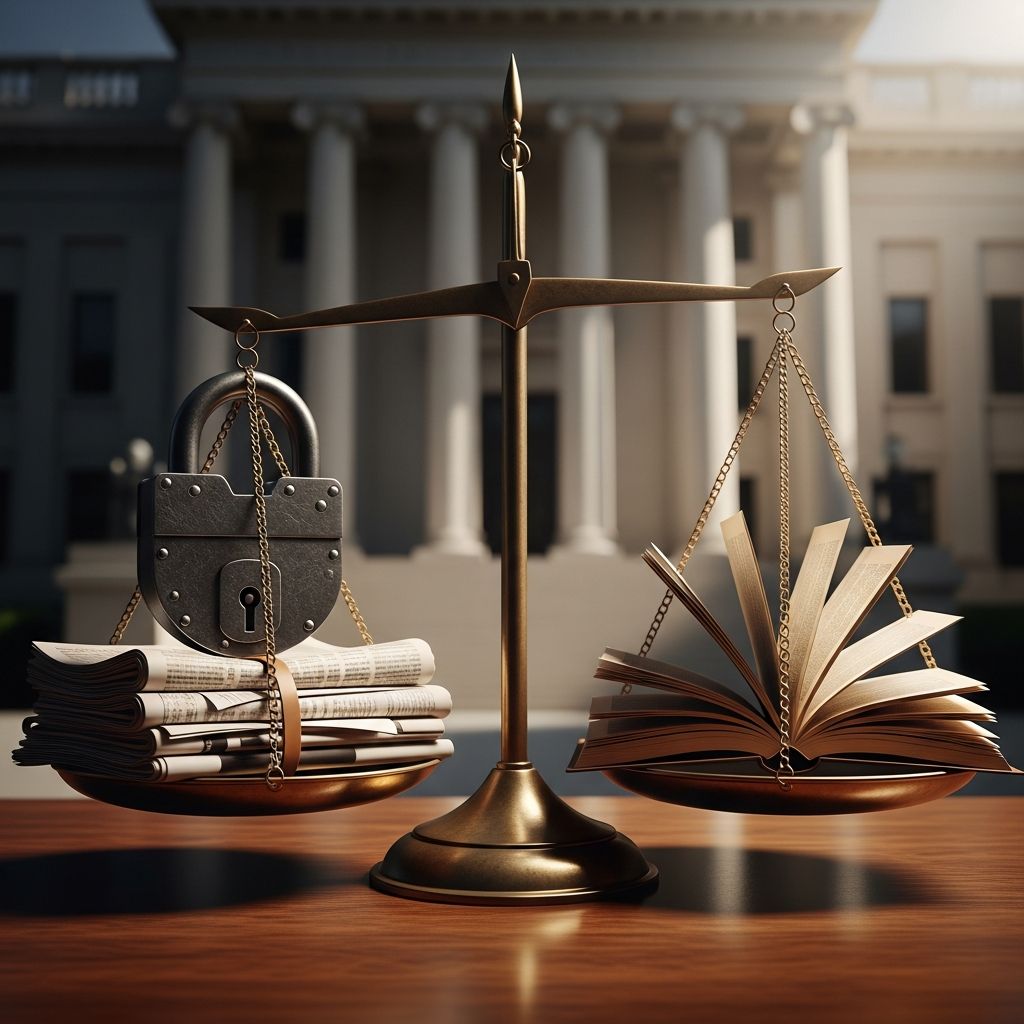
In the realm of constitutional law, few concepts carry as much weight for free expression as prior restraint. This principle stands as a bulwark against government attempts to silence speech before it reaches the public, embodying the core tensions between authority and liberty under the First Amendment. Unlike post-publication punishments like fines or imprisonment for defamation, prior restraint intervenes upfront, blocking content from ever seeing the light of day. Courts treat such measures with profound skepticism, often deeming them unconstitutional unless extraordinary circumstances demand otherwise.
Defining Prior Restraint in Constitutional Terms
Prior restraint refers to any governmental action that prohibits speech or publication in advance of its dissemination. This can manifest as injunctions, licensing requirements, or outright bans imposed by courts, agencies, or officials. The U.S. Supreme Court has long held that such interventions face a ‘heavy presumption’ against their validity, rooted in the First Amendment’s command that ‘Congress shall make no law… abridging the freedom of speech, or of the press.’
At its essence, prior restraint shifts the burden onto the government to justify suppression before harm occurs, inverting the usual paradigm where speakers are punished only after proven wrongdoing. This preemptive approach risks chilling vast swaths of protected expression, as creators self-censor to avoid uncertain legal pitfalls. Historical abuses, from colonial-era licensing under the British Stamp Act to modern permit denials for protests, underscore why the framers embedded strong protections against it.
Historical Foundations: From English Roots to American Revolution
The aversion to prior restraint traces back to 17th-century England, where the Licensing Act of 1662 empowered officials to censor publications preemptively. Colonists chafed under similar controls, experiencing warrantless searches and seizures of printing presses. James Madison, architect of the First Amendment, explicitly decried these practices in Federalist No. 84, arguing they enabled tyranny by quashing dissent before it could rally public opinion.
Post-ratification, early U.S. cases like Frohwerk v. United States (1919) hinted at limits on pre-publication review, but it was the 20th century that crystallized the doctrine. Today, this history informs a legal landscape where prior restraint is not merely disfavored but presumptively invalid, compelling the state to prove imminent, irreparable harm.
Landmark Supreme Court Decisions Shaping the Doctrine
The modern jurisprudence on prior restraint began with Near v. Minnesota (1931), the Court’s first direct confrontation with the issue. Jay Near’s scandal-sheet newspaper accused Minneapolis officials of corruption, prompting a state law to enjoin ‘malicious’ publications as public nuisances. In a landmark 5-4 ruling, Justice Hughes declared such perpetual injunctions akin to historical censorship, voiding the law and establishing that prior restraints are unconstitutional except in narrow cases like troop movements during war.
Decades later, New York Times Co. v. United States (1971)—the Pentagon Papers case—reaffirmed this stance amid Vietnam War secrecy. Despite government pleas of national security, the Court rejected injunctions against publishing classified documents, with Justices emphasizing that any prior restraint bears an ‘extremely heavy’ justificatory burden.
Other pivotal rulings include Nebraska Press Assn. v. Stuart (1976), where the Court unanimously struck down a gag order on trial coverage, insisting that fair-trial concerns rarely justify pre-publication bans. These cases form a robust precedent: temporary restraints, like preliminary injunctions, are as suspect as permanent ones absent final adjudication.
Forms and Mechanisms of Prior Restraint
Prior restraint assumes diverse guises, each testing First Amendment boundaries:
- Judicial Injunctions: Court orders barring specific publications, as in Near or Pentagon Papers.
- Licensing Schemes: Requirements for government approval before distribution, invalidated if officials wield unbridled discretion.
- Permit Denials: Refusals for rallies or films, permissible only for time-place-manner regulations, not content.
- Administrative Censorship: Agency reviews, like school officials quashing student newspapers.
- Forfeiture Orders: Pre-trial seizures of expressive materials, struck down in cases like Booksellers v. Hudnut.
These mechanisms highlight prior restraint’s breadth, from print media to digital protests, demanding vigilant judicial scrutiny.
Rare Exceptions: When Prior Restraint Survives Scrutiny
While presumptively unconstitutional, prior restraint finds limited tolerance in extreme scenarios. The Court permits it for obscenity, where low First Amendment value justifies preemptive blocks. National security offers another carve-out, theoretically for troop safety or nuclear secrets, though rarely upheld post-Pentagon Papers.
Student speech in school-sponsored contexts receives lesser protection, allowing principals to spike publications. Irreversible harm, like incitements to imminent violence, may warrant restraint if post hoc remedies fail. Even then, the government must surmount a towering evidentiary bar in adversarial proceedings, not ex parte hearings.
| Category | Allowed? | Rationale | Example Case |
|---|---|---|---|
| Obscenity | Yes (limited) | Low protected value | Alexander v. U.S. |
| National Security | Rarely | Irreparable harm | N.Y. Times v. U.S. |
| Student Media | Often | Hazelwood v. Kuhlmeier | |
| Fair Trials | No | Alternatives exist | Nebraska Press |
| General Speech | No | Heavy presumption | Near v. Minnesota |
Prior Restraint in the Digital Era and Modern Challenges
The internet has amplified prior restraint debates. Social media takedown orders, algorithm suppressions, and content moderation by platforms blur lines between state and private action. Courts grapple with whether government pressure on tech firms constitutes unconstitutional censorship.
Recent cases involve election misinformation injunctions and COVID-19 content blocks, where officials sought preemptive removals. Lower courts, citing Near, often deny such requests, prioritizing open discourse. Globally, authoritarian regimes impose digital prior restraints via ‘Great Firewalls,’ contrasting America’s protective stance.
Emerging threats include AI-generated deepfakes; while calls for pre-publication reviews grow, First Amendment hurdles loom large, demanding narrow tailoring to avoid overbreadth.
Comparing Prior Restraint to Subsequent Punishments
| Aspect | Prior Restraint | Subsequent Punishment |
|---|---|---|
| Timing | Before publication | After publication |
| Constitutional Test | Heavy presumption against | Standard scrutiny (e.g., libel) |
| Examples | Injunctions, licenses | Fines, jail for defamation |
| Chilling Effect | High (self-censorship) | Lower |
| Judicial Burden | On government | On speaker |
This table illustrates why prior restraint draws stricter review: it preempts public access entirely, unlike remedies that allow speech while penalizing harms post-facto.
Implications for Journalists, Activists, and Everyday Citizens
For reporters, prior restraint shields investigative journalism from official reprisal, fostering accountability. Activists rely on it to protest without permit vetoes based on viewpoint. Ordinary citizens benefit indirectly, as robust press freedoms underpin democratic debate.
Challenges persist in border zones like commercial speech or trade secrets, where courts balance interests more flexibly. Yet the core rule endures: governments cannot play editor-in-chief.
Frequently Asked Questions (FAQs)
What exactly constitutes prior restraint?
Any preemptive government block on speech, such as injunctions or permit denials based on content, rather than neutral regulations.
Is prior restraint ever constitutional?
Rarely, only for obscenity, certain national security threats, or school-sponsored speech, with strict proof required.
How did Near v. Minnesota change free speech law?
It invalidated perpetual injunctions on ‘scandalous’ publications, setting the ‘heavy presumption’ against prior restraints.
Can courts issue gag orders on the press?
Unlikely; Nebraska Press requires showing no alternatives exist to ensure fair trials.
Does prior restraint apply to online content?
Yes, principles extend to digital media, protecting against unwarranted takedowns or blocks.
References
- The Doctrine of Prior Restraint :: First Amendment – Justia Law — Justia. 2023. https://law.justia.com/constitution/us/amendment-01/07-the-doctrine-of-prior-restraint.html
- Prior Restraint: When (and How) the Government Can Censor You — Freedom Forum. 2023-05-15. https://www.freedomforum.org/what-is-prior-restraint/
- Prior restraint – Wikipedia — Wikipedia Contributors. 2026-01-10. https://en.wikipedia.org/wiki/Prior_restraint
- Prior Restraint: Understanding Its Legal Definition — US Legal Forms. 2024. https://legal-resources.uslegalforms.com/p/prior-restraint
- Prior Restraint | Definition, Examples & Exceptions – Study.com — Study.com. 2025. https://study.com/academy/lesson/prior-restraint-in-law-definition-lesson.html
- Prior Restraints | CECC — Congressional-Executive Commission on China. 2023. http://www.cecc.gov/prior-restraints
Similar Articles








Read full bio of Sneha Tete


