
Presidential Clemency and the Federal Death Penalty
Exploring the historic use of executive power to commute federal capital sentences.
The Constitutional Framework of Executive Clemency
The imposition of capital punishment within the United States federal criminal justice system has long been a subject of intense scrutiny, moral debate, and legal friction. At the heart of this complex issue lies the sweeping power of executive clemency—a constitutional authority that allows a sitting president to unilaterally alter the sentences of those convicted of federal crimes. In recent years, the intersection of political transitions, systemic inequalities, and the stark finality of the death penalty has thrust the president’s commutation powers into the national spotlight.
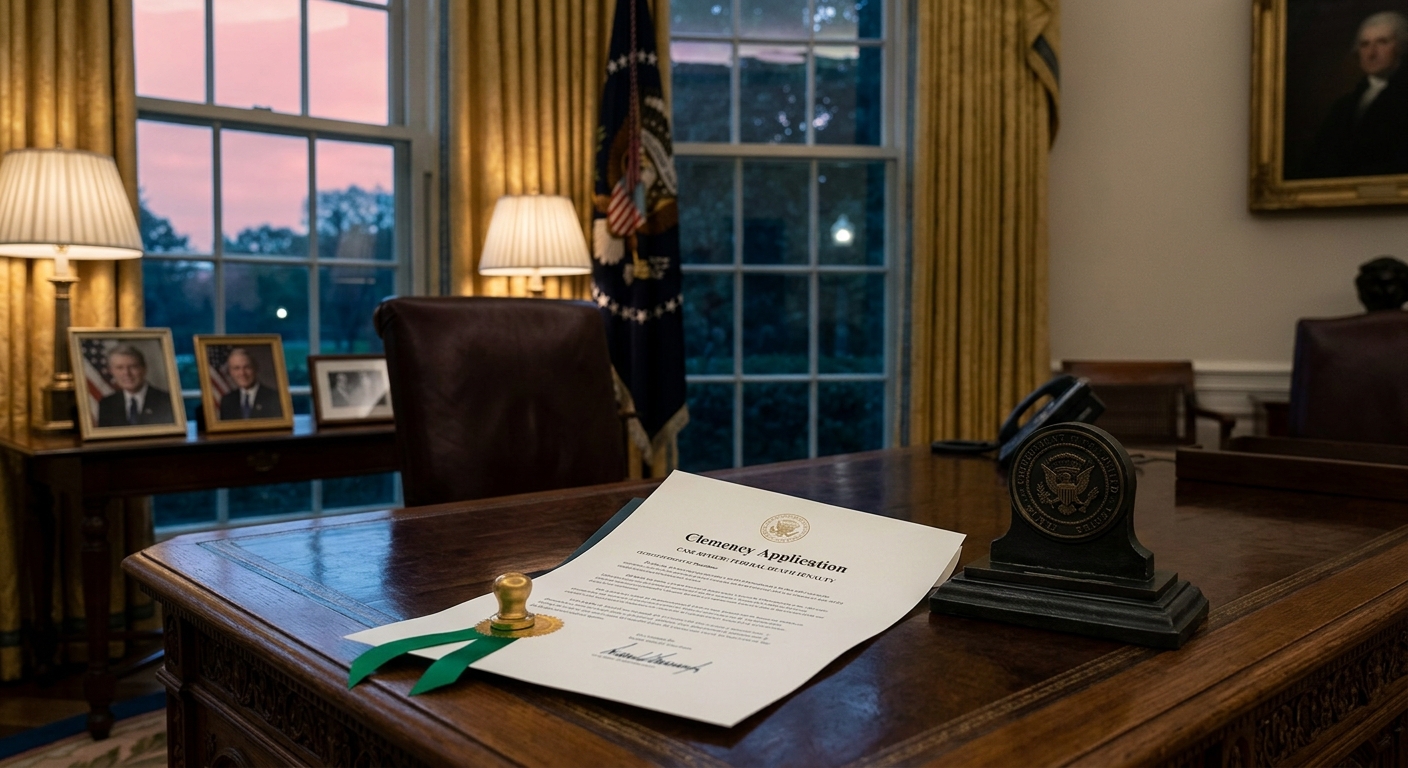
Understanding the gravity of executive intervention requires a foundational grasp of the clemency framework. Rooted in Article II, Section 2 of the U.S. Constitution, the president is granted the “Power to grant Reprieves and Pardons for Offenses against the United States.” This broad mandate encompasses several distinct forms of relief. Unlike legislative reforms, which require congressional consensus and often face insurmountable political gridlock, clemency is an unchecked executive privilege. The president does not need the approval of the Department of Justice, the federal courts, or the legislature to act. This unilateral nature makes it an exceptionally potent tool for rectifying perceived injustices or implementing immediate policy shifts.
| Type of Clemency | Legal Effect | Impact on Conviction | Application in Capital Cases |
|---|---|---|---|
| Pardon | Forgives the crime and restores civil rights (e.g., voting, holding office). | Does not erase the conviction itself but removes associated legal disabilities. | Rarely used for death row inmates unless accompanied by strong evidence of absolute innocence. |
| Commutation | Reduces or modifies a legally imposed sentence to a less severe one. | Leaves the underlying criminal conviction fully intact. | The primary mechanism used to alter a death sentence to life imprisonment without parole. |
| Reprieve | Temporarily postpones the execution of a sentence. | No impact on the conviction or the ultimate sentence length. | Often granted to allow time for additional appellate review or the consideration of new evidence. |
Systemic Flaws: The Impetus Behind Mass Commutation Calls
The push for executive intervention in capital cases is rarely driven by a defense of the crimes committed; rather, it is propelled by deep-seated concerns regarding the administration of the justice system itself. The federal execution apparatus has frequently been criticized for mirroring the same biases and inconsistencies found at the state level. These systemic flaws create a compelling argument for the use of executive clemency as an ethical corrective measure.
The Shadow of Racial Disparities
The specter of racial bias casts a long shadow over the administration of the ultimate punishment. Statistical analyses consistently demonstrate that minority defendants are disproportionately represented within the federal capital system. According to historical data from the Bureau of Justice Statistics, people of color have comprised a highly disproportionate percentage of the federal death row population . Furthermore, the race of the victim plays a confounding role in capital charging decisions. Research indicates that federal prosecutors are statistically more likely to seek the death penalty in homicide cases involving white victims compared to cases involving victims of color. For civil rights advocates, these persistent demographic disparities suggest that capital punishment is not applied purely based on the severity of the offense, but is influenced by ingrained societal biases.
Geographic Arbitrariness in Capital Charging
Beyond racial disparities, critics and legal scholars point to the issue of geographic arbitrariness. The decision to pursue federal capital charges is highly dependent on the local United States Attorney and the specific district in which a crime occurs. Some federal districts routinely authorize death penalty prosecutions, while others almost universally defer to life sentences for similar crimes. This dynamic creates what legal scholars describe as a “lottery of geography.” Two individuals committing identical offenses in different states—or even different federal districts within the same state—can face drastically different prosecutorial outcomes. This lack of uniformity undermines the constitutional guarantee of equal protection under the law and serves as a major catalyst for advocacy groups demanding blanket commutations.
The Irreversible Risk of Human Error
Another cornerstone of the movement against the federal death penalty is the inherent risk of irreversible error. While the federal judicial system is often lauded for its rigorous appellate reviews, specialized defense teams, and robust procedural safeguards, it remains fundamentally human and, therefore, fallible. It is not immune to prosecutorial misconduct, compromised forensic evidence, or the reliance on unreliable witness testimonies.
Across both state and federal systems, the steady emergence of death row exonerations has severely damaged the credibility of capital punishment. For advocates pressing for executive intervention, the mere mathematical possibility of executing an innocent person represents a moral catastrophe that vastly outweighs any retributive or deterrent justifications for the practice. A presidential commutation to life in prison, while still a profoundly severe sanction, preserves the critical possibility of future legal remedies should new, exculpatory evidence of innocence eventually come to light.
From Campaign Rhetoric to Historic Executive Action
The political urgency surrounding federal commutations is intricately tied to the cyclical nature of presidential administrations and the volatility of shifting executive policies. The federal death penalty lay largely dormant for decades until the Federal Death Penalty Act of 1994 drastically expanded the list of capital-eligible offenses. Following another long hiatus in the early 2000s, executions abruptly resumed at an unprecedented pace during the presidential transition period of 2020 and early 2021. This rapid succession of executions broke a long-standing political norm against carrying out capital sentences during a lame-duck session, underscoring how quickly a dormant system could be reactivated by a motivated administration.
When the subsequent administration assumed office, the Department of Justice swiftly imposed a moratorium on federal executions to review the policies and protocols governing capital punishment. However, legal experts and civil rights groups recognized that a moratorium is inherently fragile. Because it is merely an internal policy directive, it can be instantly revoked by any future administration. Recognizing this vulnerability, a massive coalition of civil rights organizations, legal scholars, and progressive lawmakers launched a formidable pressure campaign throughout 2024. They argued that an administrative pause was insufficient and demanded permanent action before the end of the presidential term.
This immense public and political pressure culminated in a historic milestone in December 2024, when the White House announced the mass commutation of federal death row sentences, altering the punishments of dozens of inmates to life imprisonment without the possibility of parole . This unprecedented use of executive clemency fundamentally altered the immediate trajectory of the federal justice system, ensuring that the specific individuals currently on the row could not be subjected to execution by any future administration, regardless of shifting political winds.
Public Perception: A Paradox of Support and Skepticism
The debate over capital punishment continues to evolve dramatically in the court of public opinion. While legal experts debate the constitutional merits, the broader American public holds complex and often contradictory views on the subject. According to comprehensive polling data from the Pew Research Center, roughly six in ten U.S. adults generally favor the death penalty for people convicted of murder . However, this top-line support masks a deep and pervasive skepticism regarding the actual fairness of the justice system.
The same polling data reveals that an overwhelming majority of Americans—nearly eight in ten—acknowledge there is a significant risk that an innocent person will be put to death. Furthermore, substantial majorities express explicit concerns that the death penalty is not applied equally across racial lines and harbor doubts about its efficacy as a deterrent to serious crime .
This fascinating paradox—where a majority supports the theoretical concept of capital punishment but deeply distrusts its practical implementation—creates a highly volatile political environment. It provides a layer of political cover for executives who choose to commute sentences based on systemic flaws, framing their actions as a defense of judicial integrity. Simultaneously, it fuels staunch opposition from constituents and lawmakers who view broad commutations as an unconstitutional circumvention of jury decisions and judicial verdicts.
The Legislative Horizon: Beyond Executive Orders
While executive commutations represent a monumental and life-altering shift for the individuals directly affected, they do not dismantle the underlying legal infrastructure of the federal death penalty. The Federal Death Penalty Act remains fully intact on the books, and federal prosecutors across the country retain the statutory authority to seek capital punishment for qualifying crimes. A president’s clemency power acts as a one-time relief valve for current inmates; it is not a permanent legislative cure for the system.
For the broader abolitionist movement, the ultimate goal transcends cyclical executive orders, agency memorandums, and mass commutations. The focus remains steadfastly on persuading the United States Congress to pass binding legislation that formally repeals the federal death penalty. Until such definitive legislative action is taken, the fate of future federal defendants will continue to hinge precariously on the ideological leanings of whoever occupies the Oval Office and leads the Department of Justice. The historic commutations of recent years serve as a stark reminder of the immense power concentrated in the executive branch and the enduring, painful complexities of navigating life, death, and justice in America.
Frequently Asked Questions (FAQs)
- Can a presidential commutation be overturned by a future president?
No. Once a president officially grants a commutation and the legal paperwork is executed, the decision is final and legally binding. A subsequent president cannot revoke the clemency and reinstate the original death sentence.
- Does commuting a death sentence mean the inmate will eventually be released?
In the vast majority of capital cases, a commutation changes the sentence from death to life in prison without the possibility of parole. The individual remains incarcerated for the remainder of their natural life, but the threat of state-sanctioned execution is removed.
- Can the president commute state-level death sentences?
No. The president’s clemency power, as outlined in the U.S. Constitution, applies strictly to federal crimes (offenses against the United States). The president has no jurisdiction or authority to pardon or commute sentences for individuals convicted of state crimes. Only a state’s governor or a designated state board of pardons holds that authority.
- Why do presidents often wait until the end of their term to grant clemency?
Historically, presidents have issued the bulk of their pardons and commutations during their final months or days in office. This practice helps them avoid the immediate political backlash and electoral consequences that can sometimes accompany controversial clemency decisions.
References
- WHAT THEY ARE SAYING: Lawmakers and Advocates Commend President Biden’s Historic Action to Commute Federal Death Row Sentences — The White House. 2024-12-23. https://www.whitehouse.gov/briefing-room/statements-releases/2024/12/23/what-they-are-saying-lawmakers-and-advocates-commend-president-bidens-historic-action-to-commute-federal-death-row-sentences/
- Capital Punishment, 2021 – Statistical Tables — Bureau of Justice Statistics. 2023-11-17. https://bjs.ojp.gov/library/publications/capital-punishment-2021-statistical-tables
- Most Americans Favor the Death Penalty Despite Concerns About Its Administration — Pew Research Center. 2021-06-02. https://www.pewresearch.org/politics/2021/06/02/most-americans-favor-the-death-penalty-despite-concerns-about-its-administration/
Similar Articles








Read full bio of Sneha Tete




