The Dual Jeopardy of Being Black and Foreign-Born
In the broader discourse surrounding immigration in the United States, the mainstream narrative is frequently dominated by discussions centered on the southern border and Latin American migration. However, this narrow focus often obscures the complex, multifaceted realities faced by the millions of Black non-citizens currently residing in the country. Historically, U.S. immigration policy has been shaped by exclusionary practices that heavily favored certain demographic groups while actively marginalizing others. Today, this historical legacy manifests as a deeply entrenched anti-Blackness that permeates both the criminal legal apparatus and federal immigration enforcement frameworks. For this rapidly growing demographic—which includes individuals from the Caribbean, the African continent, and South America—navigating life in the United States involves confronting a unique and dangerous intersection of systemic vulnerabilities.
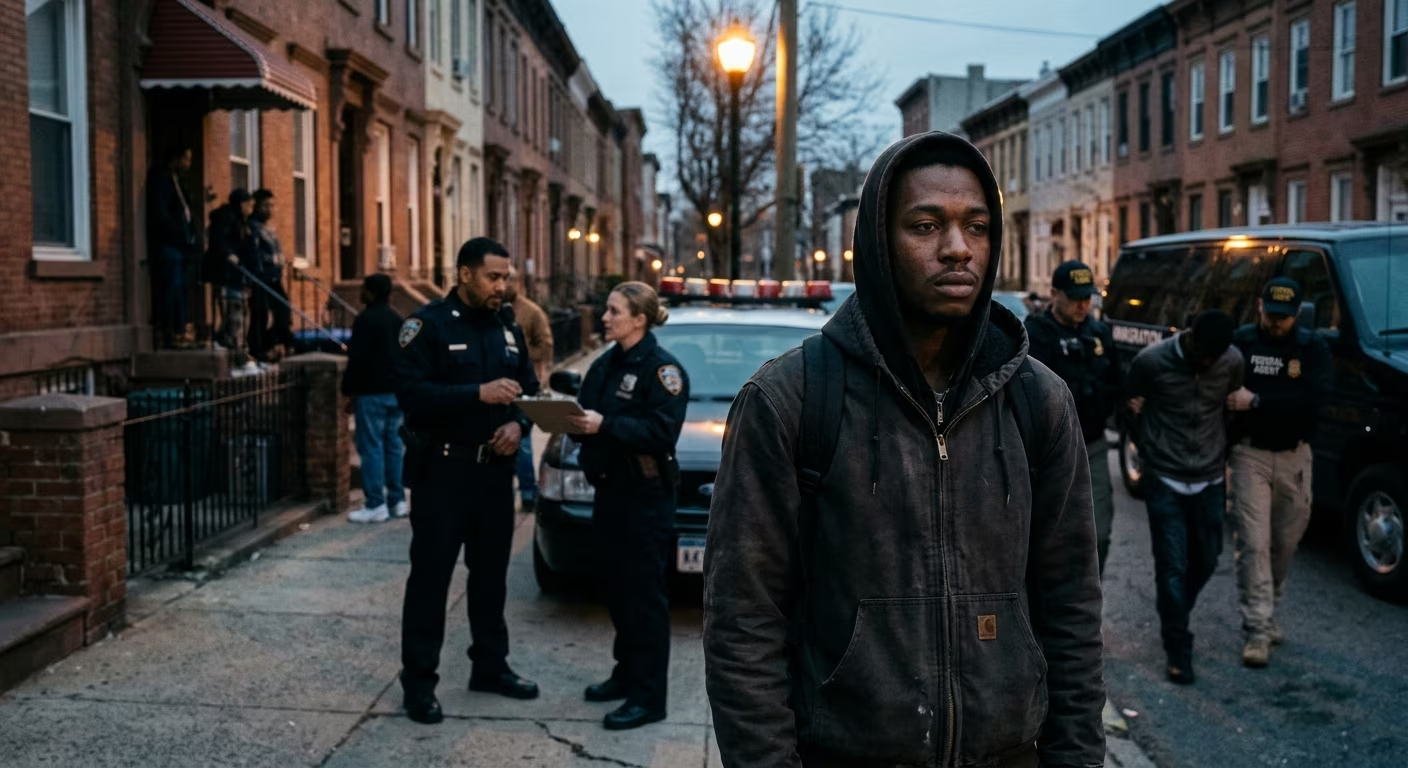
The immigrant experience for Black individuals is profoundly shaped by a dual jeopardy: the widespread anti-Black biases deeply embedded in local law enforcement, coupled with the aggressive, punitive machinery of federal immigration agencies. Rather than functioning as separate, distinct entities, local police departments and federal immigration enforcement often operate in tandem, forming a seamless dragnet. This symbiotic relationship essentially guarantees that racial profiling on the streets quickly translates into catastrophic immigration consequences, effectively punishing Black migrants twice for the same systemic prejudices. Understanding this crisis requires a deep examination of how local municipal actions fuel a national deportation machine.
The Root of the Crisis: Local Policing as an Immigration Dragnet
The journey into the federal deportation pipeline rarely begins with a targeted raid by federal immigration agents kicking down a door. Instead, for many Black immigrants, the catastrophic catalyst is a routine, everyday encounter with local law enforcement. It is a well-documented statistical reality that Black individuals in the United States face disproportionately high rates of traffic stops, pedestrian searches, and low-level arrests compared to their white counterparts. Because Black immigrants share the same physical spaces, neighborhoods, and racialized characteristics that draw unwarranted police scrutiny, they are inherently over-policed from the moment they integrate into American society.
A broken taillight, an alleged loitering violation, a minor noise complaint, or a racially motivated stop-and-frisk can instantly become a life-altering event. The psychological toll of living under this constant, hyper-visible surveillance cannot be overstated. Black immigrants must navigate their daily lives with the acute awareness that a simple misunderstanding or a biased police officer could result not just in a night in county jail, but in permanent exile from their families, jobs, and communities in the United States.
When local police make an arrest, even for a minor infraction or a charge that is ultimately dismissed, the individual’s biographical data and biometric information—such as fingerprints and mugshots—are immediately logged into centralized databases like the National Crime Information Center (NCIC). These local and state databases do not exist in a vacuum; they are intricately linked with federal repositories maintained by the Department of Homeland Security (DHS). Consequently, a discriminatory arrest at the municipal level triggers an automatic, unprompted alert to federal immigration authorities. The initial contact with local police acts as the opening valve to the deportation pipeline, demonstrating in stark terms that the criminalization of Blackness directly and unavoidably feeds the criminalization of immigration.
Institutional Synergy: How 287(g) and Detainers Fuel the Pipeline
The coordination between local police precincts and federal immigration agencies is not merely incidental or accidental; it is deliberately structured and enforced through formal government policies and administrative agreements. One of the most prominent and controversial mechanisms facilitating this synergy is Section 287(g) of the Immigration and Nationality Act. Under these specific agreements, state and local law enforcement officers are essentially deputized by the federal government, receiving delegated authority to investigate, detain, and enforce federal immigration law within their own local jurisdictions.
This operational blending transforms local county jails into proxy immigration holding centers and fundamentally alters the role of local police. Furthermore, Immigration and Customs Enforcement (ICE) heavily relies on the widespread use of “detainers.” When a local jail processes a migrant, ICE can issue a detainer request, formally asking the local facility to hold the individual for an additional 48 hours beyond their legally mandated release time, thereby giving federal agents sufficient time to arrive and assume custody.
- Blurred Jurisdictional Lines: By blending local community crime control with federal border enforcement, these policies actively encourage racial profiling. Officers may consciously use minor traffic infractions as a convenient pretext to investigate a person’s immigration status.
- Bypassing Due Process: Individuals who might otherwise post bail, win their case, or have their charges entirely dropped find themselves indefinitely detained under the broad auspices of civil immigration enforcement, effectively bypassing standard constitutional protections afforded in the criminal courts.
- Resource Drain: Local municipalities often bear the financial burden of housing these individuals for extended periods, diverting crucial taxpayer resources away from community programs and genuine public safety initiatives.
By the Numbers: The Statistical Reality of Black Migrant Deportations
The devastating, compounded impact of this overlapping carceral system is most clearly illustrated through empirical data and demographic statistics. While Black immigrants represent a relatively small fraction of the overall undocumented population in the United States, they are vastly and alarmingly overrepresented in immigration enforcement actions, particularly those based on alleged or convicted criminal activity. Research and advocacy organizations have consistently highlighted these stark racial disparities to expose the underlying biases in the system.
| Demographic Metric | Statistical Percentage | Contextual Impact and Significance |
|---|---|---|
| Undocumented Population Share | Approximately 5.4% | Black immigrants make up a very small, single-digit percentage of the total undocumented immigrant population living in the U.S. |
| Criminal Deportation Share | Approximately 20.3% | Despite their small population size, they account for over a fifth of all immigrants facing deportation proceedings on criminal grounds. |
| Police Contact as a Catalyst | 76% | More than three-quarters of Black immigrants who are eventually deported were initially flagged for removal due to contact with local police. |
These figures underscore a chilling, undeniable reality: the primary driver of deportation for Black migrants is not unauthorized border crossings or federal sweeps, but rather their unavoidable exposure to a racially biased domestic policing system. When over-policing is accepted as the standard in marginalized communities, criminal-based deportations become the inevitable, discriminatory outcome for foreign-born Black residents.
The Hidden Harms: Detention Conditions and Solitary Confinement
Once funneled out of local jails and into the sprawling federal detention system, Black immigrants face entirely new layers of systemic abuse and neglect. Immigration detention centers, many of which are operated by private, for-profit prison corporations under federal contracts, are notorious for their lack of transparency, substandard medical care, and overly punitive environments. For Black migrants, these harsh conditions are frequently compounded by pervasive anti-Black racism from facility staff and a broader culture of systemic institutional neglect.
Beyond the physical architecture of confinement, these facilities are plagued by severe medical neglect, a lack of adequate language access (particularly for those speaking indigenous African or Caribbean languages), and significant geographical barriers to obtaining legal counsel. Without adequate legal representation—which is not constitutionally guaranteed in civil immigration court—navigating the complex, adversarial deportation process becomes a nearly impossible endeavor.
One of the most alarming manifestations of this ongoing discrimination is the highly disproportionate use of solitary confinement. Ostensibly used for disciplinary infractions or protective administrative reasons, solitary confinement is widely recognized by international human rights organizations as a form of psychological torture when utilized for prolonged periods. Studies have revealed that migrants from predominantly Black countries are placed in solitary confinement at staggeringly high rates. In some documented instances, while making up less than 4% of the total ICE detention population, they account for nearly a quarter of all individuals subjected to isolation. This severe disciplinary bias mirrors the racial disparities seen in the broader American carceral system, proving that the penal practices uniquely applied to Black Americans are seamlessly transferred to Black non-citizens held in federal civil custody.
The Public Safety Paradox: Eroding Community Trust
The intentional entanglement of local municipal policing with federal immigration enforcement creates a profound, dangerous paradox: policies that are politically touted as enhancing public safety actually serve to fundamentally undermine it. When local police departments are perceived by the public as extensions of ICE, a deep, pervasive chill falls over immigrant communities. Trust, which is the foundational element of any effective community policing strategy, is completely eroded and replaced by fear.
Both documented and undocumented Black immigrants become highly reluctant to interact with law enforcement in any capacity. Victims of domestic violence, key witnesses to violent neighborhood crimes, or individuals experiencing acute medical emergencies are deeply deterred from dialing 911, fearing that a desperate call for help could inadvertently result in a family member’s detention and deportation. This systemic fear creates invisible shadows within cities where exploitation, abuse, and crime can flourish uninhibited by legal intervention.
Instead of making cities safer, conscripting local police into the federal deportation apparatus marginalizes already vulnerable populations and alienates the very communities that law enforcement is sworn to protect and serve. True public safety requires cooperation, communication, and mutual respect—all of which are destroyed when police wear the invisible badge of a deportation agent.
Charting a Path Forward: Decoupling Police from Immigration
Dismantling this unjust, dual-tiered pipeline requires a comprehensive, intentional decoupling of local law enforcement from federal immigration agencies. Advocates, legal scholars, and policy experts emphasize that true public safety and equitable justice cannot be achieved through racialized surveillance and the constant threat of deportation.
Meaningful, lasting reform must begin aggressively at the local and state levels. Municipalities and state legislatures must pass robust “sanctuary” policies that strictly prohibit the use of local tax dollars, municipal resources, and police personnel for the enforcement of federal immigration laws. Terminating existing 287(g) agreements and legally restricting police compliance with warrantless ICE detainers are crucial, non-negotiable first steps in restoring fractured community trust.
Furthermore, local investments must be entirely redirected toward community-based alternatives to detention that respect human dignity and ensure individuals appear in court without relying on punitive carceral methods. Legal defense funds must also be prioritized and expanded, equipping public defenders with specialized training in “crimmigration”—the incredibly complex intersection of criminal and immigration law—so they can effectively advise non-citizen clients of the devastating, permanent deportation risks associated with even the most minor plea deals.
On a federal level, comprehensive immigration reform must address the specific ways in which the criminal legal system unfairly and disproportionately penalizes Black migrants. This includes ending mandatory detention mandates for individuals with certain past convictions and allowing immigration judges to consider the broader, holistic context of an individual’s life, their rehabilitation, and the systemic racial biases that likely led to their initial local arrest.
Conclusion
The ongoing struggle for immigrant rights cannot be untangled from the broader fight for racial justice in the United States. For Black migrants living across the country, the looming threat of deportation is inextricably linked to the everyday dangers of over-policing, racial profiling, and systemic anti-Black racism. Recognizing that local police departments and federal immigration enforcement function together as a unified carceral machine is absolutely essential for understanding the unique, compounded perils faced by this specific demographic. As communities and activists continue to demand structural accountability and equity within the criminal justice system, those demands must explicitly include ironclad protections for Black immigrants, ensuring they are no longer subjected to the crushing weight of this dual jeopardy.
Frequently Asked Questions (FAQs)
What is the direct connection between local police and federal immigration agencies like ICE?
Local police departments often share arrest data and biometric information, such as fingerprints and photographs, with centralized federal databases. When an immigrant is arrested by local police—even for a minor offense—this information is automatically transmitted to the Department of Homeland Security. This system alerts ICE to the individual’s exact location in a local jail, facilitating a seamless transition into the federal deportation process without ICE having to conduct independent investigations.
Why are Black immigrants disproportionately affected by criminal deportations compared to other groups?
Because Black individuals in the United States inherently face much higher rates of racial profiling, unwarranted traffic stops, and low-level arrests by local law enforcement, Black immigrants are funneled into the criminal justice system at significantly higher rates than non-Black immigrants. This systemic over-policing in their daily lives translates directly into disproportionately higher rates of criminal-based deportation proceedings, as police contact is the primary trigger for ICE intervention.
What exactly is Section 287(g) of the Immigration and Nationality Act?
Section 287(g) is a specific legal provision of the Immigration and Nationality Act that allows the federal government to enter into formal memorandums of agreement with state and local law enforcement agencies. These agreements delegate specific federal immigration enforcement powers to local officers, essentially deputizing them to act as ICE agents within their communities, which blurs the line between community policing and border enforcement.
How do ICE detainers work in practice?
An ICE detainer is a formal written request issued by federal immigration authorities to a local jail, prison, or law enforcement agency. It asks the local holding agency to maintain custody of an individual for an additional 48 hours beyond their legally scheduled release time (such as after posting bail or completing a sentence). This extra window provides ICE agents with sufficient time to arrive at the local facility and assume custody of the individual for deportation purposes.
References
- Black-Alliance-for-Just-Immigration (BAJI) Statistical Data — Office of the High Commissioner for Human Rights (OHCHR). 2021-04-15. https://www.ohchr.org/sites/default/files/Documents/Issues/Racism/WGEAPD/Session27/Black-Alliance-for-Just-Immigration.pdf
- Key findings about Black immigrants in the US — Pew Research Center. 2026-03-20. https://www.pewresearch.org/short-reads/2022/01/27/key-findings-about-black-immigrants-in-the-u-s/
- Centering Black Voices in the Struggle for Immigrant Rights — Vera Institute of Justice. 2020-09-09. https://www.vera.org/news/centering-black-voices-in-the-struggle-for-immigrant-rights