
The Rise of the Robotic K-9: Should We Fear the New Police?
As law enforcement rapidly adopts quadruped robots, society faces unprecedented privacy, ethical, and regulatory dilemmas.
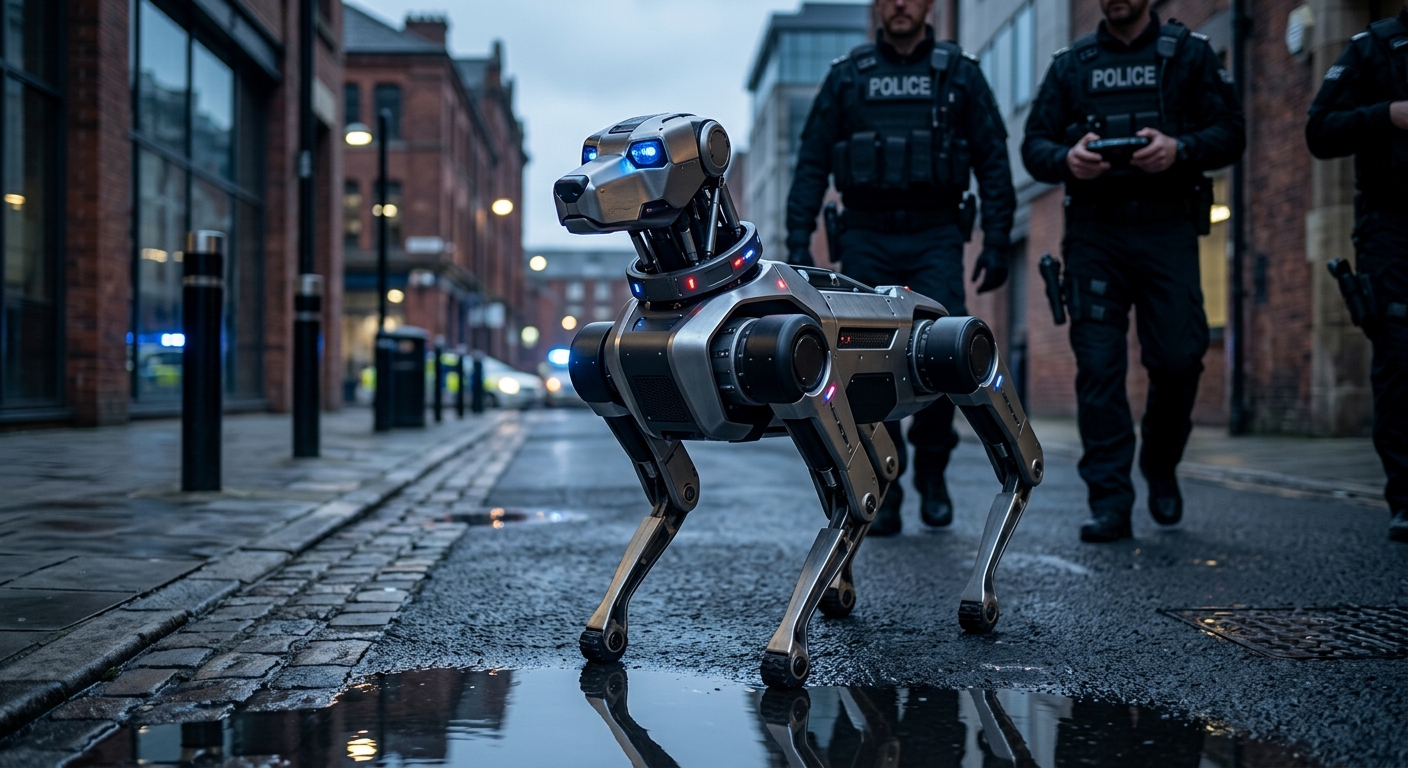
The Dawn of the Mechanical Patrol
For decades, the concept of a robotic police force was safely confined to the realm of dystopian science fiction blockbusters and cautionary cyberpunk novels. Today, however, that speculative fiction has aggressively merged with daily reality. Across major metropolitan areas and suburban townships alike, law enforcement agencies are increasingly turning to a new, highly advanced tool: the quadruped robot. Colloquially known as “robot dogs,” these agile, four-legged machines are no longer prototypes locked away in university laboratories. They are actively patrolling public spaces, assisting in high-stakes tactical operations, and fundamentally altering the relationship between heavily armed state agencies and the general public.
The visual impact of these machines cannot be overstated. Devoid of a head, equipped with an array of unblinking sensors, and moving with an eerie, biological fluidity, the robotic dog represents a massive leap in mobile technology. But beyond the initial shock value lies a profound web of ethical, legal, and privacy-related questions. As these devices transition from experimental novelty to standard-issue law enforcement equipment, communities and legal scholars are asking a vital question: Are we inadvertently building an inescapable surveillance infrastructure, one mechanical footstep at a time?
The Tactical Advantage: Why Police Want Them
To understand the rapid proliferation of robotic dogs, one must examine the legitimate tactical advantages they offer to first responders. Traditional police robots—typically heavy, boxy units moving on tank-like treads—have been utilized by bomb squads for decades. However, those older models are severely limited by terrain. They struggle with stairs, cannot easily step over debris, and possess limited agility in tight, unpredictable environments.
Quadruped robots, pioneered by engineering firms like Boston Dynamics with their flagship “Spot” model, overcome these limitations entirely. Utilizing advanced gyroscopes, dynamic balancing algorithms, and LiDAR (Light Detection and Ranging) systems, these robots can climb steep staircases, navigate over rubble, open doors with specialized arm attachments, and instantly right themselves if knocked over. A 2024 technology brief published by the National Institute of Justice (NIJ) highlighted that these highly maneuverable robots are exceptionally valuable in specific extreme scenarios, such as hazardous material spills, catastrophic structural collapses, and high-risk barricaded suspect situations.
According to data from late 2025, over 60 bomb squads and Special Weapons and Tactics (SWAT) teams across the United States and Canada have actively deployed these machines. The underlying logic from law enforcement is straightforward and compelling: in a scenario where a suspect is armed and erratic, or where a room is filled with explosive or chemical threats, it is infinitely preferable to send in a replaceable piece of hardware rather than risk the life of a human officer or a biological police canine.
The Watchful Mechanical Eye: Surveillance and Privacy Fears
While the utility of a robot dog in a bomb disposal scenario is widely accepted, the primary source of public anxiety stems from “mission creep.” Mission creep occurs when a technology procured for rare, life-threatening emergencies is gradually repurposed for routine, daily policing. When a robotic dog is utilized not just for clearing a hostage situation, but for patrolling a public park, scanning a housing project, or monitoring a peaceful protest, the civil liberties implications become staggering.
These robots are essentially roaming, dynamic data-collection hubs. A standard high-end quadruped robot can be outfitted with 360-degree high-definition cameras, infrared and thermal imaging, highly sensitive directional microphones, and continuous network connectivity. When these sensory inputs are coupled with artificial intelligence and facial recognition software, the robotic dog transforms from a mechanical scout into an autonomous surveillance node.
A comprehensive June 2024 policy report from the University of Michigan’s Science, Technology, and Public Policy program emphasized that deploying such advanced mobile surveillance exacerbates existing systemic biases. The continuous, unblinking surveillance of marginalized communities—which are historically over-policed—creates a chilling panopticon effect. Residents in these neighborhoods are subjected to a level of scrutiny that inherently assumes criminality, stripping away the fundamental right to anonymity in public spaces. The fear is not just that the robot is recording video, but that it is feeding that video into opaque, algorithmic databases that track civilian movements without a warrant or probable cause.
Comparing the Force: Traditional vs. Robotic K-9s
To fully grasp the paradigm shift, it is helpful to compare traditional biological police canines with their new mechanical counterparts. The differences highlight both the operational benefits and the profound privacy risks.
| Feature / Capability | Traditional Police Canine (Biological) | Quadruped Robot (Mechanical) |
|---|---|---|
| Primary Sensing | Advanced olfactory senses (smell), hearing. | Thermal, 360-degree HD cameras, LiDAR, acoustic sensors. |
| Data Retention | None. Relies entirely on the human handler’s interpretation and memory. | Unlimited digital recording, cloud syncing, AI facial recognition compatibility. |
| Physical Risk | Risk of injury or death to a living animal during tactical deployment. | Zero biological risk; damaged units are simply repaired or replaced. |
| Public Perception | Generally familiar, though associated with historically aggressive policing tactics. | Often viewed as intimidating, dystopian, and alienating. |
| Operational Endurance | Requires rest, food, and emotional care. Susceptible to extreme heat/cold. | Operates continuously until battery depletion; swappable batteries allow 24/7 use. |
The Weaponization Debate: Could These Machines Become Lethal?
Perhaps the most visceral fear held by the public is the potential for these robotic dogs to be weaponized. The image of an autonomous, four-legged machine equipped with a firearm is a terrifying prospect that strikes at the core of human safety. For their part, major manufacturers have attempted to quell these fears. In October 2022, Boston Dynamics, alongside five other leading robotics firms, signed a prominent open letter pledging that they would never weaponize their advanced-mobility general-purpose robots. Their terms of service explicitly prohibit customers from retrofitting the robots with weapons to harm or intimidate people or animals.
However, corporate pledges and terms of service are not legally binding treaties, nor do they control the entire global market. Other, less scrupulous manufacturers are not bound by these ethical constraints. Furthermore, there is a distinct legal gray area regarding “less-lethal” weaponry. Law enforcement agencies could theoretically equip these robots with tear gas dispensers, sound cannons (LRADs), or rubber bullet launchers. If a third-party vendor modifies a commercially purchased robot, the original manufacturer’s pledge does little to protect the public from a remote-controlled use of force.
The transition from a robot serving as a passive “eye” to an active “arm” of the state fundamentally crosses a moral Rubicon. The delegation of violent force to a remote-controlled machine removes the human elements of immediate empathy, situational de-escalation, and face-to-face accountability from high-stress policing encounters.
The Regulatory Vacuum: A Call for Oversight
As is often the case with rapid technological innovation, the deployment of robotic dogs has vastly outpaced the legal frameworks designed to regulate them. In most jurisdictions across the United States, there are no specific laws governing the use of quadruped robots by police. This regulatory vacuum allows police departments to quietly purchase these devices—often using federal grant money or asset forfeiture funds—without public consultation or city council approval.
In response, a growing coalition of civil rights advocates and privacy organizations are demanding strict oversight. One of the primary vehicles for this pushback is the implementation of Community Control Over Police Surveillance (CCOPS) laws. These laws require police departments to publicly disclose their intent to acquire new surveillance technologies and seek approval from local elected officials before purchasing them.
In jurisdictions like New York City, the Public Oversight of Surveillance Technology (POST) Act was passed to force transparency, requiring the NYPD to publish impact and use policies for tools like robotic dogs. Similarly, state legislatures, such as in Rhode Island, have drafted proactive bills explicitly aiming to ban the arming of any police robots. Yet, these measures are patchwork at best. A unified, federal regulatory framework is required to establish firm boundaries on what these machines can record, how long that data can be stored, and under what specific, extreme circumstances the robots can be deployed in civilian areas.
Balancing Innovation with Civil Liberties
The introduction of the robotic police dog is a defining moment in the evolution of law enforcement technology. The physical protection these machines offer to officers and citizens in highly volatile situations—such as dismantling an improvised explosive device or assessing a toxic chemical leak—is undeniably valuable. However, that narrow utility cannot serve as a blank check for the widespread rollout of walking surveillance towers.
If society allows these machines to become normalized on city streets without rigid legal constraints, we risk sacrificing our fundamental privacy rights on the altar of technological convenience. The burden of proof must remain on the state to justify the presence of advanced surveillance robotics in public life, ensuring that the tools designed to protect the public do not ultimately become the instruments of its subjugation.
Frequently Asked Questions
Are police robot dogs currently carrying lethal weapons?
No. Major domestic manufacturers like Boston Dynamics strictly prohibit the weaponization of their robots in their terms of service, and have publicly pledged not to arm them. However, there are currently no federal laws explicitly preventing law enforcement from modifying them with non-lethal weapons in the future.
What kind of data do these quadruped robots collect?
They are capable of collecting vast amounts of data, including high-definition video, thermal imaging, acoustic data, and environmental mapping. If linked to police databases, this hardware can be paired with artificial intelligence to perform real-time facial recognition and track civilian movements.
Why do police use robot dogs instead of traditional tracked robots?
Quadruped robots offer superior mobility. Unlike older, tank-tread robots that get stuck on stairs, curbs, or debris, robotic dogs use dynamic balancing to climb stairs, walk over uneven terrain, and even open doors, making them highly effective in complex indoor environments.
Can citizens stop their local police from buying these robots?
Citizens can advocate for local transparency legislation, such as Community Control Over Police Surveillance (CCOPS) laws. These laws require police departments to hold public hearings and gain city council approval before using public funds to purchase advanced surveillance technologies.
References
- Robot Dogs for Surveillance and Policing: Overview and Policy Recommendations — University of Michigan Gerald R. Ford School of Public Policy. 2024-06-24. https://stpp.fordschool.umich.edu/
- Quadruped Robots for Law Enforcement Applications — National Institute of Justice. 2024-05-01. https://nij.ojp.gov/
- Boston Dynamic Robot Dogs Increasingly Used By Police Departments — Bloomberg News / Tech Policy Lab. 2025-11-19. https://www.bloomberg.com/
- General Purpose Robots Should Not Be Weaponized — Boston Dynamics. 2022-10-06. https://bostondynamics.com/
Similar Articles








Read full bio of Sneha Tete




