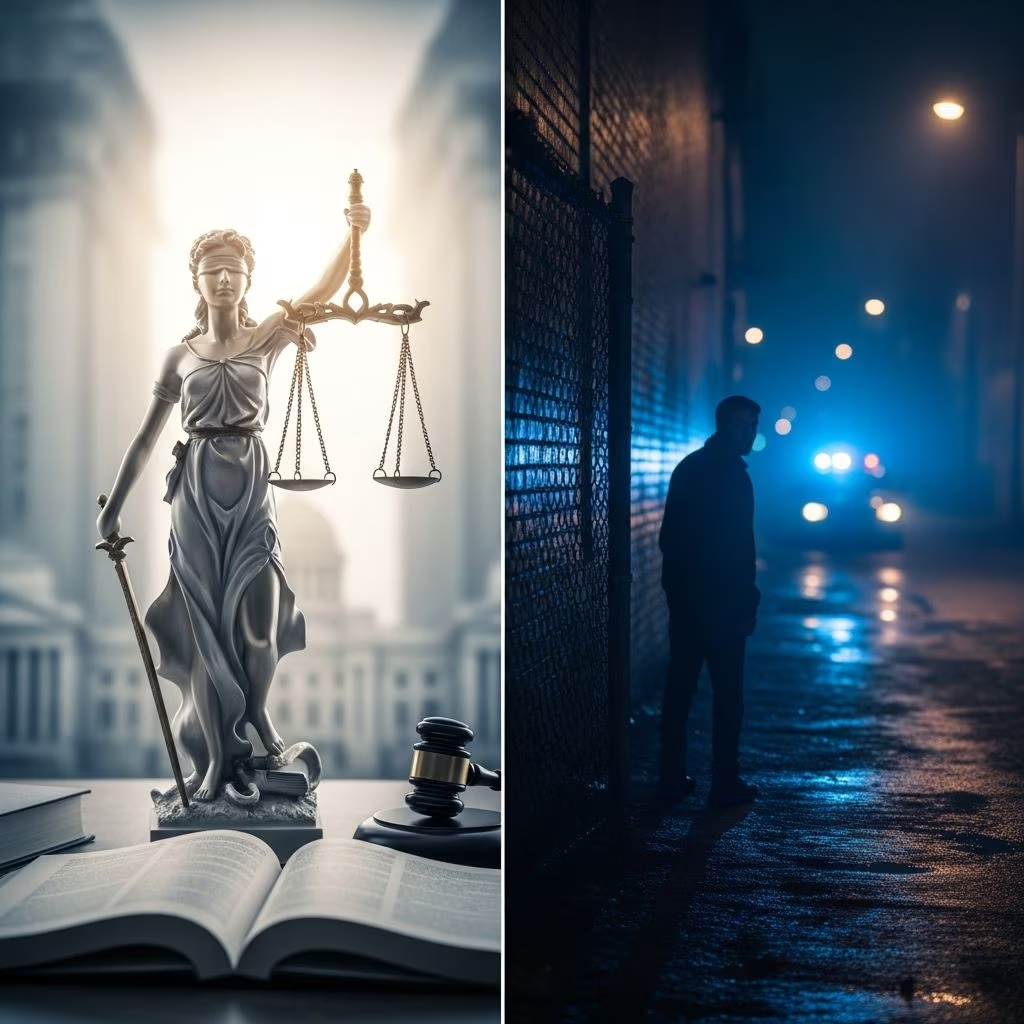
Many people assume that calling 911 guarantees police intervention and protection. However, a series of landmark Supreme Court and appellate decisions have established a counterintuitive legal principle: police do not have a constitutional duty to protect individual citizens from harm. This article explores the legal foundations of this doctrine, the court cases that established it, the limited exceptions, and what citizens need to know about personal responsibility.
The Public Duty Doctrine: Foundation of Police Legal Obligations
The cornerstone of police protection law is the public duty doctrine, a legal framework that distinguishes between duties owed to the public collectively and duties owed to specific individuals. Under this doctrine, government officials, including police officers, do not owe a specific duty of care to individual members of the public in the absence of a special relationship. Instead, their primary obligation is to protect the public as a whole and enforce the law.
This principle emerged as early as 1856 in South v. Maryland, when the Supreme Court first established that police officers have no duty to protect individuals from harm unless a special relationship exists. A special relationship might be created through actions such as placing someone in custody, making an arrest, or explicitly promising protection to a specific individual.
The policy rationale behind the public duty doctrine is pragmatic: courts recognize that government resources are limited and that police cannot be expected to prevent every conceivable harm in society. Holding officers individually liable for failure to protect every citizen would expose them to countless lawsuits and potentially paralyze law enforcement operations.
Landmark Cases That Shaped Modern Police Duty Law
DeShaney v. Winnebago County (1989)
One of the most significant cases establishing the limits of police protection obligations is DeShaney v. Winnebago County Department of Social Services. In this case, a young boy was repeatedly abused by his father—abuse that county social services knew about but failed to address. When the child was severely injured and left in a vegetative state, his mother sued.
The Supreme Court ruled that the state did not have a special obligation to protect the citizen against harms it did not create. This decision established that even when authorities are aware of ongoing danger to a specific person, they may not face legal liability for failing to intervene. The case built the foundation for understanding that constitutional protection does not include an affirmative duty for government to safeguard citizens from third-party harm.
Warren v. District of Columbia (1981)
Another critical precedent is Warren v. District of Columbia, decided by the D.C. Court of Appeals. Police had been called to a woman’s home multiple times to investigate reports of a break-in. Despite these repeated calls, officers took no significant protective action. The woman was subsequently assaulted by an intruder and sued for negligence.
The court held that police did not have a specific duty to protect her, even though she had directly requested their assistance. The ruling clarified that a general public duty to maintain order differs fundamentally from a specific duty to protect an identifiable individual. Unless there is a special relationship or explicit promise of protection, citizens cannot compel police action through legal liability.
Castle Rock v. Gonzales (2005)
Perhaps the most emotionally difficult case is The Town of Castle Rock v. Gonzales, decided by the U.S. Supreme Court in 2005. Jessica Gonzales had a protective order against her ex-husband that explicitly required police to arrest him if he violated it. He did violate the order, and when police failed to arrest him, he subsequently murdered their three children.
Gonzales sued the police for failing to enforce the restraining order. The Supreme Court ruled against her, holding that she had no constitutionally protected right to police enforcement of the order. Justice Antonin Scalia argued that “a well-established tradition of police discretion has long coexisted with apparently mandatory arrest statutes”. This ruling shock many observers because it showed that even explicit legal orders requiring police action do not create an enforceable individual right to protection.
Lozito v. New York City (2013)
A more recent case illustrates how these principles apply in modern contexts. Jay Lozito was attacked in a subway car while a police officer was present. According to reports, the officer did not intervene, allegedly because he feared the attacker had a weapon, and instead attempted to hide. Lozito sued the city for failure to protect him.
The Manhattan Supreme Court ruled against Lozito, citing the established precedent that police have no constitutional duty to protect individuals. The court held that “no direct promises of protection were made” to him, and therefore he could not sue for failure to intervene. This case demonstrated that even eyewitness police presence at an assault does not create legal liability for non-intervention.
Parkland School Shooting: Modern Application
The principle extends even to situations involving mass violence. Following the 2018 mass shooting at Marjorie Stoneman Douglas High School in Parkland, Florida, a federal judge ruled that government agencies had no constitutional duty to protect students who were not in custody. This application of the doctrine to school safety demonstrated that the limitations on police duty apply broadly, even in extreme circumstances.
Exceptions to the No-Duty Rule
While the general rule is clear, important exceptions exist. Police can be held liable under certain circumstances:
- Special Custody Relationships: When police place someone in custody or make an arrest, a special relationship is established. Police then have an affirmative duty to protect that person from harm.
- Explicit Promises of Protection: If police explicitly promise to protect a specific individual, they may create legal liability by subsequently failing to do so.
- Created Danger Doctrine: In some jurisdictions, police can be liable if they create a dangerous situation that did not previously exist.
- Deliberate Indifference: Some courts have held that police can be liable when acting with deliberate indifference to an individual’s safety.
- Civil Rights Violations: While police may not have a duty to protect from general harm, they can be held liable under Section 1983 for violating constitutional rights or for failure to intervene when other officers commit constitutional violations.
- State-Created Duties: Some states have enacted statutes creating specific police duties to protect in certain situations, such as domestic violence calls. Lawsuits against police for failure to protect may have greater success in state court under state-created duties rather than federal constitutional claims.
Constitutional Theories for Holding Police Accountable
Although police lack a general constitutional duty to protect, citizens may pursue legal claims under other theories. Section 1983 claims against police can be based on substantive due process violations, equal protection violations, or procedural due process violations.
For example, if police respond differently to similar situations based on race, gender, or other protected characteristics, they may face equal protection liability. Additionally, if police violate someone’s constitutional rights—such as rights against unreasonable search and seizure—they can be held accountable even if they had no duty to protect that person from third-party harm.
The Distinction Between Legal Duty and Actual Practice
It is important to distinguish between what the law requires and what police actually do. While police have no constitutional obligation to protect specific individuals, officers frequently engage in protective and lifesaving activities. The “protect and serve” motto reflects actual police practices and values, even if it is not a strict legal obligation.
Police may respond to requests for help, investigate crimes, and intervene in dangerous situations—not because they are legally required to protect you, but because enforcement of law and maintaining public order are their primary missions. Additionally, many police departments have internal policies and training requirements regarding how officers should respond to various situations, including domestic violence calls.
Recommendations for Police Agencies
To minimize liability and ensure consistent, professional responses to emergency situations, law enforcement experts recommend that police agencies:
- Develop and maintain written policies regarding the handling of emergency calls, including domestic violence situations.
- Provide comprehensive training to officers on proper response procedures, constitutional limitations, and civil rights considerations.
- Document all training and policy education provided to officers.
- Consult with legal advisors regarding jurisdiction-specific exceptions to the public duty doctrine.
- Understand both federal constitutional law and any state-specific statutes that may create additional duties.
What This Means for Personal Responsibility
The legal reality that police do not have a constitutional duty to protect individual citizens underscores the importance of personal responsibility for safety. While many people rely on police for protection, the law recognizes that individuals must also take steps to protect themselves. This includes:
- Being aware of your surroundings and potential threats.
- Taking appropriate security measures in your home and vehicle.
- Avoiding dangerous situations when possible.
- Considering self-defense training or tools where legal.
- Reporting threats or crimes to law enforcement.
- Seeking protective orders when facing domestic violence or harassment.
- Documenting threats and prior incidents for future legal proceedings.
Frequently Asked Questions
Q: Can I sue police for failing to respond to my 911 call?
A: In most cases, no. Unless police made an explicit promise to protect you, created a special relationship through custody or arrest, or violated your constitutional rights, you cannot sue for failure to respond. Some state laws may create exceptions in specific situations like domestic violence calls.
Q: What is a “special relationship” in police duty law?
A: A special relationship exists when police place someone in custody, make an arrest, or explicitly promise to protect a specific individual. In these circumstances, police have an affirmative duty to ensure that person’s safety.
Q: Does the “protect and serve” motto create a legal obligation?
A: No. While “protect and serve” reflects the values and actual practices of many police departments, it is not a legal obligation. Police have discretion in how they allocate resources and respond to calls for service.
Q: Are there any state laws that create police duties to protect?
A: Yes. Some states have enacted statutes creating specific police duties in particular contexts, such as mandatory or presumptive arrest policies in domestic violence cases. These state-created duties may be enforceable through state law claims even if federal constitutional protection does not apply.
Q: Can police be held liable for civil rights violations?
A: Yes. Although police may not have a duty to protect from general harm, they can be held liable under Section 1983 for violating constitutional rights, discriminatory enforcement, or deliberate indifference to safety in specific circumstances.
References
- Domestic Violence: When Do Police Have a Constitutional Duty To Protect — U.S. Department of Justice, Office of Justice Programs. January 1991. https://ojp.gov/ncjrs/virtual-library/abstracts/domestic-violence-when-do-police-have-constitutional-duty-protect
- Court Rules: Police Don’t Have To Protect? — CountyOffice.org. December 4, 2024. https://www.youtube.com/watch?v=_KN6iZAV5qo
- Police Have No Duty to Protect the Public — The American Prospect. April 18, 2022. https://prospect.org/2022/04/18/police-have-no-duty-to-protect-the-public/
- The Public Duty Doctrine and Its Implications for Police Officers — Savage Training Group. https://savagetraininggroup.com/public-duty-doctrine-implications-police-officers/
- Legal Duties and Liabilities Database — National Conference of State Legislatures. https://www.ncsl.org/civil-and-criminal-justice/legal-duties-and-liabilities-database