In the modern era of law enforcement, few technological innovations have garnered as much universal support as police body-worn cameras (BWCs). In the wake of highly publicized and tragic incidents of police violence, a rare consensus emerged among civil rights advocates, policymakers, and police departments alike: placing a digital lens on the uniform would fundamentally transform the nature of policing. The underlying premise was straightforward. An objective, unblinking electronic witness would deter excessive use of force, protect officers from unfounded civilian complaints, and restore fractured trust between communities and the state. However, as these devices transitioned from pilot programs to ubiquitous law enforcement tools, a complex and troubling paradox began to emerge, particularly during periods of large-scale civil unrest and public protest.
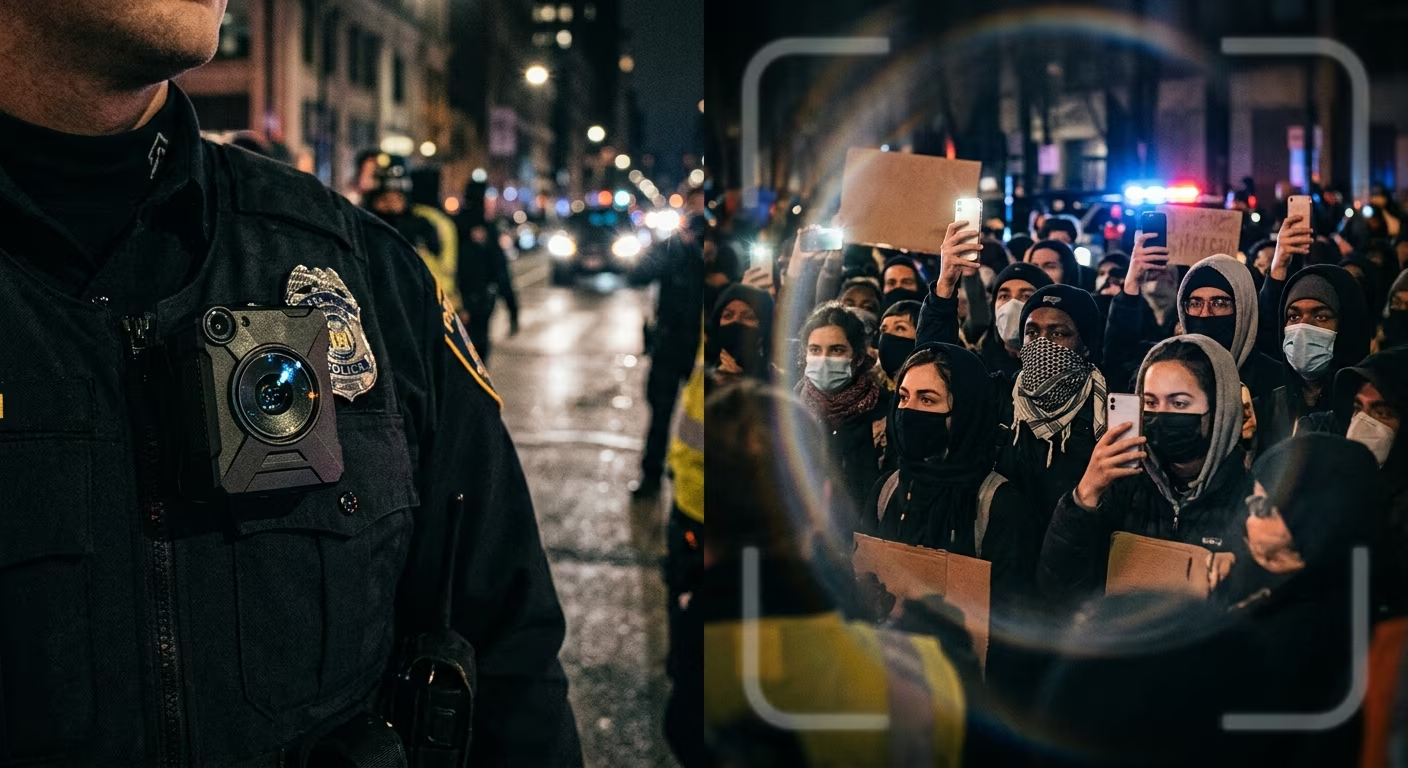
When deployed at a traffic stop, a body-worn camera primarily captures the interaction between an individual officer and a citizen, functioning roughly as intended. But when thousands of citizens take to the streets to exercise their constitutionally protected rights to assembly and free speech, the dynamic shifts entirely. In these volatile environments, a tool originally designed to monitor the police is inherently flipped outward, capturing high-definition audio and video of the public. This transformation from a mechanism of state accountability into a decentralized network of mass surveillance presents profound legal, ethical, and privacy challenges that society is only just beginning to untangle.
The Initial Promise vs. The Reality of Implementation
The rapid proliferation of body-worn cameras was nothing short of unprecedented in the history of law enforcement procurement. Driven by intense public pressure and facilitated by massive infusions of federal and state grant funding, police departments raced to equip their frontline personnel. By 2016, data from the Bureau of Justice Statistics revealed that approximately 80 percent of large police departments in the United States had adopted body-worn camera programs . The initial optimism was buoyed by early localized studies suggesting that the mere presence of a camera dramatically altered human behavior, a psychological phenomenon known as the “observer effect.”
Yet, comprehensive evaluations conducted over the subsequent decade painted a much more nuanced picture. Research supported by the National Institute of Justice has indicated that while BWCs can have a civilizing effect in specific contexts, their overarching impact on reducing police use of force is highly dependent on the strictness of departmental policies and the culture of the agency deploying them . The hardware alone is entirely agnostic; it possesses no inherent moral compass. Without rigorous enforcement protocols, the camera is merely a recording device that is entirely subject to the discretion of the individual wearing it. This realization became starkly evident when protests against systemic injustice erupted globally, pushing the boundaries of BWC policies to their absolute limits.
The Compliance Deficit: Discretion and the ‘Mute’ Button
One of the most persistent vulnerabilities in the deployment of police wearables is the reliance on human compliance. Unlike dashboard cameras, which can be automatically triggered by the activation of emergency lights or sirens, body-worn cameras generally require the officer to manually press a button to begin recording. This manual activation introduces a critical point of failure. During chaotic, rapidly evolving situations—such as the dispersal of a crowd or a physical altercation during a protest—officers may forget to activate their devices in the heat of the moment. More concerningly, investigations into police conduct during mass assemblies have repeatedly documented instances of officers intentionally covering their lenses, muting their microphones, or entirely disabling their cameras prior to engaging with demonstrators.
When the very tool meant to provide transparency is selectively deactivated, it breeds a deeper level of public cynicism. The failure to record not only deprives investigators of crucial evidence but also creates an information vacuum that is quickly filled by competing narratives. To address this compliance deficit, technological solutions are being developed, such as holsters that automatically activate the camera when a weapon is drawn. However, in the context of a protest, where weapons may not be drawn but physical force is still utilized, these triggers are insufficient. Accountability requires non-discretionary recording policies during crowd control operations, coupled with severe, uniformly applied disciplinary matrices for officers who violate these protocols.
Facial Recognition and the Chilling Effect on Assembly
The privacy implications of body-worn cameras multiply exponentially when the footage they capture is integrated with advanced algorithmic technologies. The most prominent and controversial of these integrations is Facial Recognition Technology (FRT). When law enforcement agencies run hours of high-definition crowd footage through biometric databases, they cross the Rubicon from targeted investigation to indiscriminate mass surveillance. This capability allows the state to retroactively identify, catalog, and track peaceful protesters who simply attended a rally, effectively destroying the anonymity that has historically protected political dissidents .
This intersection of wearables and artificial intelligence generates what legal scholars term a “chilling effect” on First Amendment rights. If citizens believe that their mere presence at a peaceful demonstration will result in their biometric data being permanently logged in a government database—potentially impacting their employment, travel, or personal security—they are far less likely to participate in the democratic process. The fear of algorithmic retribution fundamentally alters the cost-benefit analysis of civic engagement. Consequently, civil liberties organizations and technology ethicists have vehemently argued that body-worn camera footage must be strictly firewalled from facial recognition software and other predictive policing algorithms to preserve the sanctity of public assembly.
The Asymmetry of Information: Who Controls the Narrative?
Another profound challenge surrounding body-worn cameras is the asymmetry of data ownership and release. In most jurisdictions, the police department that records the footage also serves as its sole custodian. This creates an inherent conflict of interest when the footage documents alleged misconduct by the department’s own personnel. During periods of civil unrest, the strategic release of video evidence can profoundly shape public perception and media narratives.
Departments have frequently been accused of cherry-picking footage—expediting the release of videos that justify officer actions or highlight the aggressive behavior of specific protesters, while simultaneously stonewalling public records requests for footage that depicts police overreach . This selective transparency transforms the body camera from a tool of objective record-keeping into an instrument of public relations. To counteract this asymmetry, reformers advocate for the transfer of footage custody to independent civilian oversight boards or neutral third-party agencies. By removing the chain of custody from the police department itself, communities can ensure a more equitable and timely release of information, regardless of whom the footage implicates.
Forging a Path Forward: Accountability-First Policy Frameworks
If body-worn cameras are to fulfill their original promise without becoming engines of authoritarian surveillance, technology must be strictly subordinated to robust policy. Equipment outpaces legislation, leaving massive gray areas that are frequently exploited. Comprehensive reform requires establishing baseline standards that prioritize civilian privacy and officer accountability equally.
| Policy Component | Flawed Implementation Model | Accountability-First Model |
|---|---|---|
| Activation Rules | Officers use broad discretion to decide when to activate or mute cameras during public interactions. | Mandatory, continuous recording during all operational deployments and crowd control, with strict penalties for unauthorized deactivation. |
| Biometric Integration | Footage is routinely scanned using Facial Recognition Technology (FRT) to identify protest attendees. | Absolute statutory prohibitions on integrating BWC footage with biometric mass surveillance tools. |
| Public Access | Police leadership retains sole authority over when and if footage of critical incidents is released to the public. | Mandatory release of footage within a specified timeframe (e.g., 48 hours) following a critical incident, managed by civilian oversight. |
| Data Retention | Indefinite storage of non-evidentiary footage, creating a permanent database of citizen movements. | Strict deletion schedules for footage that does not contain use of force, arrests, or citizen complaints (typically 60 to 90 days). |
As illustrated in the framework above, an accountability-first model recognizes that the inherent value of the camera is derived entirely from the rules governing its use. Policies must be drafted with direct input from the communities most impacted by police action, rather than being developed in closed-door sessions by police unions and municipal risk managers.
Frequently Asked Questions (FAQs)
What was the original purpose of police body-worn cameras?
Body-worn cameras were primarily introduced to provide an objective, real-time audiovisual record of interactions between law enforcement officers and the public. The goals were to increase transparency, deter excessive use of force, provide evidence for criminal investigations, and quickly resolve citizen complaints against officers. They were heavily promoted as a tool to bridge the trust gap between police and minority communities.
Can police officers freely edit or delete their body camera footage?
In almost all modern systems, individual frontline officers do not have the technical capability to permanently delete or alter the footage stored on the camera’s hardware. Once recorded, the data is typically encrypted and uploaded to a secure cloud server or local database. However, the issue often lies in officers failing to turn the camera on in the first place, or system administrators at the departmental level restricting public access to the raw files.
How does facial recognition technology alter the nature of body cameras?
When facial recognition technology is applied to body camera footage, it changes the device from a passive recording tool into an active surveillance mechanism. Instead of merely documenting a specific police-civilian encounter, the camera acts as a mobile scanner, identifying every face in a crowd against massive government databases. This raises severe constitutional concerns, particularly regarding the right to anonymous public assembly and protection against unreasonable searches.
What rights do citizens have regarding police body camera recordings at protests?
Citizens generally do not have a legal expectation of privacy when in a traditional public forum, such as a street or park during a protest, meaning police can legally record them. However, civil rights advocates argue that prolonged, targeted recording of peaceful protesters without reasonable suspicion of a crime violates First Amendment principles. Citizens have the right to request public records of these recordings, though departments often use exemptions to redact or withhold the footage.
Conclusion
The evolution of police body-worn cameras from heralded instruments of accountability to potential tools of state surveillance underscores a vital lesson in the modern digital age: hardware is never a substitute for structural reform. As long as the policies governing these devices are shaped by the entities they are meant to oversee, the technology will inevitably bend toward self-preservation and enhanced control. The intersection of mass public protests and advanced mobile surveillance represents a critical juncture for civil liberties. To ensure that the digital eye serves the public interest rather than chilling democratic expression, society must demand rigorous, enforceable legal frameworks that permanently sever the link between police transparency and algorithmic mass surveillance. True accountability requires not just turning the camera on, but democratizing the power over the narrative it captures.
References
- Body-Worn Cameras in Law Enforcement Agencies, 2016 — Bureau of Justice Statistics. 2018-11-01. https://bjs.ojp.gov/library/publications/body-worn-cameras-law-enforcement-agencies-2016
- Research on Body-Worn Cameras and Law Enforcement — National Institute of Justice. 2022-01-07. https://nij.ojp.gov/topics/articles/research-body-worn-cameras-and-law-enforcement
- The Use of Facial Recognition Technologies in the Context of Peaceful Protest: The Risk of Mass Surveillance Practices and the Implications for the Protection of Human Rights — Cambridge University Press. 2025-05-15. https://www.cambridge.org/core/journals/international-journal-of-law-and-information-technology/article/use-of-facial-recognition-technologies-in-the-context-of-peaceful-protest/
- Body-Worn Cameras a Decade Later: What We Know — Police Executive Research Forum (PERF). 2023-12-01. https://www.policeforum.org/assets/BWCDecadeLater.pdf