
Vehicle Trunk Searches: Constitutional Rights & Police Authority
Understand when law enforcement can legally search your car's trunk and your Fourth Amendment protections.
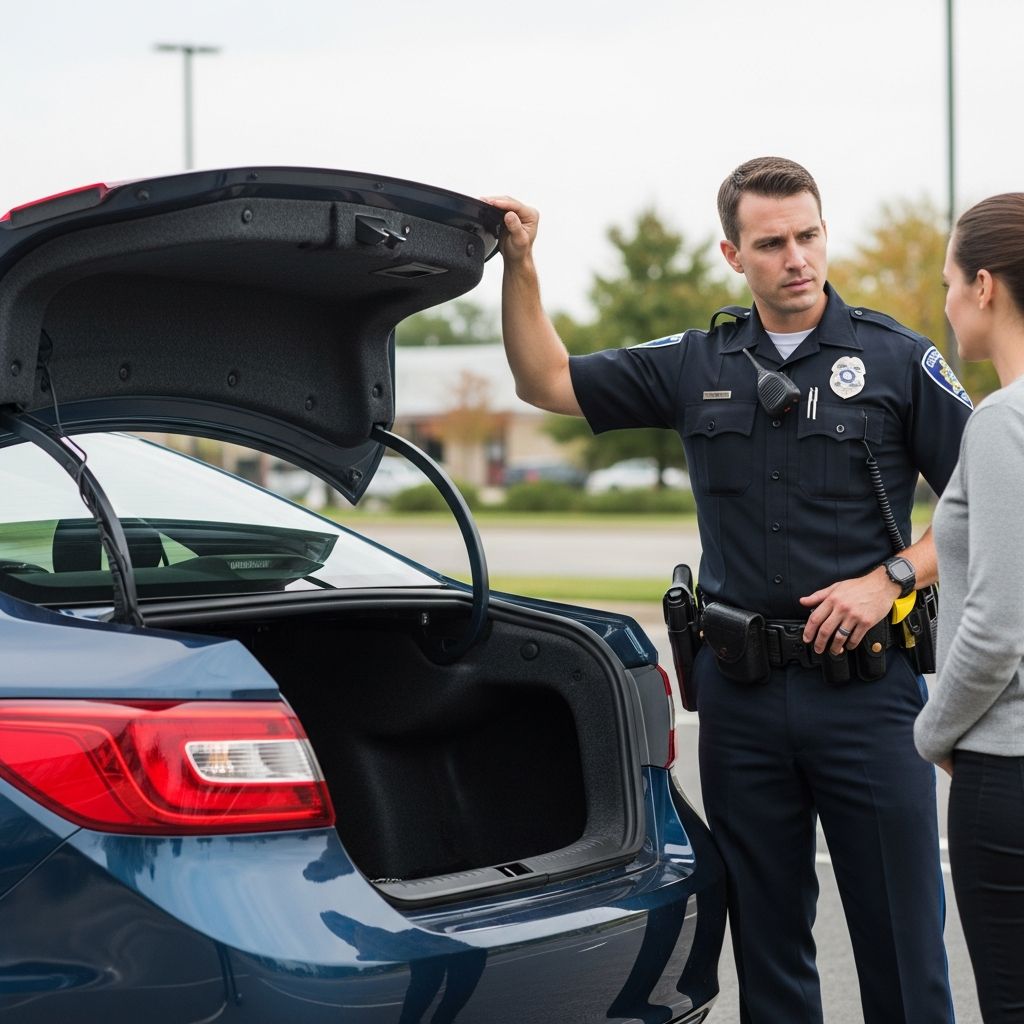
Understanding Constitutional Protections During Vehicle Stops
When law enforcement officers approach your vehicle during a traffic stop, questions often arise about what they can and cannot search. The authority to search your car’s trunk represents one of the most misunderstood aspects of vehicular law enforcement. Most drivers are unaware that police possess significant search capabilities under certain circumstances, yet important constitutional safeguards still apply. Understanding these boundaries can help protect your rights during any police encounter.
The foundation for all vehicle search protections comes from the Fourth Amendment, which shields individuals from unreasonable searches and seizures. This constitutional protection creates a baseline for what police can do during traffic stops, though courts have carved out substantial exceptions for automobiles specifically. These exceptions exist because vehicles present unique circumstances compared to homes or other private spaces.
The Fourth Amendment Framework for Vehicle Searches
The Fourth Amendment begins with a fundamental principle: searches generally require a warrant based on probable cause. However, the Supreme Court has developed an entirely separate framework for vehicles, recognizing that cars differ significantly from residences in terms of privacy expectations and practical enforcement needs. This distinction has created a complex legal landscape where officers enjoy greater search authority over vehicles than they would over homes under identical circumstances.
Courts have reasoned that vehicles, by their very nature, are mobile and can be quickly driven away. This mobility concern justifies relaxed warrant requirements that would never apply to stationary properties. Additionally, the Court has noted that individuals have diminished privacy expectations in vehicles compared to homes. The interior of a car is partially visible from outside, and the vehicle is regularly subject to regulatory inspections.
Probable Cause as the Primary Search Standard
The most important legal concept governing trunk searches is probable cause. This standard represents something more than mere suspicion but less than certainty. Probable cause exists when an officer has reasonable grounds to believe that evidence of a crime, contraband, or stolen property is present in a vehicle.
Establishing probable cause can derive from various observations and circumstances:
- The odor of controlled substances emanating from the vehicle
- Visible contraband or illegal items partially visible through windows
- Admissions made by the driver or passengers during questioning
- Information from reliable informants or dispatch information
- The driver’s behavior, appearance, or answers to police questions
- Prior knowledge of the vehicle’s involvement in criminal activity
Once an officer establishes probable cause, they may search the trunk without obtaining a warrant first. This warrantless search authority distinguishes vehicles from homes, where warrants are ordinarily required before entry. The Supreme Court has determined that the mobility of vehicles and reduced privacy expectations justify this exception to the warrant requirement.
The Plain View Doctrine and Trunk Access
The plain view doctrine represents another pathway through which officers can justify trunk searches. Under this principle, if an officer lawfully observes contraband or evidence of a crime in plain view, they may seize it and expand their search to include areas where similar items might be concealed.
For trunk searches, the plain view doctrine operates differently than in searches of accessible interior spaces. Officers cannot simply open a trunk to search for items in plain view since the trunk itself conceals contents. However, if an officer has lawfully accessed the trunk through another legal justification, items observed inside may be seized. Additionally, if an officer has probable cause to believe that contraband visible elsewhere in the vehicle might also be located in the trunk, they may search the trunk based on that probable cause.
Consent-Based Trunk Searches
One of the clearest legal pathways for conducting a trunk search involves obtaining voluntary consent from the vehicle’s driver. When an officer asks to search your trunk and you agree, no warrant or probable cause is required. This represents the most straightforward search scenario from a legal standpoint.
However, consent-based searches carry critical nuances. You possess an absolute right to refuse consent to a trunk search. Police cannot compel you to open your trunk unless they have developed probable cause or established another legal justification. Many drivers incorrectly believe they must comply with a search request during a traffic stop. In reality, refusing a search request is entirely lawful and may even protect your rights in situations where probable cause does not actually exist.
When providing or refusing consent, clearly communicate your decision to the officer and remain polite but firm. If you consent, anything found becomes admissible evidence. If you refuse, the officer must establish another legal basis for the search before proceeding. Some officers may push back against a refusal, but a simple statement such as “I do not consent to a search” suffices legally.
Routine Traffic Stops and Search Limitations
A critical limitation on police search authority emerged from Supreme Court precedent: officers cannot conduct full vehicle searches based solely on a routine traffic violation. A broken taillight, speeding citation, or expired registration does not provide probable cause to search the trunk. This protection applies even when the officer issues a ticket rather than making an arrest.
During a traffic stop for a minor violation, officers may conduct limited searches in specific circumstances. They may perform a pat-down of the driver and passengers if they possess reasonable suspicion that the individuals are armed and dangerous. However, searching the interior of the vehicle, glove compartment, or trunk requires either probable cause or consent. The traffic violation itself cannot supply the necessary legal justification.
This distinction proves important in practice. Many drivers mistakenly believe that any traffic stop grants officers broad search authority. In reality, police authority remains limited to the scope of the traffic violation unless additional factors emerge during the stop that establish probable cause.
Exigent Circumstances and Emergency Situations
Police may conduct trunk searches without a warrant when exigent circumstances exist. These represent emergency situations where obtaining a warrant is impractical or where delay would result in harm or evidence destruction.
Examples of exigent circumstances include:
- Imminent danger to officer safety or public safety
- Risk that evidence will be destroyed or hidden
- Pursuit of a fleeing suspect
- Emergency assistance needed at the scene
- Hot pursuit situations where stopping to obtain a warrant is impossible
Courts scrutinize exigent circumstance claims carefully. Police cannot create emergency situations and then claim exigent circumstances justified their actions. If an officer had time to obtain a warrant, exigent circumstances likely do not exist. The burden rests on the government to demonstrate that genuine emergency conditions made a warrant impossible to obtain.
Inventory Searches During Vehicle Impoundment
When vehicles are impounded or towed, police may conduct inventory searches of the entire vehicle, including the trunk. These searches occur during the impoundment process to document the vehicle’s contents, protect the owner’s property, and ensure officer safety. Inventory searches do not require a warrant or probable cause.
However, inventory searches must follow departmental procedures. Officers cannot use inventory search procedures as a pretext for searching vehicles when no legitimate impoundment reason exists. Additionally, any evidence discovered during a proper inventory search becomes admissible in court, even if the search was not motivated by criminal investigation.
Passenger Belongings and Trunk Searches
An important principle applies when officers search vehicles containing multiple occupants: passengers’ property within the vehicle can be searched based on probable cause to search the vehicle itself. This applies to trunks containing passenger luggage or bags. If an officer has probable cause to believe evidence or contraband is in the vehicle, they may inspect passenger belongings that could conceal the object of their search.
This principle extends to the trunk because luggage and containers within the trunk could conceal the very items the officer is investigating. Passengers cannot claim greater privacy protections in their luggage within a vehicle than the driver could claim. The search must remain reasonably tailored to the suspected contraband or evidence, but the scope can include passenger items.
State-Level Variations in Search Authority
While federal constitutional minimums apply nationwide, individual states may provide greater privacy protections than the Fourth Amendment requires. Some jurisdictions have established stricter standards for vehicle searches, requiring warrants even when probable cause exists for certain types of containers.
Before assuming federal standards apply to your situation, research your state’s specific vehicle search laws. State supreme courts have authority to provide stronger protections than the federal Constitution mandates. What is permissible in one state might be impermissible in another, even when identical facts are present.
Challenging Improper Trunk Searches
If police search your trunk without legal justification, evidence obtained through that search may be excluded from court proceedings. This exclusionary remedy represents the primary protection against unconstitutional searches. When evidence is suppressed, prosecution becomes significantly more difficult.
To challenge a trunk search, an attorney must demonstrate that the officer lacked:
- Valid probable cause for the search
- Consent to the search
- Exigent circumstances justifying the search
- Valid impoundment or inventory search procedures
- Other legal authority for the search
The burden initially rests on the government to justify the search. Once challenged, prosecutors must present evidence demonstrating the search’s legality. Successful challenges can result in critical evidence being excluded, potentially leading to case dismissal.
Practical Considerations During Traffic Stops
Understanding your rights during a traffic stop is essential. You should know that:
- You must provide your driver’s license, vehicle registration, and proof of insurance upon request
- You may remain silent beyond providing required documents
- You can refuse consent to searches without providing reasons
- You can ask whether you are free to leave or being detained
- You can request an attorney before answering detailed questions
- Refusing consent does not automatically provide probable cause for a search
When an officer requests to search your trunk, you control whether that search occurs in the absence of probable cause or another legal justification. Exercise this control wisely based on your circumstances.
Common Questions About Trunk Searches
Q: Can police search my trunk during a routine traffic stop?
A: Not without your consent or probable cause. A traffic violation alone does not justify a trunk search. Officers may only search your trunk if they possess probable cause to believe contraband or evidence is present, you consent to the search, or exigent circumstances exist.
Q: What exactly is probable cause?
A: Probable cause exists when an officer has reasonable grounds to believe that evidence of a crime or contraband is present. It requires more than suspicion but less than certainty. Observable facts supporting probable cause include the odor of drugs, visible contraband, or suspicious behavior combined with other factors.
Q: Must I consent if an officer asks to search my trunk?
A: No. You have an absolute right to refuse consent to any search. Simply stating “I do not consent to a search” is sufficient. Refusing consent is not illegal and does not itself provide officers with probable cause to search.
Q: Can my vehicle be searched if I am arrested?
A: Yes. If you are arrested in connection with your vehicle, police may search the vehicle more extensively based on the arrest. However, the scope of the search is limited to areas where evidence of the arrest crime might be concealed.
Q: What happens if evidence is found through an illegal search?
A: Evidence obtained through an unconstitutional search may be excluded from court proceedings. Your attorney can file a motion to suppress the evidence, potentially resulting in charges being dropped if the evidence is critical to the prosecution’s case.
Q: Do different states have different trunk search rules?
A: Yes. While federal constitutional minimums apply everywhere, states can establish stricter protections. Research your state’s specific laws regarding vehicle searches, as some jurisdictions require warrants for certain types of searches that would be permissible elsewhere.
Q: Can police search my trunk if they smell marijuana?
A: The odor of marijuana can establish probable cause for a search in many jurisdictions, though this is evolving as marijuana legalization changes. Even where marijuana is legal, officers may still search if they suspect illegal activity. Consult your state’s current laws on this issue.
Protecting Your Rights in Vehicle Searches
Understanding the legal standards governing trunk searches empowers you to protect your Fourth Amendment rights. While police possess significant authority to search vehicles under appropriate circumstances, important limitations still exist. Knowing when officers can and cannot search your trunk allows you to make informed decisions during traffic stops and protect yourself from unreasonable government intrusion. If you believe your trunk was searched illegally, consult with a qualified attorney who can evaluate your specific circumstances and pursue appropriate legal remedies.
References
- Fourth Amendment Text and Jurisprudence — U.S. Constitution, Cornell Law School Legal Information Institute. https://www.law.cornell.edu/constitution/fourth_amendment
- Vehicular Searches — Justia Law, Fourth Amendment jurisprudence. 2024. https://law.justia.com/constitution/us/amendment-04/16-vehicular-searches.html
- Wyoming v. Houghton, 526 U.S. 295 — Supreme Court of the United States. 1999. https://supreme.justia.com/cases/federal/us/526/295/
- Knowles v. Iowa, 525 U.S. 113 — Supreme Court of the United States. 1998. https://supreme.justia.com/cases/federal/us/525/113/
- When is There Probable Cause to Search a Vehicle in Pennsylvania? — Pittsburgh Criminal Attorney. 2023. https://www.pittsburghcriminalattorney.com/theres-a-new-rule-for-vehicle-searches-in-pennsylvania/
Similar Articles








Read full bio of medha deb


